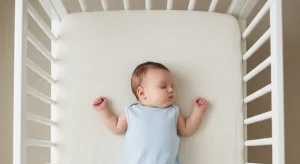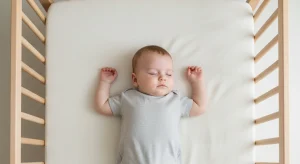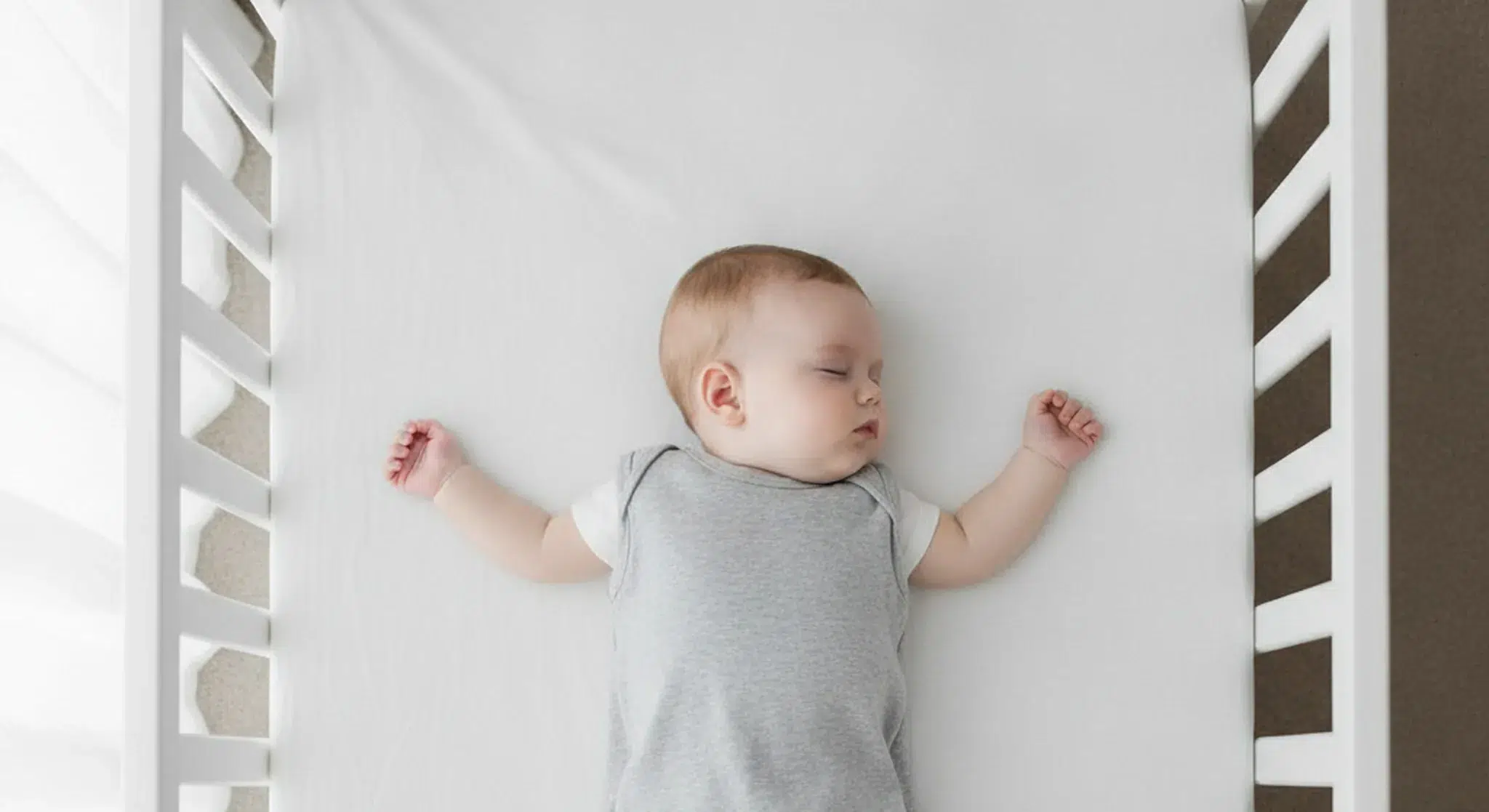


Babies should always be placed on their back to sleep until their first birthday, and stomach sleeping only becomes safe once your baby can roll both ways on their own.
That rolling milestone usually arrives somewhere between 4 and 6 months, and even then the rule is to start every sleep on the back and let your baby find their own position.
This guide explains the safe age for stomach sleeping, why back sleeping matters so much, what to do when your baby starts rolling, and how to keep the whole sleep space safe.
Key Takeaways
- Place your baby on their back for every sleep until age 1. This is the single most important safe sleep rule.
- Stomach sleeping is only safe once your baby can roll both ways independently, usually around 4 to 6 months.
- Even after your baby can roll, start every sleep on the back and let them settle where they choose.
- Stop swaddling as soon as your baby shows any sign of rolling, so their arms are free to reposition.
- Keep the crib completely bare: a firm flat mattress, a fitted sheet, and nothing else.
The short answer
There is no fixed calendar date. Stomach sleeping becomes acceptable when your baby can roll from back to tummy and tummy to back on their own, which most babies manage between 4 and 6 months. Until then, always place your baby on their back and gently return them if they roll.
Table of Contents
Why Back Sleeping Matters So Much
Since pediatricians began recommending back sleeping, sudden infant deaths have dropped dramatically. Back sleeping keeps a baby’s airway open and clear, and it prevents a young baby from rebreathing trapped air face down in the mattress. The American Academy of Pediatrics recommends back sleeping for every sleep, every time, until age 1, including for babies with reflux.
Stomach and side sleeping both raise the risk in young babies, which is why the guidance is so firm. Side sleeping is unstable and can roll into stomach sleeping, so it is not a safe middle ground.
The Rolling Milestone Changes the Rules
Everything shifts once your baby develops the strength and coordination to roll both ways. A baby who can roll from back to tummy and from tummy back to their back has the neck control and motor skill to move out of a position that feels wrong.
Most babies reach this two-way rolling somewhere between 4 and 6 months, though the range is wide and normal. At that point, if your baby rolls onto their stomach during sleep on their own, the AAP says you can leave them there. You do not need to stay up all night flipping them back.
The key phrase is both ways. A baby who can roll to their tummy but cannot yet roll back should be gently returned to their back, because they can get stuck in a position they cannot escape.
What to Do When Your Baby Starts Rolling
- Keep placing your baby on their back to start every sleep, even once they roll well. The starting position is what you control.
- If your baby can roll both ways and chooses their stomach, let them sleep that way without repositioning.
- If your baby can only roll one way, gently return them to their back when they roll to their tummy.
- Give plenty of supervised tummy time while awake to build the strength that makes rolling safe.
- Make sure the crib is bare so a rolling baby cannot press their face into anything soft.
Stop Swaddling Before Rolling Starts
A swaddled baby cannot use their arms to push up or roll back, which makes stomach sleeping dangerous. As soon as you see any sign your baby is trying to roll, it is time to stop swaddling and move to a sleep sack that leaves the arms free.
Do not wait for a full roll to happen in the crib. The first attempts are the signal. Our guide on when to stop swaddling covers the transition step by step.
A Safe Sleep Checklist
- Back to sleep for every nap and every night until age 1.
- A firm, flat, level sleep surface with a fitted sheet and nothing else.
- No pillows, blankets, bumpers, wedges, positioners, or stuffed toys in the sleep space.
- A sleep sack instead of loose blankets for warmth.
- Room-share without bed-sharing for at least the first 6 months.
- A smoke-free environment and, if possible, a pacifier at sleep time once feeding is established.
Rolling and positioning connect to several milestones. See our guides on when babies roll over, when to stop swaddling, and newborn sleeping on their side. To understand the arms-up position many babies settle into, read why babies sleep with their arms up. For the wider view, see our baby sleep schedule by age guide.
Understand your baby’s sleep
Get a personalized plan built around your baby’s age, patterns, and temperament.
- Related reading: can babies sleep on their side.
Frequently Asked Questions
At what age can babies sleep on their stomach?
There is no fixed age. Stomach sleeping is only safe once your baby can roll both ways on their own, usually between 4 and 6 months. Until then, always place your baby on their back.
What should I do if my baby rolls onto their stomach at night?
If your baby can roll both ways independently, you can leave them in the position they choose. If they can only roll one way, gently return them to their back. Always start sleep on the back.
Is it safe for a baby with reflux to sleep on their stomach?
No. Back sleeping is safest even for babies with reflux, and the reflux benefit of stomach sleeping does not outweigh the risk. Place your baby on their back and manage reflux with upright holding after feeds.
When should I stop swaddling for stomach sleeping safety?
Stop swaddling at the first sign your baby is trying to roll, often around 8 to 12 weeks. A swaddled baby cannot push up or roll back, which makes stomach sleeping dangerous, so switch to an arms-free sleep sack.
Do I need to flip my baby back over all night?
Once your baby can roll both ways on their own, no. You still place them on their back to start, but you can let them settle where they roll. Before two-way rolling, gently reposition them onto their back.
Related Betteroo Guides
4 Sources
- American Academy of Pediatrics. Sleep-Related Infant Deaths: Updated 2022 Recommendations for Reducing Infant Deaths in the Sleep Environment. Pediatrics, 2022.
https://publications.aap.org/pediatrics/article/150/1/e2022057990/188304 - NICHD Safe to Sleep. Ways to Reduce Baby’s Risk: Back Sleeping.
https://safetosleep.nichd.nih.gov/reduce-risk/back-sleeping - American Academy of Pediatrics, HealthyChildren.org. How to Keep Your Sleeping Baby Safe.
https://www.healthychildren.org/English/ages-stages/baby/sleep/Pages/A-Parents-Guide-to-Safe-Sleep.aspx - Paruthi S, et al. Recommended Amount of Sleep for Pediatric Populations: A Consensus Statement of the American Academy of Sleep Medicine. Journal of Clinical Sleep Medicine, 2016.
https://jcsm.aasm.org/doi/10.5664/jcsm.5866