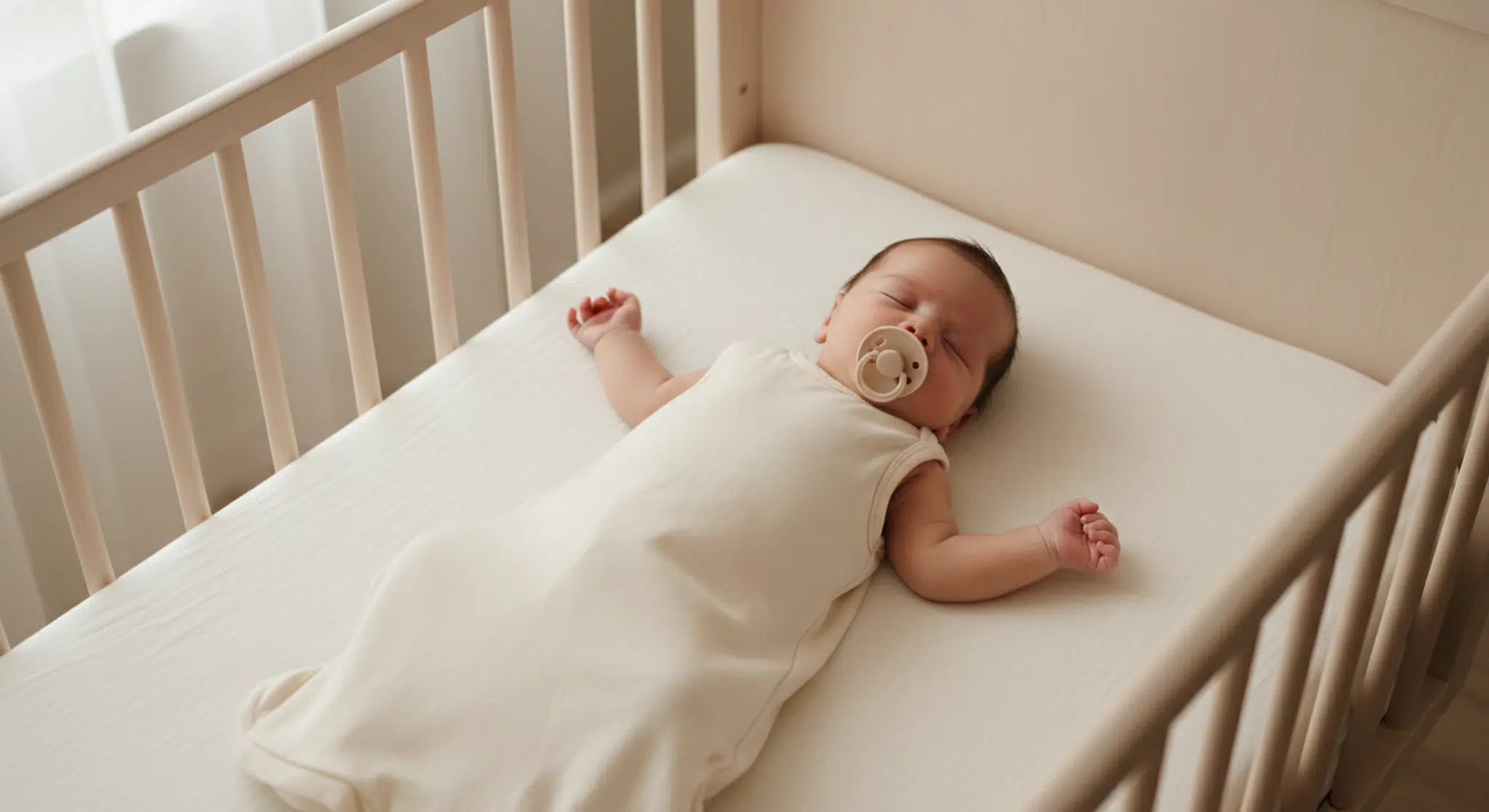
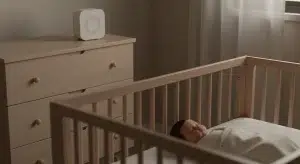
Yes. Babies can safely sleep with a pacifier, and the American Academy of Pediatrics actively recommends offering one at nap time and bedtime because it is associated with a reduced risk of SIDS.
Pacifiers attract more conflicting opinions than almost any other piece of baby equipment. Someone will tell you they ruin teeth, someone else that they wreck breastfeeding, and a third person that you will never get rid of it.
The sleep question, at least, has a clear evidence-based answer, and it runs opposite to what many parents expect. Offering a pacifier at sleep is not merely permitted. It is one of the specific measures the AAP recommends for reducing sleep-related infant death.
Key Takeaways
The AAP recommends offering a pacifier at nap time and bedtime to reduce SIDS risk.
The protective effect holds even if the pacifier falls out after your baby is asleep.
You do not need to put it back in once it falls out during sleep.
For breastfed babies, wait until breastfeeding is firmly established. Formula-fed babies can start whenever.
Never attach a pacifier to a cord, clip, ribbon, or stuffed toy during sleep. This is a strangulation risk.
Do not force it. If your baby refuses a pacifier, that is fine and no intervention is needed.
As an Amazon Associate, Betteroo earns from qualifying purchases.
Table of Contents
What the AAP Actually Recommends
The AAP’s 2022 safe sleep recommendations include offering a pacifier at nap time and bedtime as a protective measure. This sits alongside the better-known guidance: back to sleep, a firm flat surface, a bare crib, and room sharing without bed sharing.
Multiple studies have reported a protective effect of pacifier use against SIDS. The association is consistent enough that it moved from an interesting finding to an active recommendation.
Quick Answer
Offer a pacifier when you put your baby down for sleep. If they take it, good. If they spit it out, that is fine. If it falls out after they are asleep, leave it out. And if your baby refuses pacifiers entirely, no action is needed.
Why it helps is not fully settled. Leading hypotheses include the pacifier keeping the tongue forward and maintaining airway patency, promoting a lighter arousal threshold so babies rouse more readily from a breathing challenge, and the bulk of the pacifier shield physically preventing the face from pressing directly into bedding.
The most striking detail is that the protective effect appears even when the pacifier falls out shortly after the baby falls asleep. That is why the guidance is to offer it at sleep onset, and why there is no need to reinsert it through the night.
Timing for Breastfed Babies
This is the one genuine caveat, and it is a timing question rather than a prohibition.
For breastfed infants, the AAP advises delaying pacifier introduction until breastfeeding is firmly established. The concern is that early pacifier use might reduce time at the breast during the period when supply is being calibrated to demand.
Established breastfeeding has a specific definition: sufficient milk supply, a consistent, comfortable, and effective latch that transfers milk well, and appropriate weight gain along normal growth curves. The time this takes varies between families. For many it is around 3 to 4 weeks, but it can be sooner or later.
Babies who are not being directly breastfed, including formula-fed babies and those fed expressed milk by bottle, can begin pacifier use as soon as desired. There is no waiting period.
Exclusively breastfeeding: wait until feeding is comfortable, effective, and weight gain is on track.
Formula feeding: a pacifier can be offered from birth.
Combination feeding: discuss timing with your pediatrician or an IBCLC.
Premature or NICU babies: pacifiers are often actively used to develop sucking. Follow your care team.
If your baby is in the NICU, non-nutritive sucking on a pacifier is frequently encouraged as part of feeding development, so hospital guidance may differ from general advice and should be followed.
The Safety Rules That Matter
Pacifiers are simple, but a few rules are non-negotiable during sleep.
Never attach a pacifier to a cord, ribbon, clip, or strap during sleep. Anything around a sleeping baby’s neck is a strangulation hazard. Clips are for the stroller and the awake hours only.
Never use a pacifier attached to a stuffed animal for a baby under 12 months. The plush portion is a suffocation risk in the crib.
Use a one-piece pacifier where the nipple, shield, and handle cannot separate. Multi-part designs can come apart and become a choking hazard.
Check the shield size. It should be at least 1 and 1/4 inches across with ventilation holes so it cannot be drawn into the mouth.
Inspect before every use. Pull the nipple firmly. Discard immediately at any sign of thinning, stickiness, discoloration, tears, or cracks.
Replace regularly, roughly every 4 to 8 weeks, and always after illness.
Do not coat it in honey, sugar, or anything sweet. Honey carries infant botulism risk before 12 months and sugar causes decay.
Never clean it in your own mouth. This transfers cavity-causing bacteria to your baby.
Size matters more than parents expect. Pacifiers are sold in age brackets because the nipple length and shield dimensions are matched to mouth size. A pacifier that is too large for a young infant can obstruct breathing, and one too small for an older baby is more easily swallowed past the shield.
Do Pacifiers Cause Nipple Confusion or Dental Problems?
Two concerns come up constantly, and both are more nuanced than the headline version.
Nipple confusion. The evidence here is genuinely mixed. Some studies have found an association between early pacifier use and shorter breastfeeding duration, but this may reflect that parents already struggling with feeding are more likely to introduce a pacifier, rather than the pacifier causing the difficulty. The AAP’s practical resolution is the timing guidance above: wait until breastfeeding is established, then it is not a significant concern.
Dental effects. These are real but are related to duration of use over years, not to sleeping with a pacifier as an infant. The American Academy of Pediatric Dentistry notes that pacifier use generally does not cause lasting problems if it stops by around age 2 to 4. Prolonged use beyond that can affect bite alignment and palate shape.
There is also a documented benefit worth mentioning: pacifier use during sleep is associated with a reduced rate of ear infections in some studies, though heavy daytime use in older infants has been linked to an increased rate. As with most things, the pattern of use matters more than the object.
Pacifier in, still waking hourly?
A pacifier helps some babies and becomes a 2am job for others. Betteroo builds a plan that fits how your baby actually settles. About two minutes.
Here is the practical downside nobody warns you about. Around 4 to 7 months, some babies develop a strong pacifier association but cannot yet find and reinsert it themselves. The result is a baby who wakes every time it falls out, and a parent doing pacifier runs several times a night.
This is a real and common problem, and it is worth knowing you have options rather than simply enduring it.
Wait it out. Most babies can retrieve and reinsert a pacifier independently somewhere between 7 and 10 months, once fine motor skills mature. The problem often solves itself.
Scatter several in the crib. Once your baby can grasp deliberately, multiple pacifiers within reach raise the odds they find one alone. Plain pacifiers only, nothing attached.
Teach the skill during the day. Hand it to them shield-first and let them practice guiding it in while awake.
Offer at sleep onset only, and do not reinsert overnight. This keeps the SIDS-protective benefit without the association deepening.
Drop it entirely if the cost has come to exceed the benefit. After 6 months, when SIDS risk has fallen substantially, this is a reasonable choice.
If you decide to stop, most families find going cold turkey easier than gradual reduction for a baby under about 12 months. Expect two to three difficult nights and then improvement. For toddlers, gradual approaches and preparation tend to work better.
When to Wean Off the Pacifier
There is no single right age, but there are some sensible anchors. SIDS risk drops considerably after 6 months, so the protective rationale weakens after that point.
The American Academy of Pediatric Dentistry and the AAP generally suggest weaning between ages 2 and 4 to avoid dental effects, with many pediatricians recommending limiting use to sleep only after about 12 months.
Under 6 months: keep offering at sleep. The protective benefit is at its most relevant.
6 to 12 months: continue if it helps. Consider stopping if night reinsertion has become a burden.
12 to 24 months: a reasonable window to limit use to sleep only.
2 to 4 years: the usual target range for stopping altogether.
If your baby never took a pacifier, none of this applies and nothing is missing. Pacifier acceptance varies enormously and refusing one is not a problem to be solved.
When to Talk to Your Pediatrician
Pacifier use rarely needs medical input, but raise it if any of these apply.
You are breastfeeding and unsure whether feeding is established enough to introduce one.
Your baby is having difficulty latching, or breastfeeding is painful, after starting a pacifier.
Poor weight gain, at any point, whatever the feeding method.
Frequent ear infections, which are worth discussing in the context of pacifier use.
Your child is over 2 and you would like a practical plan for weaning.
You notice changes to the shape of the bite or palate, or your dentist raises a concern.
Your baby seems to gag, choke, or struggle to breathe with a pacifier. Stop use and get it checked.
If your baby was born prematurely or spent time in the NICU, follow your care team’s specific guidance, which may differ from general recommendations because non-nutritive sucking is often used deliberately.
Frequently Asked Questions
Is it safe for a baby to sleep with a pacifier?
Yes. The American Academy of Pediatrics recommends offering a pacifier at nap time and bedtime because it is associated with a reduced risk of SIDS. The pacifier should never be attached to a cord, clip, ribbon, or stuffed toy during sleep, as anything around a sleeping baby’s neck is a strangulation hazard.
Do I need to put the pacifier back in if it falls out?
No. The protective effect against SIDS is observed even when the pacifier falls out after your baby has fallen asleep. Offer it at sleep onset, and if it comes out during the night you can leave it out.
When can I give my breastfed baby a pacifier?
Wait until breastfeeding is firmly established, meaning sufficient supply, a comfortable and effective latch, and appropriate weight gain. For many families this is around 3 to 4 weeks, but timing varies. Babies who are not directly breastfed can use a pacifier as soon as desired.
Can a pacifier cause SIDS?
No. The evidence points the opposite way. Pacifier use at sleep is associated with a reduced risk of SIDS, which is why the AAP recommends it. The risk comes from attaching pacifiers to cords, clips, or stuffed toys, which introduces a strangulation or suffocation hazard.
When should my child stop using a pacifier?
SIDS risk drops substantially after 6 months, so the protective rationale weakens then. Many pediatricians suggest limiting use to sleep only after about 12 months, and dental guidance generally recommends stopping between ages 2 and 4 to avoid effects on bite alignment.
If the pacifier has become a 2am job
There is a way out that does not involve three bad weeks. Betteroo builds a plan around your baby’s age and sleep associations. Two minutes.