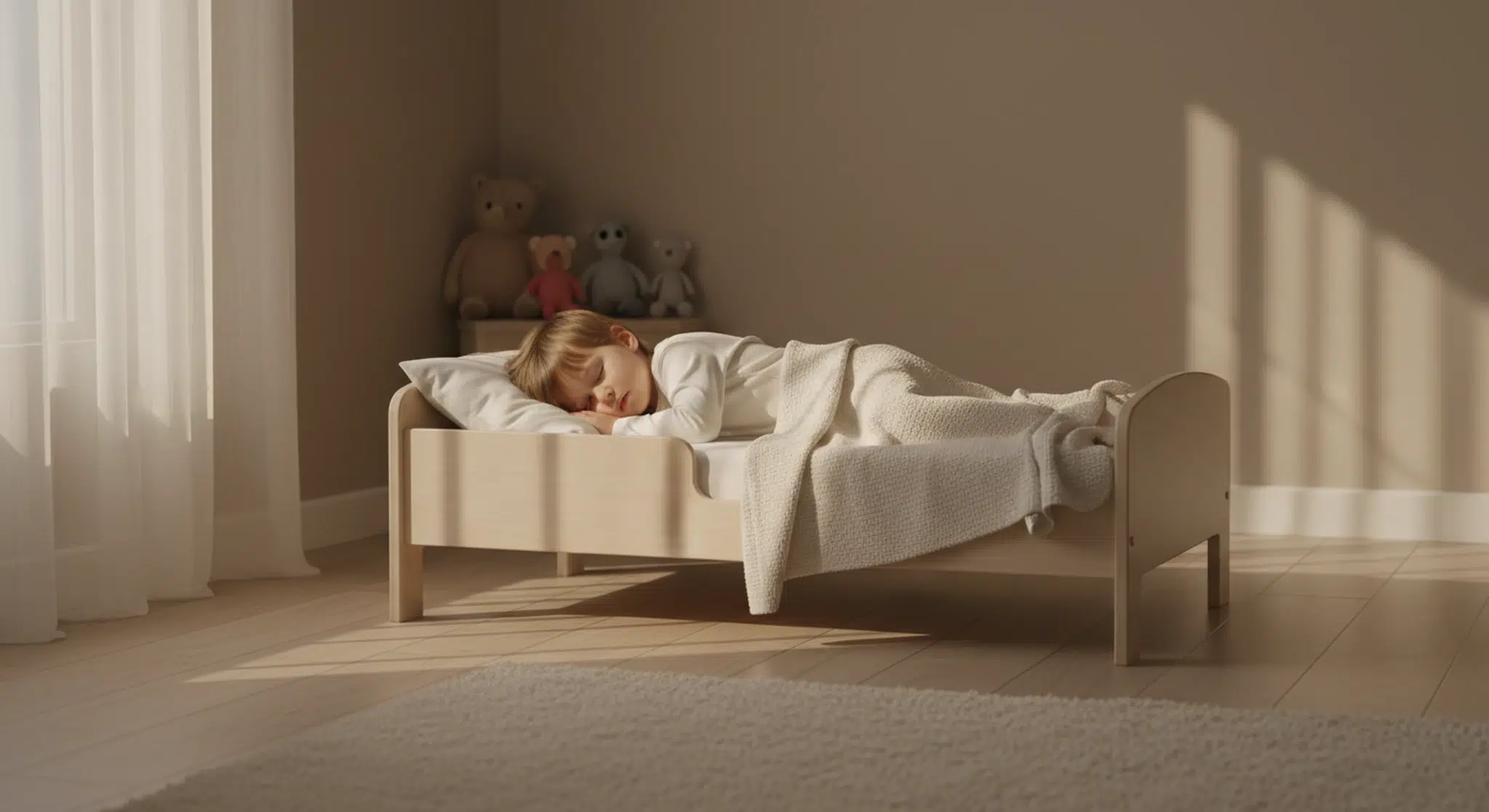
A toddler pillow is a small, low, firm pillow sized for a young child’s head and neck, and the honest answer to “when can my toddler have one” is: not before age 2, and for most children the natural moment is the move to a toddler bed, often closer to 2.5 or 3. Before that, a pillow adds risk and zero benefit.
Adults cannot imagine sleeping without a pillow, so it feels almost unkind that toddlers sleep flat on a bare mattress. But toddler bodies are built differently: their heads are proportionally larger and their necks shorter, so lying flat keeps a young child’s airway and spine in neutral alignment. They are not missing anything.
This guide covers when a toddler can safely have a pillow, why the crib should stay bare past the first birthday, what makes a proper toddler pillow different from a throw pillow, and how to introduce one without wrecking bedtime.
Key Takeaways
No pillows in the crib for at least the first 12 months; the AAP’s bare-crib rule is about suffocation risk, and soft bedding is a leading factor in sleep-related infant deaths.
Most experts suggest waiting until at least age 2, and the most natural moment is the toddler bed transition, usually between 2.5 and 3.5 years.
Toddlers do not need a pillow for comfort or alignment; their proportions make flat sleeping anatomically correct.
When you do introduce one, choose a small (about 13 x 18 inches), low-loft (2 to 3 inches), firm pillow with a breathable cover, and skip feather and memory-foam versions.
Introduce the pillow at bedtime as a one-change-at-a-time event, not bundled with a new bed, potty training, and a big-kid comforter in the same week.
Table of Contents
Why Babies and Young Toddlers Cannot Have Pillows
The AAP and NICHD safe sleep guidelines are unambiguous: for at least the first 12 months, babies sleep alone, on their backs, on a firm flat surface, with nothing soft in the sleep space. No pillows, no bumpers, no blankets, no stuffed animals. Soft objects can mold around an infant’s face and obstruct breathing, and pillows are among the most dangerous offenders in sleep-related death data.
Past the first birthday the suffocation risk drops substantially, but it does not vanish on a schedule. A 14 month old can still wedge their face into soft bedding and lacks the strength and arousal responses of an older child. That is why the practical recommendation for pillows lands at age 2 or later, not at 12 months. The same logic and timeline apply to blankets; see when can babies sleep with a blanket.
There is also a comfort myth to retire: toddlers sleep flat comfortably because their heads are proportionally bigger and their shoulders narrower. A pillow actually kinks a young toddler’s neck forward. If you have watched your child fall asleep flat on a play mat, cheek to the floor, perfectly content, you have seen the anatomy in action.
When Can a Toddler Have a Pillow?
Earliest: age 2. By then, the acute suffocation risk of infancy has largely passed for a healthy child who can roll, sit, stand, and reposition easily in sleep.
Most natural: the toddler bed transition. Many families simply wait and hand over the first pillow the night the crib becomes a bed, typically between 2.5 and 3.5 years. It keeps the crib bare to the end (one less thing to climb on, one less variable), and it makes the pillow part of the exciting big-kid upgrade. Our guide on when to transition to a toddler bed explains the timing of the move itself.
Signals your toddler is ready: they are over 2, they rest their head on a folded blanket or your pillow during stories, they sleep restlessly and seem to hunt for something to prop their head on, or they have moved to a bed. None of these obligate you; plenty of 3 year olds sleep pillowless by preference, and that is fine too.
If your child is 2+ and still in a crib, a pillow is permitted but think twice: anything in a crib is a step stool for a climber, and if a bare-crib sleeper is happy, there is no reason to renovate.
Big kid bed on the horizon?
Take Betteroo’s free sleep quiz and get a step-by-step plan for the toddler bed transition, pillow included.
A toddler pillow is not a small decorative pillow; it is a purpose-built sleep surface. Here is what to look for:
Size: about 13 x 18 inches. A standard adult pillow swallows a toddler’s shoulders and pushes the head too far forward.
Loft: low, roughly 2 to 3 inches. The test: with your child lying on their back, the head should tilt neither up nor down; ear, shoulder, and hip stay in a straight line side-lying.
Firmness: firm enough that a hand pressed into the center springs back rather than leaving a face-shaped crater. If it hugs the face, it fails.
Fill: hypoallergenic polyester cluster fill or firm latex-free foam. Skip feather and down (allergens, too soft) and skip memory foam for young toddlers; it contours around the face, which is the exact property you do not want.
Cover: breathable cotton, washable, with a snug pillowcase that cannot slip off and become loose fabric.
Certifications: look for OEKO-TEX or CertiPUR-US labels and avoid pillows with decorative buttons, ribbons, or loose applique.
How to Introduce a Pillow Without Breaking Bedtime
Introduce it as one change on its own quiet week. If the pillow arrives the same weekend as the new bed, the new comforter, and the underwear graduation, you will never know which variable exploded bedtime. Sequence the upgrades.
Let your toddler help choose the pillowcase, put the pillow in place during the day, and fold it into the routine without ceremony at night. Some toddlers spend a few nights sleeping sideways across it, under it, or hugging it like a bear. All normal. If they push it away, shrug and try again in a month; a pillow is a preference, not a milestone with a deadline.
Keep the rest of the sleep space boring and consistent: same bedtime, same routine, dim room, and if your child still wears a sleep sack, the pillow can coexist with it in a bed. In a crib, prefer one or the other; our toddler sleep sack roundup covers that side of the equation.
Common Questions About Timing and Safety
My 18 month old keeps lying on soft things. Can I give the pillow early? Resting the head on plush toys during playtime is universal toddler behavior, not a sleep requirement. Under 2, keep the crib bare anyway.
Travel and daycare: skip the pillow for naps away from home until the pillow habit is established in the bed at home; consistency beats accessories. Daycares generally follow no-pillow rules for under-2 rooms, which aligns with everything above.
What about toddler-size comforters? A light toddler blanket is fine in a bed from age 2; save the thick duvet for later. Warmth layering guidance lives in our room temperature guide.
When to Check with Your Pediatrician
Talk to your pediatrician before introducing a pillow if your child was premature, has low muscle tone, a neuromuscular condition, severe reflux, or any airway or breathing concern, including loud nightly snoring; these change the risk calculus of soft bedding. Also mention persistent restless sleep, sweating, or mouth breathing, which are worth evaluating on their own rather than treating with bedding changes.
Frequently Asked Questions
When can a toddler have a pillow?
Not before age 2, and many families wait for the toddler bed transition between 2.5 and 3.5 years. Before age 2, pillows add suffocation risk with no comfort benefit, because toddlers’ proportions make flat sleeping anatomically comfortable.
Why can’t my 1 year old have a pillow in the crib?
Soft bedding can mold around a young child’s face and obstruct breathing, and pillows are a leading factor in sleep-related deaths involving soft objects. The AAP recommends a completely bare sleep space for at least the first 12 months, and practically speaking the crib does best staying bare until it is retired.
What size pillow should a toddler use?
About 13 x 18 inches with a low 2-to-3-inch loft and firm fill. On their back the head should lie neutral, not propped forward; side-lying, the ear, shoulder, and hip should form a straight line. Standard adult pillows are too big and too high.
Are memory foam pillows safe for toddlers?
Best avoided for young toddlers. Memory foam contours around the face and rebounds slowly, which is the opposite of what you want near a small child’s airway. Choose firm hypoallergenic cluster fill or a firm ventilated foam designed for toddlers instead.
Does my toddler actually need a pillow?
No. A pillow is a comfort preference, not a developmental need. Some children happily sleep flat until 3 or 4. If your child sleeps well without one, there is no reason to introduce one on any particular schedule.
Make the whole night easier, not just the pillow
Betteroo’s free quiz builds a personalized toddler sleep plan: schedule, routine, transitions, and the tricky nights in between.