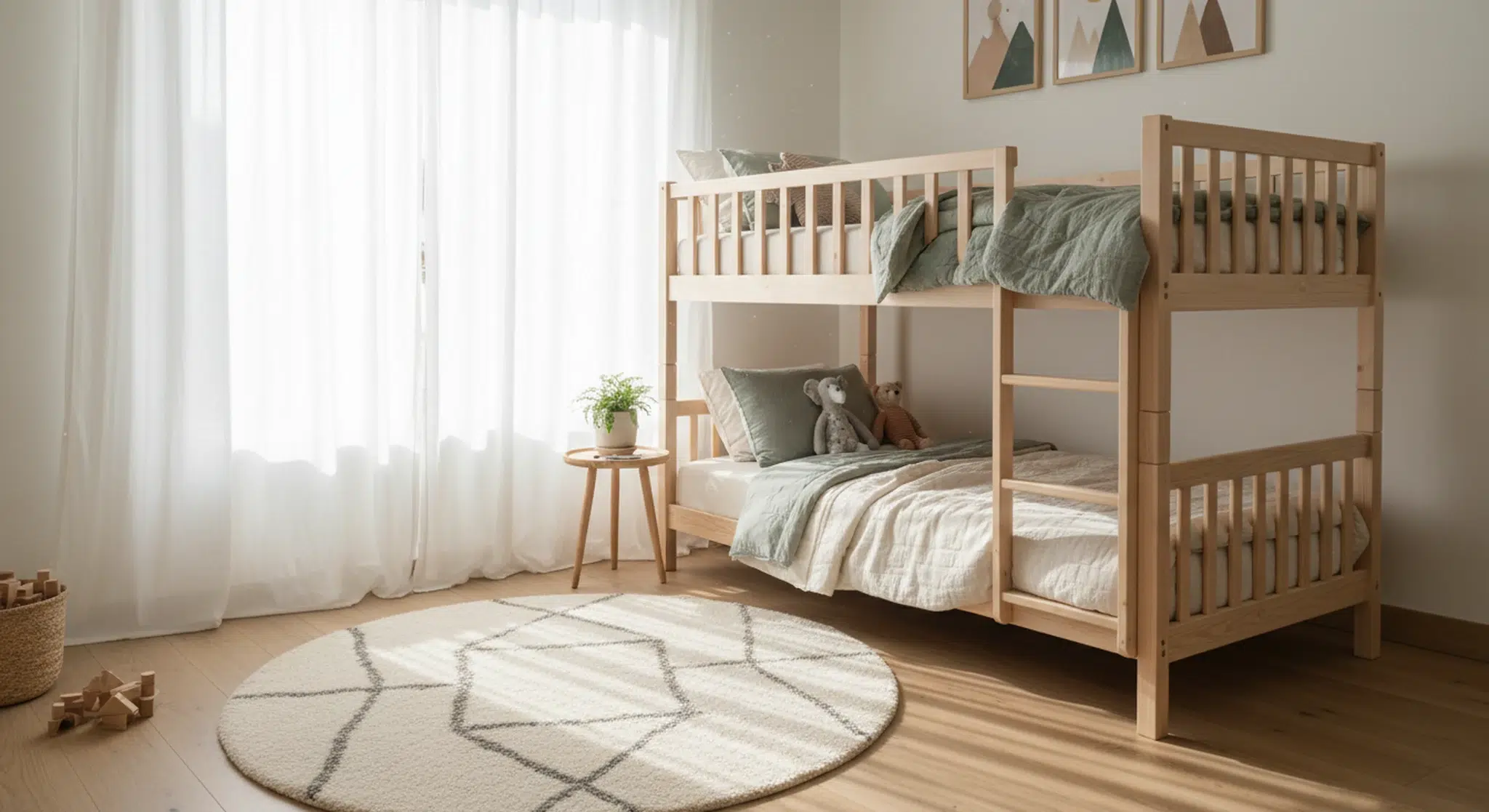
Toddler bunk beds can save space and delight siblings, but safety has to come first. The key rule from pediatric and safety experts is simple: no child under six on the top bunk. Here is a complete guide to choosing and setting up a bunk bed that works for a room with a toddler.
Bunk beds are a favorite for shared rooms and space-tight homes, and plenty of families want one before their children are school age. The good news is that a toddler can absolutely be part of a bunk bed household. The important news is that where they sleep, and what you buy, makes all the difference.
This guide covers what every parent needs before ordering a bunk bed for a toddler: the firm safety rules, the features that separate a safe bed from a risky one, the designs that suit young children, how to set up the bottom bunk, and when a child is truly ready to climb up top.
Key Takeaways
No child under six should sleep on the top bunk, per the AAP and CPSC. Toddlers belong on the bottom.
Falls are the most common bunk bed injury, and young children are injured most often.
Look for full guardrails, a snug mattress fit, a sturdy ladder, and compliance with the ASTM safety standard.
Low, floor, and house-frame bunks are the most toddler-friendly designs.
Add a bottom-bunk rail, anchor the frame, and set clear no-jumping rules.
Table of Contents
Are Toddler Bunk Beds Safe?
This is the first question every parent should ask, and the answer comes with a firm rule. Safety experts, including the American Academy of Pediatrics and the U.S. Consumer Product Safety Commission, advise that no child under six years old should sleep on the upper bunk of a bunk bed. Younger children lack the coordination and judgment to use a top bunk safely, and falls from the upper bunk are the most common and most serious bunk bed injury.
Bunk beds send tens of thousands of children to emergency rooms in the United States every year, most often from falls, and the majority of those injured are young children. That does not mean bunk beds are off-limits for a household with toddlers. It means a toddler belongs on the bottom bunk, or in a low, toddler-specific design, while the top bunk waits for an older sibling or a later birthday.
What to Look For in a Toddler-Friendly Bunk Bed
If you are buying a bunk bed for a room that includes a toddler, the features below separate a safe choice from a risky one. Look for a bed that meets the current ASTM safety standard and carries clear guardrail and spacing details.
Full-length guardrails on both sides of the top bunk, with any gap small enough to prevent a child’s body from slipping through and no gap wider than about 3.5 inches.
A snug mattress fit so there is no gap between the mattress and the guardrail where a child could become trapped, and a foundation that keeps the mattress from shifting.
The right mattress height, with the guardrail rising at least five inches above the top of the mattress. Overly thick mattresses defeat the guardrail.
A sturdy, securely attached ladder with flat, slip-resistant steps, ideally angled rather than vertical for easier climbing.
Solid, stable construction that does not wobble, with rounded corners and no sharp edges or protruding bolts.
Slat gaps under three inches and a strong mattress support system, since a mattress resting only on a soft frame or loose slats can collapse.
Types of Bunk Beds That Work With Toddlers
Not all bunk beds are tall, ladder-and-top-bunk affairs. Several designs are far friendlier to a household with a toddler, keeping little ones low to the ground while still saving space or sharing a room.
Low or floor bunk beds: Shorter overall height means a gentler distance to the floor. Some Montessori-style floor bunks sit especially low, which suits a young child transitioning from a crib.
House-frame bunk beds: Popular low-profile designs with a roof shape, often sized so the bottom bunk is close to the floor and toddler-appropriate.
Twin-over-twin with the toddler below: The most common approach for mixed-age siblings, with the toddler on the bottom and an older child up top.
Convertible bunks that split: Beds that separate into two standalone beds let you wait to stack them until both children are old enough.
Big days are easier after a good night of sleep.
If naps or bedtime are a struggle, our free two-minute quiz builds a gentle, personalized plan.
A toddler on the bottom bunk still needs a safe setup. Treat it much like the transition from a crib to a regular bed, because that is essentially what it is. The good news is that a bottom bunk is close to the floor, which makes it one of the gentler places for a young child to sleep.
Add a removable bed rail to the open side of the bottom bunk to prevent roll-out falls.
Keep the area beside the bed clear and consider a soft rug underneath for extra cushioning.
Make sure the toddler cannot climb the ladder to the top bunk unsupervised; some families remove or block the ladder until the child is older.
Anchor the whole bed frame so it cannot tip, and check periodically that all bolts stay tight.
Use a properly fitting mattress and a fitted sheet, and skip heavy bedding for the youngest sleepers.
The widely recommended minimum age for the upper bunk is six years old, and age is only part of the picture. A child ready for the top bunk should be able to climb the ladder confidently and safely, follow the rules about no jumping and no roughhousing up top, and wake and move without being disoriented in the night.
Even for an older child, keep guardrails on both sides, use a nightlight so nighttime trips are safe, and establish clear rules: one person on the top bunk at a time, no playing or jumping, and always use the ladder. Revisiting these rules regularly matters more than the exact birthday, because a bunk bed is only as safe as the habits around it.
A Quick Bunk Bed Buying Checklist
Before you order, run through this short list to make sure any bunk bed you are considering is a safe, lasting choice for a room that includes a toddler.
Does it meet the current ASTM F1427 bunk bed safety standard?
Are there full guardrails on both sides of the top bunk with safe gap sizes?
Is the construction solid and wobble-free, with a strong mattress support?
Will the toddler sleep on the bottom, with the top reserved for a child six or older?
Can you add a bottom-bunk rail and anchor the frame to the wall?
Are the mattresses the correct thickness so guardrails still clear them by five inches?
Pediatric injury data is clear and worth repeating: the single most important bunk bed rule is that children under six do not belong on the top bunk. Most bunk bed injuries are falls, most happen to young children, and many occur during play rather than sleep, which is why supervision and firm no-jumping rules matter as much as the hardware itself.
Beyond the age rule, the safest bunk bed is one that meets current safety standards, has full guardrails and a snug mattress fit, is anchored so it cannot tip, and is used with clear household rules. If you are ever unsure whether your child is ready or whether a specific bed is safe, your pediatrician can help you weigh your child’s coordination and development. When in doubt, keep your toddler low to the ground and let the top bunk wait.
Frequently Asked Questions
Are bunk beds safe for toddlers?
Bunk beds can be safe for a household with a toddler as long as the toddler sleeps on the bottom bunk. The American Academy of Pediatrics and the Consumer Product Safety Commission advise that no child under six use the top bunk, because young children lack the coordination and judgment to use it safely and falls are the most common serious injury. A toddler on a low bottom bunk, with a guardrail and an anchored frame, can sleep safely.
What age can a child sleep on a bunk bed?
A child can sleep on the bottom bunk as a toddler, treated much like the move from a crib to a regular bed. For the top bunk, the recommended minimum age is six years old. Beyond age, a child should be able to climb the ladder confidently, follow no-jumping rules, and move safely in the night before using the upper bunk, even once they reach six.
What should I look for in a toddler bunk bed?
Look for full-length guardrails on both sides of the top bunk with gaps no wider than about 3.5 inches, a snug mattress fit with no entrapment gaps, guardrails that clear the mattress by at least five inches, a sturdy securely attached ladder, solid wobble-free construction, and compliance with the current ASTM F1427 standard. For the toddler’s own spot, choose a low or floor-style bunk and add a removable bed rail to the bottom.
Can two toddlers share a bunk bed?
Two toddlers should not share a stacked bunk bed, because neither should be on the top bunk under age six. If you have two very young children, the safest options are two beds on the floor, a convertible bunk used unstacked as two separate beds, or waiting until the older child turns six to stack them. Keep both young children low to the ground until they are old enough for the upper bunk.
How do I make a bunk bed safe for my toddler?
Put your toddler on the bottom bunk and add a removable bed rail to the open side. Anchor the whole frame so it cannot tip, keep the floor beside the bed clear with a soft rug underneath, and block or remove the ladder so your toddler cannot climb up unsupervised. Use a correctly fitting mattress, check that all bolts stay tight, and set firm rules of no jumping and one child up top at a time for older siblings.
Playful days, peaceful nights.
Betteroo builds a personalized sleep plan for your child. Take the free two-minute quiz to get started.