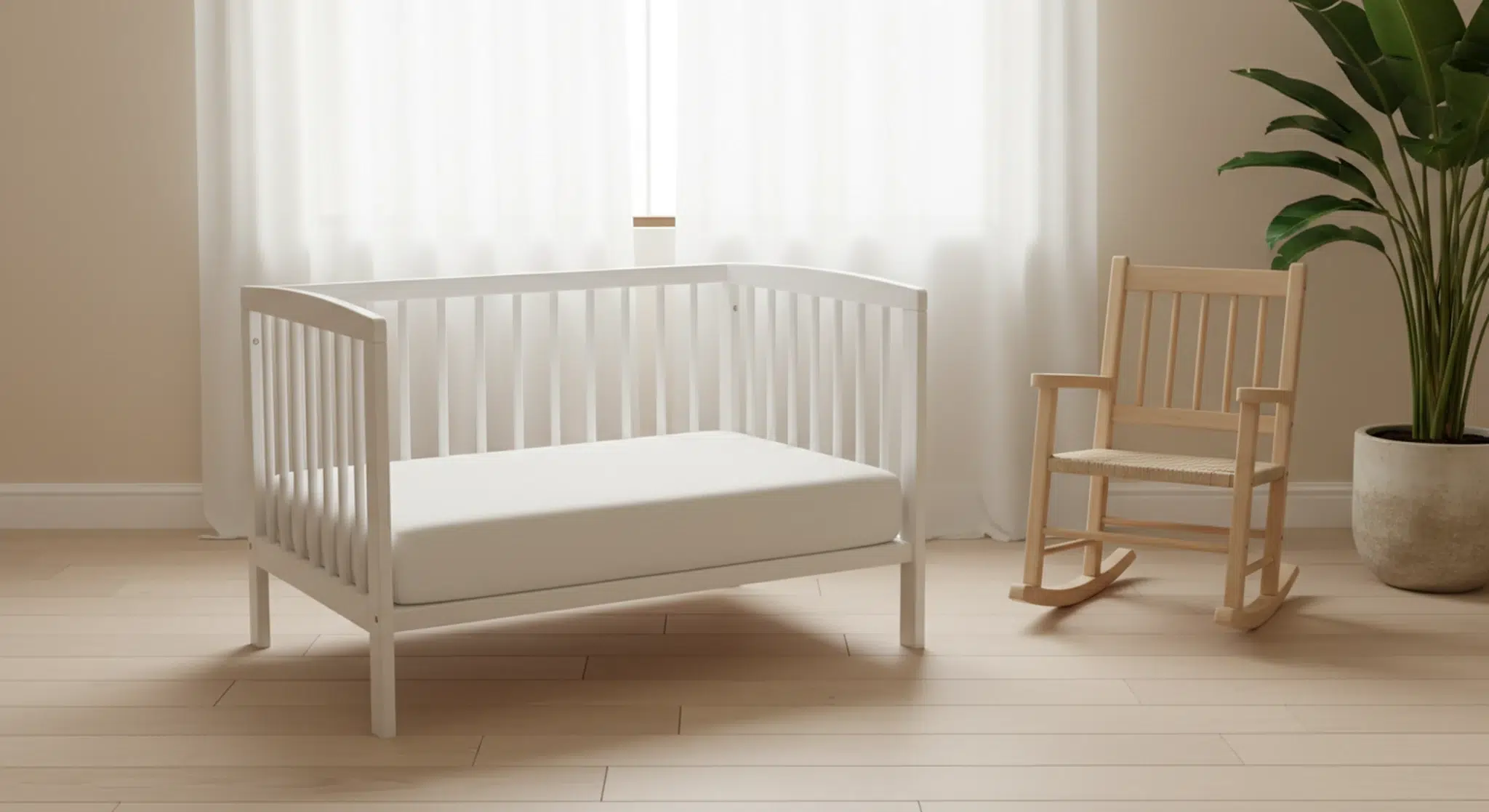
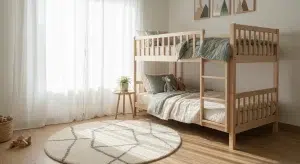
A mini crib is a smaller-than-standard crib that must meet the CPSC’s federal standard for non-full-size cribs, and it is a safe sleep space when you use the maker’s mattress, keep it bare except for a fitted sheet, and stop at the label’s limits.
Mini cribs are popular with parents who room share, live in apartments or need a second crib at a grandparent’s home. They are real cribs, not toys or travel gadgets, but they come with a few rules that full-size cribs do not, mostly about the mattress and how long your child can use one.
We read the CPSC’s federal crib rules and the American Academy of Pediatrics (AAP) safe sleep guidance in October 2026. Below you will find what counts as a mini crib, how it compares with a full-size crib, bassinet and play yard, how to set one up, and the signs your child has outgrown it.
Key Takeaways
A mini crib is what the CPSC calls a non-full-size crib, covered by its own mandatory standard (16 CFR part 1220).
Mini cribs have no single standard size, so use the mattress the maker supplies or specifies for your model.
Never add a second mattress or padding: the CPSC warns gaps can trap a baby’s face.
Back to sleep, firm flat mattress, fitted sheet only: the AAP rules apply exactly as in a full-size crib.
Stop at the label’s limits, or sooner if your child climbs or the rail falls low on their body.
As an Amazon Associate, Betteroo earns from qualifying purchases.
Table of Contents
What Is a Mini Crib?
Quick Answer
A mini crib is a smaller crib built like a regular one, with a sturdy frame and slatted sides, but with inside dimensions outside the federal full-size crib range. The U.S. Consumer Product Safety Commission (CPSC) calls these non-full-size cribs and requires them to meet their own mandatory standard (16 CFR part 1220). Use only the mattress the maker supplies or specifies, keep the crib bare except for a fitted sheet, and follow the height and weight limits on the label.
Federal rules do not use the phrase “mini crib.” Instead, the CPSC separates cribs into two groups by interior size. A full-size crib measures 28 inches (plus or minus 5/8 inch) wide by 52 3/8 inches (plus or minus 5/8 inch) long inside, according to the CPSC’s crib mattress guidance. Anything designed to sleep an infant whose interior falls outside the full-size range counts as a non-full-size crib.
CPSC examples of non-full-size cribs include portable cribs, crib pens, specialty cribs, and undersize and oversize cribs; a mini crib is an undersize crib. Mesh or net cribs, cradles, baby baskets and bassinets are not covered by this standard and have their own rules. Still choosing between categories? See our bassinet vs. crib comparison.
The Federal Safety Standard (16 CFR Part 1220)
Every mini crib made or sold in the United States must meet the mandatory CPSC standard for non-full-size baby cribs, which adopts ASTM F406 with CPSC changes. The required version depends on when the crib was made or imported:
Made or imported after
Must meet
June 28, 2011
ASTM F406-10a with modifications
November 12, 2012
ASTM F406-17 with modifications
March 24, 2014
ASTM F406-19 with modifications
October 28, 2019
ASTM F406-22 with modifications
April 5, 2025
ASTM F406-24 with modifications
Non-full-size crib standard by manufacture or import date, as listed by the CPSC.
The CPSC lists what the standard checks, including corner posts, sharp edges, small parts, openings, latching, stability, side height, spacing of parts, hardware, slat strength, mattress support impact tests and prevention of mis-assembly.
Two requirements help you directly. Each crib must carry a permanent label with the maker’s name, U.S. contact information, model number and the month and year it was made, and makers must include a product registration card so they can reach you about a recall. Fill it out.
The 2011 rules and drop sides. The CPSC’s 2011 Q&A explains that from June 28, 2011, traditional drop-side cribs could no longer be made or sold, and cribs needed sturdier slats and mattress supports, better hardware and tougher testing. The rules covered full-size and non-full-size cribs, and child care facilities and hotels had until December 28, 2012, to comply. The AAP adds that crib slats should be no more than 2 3/8 inches apart.
Mini Crib Size and Mattress Fit
There is no single standard mini crib size. The federal rule only says a non-full-size crib falls outside the full-size range (an interior longer than 55 inches or shorter than 49 3/4 inches, or wider than 30 5/8 inches or narrower than 25 3/8 inches, per the CPSC). Within that, each maker picks its own dimensions.
So do not assume a mattress labeled “mini crib” fits your mini crib. Under the CPSC crib mattress rule (16 CFR part 1241), an after-market mattress for a non-full-size crib or play yard must be at least as large as the original, lie flat and be tested with each product it claims to fit. The CPSC states that “generic compatibility based on a size measurement cannot meet these requirements.”
Best option: use the mattress that came with the mini crib, or one the crib’s manufacturer specifies for that model.
Replacement mattress: choose one that names your crib’s brand and model number, as the CPSC advises for play yard mattresses.
Never stack or pad: the CPSC warns that extra padding or a second mattress can create gaps between the mattress and the sides where a baby’s face can become trapped.
Check the fit: the AAP says the mattress should be firm, should not sag under your baby’s weight, and should fit snugly against the crib sides with no gap. If you can see a gap, do not use that mattress.
A full-size crib mattress will not work in a mini crib. For standard dimensions and a hands-on fit check, see our crib mattress size guide.
How It Compares: Full-Size Crib, Bassinet and Play Yard
All four can be safe sleep spaces when they meet the federal standard for their category and are used as directed.
Mini crib
Full-size crib
Bassinet
Play yard
Federal standard
Non-full-size baby cribs (16 CFR part 1220)
Full-size baby cribs (16 CFR part 1219)
Separate CPSC bassinet standard
Separate CPSC play yard standard
Inside size
Outside the full-size range; varies by maker
28 by 52 3/8 inches (each plus or minus 5/8 inch), per CPSC
Smaller; varies by maker
Varies by maker
Sides
Rigid frame, usually slats
Rigid frame, usually slats
Varies by model
Mesh or fabric sides
Mattress
Supplied or specified by the maker
Standard full-size crib mattress
Pad supplied by the maker
Pad supplied by the maker or a compatible replacement for that model
How long it lasts
Until the label’s limits or the signs below; often shorter than a full-size crib
Usually into the toddler years
Shortest; check the label
Check the label
Best for
Small rooms, room sharing, a second home
A dedicated nursery
The early months beside your bed
Travel and grandparents’ homes
Mini crib compared with other infant sleep spaces. Federal parts from CPSC guidance; size and use limits come from each product’s label.
The CPSC’s 2011 Q&A notes that play yards with mesh or fabric sides are not covered by the crib standards. Leaving a bassinet? See our bassinet to crib transition guide.
Stuck on night two or three?
Our free two-minute quiz builds a gentle, personalized sleep plan that adapts when progress stalls.
A mini crib makes the most sense when space or room sharing matters more than years of use.
Room sharing in a small bedroom: the American Academy of Pediatrics (AAP) recommends keeping your baby’s sleep space in your room, close to your bed, for at least the first 6 months, and says room sharing can reduce the risk of SIDS by as much as 50%. A smaller crib can fit beside your bed where a full-size crib will not.
Small homes and second homes: a mini crib leaves more floor space in a shared room, and many families keep one at a grandparent’s home.
Twins or multiples in a tight space: the AAP says never to bed-share, including with twins or other multiples. Two smaller cribs can give each baby a separate sleep space where two full-size cribs would crowd the room.
The safe sleep rules are the same for a mini crib as for any crib. According to the AAP’s 2022 guidance for parents:
Place your baby on their back for every nap and every night. The AAP says side sleeping is as dangerous as stomach sleeping.
Use a firm, flat mattress that does not sink under your baby’s weight, with only a fitted sheet that fits that mattress.
Keep pillows, quilts, comforters, mattress toppers, non-fitted sheets, blankets, toys and bumper pads out of the crib.
Skip weighted blankets, weighted sleepers and weighted swaddles.
Dress your baby in one layer more than you are wearing, or use a wearable blanket such as a baby sleep sack.
Do not use a crib that is broken or missing hardware or instructions.
Bumpers are banned. Under the Safe Sleep for Babies Act, crib bumpers (including padded bumpers, vinyl bumper guards and vertical slat covers, per the CPSC) have been banned since November 12, 2022. See our crib bumper guide.
Placement and assembly. Follow the maker’s instructions and tighten all hardware. The AAP advises placing the crib away from windows and radiators, out of reach of blind and curtain cords, and at least an arm’s length from dressers. Nationwide Children’s Hospital advises anchoring dressers and heavy furniture. More in our safe sleep environment checklist.
When Does a Baby Outgrow It?
There is no universal age or weight limit for mini cribs. Your crib’s label and instructions set the limits; stop when your child reaches any one of them, or sooner if you see these signs.
Sitting up or pulling to stand: the AAP advises keeping the mattress at its highest setting while your baby is immobile and lowering it before your baby can sit or stand; see when to lower the crib mattress.
The rail is getting low: Nationwide Children’s Hospital lists a top rail below three quarters of your child’s height, with the mattress already at its lowest setting, as a sign of readiness for a bed.
Climbing attempts: the same hospital lists pulling up and over the rail, or getting a leg over or onto the top rail, even before an actual climb-out.
Height: Nationwide Children’s lists about 35 inches tall as a sign, and the AAP says a child who is about 3 feet tall should move to a bed.
When you see these signs, move to a full-size crib or a bed rather than waiting for a fall. Our toddler bed transition guide walks through it.
Buying Used or Hand-Me-Down
A secondhand mini crib needs a careful check first. The CPSC said in 2011 that cribs from before the new rules are unlikely to comply and you cannot tell by looking.
Read the label: find the permanent label with the model number and month and year of manufacture. Skip any crib made before June 28, 2011, or one with no label.
Check recalls: search the model at cpsc.gov/Recalls and SaferProducts.gov, and contact the maker if you are unsure.
No drop side: the AAP says cribs with drop rails are not safe and should not be used.
All the parts: the AAP says not to use a crib that is broken or missing hardware or instructions.
No modifications: no added paint, cut slats or homemade repairs. AAP crib guidance warns that older finishes may contain lead-based paint.
Right mattress: get the mattress made for that exact model, never a substitute pad.
If a crib fails these checks, the CPSC advises against reselling or donating it and says to take it apart before discarding it.
What to Look For When Buying
We do not recommend brands. Compare mini cribs on these points:
Certification: the CPSC suggests asking for a certificate showing the crib meets 16 CFR part 1220; also look for the permanent label and registration card.
Mattress included: a crib sold with its own firm mattress removes the fit guesswork.
Clear limits: the instructions should state the height, weight or developmental limit for each mattress position.
Fixed sides and several mattress heights: no drop side, and enough settings to lower the mattress as your baby starts sitting and standing.
Smooth construction: no splinters, sharp edges or decorative cutouts in the end panels.
Sheets:fitted sheets made for that model or that size mattress, which stay tight when you tug the corners.
Convertible mini cribs turn into a small bed or daybed later. Convert only as the instructions describe, and only once your child has outgrown the crib.
Safety Checklist Before Every Use
Baby on their back, every sleep.
Mattress firm, flat and the right one for this model, at the right height for your baby’s stage.
No gap between the mattress and the sides; no second mattress or extra padding.
Only a fitted sheet, snug at every corner.
No pillows, blankets, bumpers, toys or positioners.
Hardware tight, no loose or missing parts, no cracked slats.
Crib away from windows, cords and heaters.
Your child is within the label’s limits and is not climbing.
Bring up sleep space questions at any well-baby visit, especially if you are room sharing in a small space, buying a used crib, or unsure whether your child has outgrown the mini crib. Talk to your pediatrician sooner if your baby will only sleep in a swing, car seat or inclined product (the CPSC says to move a sleeping baby from those to a firm, flat crib, bassinet or play yard), if your baby has a medical condition that affects sleep position, or if your toddler is climbing out of the crib. If a crib or mattress ever injures your child, get care first, then report it at SaferProducts.gov.
Frequently Asked Questions
How long can a baby sleep in a mini crib?
Until your child reaches any limit printed on the crib’s label or instructions, or shows signs of outgrowing it. Nationwide Children’s Hospital lists climbing attempts, a top rail below three quarters of your child’s height with the mattress at its lowest setting, and a height of about 35 inches as signs it is time for a bigger crib or a bed.
Can a newborn sleep in a mini crib?
Yes, if the mini crib meets the federal standard for non-full-size cribs and is used as directed. Put your newborn on their back on the firm mattress made for that crib, at the highest mattress setting, with only a fitted sheet. The AAP advises keeping the sleep space in your room for at least the first 6 months.
Is a mini crib safe for my baby?
The AAP says babies should sleep in a crib, bassinet, portable crib or play yard that meets CPSC standards, and a mini crib that meets the non-full-size crib standard, is assembled correctly and is not recalled fits that advice. Use only the mattress supplied or specified for that model, never add padding or a second mattress, and keep the crib bare except for a fitted sheet.
Is a mini crib the same as a play yard?
No. A mini crib has a rigid frame, usually with slats, and falls under the federal non-full-size crib standard. A play yard has mesh or fabric sides and is covered by a separate CPSC play yard standard. Both can be safe sleep spaces when used with the mattress made for them and nothing else inside.
Can I use a regular crib mattress in a mini crib?
No. A full-size crib mattress is made for a crib about 28 by 52 3/8 inches inside, and mini crib interiors are smaller and vary by maker. Use the mattress that came with your mini crib or one the manufacturer lists for your exact model, so it lies flat with no gaps.
Is a mini crib better than a bassinet?
Neither is safer by default; both must meet their own federal standards. A bassinet is smaller and usually outgrown sooner, which suits the first months next to your bed. A mini crib takes a bit more space but usually lasts longer. Check each product’s label limits and pick what fits your room.
Gentle changes, peaceful nights.
Betteroo builds a personalized sleep plan for your baby or toddler. Take the free two-minute quiz to get started.