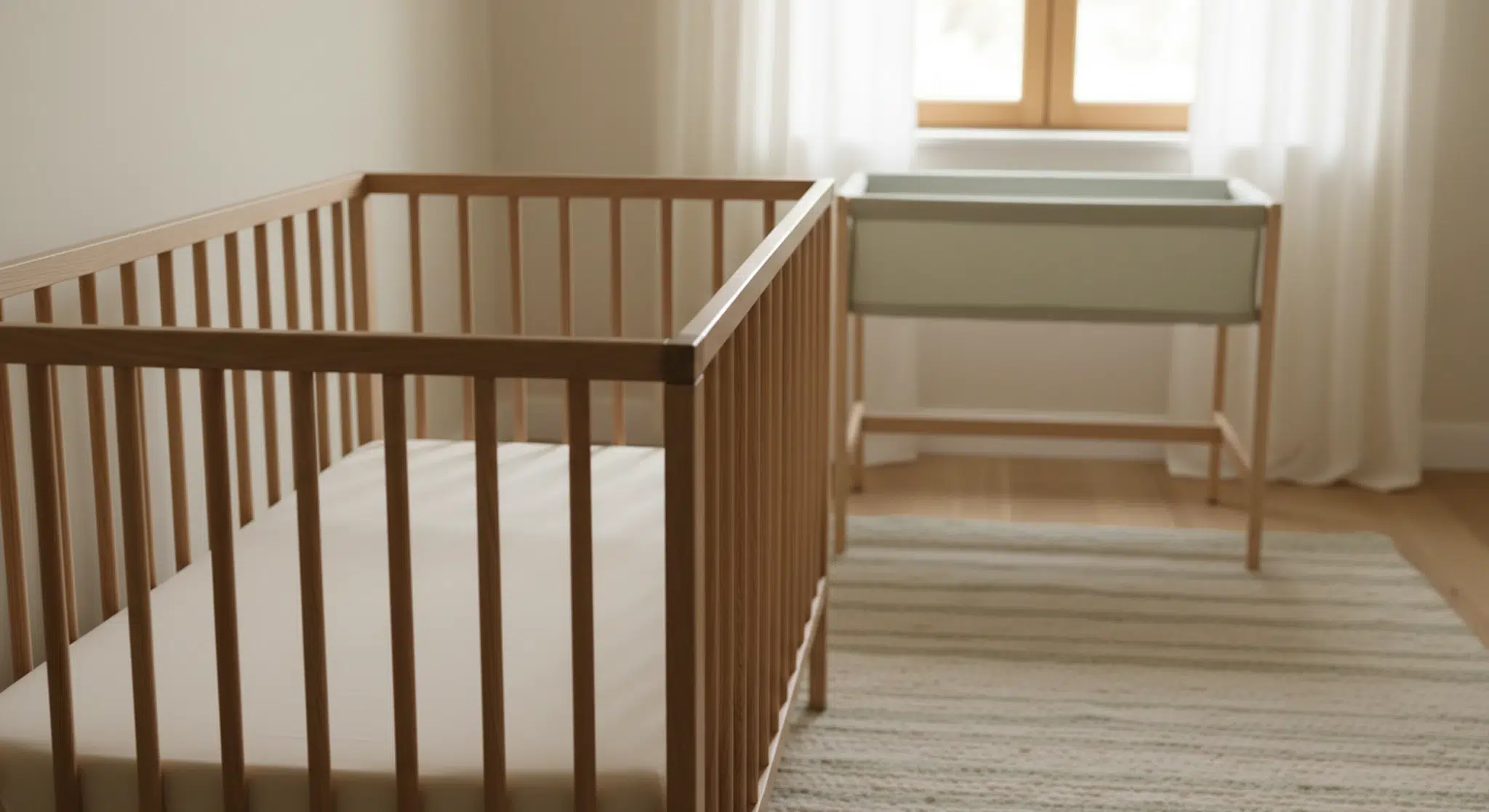
Most babies move from a bassinet to a crib between 3 and 6 months. The trigger is not age but safety: whichever comes first out of the weight limit, rolling over, or pushing up on hands and knees.
The bassinet is one of the great conveniences of the newborn months. It is small, it fits beside your bed, and it puts your baby within arm’s reach at 3am. Which is exactly why the move out of it feels like a downgrade, both logistically and emotionally.
The good news is that this transition is usually far less disruptive than parents fear, and unlike many baby milestones it has clear, objective triggers. You do not have to guess. Your bassinet’s manual and your baby’s motor skills will tell you when.
Key Takeaways
Most babies transition between 3 and 6 months, but go by safety triggers, not age.
Move immediately if your baby reaches the weight limit, starts rolling, or pushes up on hands and knees.
Bassinet weight limits are typically 15 to 20 pounds. Check your specific model.
The AAP recommends room sharing for at least 6 months, so the crib can stay in your room.
A gradual approach using naps first tends to work better than switching everything at once.
Keep as much of the sleep environment identical as possible, especially white noise and routine.
As an Amazon Associate, Betteroo earns from qualifying purchases.
Table of Contents
The Three Triggers That Mean Move Now
Unlike most sleep transitions, this one has hard limits. Any single one of these means the bassinet is no longer safe, regardless of how well your baby is sleeping in it.
Quick Answer
1. The weight limit. Usually 15 to 20 pounds, but it varies by model. Check the manual. 2. Rolling over. In either direction, even once. 3. Pushing up on hands and knees, or sitting up unassisted.
Whichever comes first is your signal. Do not wait for the others.
Weight limit. This is a structural rating, not a suggestion. Bassinets have smaller frames and lighter construction than cribs, and exceeding the stated limit risks the base or fabric sides failing. Manufacturers test to these limits specifically. Some bassinets state a length limit as well, or specify that the baby’s head should be a certain distance below the rim.
Rolling. Bassinet walls are lower and often softer than crib rails. A baby who can roll can shift toward a side, and mesh or fabric walls can conform to the face in a way rigid slats cannot. Rolling is the trigger most often missed because it can appear suddenly.
Pushing up. A baby who can push onto hands and knees has enough strength to shift their weight against a bassinet wall and potentially tip it, particularly on models with a narrow footprint or wheels.
Most babies hit at least one of these between 3 and 6 months. Some larger babies reach the weight limit at 8 or 10 weeks, and some small babies roll before they get near it. Watch the skills, not the calendar.
You Can Keep the Crib in Your Room
This point resolves the most common source of dread around this transition, and a lot of parents do not realize it is an option.
The AAP recommends that infants sleep in the parents’ room, on a separate surface, ideally for at least the first 6 months. Room sharing is associated with a substantially reduced risk of sleep-related death. Moving from bassinet to crib does not have to mean moving to another room.
If your room can fit a full-size crib, that is the simplest path: you change one variable, the sleep surface, and keep everything else the same. If it cannot, a mini crib or a portable crib is a legitimate middle step. These are smaller than full cribs, meet the same federal safety standards, and typically accommodate babies well past the point a bassinet would.
Full-size crib in your room: the cleanest option if space allows.
Mini crib or portable crib: smaller footprint, same safety standards, buys several months.
Play yard with a bassinet insert removed: many meet crib standards for the lower level. Check your manual.
Crib in a separate room: fine after 6 months, or earlier if room sharing is not workable.
Splitting the change into two steps, surface first and room later, is usually easier on everyone than doing both at once.
Why the Crib Can Feel Harder at First
Some babies move over without noticing. Others resist for a few nights, and there are understandable reasons.
A bassinet is small and enclosed, with walls close on every side, which approximates the containment of the womb. A crib is comparatively vast. A baby used to feeling boundaries nearby can find the open space unsettling, especially when they surface between sleep cycles and reach out to find nothing there.
The surface differs too. Bassinet mattresses are often thinner and slightly more yielding, while crib mattresses are firmer and flatter. Sound and air movement differ in a larger space. And if the crib is in another room, your baby loses the ambient sound and smell of you nearby, which for some babies is the biggest change of all.
None of this makes the crib worse. It makes it different, and difference is what babies notice. Most adjust within three to seven nights.
Transition going badly?
Betteroo builds a plan around your baby’s age, temperament, and current sleep associations, including how to handle a move like this. About two minutes.
If you have time to do this gradually, spread it over one to two weeks. If a safety trigger has already been hit, move immediately and use these ideas to smooth it rather than to delay.
Step
What to do
How long
1. Familiarize
Awake play time in the crib each day, so it is a known place
2 to 3 days
2. First nap
Move the first nap of the day to the crib, keep other sleep in the bassinet
2 to 3 days
3. All naps
Shift remaining daytime naps to the crib
2 to 3 days
4. Bedtime
Start the night in the crib, using the bassinet if needed after a night waking
2 to 3 days
5. Full nights
All sleep in the crib, and retire the bassinet
Ongoing
A gradual bassinet to crib transition over roughly two weeks.
The first nap of the day is the strategic starting point because sleep pressure is highest then and the drive to sleep will do some of the work for you. The hardest nap is usually the last of the day, so leave it until the pattern is established.
Keep white noise identical, same machine, same sound, same volume. This is the single most portable cue.
Keep the bedtime routine unchanged, same order, same songs, same timing.
Warm the mattress briefly with your hand before laying your baby down.
Use a sleep sack, which provides some of the containment the bassinet gave.
Put the crib in the same relative position if you can, so the view from it is familiar.
Keep the room dark, which reduces how much bigger the space feels.
A note on swaddling: if your baby is still swaddled and is moving to a crib because they started rolling, the swaddle must stop at the same time. A swaddled baby who rolls onto their stomach cannot push up or reposition. Move to a sleeveless sleep sack with arms free.
Crib Safety Setup Before the First Night
Before your baby’s first night in the crib, run through the basics.
Firm, flat mattress that fits snugly, with no more than two fingers’ width of gap at any side.
Fitted sheet only. No bumpers, pillows, blankets, wedges, positioners, or stuffed toys.
Mattress at the correct height for your baby’s stage. If they are rolling, they are close to sitting, so do not leave it at the top setting.
Slats no more than 2 and 3/8 inches apart, about the width of a soda can.
Crib away from windows, blind cords, curtains, wall hangings, and furniture that can be reached.
Hardware tightened, and rechecked a week later.
Baby on their back, for every sleep, until they can roll both ways independently.
Once your baby can roll reliably in both directions on their own, you do not need to reposition them if they roll to their stomach during sleep. Continue placing them on their back to start, but let them find their own position from there.
What to Expect After the Move
Give it about a week before drawing conclusions. Two rough nights in a row is normal and is not evidence the move failed.
Some babies actually sleep better in a crib, because there is more room to move and stretch, and because a baby right next to your bed may have been waking to sounds you make in your own sleep.
If after a full week your baby is consistently sleeping worse, it is usually worth checking the fundamentals rather than reversing the decision. Wake windows that no longer match their age, a room that is too light, an inconsistent routine, or a developmental leap happening at the same time are more likely explanations than the crib itself.
If a safety trigger has been reached, going back to the bassinet is not an option regardless of how the nights are going. Work on the crib instead.
When to Talk to Your Pediatrician
This transition is usually straightforward, but raise it if any of the following apply.
Your baby has reflux or a medical condition and you have been advised about specific sleep positioning.
Your baby was born prematurely and you are unsure how to time the move against corrected age.
Your baby has hip dysplasia, low tone, or another condition affecting movement or positioning.
Your baby has stopped sleeping almost entirely after the move and it has not improved after two weeks.
You have been told to use an inclined sleep surface. Inclined sleepers are not considered safe for sleep, so this is worth confirming.
You are so exhausted that the transition feels unmanageable. That is a legitimate reason to ask for support.
Inclined sleep products deserve a specific flag. Products with an incline greater than 10 degrees are not safe for infant sleep, and several have been recalled. Sleep should be on a firm, flat surface unless a doctor has specifically prescribed otherwise for a diagnosed condition.
Frequently Asked Questions
When should I move my baby from a bassinet to a crib?
Move when your baby reaches the bassinet’s weight limit, starts rolling over, or can push up on hands and knees, whichever comes first. For most babies this happens between 3 and 6 months, but the safety triggers matter more than the age.
What is the weight limit for a bassinet?
Most bassinets have a limit between 15 and 20 pounds, but this varies significantly by model, and some also specify a maximum length. Check your specific bassinet’s manual, as the limit is a structural rating rather than a guideline.
Can I keep the crib in my room?
Yes, and the AAP recommends room sharing on a separate sleep surface for at least the first 6 months. If a full-size crib will not fit, a mini crib or portable crib meets the same federal safety standards and is a good middle option.
How long does it take a baby to adjust to a crib?
Most babies adjust within three to seven nights. Some notice no difference at all. Give any transition about a week before judging it, and expect a couple of rough nights along the way, which is normal rather than a sign the move has failed.
Should I stop swaddling when moving to a crib?
If the move is prompted by rolling, then yes, stop swaddling at the same time. A swaddled baby who rolls onto their stomach cannot push up or reposition, which is unsafe. Move to a sleeveless sleep sack with the arms free.
New crib, same broken nights?
Betteroo builds a sleep plan around your baby’s real age and stage, so a transition does not turn into a month of regression. Two minutes to start.