In the bassinet vs. crib debate, there is no wrong answer: both are safe places for a newborn to sleep, as long as they meet current safety standards and you use them correctly.
The real differences are size, lifespan, and convenience. A bassinet is small, portable, and built for the first few months. A crib is bigger, sturdier, and lasts for years.
This guide compares a bassinet and a crib side by side, explains what the American Academy of Pediatrics says about each, answers whether you need both, and shows when it is time to move from one to the other.
Key Takeaways
A bassinet and a crib are equally safe when they meet CPSC standards and are used with a firm, flat, bare surface.
Bassinets last about 3 to 6 months. Stop at the weight limit or when your baby rolls or pushes up.
Cribs can be used from the first night until your child is 35 inches tall or tries to climb out.
You do not need both. A crib alone is enough, and a bassinet mainly makes room sharing easier.
The AAP recommends room sharing on a separate surface, ideally for at least the first 6 months.
Table of Contents
Bassinet vs. Crib: The Key Differences
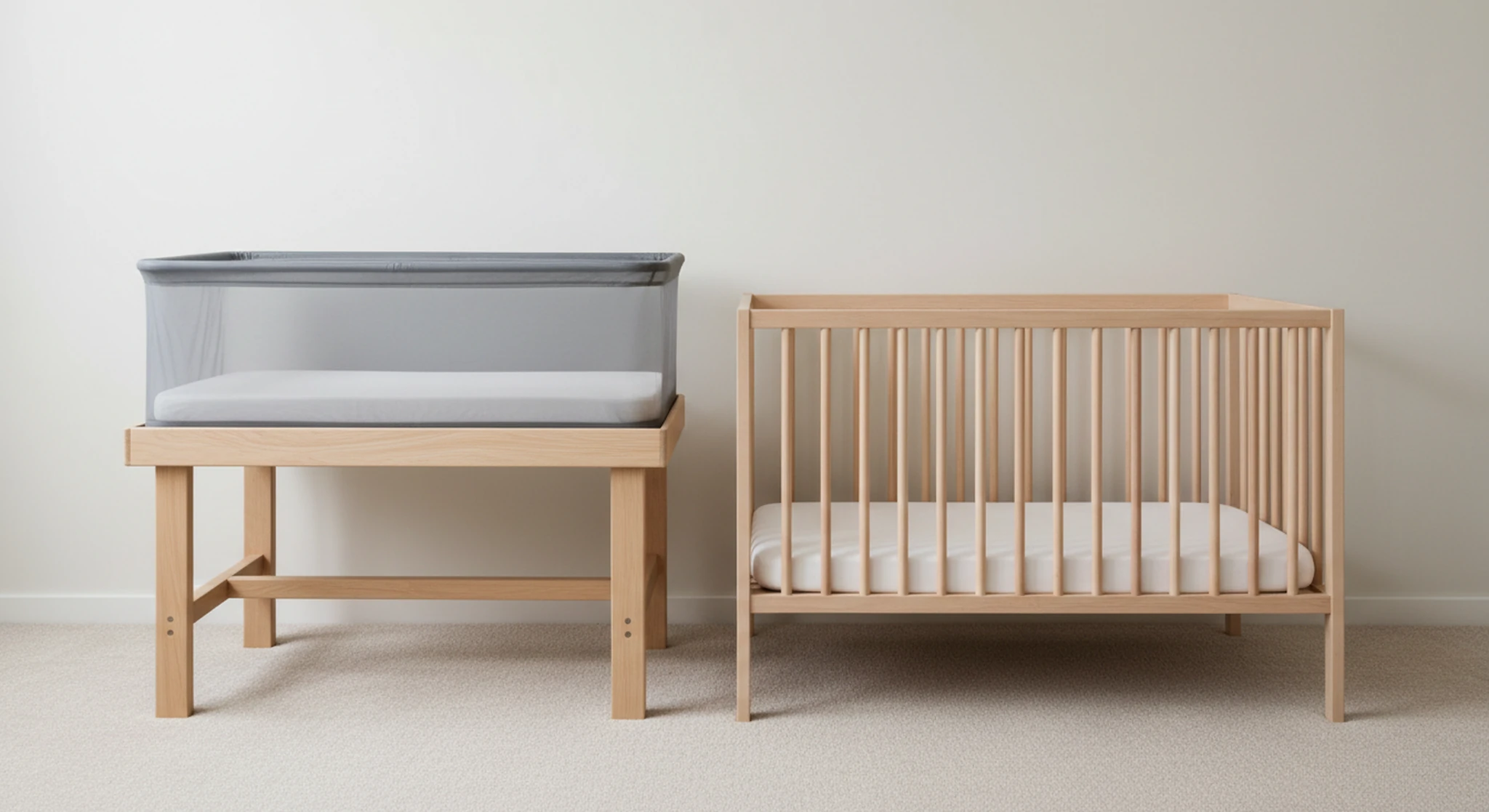
A bassinet and a crib do the same job, giving your baby a safe, separate place to sleep, at very different scales. Here is the bassinet vs. crib comparison at a glance:
Bassinet
Crib
Size
Small and compact, sized for a newborn
Interior about 28 x 52 inches (full-size)
How long it lasts
About the first 3 to 6 months
Birth to about age 2 or 3
Limit to watch
Weight limit (often 15 to 20 lb) or when baby rolls or pushes up
Child reaches 35 inches tall or tries to climb out
Portability
Light, often has wheels, easy to move between rooms
Heavy and stays in one place
Fits beside your bed
Yes, in most bedrooms
Sometimes, in larger bedrooms
Typical cost
Lower, with a wide range for smart models
Higher, plus a mattress, but used for years
Mattress
Thin pad included. Use only that pad
Sold separately in a standard size
Federal safety standard
16 CFR part 1218
16 CFR part 1219
Bassinet vs. crib: size, age range, limits, portability, and cost.
The short version: a bassinet is about convenience in the early months, and a crib is about longevity. Both can be completely safe choices.
What Is a Bassinet?
A bassinet is a small, freestanding bed made for newborns and young infants. Most have a rigid frame with mesh or fabric sides, a thin flat pad, and a stand that brings the baby up to about the height of an adult bed. Some have wheels, storage baskets, or sides that lower so you can see and reach your baby from bed.
Parents like bassinets because they fit in a bedroom, make night feeds easier, and are simple to move. That matters after a cesarean birth or a hard delivery, when bending over a low crib rail is painful.
The tradeoff is time. Babies outgrow bassinets fast. Every bassinet has a weight limit in the manual, commonly 15 to 20 pounds, and most also tell you to stop when your baby can roll over or push up on hands and knees, whichever comes first. For many babies that is somewhere between 3 and 6 months.
What Is a Crib?
A crib is a larger bed with tall slatted sides, designed to hold a baby safely from birth through the toddler years. A full-size crib uses a standard mattress (see our guide to crib mattress size), and the mattress support can be lowered as your baby learns to sit and stand.
A crib costs more at the start and takes up more floor space, but it is the one sleep space most families use for two years or more. Many models convert into a toddler bed. Under AAP guidance, a child should move out of the crib when they are 35 inches tall or when they start trying to climb out.
Newborns can sleep in a crib from the very first night. There is no safety reason to start with a bassinet. A big, bare crib may look empty to you, but a firm, flat, empty space is exactly what a baby needs.
Bassinet vs. Crib: Which Is Safer?
Neither is safer by design. The American Academy of Pediatrics says babies should sleep on a firm, flat surface in a crib, bassinet, portable crib, or play yard that meets Consumer Product Safety Commission standards. A bassinet and a crib that meet those standards are both acceptable.
What matters more than the type of bed is how you use it:
Back to sleep: place your baby on their back for every sleep, naps included.
Flat and firm: the surface should not incline more than 10 degrees. Inclined sleepers are banned in the United States.
Bare: only a fitted sheet. No pillows, blankets, bumpers, positioners, or stuffed animals.
Original mattress only: use the pad that came with the bassinet, and a correctly sized mattress in the crib. Never add padding.
Respect the limits: stop using the bassinet at the weight limit or at the first signs of rolling or pushing up.
Check for recalls: look up your model on the CPSC website, especially if it is secondhand.
If your bassinet rocks, glides, or vibrates, read the manual closely. Many manufacturers tell parents to lock the rocking feature when the baby is asleep or unattended. Our guide to a safe sleep environment covers the full checklist.
Tired nights don’t have to last forever.
Our free two-minute quiz builds a gentle, personalized sleep plan for your baby’s age and temperament.
Small footprint that fits beside your bed, which makes room sharing simple.
Easier night feeds and less bending while you recover from birth.
Portable between rooms, and some models fold for travel.
A cozy scale that some parents find reassuring in the newborn weeks.
Cons
Used for only a few months.
Weight and development limits arrive quickly, sometimes before parents are ready.
You will still need a crib or another long-term sleep space.
Mattress pads and sheets are model-specific, so replacements can be hard to find.
Pros and Cons of a Crib
Pros
One purchase can last from birth to age 2 or 3, longer if it converts to a toddler bed.
Standard mattress and sheet sizes are easy to find and replace.
Sturdy, with an adjustable mattress height as your baby grows.
No transition needed later, since your baby already knows the space.
Cons
Takes up a lot of floor space and may not fit in a bedroom.
Not portable.
Higher upfront cost, plus a mattress.
Lifting a newborn over the rail can be uncomfortable after a cesarean birth.
Do You Need Both a Bassinet and a Crib?
No. You need one safe sleep space, and a crib alone is enough. A bassinet is a convenience, not a requirement. Many families use both because it makes the first months easier: a bassinet in the parents’ room for the early weeks, then a crib.
The AAP recommends room sharing, which means your baby sleeps in your room on their own separate surface, ideally for at least the first 6 months. That recommendation is the main reason bassinets are so popular. If your bedroom fits a crib, a crib works just as well for room sharing.
There are middle options too:
Mini crib: smaller than a full-size crib, often on wheels, and usable for longer than a bassinet.
Play yard with a bassinet insert: a portable option that works for travel and later as a play space. Use the insert only up to its stated limit.
Bedside sleeper: a bassinet that attaches to the side of the adult bed while keeping a separate surface for the baby. Look for one that meets the federal bedside sleeper standard.
How to Choose: 6 Questions to Ask
How big is your bedroom?: If a crib will not fit beside your bed, a bassinet or mini crib makes room sharing possible.
What is your budget?: If you want to buy once, choose the crib and skip the bassinet.
How is your recovery likely to go?: After a cesarean birth, a bedside bassinet at bed height can spare you a lot of bending.
Do you have stairs or a multi-level home?: A light, portable bassinet lets your baby nap safely near you during the day.
Will you travel often?: A play yard may give you more value than a bassinet.
Are you planning more children?: A sturdy bassinet or mini crib can be reused, as long as it is not recalled and has all its parts.
Move your baby to a crib as soon as any one of these is true:
Your baby reaches the bassinet’s weight limit.
Your baby starts to roll over.
Your baby can push up on hands and knees or pull on the sides.
Your baby looks cramped, or bumps the sides and wakes.
For most babies this happens between 3 and 6 months. You can keep room sharing after the switch by placing the crib in your room. Start with naps in the crib, keep the same bedtime routine, and expect a few nights of adjustment. Our step-by-step guide to the bassinet to crib transition has a full plan, and if your newborn is fighting the bassinet itself, see what to do when baby won’t sleep in the bassinet.
Ask your pediatrician about your baby’s sleep space if your baby was born early, has reflux or breathing concerns, or if you have been told to elevate your baby’s head. The AAP does not recommend inclined sleep surfaces, wedges, or positioners, even for reflux, so check before using any product that promises to help.
If you are exhausted and worried about falling asleep with your baby in your arms, tell your pediatrician. They can help you build a plan for safer nights.
Frequently Asked Questions
Is a bassinet or a crib better for a newborn?
Both are safe for a newborn when they meet CPSC safety standards. A bassinet is smaller and easier to keep beside your bed. A crib lasts much longer. Choose based on your space, budget, and recovery needs.
Can a newborn sleep in a crib right away?
Yes. A newborn can sleep in a crib from the first night. Use a firm, flat mattress with a fitted sheet and nothing else in the crib.
How long can a baby sleep in a bassinet?
Most babies use a bassinet for about 3 to 6 months. Stop when your baby reaches the weight limit in the manual, often 15 to 20 pounds, or starts to roll over or push up on hands and knees.
Do I need both a bassinet and a crib?
No. A crib alone is enough. A bassinet is a convenience that makes room sharing and night feeds easier in the early months.
Is a bassinet safer than a crib?
No. The AAP considers a crib, bassinet, portable crib, or play yard that meets CPSC standards to be acceptable. Safety depends on a firm, flat, bare surface and placing your baby on their back.
What is the difference between a bassinet and a mini crib?
A bassinet is smaller and has a low weight limit, so it is used for a few months. A mini crib has rigid slatted sides like a crib and can often be used for a year or longer.
Calmer days, better nights.
Betteroo builds a personalized sleep plan for your baby. Take the free two-minute quiz to get started tonight.