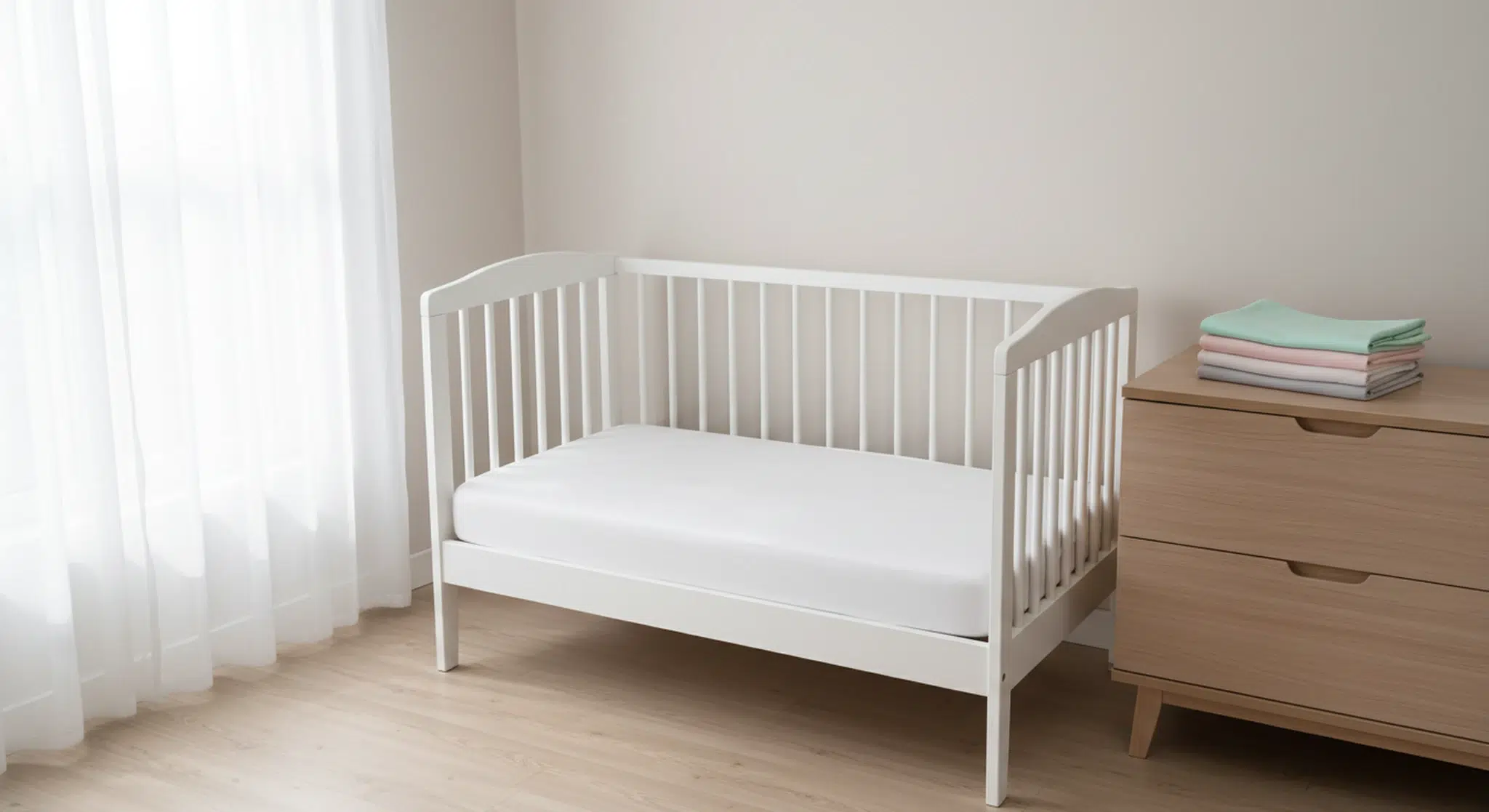
How many crib sheets do I need? For most families, about 3 fitted crib sheets per crib mattress is enough: one on the mattress, one in the wash and one spare for night leaks or spit-up.
That is a practical household estimate, not an official number, and you may want 4 to 6 if your baby has reflux, you have frequent diaper leaks, your baby sleeps in more than one place or you do laundry only once a week.
Below you will find what the AAP and CPSC actually say about crib sheets, how a sheet should fit, how crib, mini crib, play yard and bassinet sheets differ, a materials comparison, how to use a waterproof protector safely and a registry table by scenario.
Key Takeaways
About 3 fitted crib sheets per mattress works for most families: one on, one in the wash, one spare.
Buy 4 to 6 for reflux, frequent leaks, daycare or limited laundry, plus separate sheets for a bassinet or play yard.
The AAP says to use only a fitted sheet, with no other bedding or soft objects.
The CPSC says a crib sheet must fit snugly so a tug on a corner cannot pull it off. Never use an adult sheet.
Any waterproof mattress cover should be thin and tightly fitting. Replace sheets that no longer fit snugly.
As an Amazon Associate, Betteroo earns from qualifying purchases.
Table of Contents
How Many Crib Sheets Do I Need? The Short Answer
Quick Answer
Most families do well with about 3 fitted crib sheets per crib mattress: one on the mattress, one in the wash and one spare for a 2 a.m. leak or spit-up. Plan on 4 to 6 if your baby spits up a lot, you have diaper leaks, you share laundry with a busy household or you have no washer at home. This is a practical household estimate, not a medical or official number.
No safety agency sets a number of sheets. What the American Academy of Pediatrics (AAP) and the U.S. Consumer Product Safety Commission (CPSC) do spell out is what kind of sheet belongs in a baby’s bed: a fitted sheet made for that mattress, and nothing else.
Three works for most homes because it covers the normal cycle: one in use, one in the laundry, one folded and ready. When a diaper leaks at 3 a.m., you put the clean sheet on, settle your baby and deal with the laundry in the morning.
When You Might Want More Than 3 Crib Sheets
Your number goes up when sheets get dirty faster than you can wash them, or when you have more than one sleep space. Count sheets for each mattress your baby actually sleeps on.
Frequent spit-up or reflux: if your baby spits up often, you may change the sheet more than once a night. Our guide to reflux and sleep explains what is common and when to call the doctor.
Diaper leaks: a run of nighttime leaks can use up a spare sheet fast. One or two extra sheets cover a rough week.
A second crib or a grandparent’s house: a crib at a relative’s home needs its own sheets sized for that mattress.
A play yard or bassinet: these mattresses are a different size from a crib mattress, so they need their own sheets. Most families need 2 for each one.
Daycare: if your child care program asks you to supply sheets for the crib or play yard there, ask what size they use and how often they send them home. Our daycare and back-to-work sleep guide covers what else to ask about naps.
No washer at home: if you use a laundromat or a shared building laundry once a week, plan on enough sheets to last 7 days plus a couple of spares for accidents.
Safe Sleep Rules for Crib Sheets
The sheet is the only thing that should be in your baby’s sleep space. Here is what the primary sources say.
Only a fitted sheet: the AAP 2022 safe sleep policy statement recommends a firm, flat, level surface “covered by a fitted sheet with no other bedding or soft objects,” and says the sleep environment “should be clear of everything but a fitted sheet.” HealthyChildren.org, the AAP’s parent site, puts it simply: “Use a fitted sheet only.”
Bare is best: the CPSC’s safe sleep guidance uses the phrase “Bare is Best”: nothing but a fitted sheet in a crib, bassinet or play yard. The NICHD Safe to Sleep campaign agrees that a crib with nothing in it except a fitted sheet covering the mattress “may seem bare,” but “it is the safest option for baby.”
No loose or nonfitted sheets: the AAP lists nonfitted sheets alongside blankets, quilts, comforters, pillows and mattress toppers as soft bedding that can raise the risk of entrapment, suffocation or strangulation.
No bumpers, pillows or toys: HealthyChildren.org says there should be no blankets, pillows, stuffed toys or bumper pads in your baby’s bed, and warns against bumper pads or related products that attach to crib slats or sides.
No weighted products: both the AAP and the CPSC say not to use weighted blankets, sleepers or swaddles.
Babies under 12 months should sleep alone, on their back, on a firm, flat surface. HealthyChildren.org describes firm as a surface that “shouldn’t indent when your baby is lying on it,” and says any surface that inclines more than 10 degrees is not safe for sleep. To keep your baby warm without a blanket, use a wearable blanket; our sleep sack guide covers sizing. For a full room checklist, see how to create a safe sleep environment.
How a Crib Sheet Should Fit (CPSC Guidance)
A sheet that comes loose is a hazard, not just an annoyance. The CPSC crib sheet safety alert says to make sure crib sheets “fit snugly on a crib mattress and overlap the mattress so it cannot be dislodged by pulling on the corner of the sheet.” It also says: “Never use crib sheet unless it fits securely on crib mattress.”
The CPSC’s crib safety tips add: “Use only a fitted bottom sheet specifically made for crib use.” And its alert is direct about one common shortcut: “Never use an adult sheet on a crib mattress; it can come loose and present an entanglement hazard to young children.”
A simple routine every time you change the bed:
Pull the elastic fully under all four corners of the mattress, not just over the top edge.
Tug each corner of the sheet firmly. If any corner pops off or rides up, that sheet does not fit this mattress and should not be used on it.
Run your hand across the surface. The sheet should lie flat and tight with no loose fabric, folds or bunching.
Fit also depends on the mattress. The AAP says the mattress should hold its shape with the fitted sheet designated for it, with no gaps between the mattress and the crib wall, and that you should only use mattresses designed for the specific product. Our crib mattress size guide walks through measuring and checking the fit.
Stuck on night two or three?
Our free two-minute quiz builds a gentle, personalized sleep plan that adapts when progress stalls.
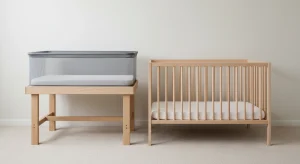
Crib Sheet Sizes: Crib, Mini Crib, Play Yard and Bassinet
Sheets are sized to a type of mattress, and the types are not interchangeable. A sheet made for a different mattress can be loose or can pull off.
Sleep space
Mattress size
Which sheet to use
Full-size crib
The federal crib mattress standard (16 CFR 1241) requires at least 27 1/4 inches wide and 51 5/8 inches long
A fitted crib sheet labeled for a standard or full-size crib mattress, deep enough for your mattress thickness
Mini crib
No single standard size; check the mattress label
A fitted sheet labeled for mini or non-full-size crib mattresses that matches your mattress dimensions
Play yard (pack and play)
Varies by model; check the label on the pad that came with it
A fitted sheet labeled for play yards and sized for that pad
Bassinet
Varies by model and shape (oval, rectangle); check the label
A fitted sheet the bassinet maker specifies, or one labeled for that exact mattress size and shape
Measure your own mattress and read the label before you buy sheets.
Measure, then buy: measure the length, width and thickness of each mattress and compare them with the dimensions on the sheet package. Our mini crib guide explains why mini crib sizes vary so much.
Thickness matters: a sheet with shallow pockets can pull up at the corners on a thicker mattress. Read the pocket depth on the package.
Keep the original play yard pad: the AAP says to use only mattresses designed for the specific product, and HealthyChildren.org says not to use products for sleep that are not specifically marketed for infant sleep. Do not add padding or a second mattress under the sheet.
Material is mostly about comfort, warmth and how a sheet holds up to frequent washing. Fit comes first; this is a qualitative comparison, not a safety ranking.
Material
What it feels like
Pros
Cons
Cotton (woven, such as percale)
Crisp and smooth
Easy to wash often, widely available, works year round
Woven fabric has little stretch, so fit depends on good elastic and correct size
Cotton jersey (knit)
Soft and stretchy, like a T-shirt
The stretch helps it hug the mattress corners
Can pill or thin out after many washes
Muslin
Light, airy, softens with washing
A lightweight option for warm rooms
Loosely woven fabric can wrinkle and may wear through sooner
Flannel
Brushed and warm
Feels cozy in a cool room
Can feel too warm in a heated room; may pill
Bamboo-derived rayon (often labeled viscose)
Very smooth and silky
Soft and drapey
Often needs gentler washing; check the care label and fiber content
Pick by feel and care needs; any material must be a fitted sheet sized for your mattress.
A warm flannel sheet is not a reason to add a blanket, and a soft sheet is not a reason to add padding. Keep the crib bare.
Waterproof Mattress Protectors and Double Layers
Many crib mattresses already have a water-resistant cover. If yours does not, a mattress protector can help with leaks.
The AAP 2022 policy statement says: “If a mattress cover is used to protect against wetness, it should be tightly fitting and thin.” It also says mattress toppers designed to make the sleep surface softer are not appropriate for babies under 1 year, and that pillows or cushions should not be used as a mattress or added to one.
Choose a thin, fitted waterproof protector made for your mattress size, not a padded or quilted topper.
Put the protector on the mattress and the fitted sheet over it. Do the corner tug test with both layers on.
Count protectors like sheets: one on the mattress and one in the wash is usually enough.
Some parents “double sheet” the crib (sheet, protector, sheet, protector) for faster night changes. Neither the AAP nor the CPSC addresses this setup in the pages we read. If you try it, every layer must be fitted, thin and made for that mattress, the stack must still fit snugly with no corner popping up, and the surface must stay firm and flat. If the layers make the sheet loose or the surface soft, go back to one protector and one sheet.
How Many Crib Sheets for Your Registry, by Scenario
A starting point per mattress; adjust for your laundry routine.
Your situation
Crib sheets
Other sheets
Waterproof protectors (thin, fitted)
One crib, washer at home, average spit-up
3
None
1 to 2, if the mattress has no water-resistant cover
One crib plus a bassinet for the first months
3
2 bassinet sheets
1 to 2 for the crib
One crib plus a play yard for travel or naps
3
2 play yard sheets
1 to 2 for the crib
Frequent spit-up, reflux or diaper leaks
4 to 6
Add 1 for each extra sleep space
2
Weekly laundromat or shared laundry
5 to 7
2 to 3 for each extra sleep space
2
Two cribs (home and a relative’s house)
3 for the home crib, 2 for the second
As needed
1 for each crib
Child care asks you to supply sheets
Your home count, plus 2 for daycare
Size them for the daycare crib or play yard
Ask the program first
Household estimates for planning, not official recommendations.
Add sheets to your list alongside the other sleep basics in our baby registry checklist, and see baby must-haves. Buy one sheet first and test the fit before buying the rest.
Washing and Rotating Crib Sheets
There is no official rule for how often to change a crib sheet. Many families change it about once a week and any time it gets wet or soiled.
Wash before first use: many families wash new sheets before putting them on the crib. Follow the care label for temperature and drying.
Follow the label: some fabrics shrink or lose stretch in high heat. A sheet that shrinks may no longer fit, so check the fit after the first wash.
Make night changes easier: keep the spare sheet folded in the same spot every night, near the crib, so you can change the bed in the dark without hunting.
Never leave extras in the crib: a spare sheet or a burp cloth left in the crib is soft bedding. Store spares on a shelf or dresser.
When to Replace Crib Sheets
The CPSC says never to use a crib sheet unless it fits securely, so the main reason to replace a sheet is fit. Retire a sheet when:
The elastic is stretched out or the corners pop off when you tug them.
It has holes, tears or loose threads.
It has shrunk and you have to fight to get it over the mattress, or it pulls the mattress edges up.
You change mattresses, or the sheet was made for a different size or thickness.
For most families, 3 fitted crib sheets per crib mattress is plenty: one on, one in the wash and one spare. Buy more if you are dealing with frequent spit-up, leaks or limited laundry, and add separate sheets sized for any bassinet, play yard or second crib.
Whatever number you choose, use only fitted sheets made for that mattress, check that the corners stay put, keep any waterproof cover thin and tight, and keep the crib bare. If your baby spits up a lot, seems uncomfortable after feeds or is wetting through diapers often, mention it to your pediatrician.
Frequently Asked Questions
How many crib sheets do I need for a newborn?
Most families do well with about 3 fitted crib sheets per mattress: one on the bed, one in the wash and one spare for night leaks. If your newborn sleeps in a bassinet or play yard for the first months, you also need about 2 sheets sized for that mattress. Buy more if spit-up is frequent or laundry is limited.
How often should you change crib sheets?
There is no official schedule. Many families change the crib sheet about once a week and right away whenever it gets wet, soiled or covered in spit-up. During a stomach bug or a run of diaper leaks, you may change it more than once a night, which is why a spare sheet nearby helps.
Can I use a regular sheet on a crib mattress?
No. The CPSC warns never to use an adult sheet on a crib mattress because it can come loose and become an entanglement hazard. Use only a fitted sheet made for a crib mattress of your size, and check that every corner stays in place when you tug it.
Are crib sheets and pack and play sheets the same size?
No. A play yard pad is smaller and thinner than a full-size crib mattress, so a crib sheet will be loose on it. Use a fitted sheet labeled for play yards and sized for the pad that came with your play yard. Check the label for dimensions before you buy.
Do I need a mattress protector for a crib?
It is optional. Many crib mattresses already have a water-resistant cover. If you add a protector, the AAP says a cover used against wetness should be tightly fitting and thin. Avoid padded toppers, and put the fitted sheet over the protector so the surface stays firm and flat.
Is it safe to layer crib sheets and waterproof pads?
Safety agencies do not address this setup directly. If you layer, every layer must be thin, fitted and made for that mattress, and the stack must still fit snugly with no corners lifting and a firm, flat surface. If the layers loosen the sheet or soften the surface, use one protector and one sheet.
Gentle changes, peaceful nights.
Betteroo builds a personalized sleep plan for your baby or toddler. Take the free two-minute quiz to get started.
Moon RY, Carlin RF, Hand I; AAP Task Force on SIDS. Sleep-Related Infant Deaths: Updated 2022 Recommendations for Reducing Infant Deaths in the Sleep Environment. Pediatrics. 2022;150(1):e2022057990. https://pubmed.ncbi.nlm.nih.gov/35726558/