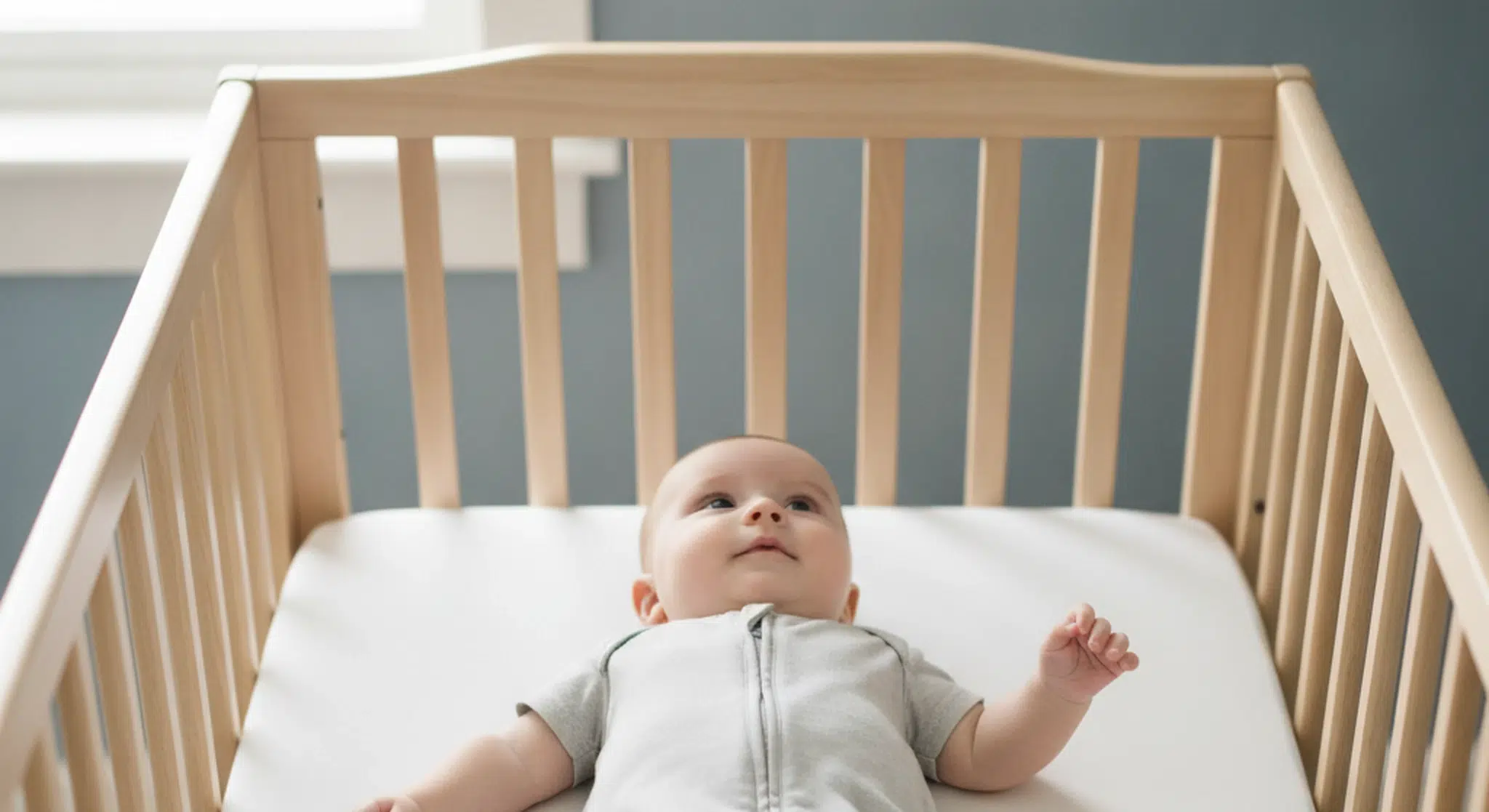
At four months, most babies can stay awake for about 1.5 to 2.5 hours between sleeps, with the shortest window in the morning and the longest right before bedtime.
Four months is the age when wake windows suddenly matter more than ever, because it is also when many babies hit the shift often called the four month sleep regression. Sleep cycles mature, naps get pickier, and the awake time you allow before each sleep becomes a powerful lever.
Below are realistic wake window ranges for a four month old, how many naps to expect as they begin to consolidate, the tired cues to read, and a sample day you can bend to fit your own baby.
Key Takeaways
A 4 month old’s wake window is typically about 1.5 to 2.5 hours, shortest in the morning and longest before bed.
Most 4 month olds take 3 to 4 naps as daytime sleep starts to organize into a pattern.
The AASM recommends 12 to 16 hours of sleep per 24 hours for babies 4 to 12 months.
The four month change is a permanent maturation of sleep, not a regression that undoes progress.
Overtiredness from a too-long window is the usual cause of short naps and bedtime battles.
Table of Contents
4 Month Old Wake Windows at a Glance
Awake time at four months is longer than the newborn weeks and a little more predictable, but it still shifts across the day. Plan the first window a bit short, and expect the last window before bed to be the longest.
Time of day
Typical wake window
Morning (first of the day)
About 1.5 to 1.75 hours
Midday
About 2 to 2.25 hours
Before bedtime
About 2.25 to 2.5 hours
Typical 4 month wake windows. Ranges are illustrative starting points.
If naps are short or your baby fights going down, the wake window just before that sleep is the first thing to adjust. At four months, a window that ran fifteen minutes too long is a very common reason for a twenty minute catnap.
How Much Sleep and How Many Naps at 4 Months
From four months, sleep needs settle into the well known band: the AASM recommends 12 to 16 hours per 24 hours for infants 4 to 12 months, including naps.1 Most four month olds sleep around 10 to 12 hours overnight, with waking, plus 3 to 4 hours of daytime sleep.
Expect 3 to 4 naps. Many babies are still on four shorter naps early in the fourth month and drift toward three as naps lengthen. There is no need to force a nap drop yet. Let the day tell you when a nap is genuinely no longer needed.
The Four Month Change and Wake Windows
Around four months, infant sleep permanently matures to include lighter and deeper stages, much like adult sleep. Babies now surface fully between sleep cycles and may cry out if they were used to being put down already asleep. This is often called the four month sleep regression, but it is really a one way developmental step forward.
Good wake window timing helps you ride it out. A baby who goes down slightly undertired or overtired will struggle at these lighter cycle transitions. Aim for the middle of the range, watch the cues, and keep bedtime from drifting late. Our sleep regression ages guide explains the pattern in depth.
Reading Tired Cues at 4 Months
Wake windows are estimates. Your baby is the real clock. At four months, early tired cues include looking away from you, going quiet or still, rubbing the face, and yawning.
Catch sleep at early cues: staring, turning away, face rubbing, first yawn.
Late cues mean overtired: arching, frantic crying, clinginess, clenched fists.
Put down at early cues, most babies settle faster and nap longer.
Naps fell apart at 4 months?
A personalized plan can retune wake windows to your baby and steady the day.
One common four month shape, on a three to four nap day. Times are illustrative. Shift the whole thing to match your baby’s natural wake time.
Time
What is happening
Wake window
7:00 AM
Wake and feed
Start of day
8:30 AM
Nap 1
After about 1.5 hr
Late morning
Feed, awake time, Nap 2
About 2 hr awake
Afternoon
Nap 3, sometimes a short Nap 4
2 to 2.25 hr awake
6:30 to 7:30 PM
Bedtime routine and bed
After about 2.25 to 2.5 hr
One common 4-month rhythm. Nap count varies by baby.
Keep the sleep space bare and put your baby down on the back for every sleep, in line with AAP safe sleep guidance, and stop swaddling now if there is any sign of rolling.4 For the whole year of awake times, see wake windows by age.
When to Talk to Your Pediatrician
Total daily sleep is consistently well below about 12 hours.
Your baby is inconsolable at sleep times no matter the window length.
Snoring, breathing pauses, or feeding and growth concerns.
Your own exhaustion is affecting your wellbeing.
The four month stretch is hard on parents. A rough patch is expected, but persistent worries about sleep, feeding, or breathing are always worth a call.
Frequently Asked Questions
What is the wake window for a 4 month old?
Most 4 month olds can stay awake about 1.5 to 2.5 hours between sleeps, with the shortest window in the morning and the longest before bedtime. Aim for the middle of the range and adjust based on your baby’s tired cues.
How many naps should a 4 month old take?
Usually 3 to 4 naps a day. Many babies start the month on four shorter naps and move toward three as naps lengthen. There is no need to force a nap drop at this age.
How much should a 4 month old sleep?
About 12 to 16 hours per 24 hours including naps, per the AASM recommendation for infants 4 to 12 months. That is often roughly 10 to 12 hours overnight with waking, plus 3 to 4 hours of daytime sleep.
Why did my 4 month old’s naps get worse?
Around four months, sleep permanently matures so babies fully wake between cycles. This is often called the four month sleep regression. Solid wake window timing and a consistent, calm settling routine help you through it, and it does not undo earlier progress.
What time should a 4 month old go to bed?
Bedtime commonly falls between about 6:30 and 7:30 PM, timed so the last wake window is around 2.25 to 2.5 hours. If your baby was overtired in the evening, try an earlier bedtime for a few nights.
Can a 4 month old’s wake window be too long?
Yes. Awake stretches much past 2.5 hours often tip a four month old into overtiredness, which usually causes harder settling and shorter naps. If you see that pattern, shorten the window before the next sleep first.
Want a schedule that fits your 4 month old?
Get a personalized, adaptive plan instead of a one-size chart.
Paruthi S, Brooks LJ, D’Ambrosio C, et al. Recommended Amount of Sleep for Pediatric Populations: A Consensus Statement of the American Academy of Sleep Medicine. J Clin Sleep Med. 2016;12(6):785-786. https://pubmed.ncbi.nlm.nih.gov/27250809/
Mindell JA, Telofski LS, Wiegand B, Kurtz ES. A Nightly Bedtime Routine: Impact on Sleep in Young Children and Maternal Mood. Sleep. 2009;32(5):599-606. https://pubmed.ncbi.nlm.nih.gov/19480226/
American Academy of Pediatrics. Sleep-Related Infant Deaths: Updated 2022 Recommendations for Reducing Infant Deaths in the Sleep Environment. Pediatrics. 2022;150(1). https://pubmed.ncbi.nlm.nih.gov/35726558/