The standard crib mattress size in the United States is at least 27 1/4 inches wide by 51 5/8 inches long, and no more than 6 inches thick.
Those numbers are not a suggestion from mattress brands. They are set by federal safety rules, because a mattress that fits the crib tightly is one of the simplest ways to protect a sleeping baby.
This guide explains crib mattress size and dimensions in detail: the standard measurements, how mini crib, play yard, bassinet, and toddler bed mattresses compare, how thick a crib mattress should be, and how to check the fit at home in under a minute.
Key Takeaways
A full-size crib mattress must be at least 27 1/4 x 51 5/8 inches and no more than 6 inches thick (16 CFR part 1241).
A full-size crib interior is about 28 x 52 3/8 inches, so standard mattresses and cribs are made to fit each other.
Do the two-finger test: if more than two fingers fit between the mattress and the crib side, the mattress is too small.
Mini crib, play yard, and bassinet mattresses are not standardized. Use only the one made for your product.
Toddler beds use the same mattress as a full-size crib.
Table of Contents
What Is the Standard Crib Mattress Size?
Quick Answer
A standard (full-size) crib mattress in the United States must be at least 27 1/4 inches wide and 51 5/8 inches long, and no more than 6 inches thick. Most are sold as roughly 28 x 52 inches. Mini crib mattresses are smaller, commonly about 24 x 38 inches, and are not standardized.
Crib mattress size is one of the few baby product measurements set by federal law. The Consumer Product Safety Commission (CPSC) regulates full-size crib mattresses under 16 CFR part 1241, which took effect on August 15, 2022 and builds on the ASTM F2933 industry standard. The rule sets a minimum width and length so that a mattress cannot be too small for a standard crib.
The crib itself is regulated too. Under the CPSC’s full-size crib rule, the interior of a full-size crib must measure 28 inches wide by 52 3/8 inches long, give or take 5/8 inch in each direction. Put those two rules together and you get the goal: any full-size crib mattress should fit any full-size crib with only a small gap around the edge.
Crib Mattress Dimensions Chart
Here is how standard crib mattress dimensions compare with the other sleep surfaces you may be shopping for:
Mattress type
Typical dimensions
Thickness
Standardized?
Full-size (standard) crib
At least 27 1/4 x 51 5/8 in (about 28 x 52 in)
Up to 6 in
Yes, by federal rule
Mini crib
About 24 x 38 in (varies by brand)
Varies. Follow the manual
No. Use the size your crib maker specifies
Play yard / pack and play
Varies by model
Aftermarket pads limited to 1 1/2 in
No. Use the pad made for your model
Bassinet
Varies widely by model
Thin, about 1 to 1 1/2 in
No. Use only the pad it came with
Toddler bed
Same as a full-size crib mattress
Up to 6 in
Yes
Twin bed
38 x 75 in
Varies
Industry standard
Crib mattress size compared with mini crib, play yard, bassinet, toddler bed, and twin mattresses.
In metric terms, a standard crib mattress is at least about 69 x 131 centimeters and no more than about 15 centimeters thick.
Why Crib Mattress Size Matters for Safety
A mattress that is too small leaves a gap between the mattress and the crib frame. A baby can slip into that gap and become trapped, which is a suffocation and entrapment hazard. A mattress that is too large will bend or bunch, which creates an uneven surface.
That is why the rule is about fit, not comfort. According to the Federal Register notice for the crib mattress standard, the CPSC wrote the rule to address hazards such as gaps, overly soft surfaces, and poorly fitting aftermarket mattresses. The American Academy of Pediatrics (AAP) gives parents the same message in plain language: use a firm, flat mattress designed for your specific crib, covered only with a fitted sheet.
Fit is one part of a safe sleep space. For the full picture, see our guide to creating a safe sleep environment.
How to Check the Fit: The Two-Finger Test
Even with standard sizes, check the fit yourself. Cribs and mattresses each have a small allowed tolerance, and those can add up.
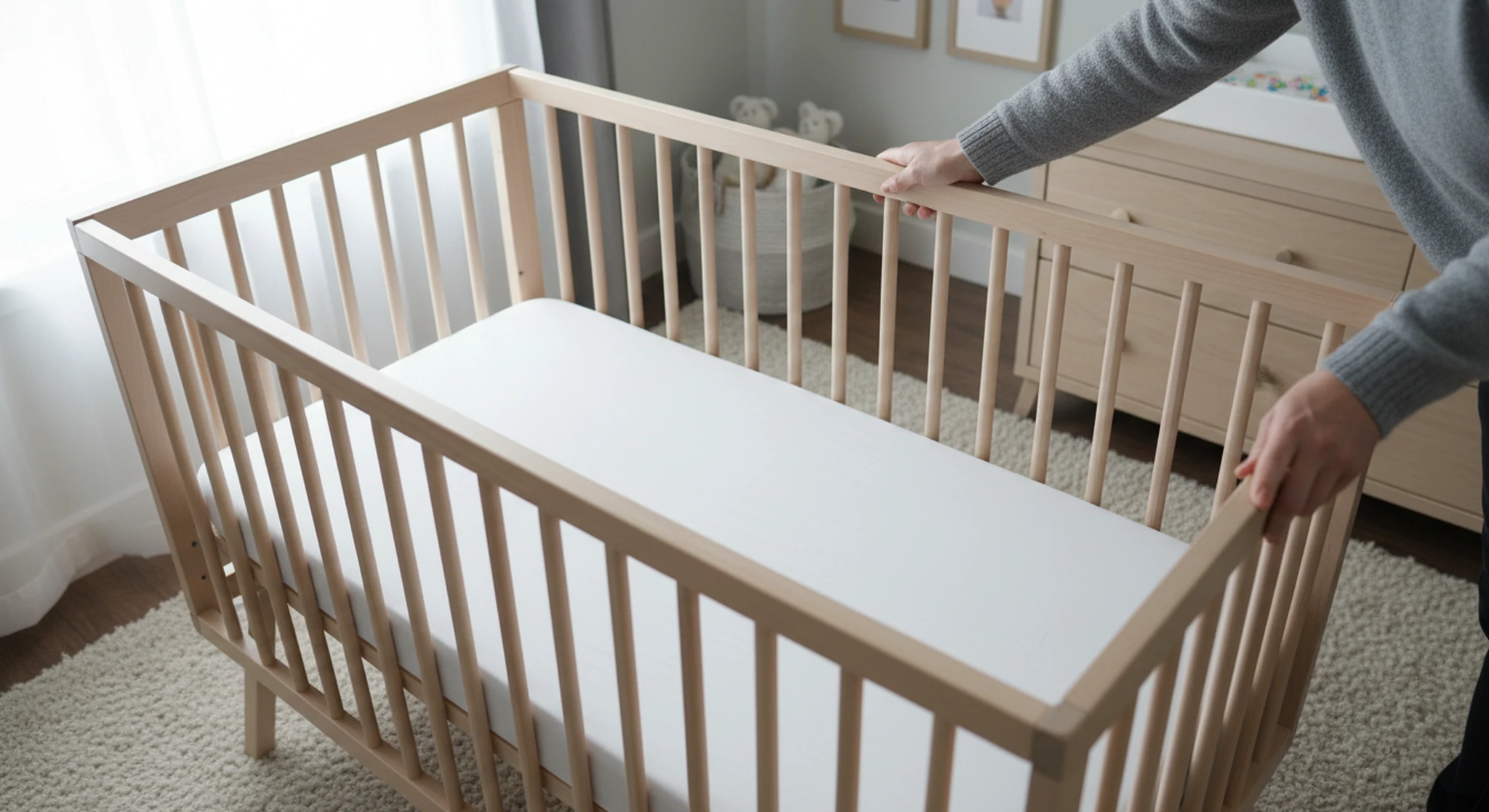
Step 1: place the bare mattress in the crib and push it firmly into one corner.
Step 2: look at the gap on the opposite sides.
Step 3: try to slide your fingers between the mattress edge and the crib frame.
Step 4: if more than two fingers fit, the mattress is too small for that crib. Do not use it.
Repeat the check after you put on the fitted sheet and any waterproof cover. A thick or quilted cover can change how the mattress sits. The sheet should fit tightly, with no loose fabric you can pinch up at the corners.
Tired nights don’t have to last forever.
Our free two-minute quiz builds a gentle, personalized sleep plan for your baby’s age and temperament.
Full-size crib mattresses cannot be more than 6 inches thick. Most fall between 4 and 6 inches. Thickness matters for two reasons:
Rail height: a thicker mattress raises your baby closer to the top of the rail. Cribs are tested with the maximum 6 inch thickness in mind, so a taller mattress would make climbing or falling out easier.
Firmness: a thicker mattress is not a softer or better one. Babies need a firm, flat surface that does not mold around the face. The federal standard includes a firmness test for this reason.
A quick home check: press your hand into the center and edges of the mattress. It should spring back right away and not hold the shape of your hand. As your baby grows and starts to sit and pull up, you will also need to lower the mattress support. Our guide on when to lower the crib mattress walks through the timing.
Mini Crib Mattress Size
Mini cribs are legally called “non-full-size cribs,” and that name explains the challenge: there is no single mini crib mattress size. Many mini cribs take a mattress of about 24 x 38 inches, but lengths, widths, and thicknesses differ from brand to brand.
The safest approach:
Use the mattress that came with the mini crib, or the exact replacement size listed in the manual.
Check the fit. The federal rule says a non-full-size crib mattress should leave no more than a 1/2 inch gap at any point around its edge.
Do not use a standard crib mattress, a folded blanket, or a pad from another product.
Follow the manual’s maximum mattress thickness. Many mini cribs specify a thinner mattress than a full-size crib.
Play Yard and Bassinet Mattresses
Play yards and bassinets have soft or mesh sides, so the mattress fit is even more important. A pad that is too thick or too small can let a baby become wedged between the pad and the flexible side.
Play yards: use only the pad that came with your model. Aftermarket play yard mattresses are limited to 1 1/2 inches thick under the federal standard and must be made for the specific product. Never add an extra mattress or topper for comfort.
Bassinets: use only the manufacturer’s pad and its matching fitted sheet. Bassinet shapes vary too much for generic pads.
Yes. Toddler beds are designed to use a full-size crib mattress, so you can move the same mattress over when your child is ready. Many cribs also convert into a toddler bed with a guardrail kit and keep the mattress in place.
Many crib mattresses are dual-sided, with a firmer infant side and a slightly softer toddler side. Keep the firm side up for at least the first 12 months, then flip it when your toddler moves on. A twin mattress (38 x 75 inches) is much larger and is the usual next step after the toddler bed. Our guide covers when to transition to a toddler bed.
How to Measure Your Crib and Mattress
If you have a hand-me-down crib, an imported crib, or a round or oval crib, measure before you buy:
Measure the inside of the crib, wall to wall, for width and length. Measure at mattress level, not at the top rail.
A full-size crib interior should be about 28 x 52 3/8 inches. If yours is very different, it is a non-full-size crib and needs its own mattress.
Measure the mattress across the widest points, without a sheet.
Check the label. Crib mattresses sold in the United States must state their dimensions and carry warnings about fit.
For round, oval, or other shaped cribs, buy only the mattress made by that manufacturer for that model.
Be cautious with older cribs. Federal crib standards changed in 2011, when drop-side cribs were banned. The AAP advises against using cribs made before then or any crib with missing or broken parts.
Crib Sheets and Mattress Covers
Standard fitted crib sheets are made for a 28 x 52 inch mattress and for depths up to about 6 inches. Mini crib and play yard sheets are sized separately and are not interchangeable.
Choose a sheet that fits snugly and wraps well under every corner.
A thin, fitted waterproof cover is fine. Avoid thick quilted pads and mattress toppers.
Skip bumpers, pillows, blankets, and positioners. A fitted sheet is the only bedding a baby needs.
Shopping for the mattress itself? Our tested picks are in the best crib mattress guide.
Replace a crib mattress if it sags, has a soft spot or body impression, has torn or cracked covering, or no longer passes the two-finger test in your crib. If you are using a secondhand mattress, check that it is firm, clean, intact, and the correct size for your crib.
Talk to your pediatrician if you have questions about your baby’s sleep space, especially if your baby was born early or has a medical condition. You can also check the CPSC website for recalls on your crib or mattress.
Frequently Asked Questions
What is the standard crib mattress size?
A standard crib mattress in the United States is at least 27 1/4 inches wide and 51 5/8 inches long, and no more than 6 inches thick. Most are labeled as about 28 x 52 inches.
Are all crib mattresses the same size?
All full-size crib mattresses must meet the same minimum dimensions, so they fit any full-size crib. Mini crib, play yard, and bassinet mattresses are not standardized and vary by brand.
What size is a mini crib mattress?
Many mini crib mattresses measure about 24 x 38 inches, but there is no standard. Use the mattress that came with your mini crib or the exact size listed in its manual.
How thick should a crib mattress be?
A full-size crib mattress can be up to 6 inches thick, and most are 4 to 6 inches. Firmness matters more than thickness. The surface should be flat and spring back when pressed.
Is a crib mattress the same size as a toddler bed mattress?
Yes. Toddler beds are made to use a standard full-size crib mattress, so you can keep the same mattress when your child moves out of the crib.
How do I know if my crib mattress fits?
Push the mattress into one corner of the crib and check the gap on the opposite sides. If you can fit more than two fingers between the mattress and the crib frame, it is too small.
Calmer days, better nights.
Betteroo builds a personalized sleep plan for your baby. Take the free two-minute quiz to get started tonight.