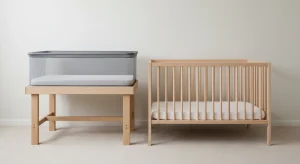
Your baby sleeps beautifully on you and wakes the instant you put them down. This is not a discipline problem, and it is not something you caused by holding them too much. It is close to the default setting for a newborn.
That does not make it easy. Contact-only sleep is exhausting, and exhaustion is what pushes parents toward the genuinely risky shortcuts at 3am.
So here is what is actually happening, what tends to help, and the one thing to avoid no matter how tired you get.
Key Takeaways
Waking on transfer is driven by the startle reflex and short sleep cycles, not by habit or spoiling.
The NHS explicitly normalizes this: in the early weeks many babies only fall asleep in your arms.
Frequent night waking is normal and expected. Babies need to feed every 2 to 3 hours.
If you might fall asleep, a cleared adult bed is far safer than a sofa or armchair. Couch sharing carries up to 67 times the risk.
Skip the popular tips about warming the mattress or putting a worn shirt in the crib. Both conflict with safe sleep guidance.
Table of Contents
Why Your Baby Wakes the Moment You Put Them Down
Quick Answer
Most transfer wake-ups come down to the Moro reflex, which fires on sudden position changes, plus short infant sleep cycles that create natural wake points. Both are developmental. Neither is a habit you created, and neither responds to being firmer about it.1
The startle reflex is triggered by suddenness, not height
The Moro reflex is an involuntary response to a sudden change in position. The detail that matters for you: it is triggered by the suddenness of the stimulus and not the distance of the drop.1 Lowering your baby the last few inches quickly is enough to set it off, even if you have been gentle the whole way down.
The reflex begins to fade around 12 weeks and is usually gone by about 6 months.1 For a lot of families, that is the real fix, and it arrives on its own.
Infant sleep cycles are short, with frequent surfacing
Babies cycle through sleep faster than adults and spend proportionally more time in light, active sleep. Every cycle transition is a natural point to surface. On you, they surface, register warmth and a heartbeat, and go back down. In the crib they surface, register that everything has changed, and wake fully.
Frequent waking is not a malfunction
Dr. Rachel Moon, who chairs the AAP task force on safe sleep, puts it plainly: parents might think their infant is waking up too much and fear something is wrong, but babies by their nature wake frequently, and they have to wake to feed every 2 to 3 hours, so this is normal and healthy and should be expected.2
It is also worth knowing how long this genuinely lasts. In a cohort of nearly 400 infants, 37.6 percent were not sleeping 6 consecutive hours at 6 months, and 27.9 percent still were not at 12 months. That study found no association between uninterrupted sleep and developmental scores or maternal mood.3 If your 8 month old still wakes, you are in ordinary company.
You Are Very Much Not Alone in This
Before any of the practical advice, here is the number that reframes the whole problem. In our State of Baby Sleep 2026 report, a survey of 74,379 parents across 112 countries, we asked how babies actually fall asleep.
Fewer than 1 in 10 babies fall asleep on their own. Nearly two thirds are fed to sleep. If your baby only settles on you, you are not in a minority, you are in the overwhelming majority.
That matters practically as well as emotionally. Advice written as though independent sleep is the default is describing about 9.7 percent of babies.
What Actually Helps
None of these are magic, and some babies will resist all of them for a few more weeks. That is a real outcome, not a failure of technique.
Put your baby down drowsy rather than fully asleep
The AAP recommendation is to put babies to bed when they are drowsy and not wait until they are asleep, because a baby who is held or rocked all the way to sleep may struggle to settle again when they wake.4
One important qualifier that most articles leave out: the AAP scopes this advice to around 4 months and older.4 Under 4 months, there is no expectation that your newborn does this, and no reason to push it.
Make the transfer slow and continuous
Since the reflex responds to suddenness, keep the movement gradual. Lower your baby feet and bottom first, keep a hand on their chest for a moment after they are down, and release slowly rather than lifting away.
Build day and night contrast
The NHS suggests keeping days bright and social, with normal household noise, and nights dim and dull: lights low, minimal talking, put down as soon as fed and changed, no play, and no unnecessary changes.5
Keep a consistent bedtime routine
This one has actual randomized evidence behind it. A trial of 405 mother and child pairs found that introducing a consistent bedtime routine improved sleep onset latency, the longest continuous sleep stretch, and the number and duration of night wakings, and also improved maternal mood.6 The NHS version is bath, fresh nappy and night clothes, into bed, story, dimmed lights, kiss and cuddle.5
Give them a moment before you go in
The AAP notes that babies need time to put themselves back to sleep, and that it is normal for a 6 month old to wake and then resettle after a few minutes.4 This does not mean ignoring a baby who needs feeding, changing, or comfort when unwell. It means not intercepting every stir.
Two Popular Tips We Are Not Going to Give You
Both of these appear constantly in articles on this topic. Both conflict with safe sleep guidance, and we would rather explain why than quietly omit them.
Warming the mattress before the transfer
The theory is that the temperature change wakes the baby. Maybe. But the fix means introducing a heat source into a sleep space, and overheating is an established risk factor. The AAP guidance is layers rather than added warmth, with a check for sweating, a hot chest, and flushed skin.7 The trade is not worth it.
Putting a worn t-shirt in the crib so it smells like you
This puts a loose soft object into the sleep space, which is directly against AAP guidance on soft bedding.7 Loose fabric near an infant’s face is exactly the hazard the soft-bedding rules exist to prevent.
Also worth a flag: prescriptive wake window charts down to the 15 minute increment are practitioner convention rather than research. They can be a useful loose guide, and we have written about how much evidence actually sits behind them.
Touched out and running on nothing?
Get a sleep plan built around your baby’s actual age and pattern, not a schedule that assumes an average baby.
The 3am Safety Rule Worth Knowing Before You Need It
Read this part now, while you are not exhausted. The decisions that go wrong are made at 3am by people who have not slept.
Never feed or settle your baby on a sofa or armchair at night
Sharing a sleep surface on a couch, soft armchair, or cushion is associated with a risk of sleep-related infant death up to 67 times higher.8 It is the single highest-risk scenario in the literature. If you are tired enough that falling asleep is plausible, do not sit down on the sofa with your baby.
Here is the part that surprises people. The AAP does not endorse planned bed sharing. But it does give contingency advice, because unplanned sleep happens: if there is any possibility you might fall asleep while your baby is in your bed, make sure there are nothing that could cover your baby’s face, head and neck or overheat them, and move your baby to their own space as soon as you wake.9
Read those two together and the practical takeaway is counterintuitive but important: a cleared adult bed is meaningfully safer than a sofa. Prepare the bed in advance rather than assuming you will stay awake.
Other risk multipliers from the same AAP data: bed sharing with anyone impaired by fatigue, alcohol, cannabis, opioids, sedating medication, or who smokes, carries more than 10 times the risk. For an infant under 4 months it is 5 to 10 times. For preterm or low birth weight infants, 2 to 5 times.8
On the other side of the ledger: room sharing without bed sharing, for at least the first 6 months, is associated with up to a 50 percent reduction in SIDS risk.8 Having the crib or bassinet next to your bed is both safer and, practically, makes night transfers much easier.
Is Contact Napping a Problem?
Not in itself. The dividing line is not contact, it is supervision and surface.
Situation
Status
Awake, alert adult holding a sleeping baby on a firm surface
Fine
Baby in a carrier with face visible and chin off the chest
Fine
Caregiver dozing off while holding the baby on a sofa or recliner
High risk. This is the 67x scenario8
Baby left to sleep in a swing, bouncer, car seat, or lounger
Not a safe sleep surface10
Baby moved to a flat firm surface once asleep
Fine
When contact sleep is fine and when it is not
So contact naps during the day, while you are awake and watching, are not something to feel guilty about. The risk enters when you fall asleep too, especially anywhere other than a cleared bed.
If your baby falls asleep in a car seat, carrier, or swing, move them to a flat surface as soon as it is practical.10
When to Talk to Your Pediatrician
Crib refusal on its own is a developmental stage, not a medical sign. But raise it with your pediatrician if it comes alongside any of these:
Poor weight gain, or your baby has not returned to birth weight by day 10 to 14
Snoring, mouth breathing, or pauses in breathing during sleep
Arching, crying, or apparent pain consistently after feeds
Fewer than six wet diapers a day11
Your baby seems difficult to rouse or is feeding poorly
You are struggling with your own mood, anxiety, or exhaustion
That last one belongs on the list. Persistent infant sleep problems are strongly associated with maternal depression, and it is a treatable thing worth raising rather than absorbing.12
Frequently Asked Questions
Why does my baby only sleep on me?
Because being held provides warmth, movement, and a heartbeat, which suppresses the startle reflex that otherwise fires when they are put down. The Moro reflex responds to the suddenness of a position change rather than the distance, so even a gentle transfer can trigger it. It fades from around 12 weeks and is generally gone by 6 months. The NHS explicitly notes that in the early weeks many babies only fall asleep in your arms.
Am I creating a bad habit by holding my baby to sleep?
No. Contact-seeking is normal infant biology, and no evidence suggests that responding to a newborn creates a lasting sleep problem. The AAP does suggest putting babies down drowsy rather than fully asleep, but it scopes that advice to around 4 months and older. Below that age there is no habit to worry about.
Is it safe to let my baby sleep on me?
While you are awake and alert, yes. The risk begins if you fall asleep too. Falling asleep on a sofa or armchair with your baby carries a risk of sleep-related death up to 67 times higher, which makes it the most dangerous option available. If you think you might fall asleep, a cleared adult bed with no pillows or loose bedding is far safer than a couch.
How long until my baby sleeps in the crib?
It varies enormously and often improves as the startle reflex fades between about 3 and 6 months. There is no standard timeline. For context on how gradual infant sleep consolidation really is, one cohort found 37.6 percent of babies were not sleeping 6 consecutive hours at 6 months, and 27.9 percent still were not at 12 months.
Should I use a sleep positioner or a nest so the crib feels cozier?
No. Sleep positioners, nests, pods, wedges, and loungers are not safe sleep surfaces and have been linked to infant deaths. Inclined sleepers with a surface angle greater than 10 degrees are federally banned in the United States. Your baby needs a firm, flat, empty surface, however unwelcoming that looks to you.
Does swaddling help with crib transfers?
It can, because it limits the arm movement that accompanies the startle reflex, and swaddled infants do arouse less and sleep longer. Always place a swaddled baby on their back, and stop swaddling at the first sign of rolling attempts. See our guides to how to swaddle a baby and when to stop swaddling.
Ready to get some of your nights back?
Get a personalized sleep plan that adapts to your baby, with safe sleep built in rather than bolted on.
Mindell JA, Telofski LS, Wiegand B, Kurtz ES. A nightly bedtime routine: impact on sleep in young children and maternal mood. Sleep. 2009;32(5):599-606. https://pubmed.ncbi.nlm.nih.gov/19480226/
Moon RY, Carlin RF, Hand I; AAP Task Force on Sudden Infant Death Syndrome. Sleep-Related Infant Deaths: Updated 2022 Recommendations. Pediatrics. 2022;150(1):e2022057990. https://pubmed.ncbi.nlm.nih.gov/35726558/
Hiscock H, Wake M. Randomised controlled trial of behavioural infant sleep intervention to improve infant sleep and maternal mood. BMJ. 2002;324:1062. https://pubmed.ncbi.nlm.nih.gov/11991909/