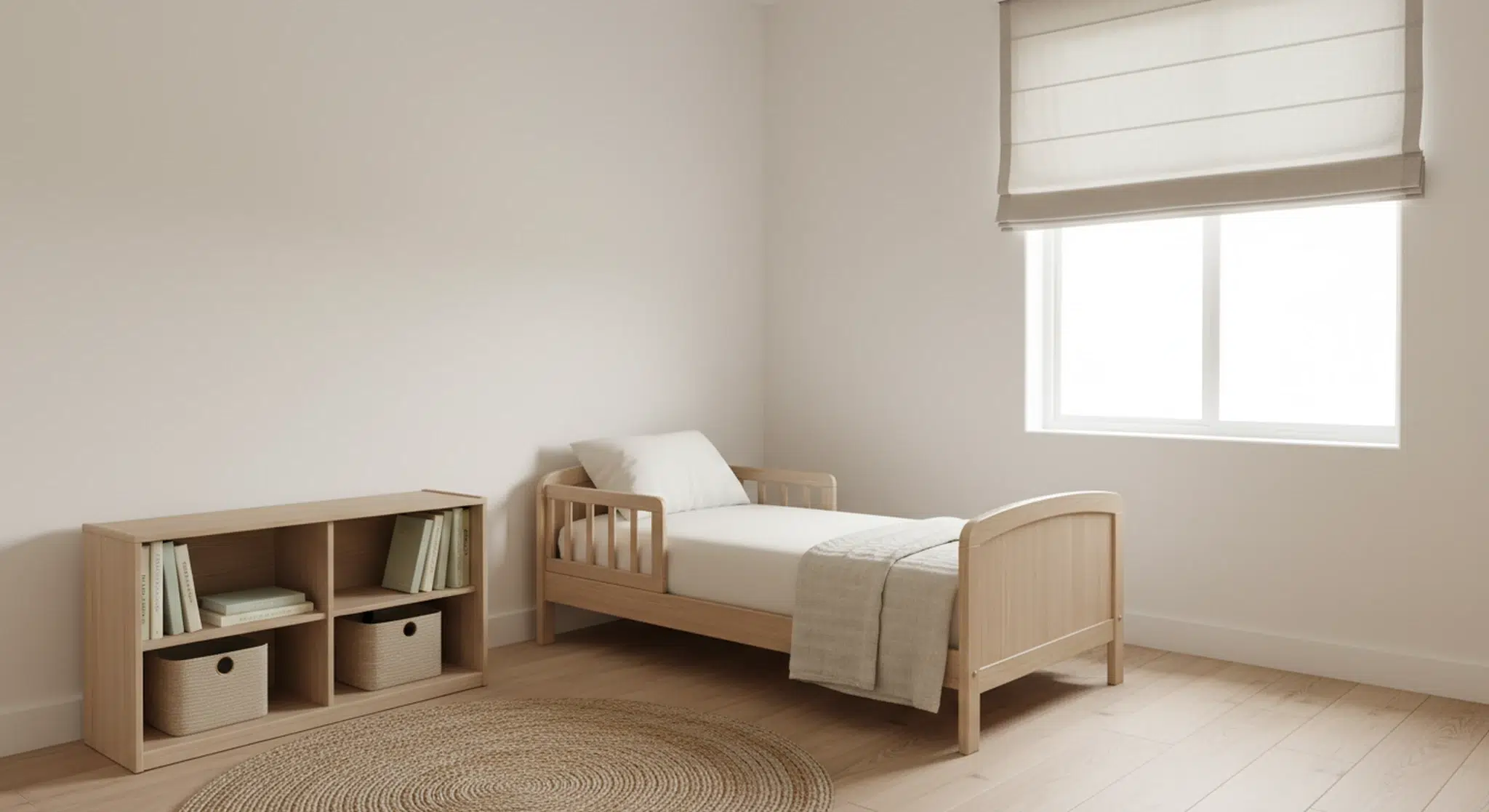
The best toddler room ideas start with safety (anchored furniture, cordless window coverings, outlet covers), then add a calm, dark sleep zone, storage at your child’s height, and simple decor that can grow with them.
Moving from nursery to toddler room is a big shift. Your child can now climb, open drawers and pull on anything in reach, so these toddler room ideas focus first on what keeps them safe, then on what helps them sleep and play independently.
We checked the safety guidance with the CPSC, the American Academy of Pediatrics, KidsHealth and Cleveland Clinic. Below you will find 30 numbered ideas, from the sleep zone and storage to color, shared rooms, small spaces and budget DIY, plus a printable checklist.
Key Takeaways
Anchor every dresser, bookshelf and TV: the CPSC counts 459 child tip-over deaths from 2000 to 2018.
Use cordless window coverings and move the bed away from windows.
Most toddlers move from crib to bed between 18 months and 3 years; climbing out is the clearest sign.
Keep the sleep zone dark, quiet, simple and free of screens.
Low, open storage builds independence; calm colors and removable decor let the room grow with your child.
As an Amazon Associate, Betteroo earns from qualifying purchases.
Table of Contents
What Makes a Good Toddler Room?
Quick Answer
A good toddler room is safe first (furniture anchored to the wall, cordless window coverings, outlet covers, window guards), simple (less clutter, fewer things to climb), set up with storage at your child’s height, and built around a calm sleep zone that is dark, quiet and free of screens.
A toddler climbs, opens drawers and pulls on cords, so a room that worked as a nursery can quickly fill with ladders and temptations. The 30 ideas below are grouped by job. Start at idea 1 and work down; the checklist near the end is a one-evening walk-through.
Safety First: Toddler Room Ideas That Prevent Injuries
The U.S. Consumer Product Safety Commission (CPSC) reports 459 tip-over deaths of children 17 and younger from 2000 to 2018, and 93 percent of those child deaths involved children 5 and younger.
1. Anchor every dresser, bookshelf and TV: the CPSC’s Anchor It campaign says to anchor furniture to the wall, store heavier items on lower shelves and in lower drawers, and avoid placing toys or remotes where kids might climb to reach them. Drawers can work like a ladder.
2. Go cordless on every window: the CPSC says the safest window coverings where young children are present are cordless, and it reports about nine children age 5 and younger die each year from strangulation on window cords. Until you can replace corded blinds, make pull cords as short as possible and anchor loop cords to the floor or wall.
3. Move the bed away from the window: the CPSC advises moving all cribs, beds, furniture and toys away from windows and window covering cords, preferably to another wall.
4. Fit window guards or stops: the CPSC notes that window screens do not stop children from falling out. Use window guards or safety netting with openings of 4 inches or less, and keep at least one window in each room easy for an adult to open as a fire escape.
5. Cover outlets and tame cords: the CPSC recommends outlet covers that children cannot easily remove and that are too large to choke on, or tamper-resistant receptacles when you replace outlets.
6. Keep small parts out of the room: federal rules ban small parts in toys and products meant for children under 3, because they pose a choking risk, according to the CPSC. Older siblings’ building sets, beads and craft supplies belong in another room or in high, latched storage.
7. Add alarms, bumpers and a door plan: the CPSC advises a smoke alarm inside each bedroom, a carbon monoxide alarm near sleeping areas, and corner or edge bumpers that stay securely attached on sharp furniture edges. If your toddler wanders at night, a sturdy door knob cover or a gate can keep them out of stairs and hazardous rooms (see how to get a toddler to stay in bed).
Also skip heavy frames, mirrors and shelves above the bed, since anything mounted there could fall. Pediatrician Laura O’Connor, writing for Cleveland Clinic, suggests kneeling to see the room from your child’s height to spot open outlets, cords and unlocked windows.
The Sleep Zone: Crib, Toddler Bed or Floor Bed
8. Time the move out of the crib to your child, not the calendar: Cleveland Clinic says most toddlers move from a crib to a bed between 18 months and 3 years, and that a child who keeps climbing out with the mattress at its lowest setting is ready. It cites the American Academy of Pediatrics (AAP): a child taller than 35 inches, or whose crib rail reaches their nipple line when standing, has outgrown the crib. See when to transition to a toddler bed.
9. Choose a low bed with a side rail: KidsHealth (Nemours) suggests a toddler bed or a big kid bed with a side rail once a child is climbing out of the crib. A low frame means a shorter fall: Cleveland Clinic compares a drop of about 4.5 feet from a crib rail with about 2 feet from a toddler bed.
10. Keep the bed simple: for babies under 12 months, the AAP says sleep must be on the back on a firm, flat surface with no pillows, blankets, quilts, toys or bumper pads. After the first birthday, KidsHealth says a light blanket and a lovey (a small soft blanket or stuffed animal) are OK. Keep it to one or two favorites so the bed does not become a climbing pile.
11. Make it dark and quiet: KidsHealth suggests keeping curtains or blinds closed so sunlight does not wake your toddler, and checking the room for noise. Cordless blackout shades handle both.
12. Add a dim night light and keep screens out: a low, warm night light helps a toddler who fears the dark find their way, and the AAP recommends a night light so a child can see the ladder of a bunk bed. KidsHealth says devices should not be in your child’s bedroom. Our guide to what color light is best for sleep explains more.
Montessori floor beds let a child climb in and out alone, which means the whole room becomes the “crib,” so every safety step above matters even more. For babies under 12 months, the CPSC recommends sleep products that meet federal safety standards (cribs, bassinets, play yards and bedside sleepers), with baby on their back on a firm, flat surface with nothing else in the sleep area. Read our Montessori floor bed guide before you choose this setup.
Big days go better with a good night of sleep.
Got a little one at home too? Our free two-minute quiz builds a gentle, personalized sleep plan for babies and toddlers.
Layout: Create Zones for Sleep, Play, Reading and Dressing
Even a small room works better when each corner has one job.
13. Put the bed in the quietest corner: away from the door, the window and the play area if you can.
14. Build a reading nook: a low, wall-anchored shelf with books facing forward, a floor cushion and a soft rug make a spot for quiet time before bed. Rotate a few books every couple of weeks.
15. Keep a small play zone, not a toy store: a clear patch of floor with one bin of blocks or a play kitchen is plenty.
16. Set up a dressing station: low hooks for tomorrow’s outfit, a small basket of socks, and a laundry hamper your child can reach.
Do books and cuddles in the same zone every night; our toddler bedtime routine guide keeps it short and predictable.
Storage at Your Toddler’s Height
17. Use open bins on low shelves: fabric or woven bins with no lids are easy to tip out and fill back up, and there is no lid to pinch little fingers. A picture label shows pre-readers where things go.
18. Hang low hooks: for a robe, a backpack or a favorite hat.
19. Lower the closet rod or try an open wardrobe: a tension rod or adjustable rod at toddler height lets your child see and pick clothes.
20. Store heavy and tempting things low or out: following the CPSC’s advice, heavy items go in bottom drawers and on bottom shelves, and nothing tempting sits on top of a dresser where it invites climbing.
Toddler Room Ideas for Color and Theme
A toddler room does not need a full theme to feel special.
21. Pick a calm base palette: soft neutrals, muted greens, dusty blues, warm whites and pale clay tones are restful and easy to change later. Add brighter color through a rug or bedding.
22. Choose a theme your child can grow into: nature, animals, the night sky or transport all work at 2 and at 6. Our nursery themes guide has dozens of ideas, and most translate well to a toddler room.
23. Use removable decor: peel-and-stick wall decals, framed prints in light, shatter-resistant frames, and fabric bunting let you change the look without repainting. For more styling ideas, see our nursery decor ideas.
Let your toddler choose one or two small things, like a bin color or a print, so the room feels like theirs.
Boy, Girl and Shared Toddler Room Ideas
“Boy” themes (trucks, dinosaurs) and “girl” themes (florals, rainbows) are just styles that suit any child, and a neutral base makes the room easy to pass down later.
24. Plan a shared room with two clear zones: give each child their own bed area, hooks and bin, and keep shared toys in the middle. See two under two for juggling two sleepers.
25. Think carefully about bunk beds: the AAP says not to let a child younger than 6 sleep in the top bunk. See its full safety rules in the FAQ below and our toddler bunk beds guide before buying.
Small Room and Budget DIY Ideas
Many of the most useful toddler room ideas cost little or nothing.
26. Go vertical, carefully: wall-mounted shelves free up floor space. Mount them into studs, away from the bed, and keep them for light items.
27. Choose furniture that does two jobs: a low bench with bins underneath, or under-bed drawers, gives you seating and storage in one footprint.
28. Refresh what you already own: paint an old dresser (then anchor it), swap knobs, or rotate toys from a closet bin instead of buying more.
Toddler Room Ideas That Grow With Your Child
29. Buy for the next stage: a crib that converts, or a low twin frame, can carry your child into the preschool years.
30. Add a sleep cue for big kid mornings: once your child is in a bed, an OK-to-wake clock that changes color in the morning can help a toddler who wakes too early understand when it is time to get up.
Revisit the room every six months or so: raise the hooks, check every anchor is tight, and re-check for small parts when new toys or a younger sibling arrive.
Toddler Room Checklist
Use this quick walk-through when you set up the room and again every few months.
Area
Check
Why it matters
Furniture
Dresser, bookshelf and any TV anchored; heavy items low
CPSC: tip-overs can crush young children
Windows
Cordless coverings; bed and furniture moved away from windows
CPSC: window cords can strangle young children
Window guards
Openings 4 inches or less; one window still opens for fire escape
CPSC: screens do not stop falls
Outlets and cords
Covers or tamper-resistant outlets; lamp cords out of reach
CPSC: reduces shock risk
Small parts
No small parts or older siblings’ tiny toys within reach
CPSC: small parts are a choking hazard under 3
Alarms
Smoke alarm inside the bedroom; CO alarm near sleeping areas
CPSC childproofing guidance
Sleep space
Under 12 months: firm, flat, bare, baby on back. After 1: light blanket and one lovey are OK
AAP and KidsHealth
Bed
Low, with a side rail; away from windows and wall shelves
KidsHealth and CPSC
Light and noise
Dark at night, dim night light if needed, no screens in the room
KidsHealth
Bunk beds
No one under 6 on the top bunk; guardrail, ladder, corner placement
The best toddler room ideas are the unglamorous ones: anchor the furniture, go cordless, move the bed away from the window, and keep storage low enough for your child to reach. Build a calm, dark sleep zone with a simple bed and no screens, then add color, a reading nook and a theme your child can grow into.
If bedtime battles continue in a lovely room, look at routine and timing next; a consistent plan usually helps more than new decor.
Frequently Asked Questions
What are the best toddler room ideas for a small space?
Keep the floor as open as possible, use wall-mounted shelves anchored into studs, and choose furniture that does two jobs, such as under-bed drawers or a bench with bins. Stick to a calm palette and a few toys at a time. Always anchor dressers and shelves, and keep the bed away from windows and cords.
How do I make my toddler’s room safe?
Anchor dressers, bookshelves and TVs to the wall, as the CPSC advises. Use cordless window coverings, move the bed away from windows, fit window guards with openings of 4 inches or less, cover outlets, and keep small parts out of reach for children under 3. Add a smoke alarm inside the bedroom and check the room from your child’s eye level.
When should a toddler move from a crib to a bed?
Cleveland Clinic says most toddlers move to a bed between 18 months and 3 years. Climbing out of the crib with the mattress at its lowest setting is the clearest sign. It cites the AAP that a child taller than 35 inches, or whose crib rail reaches their nipple line, has outgrown the crib.
What should be in a toddler’s bedroom?
A safe, low bed, a wall-anchored dresser or shelf, low open bins for toys and books, hooks your child can reach, a small reading spot, cordless blackout window coverings and a dim night light if needed. A smoke alarm belongs inside the room. Leave out screens, heavy wall decor above the bed and toys with small parts.
Should a toddler have a TV or tablet in their room?
No. KidsHealth, from Nemours Children’s Health, says devices should not be in a child’s bedroom and suggests keeping toddlers away from screens in the hour before bedtime. If there is a TV elsewhere in your home, the CPSC advises placing it on a sturdy, low base, pushing it back as far as possible and anchoring it.
Can a toddler sleep on the top bunk?
No. The American Academy of Pediatrics says not to let a child younger than 6 sleep in the top bunk. For older children, it advises placing bunks in a corner with walls on two sides, using a guardrail with a gap no wider than 3 1/2 inches, attaching a ladder, adding a night light and banning jumping on either bunk.
Gentle changes, peaceful nights.
Betteroo builds a personalized sleep plan for your baby or toddler. Take the free two-minute quiz to get started.