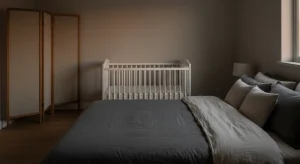
Some research does link sleeping in a separate room to slightly longer sleep stretches after about four months, but the American Academy of Pediatrics still recommends room sharing without bed sharing for at least the first six months to lower the risk of sleep-related death.
This is one of the most common and most conflicted questions in the first year. Parents hear that babies sleep better alone, and they also hear that room sharing is safer. Both contain truth, and the honest answer depends on your baby’s age and how you weigh the tradeoffs.
Here is what the evidence actually shows, what the AAP recommends and why, and how to think through the decision for your own family without guilt.
Key Takeaways
The AAP recommends room sharing without bed sharing for at least 6 months, ideally 12, to reduce sleep-related death risk.
Some studies find babies who sleep in their own room by 4 to 9 months have modestly longer sleep stretches.
Longer stretches are not the same as safer, and the SIDS evidence drives the AAP guidance.
If you do move your baby, do it after the safest window and keep the crib bare and safe.
There is no single right answer. It is a family decision weighing safety guidance and sleep.
As an Amazon Associate, Betteroo earns from qualifying purchases.
Table of Contents
What the Research Actually Shows
A frequently cited 2017 study in Pediatrics followed hundreds of families and found that babies who were already sleeping in their own room by four and nine months tended to have somewhat longer stretches of nighttime sleep than those still room sharing. Other survey data points the same direction: as babies get older, independent room sleepers sometimes log marginally more consolidated sleep.
It is worth being precise about what that means. These are averages with wide variation, the differences are modest, and correlation is not proof that the room itself causes better sleep. Families who move a baby earlier may differ in other ways. The takeaway is a mild association, not a guarantee that your baby will sleep through if you change rooms.
Why the AAP Recommends Room Sharing
The AAP’s 2022 safe sleep guidance recommends that babies sleep in the parents’ room, on their own separate safe surface such as a crib or bassinet, for at least the first six months and ideally the first year.2 The reason is risk reduction: room sharing without bed sharing is associated with a lower risk of sleep-related infant death during the highest risk months.
This is the core tension. The period when room sharing offers the most protection, the first six months, overlaps with the period when some parents most want to move the baby out for sleep. The AAP guidance treats safety during that window as the priority.
Longer Stretches Versus Safer Sleep
It helps to separate two different questions. One is whether a baby sleeps for longer stretches. The other is whether the sleep arrangement is safer. The evidence suggests a separate room may nudge the first slightly in older babies, while the AAP guidance is built around the second.
Quick Answer
If your baby is under six months, the AAP recommends keeping them in your room on their own safe surface. After six months, and especially after the first year, moving to their own room is a reasonable personal choice, made safer by keeping the crib completely bare.
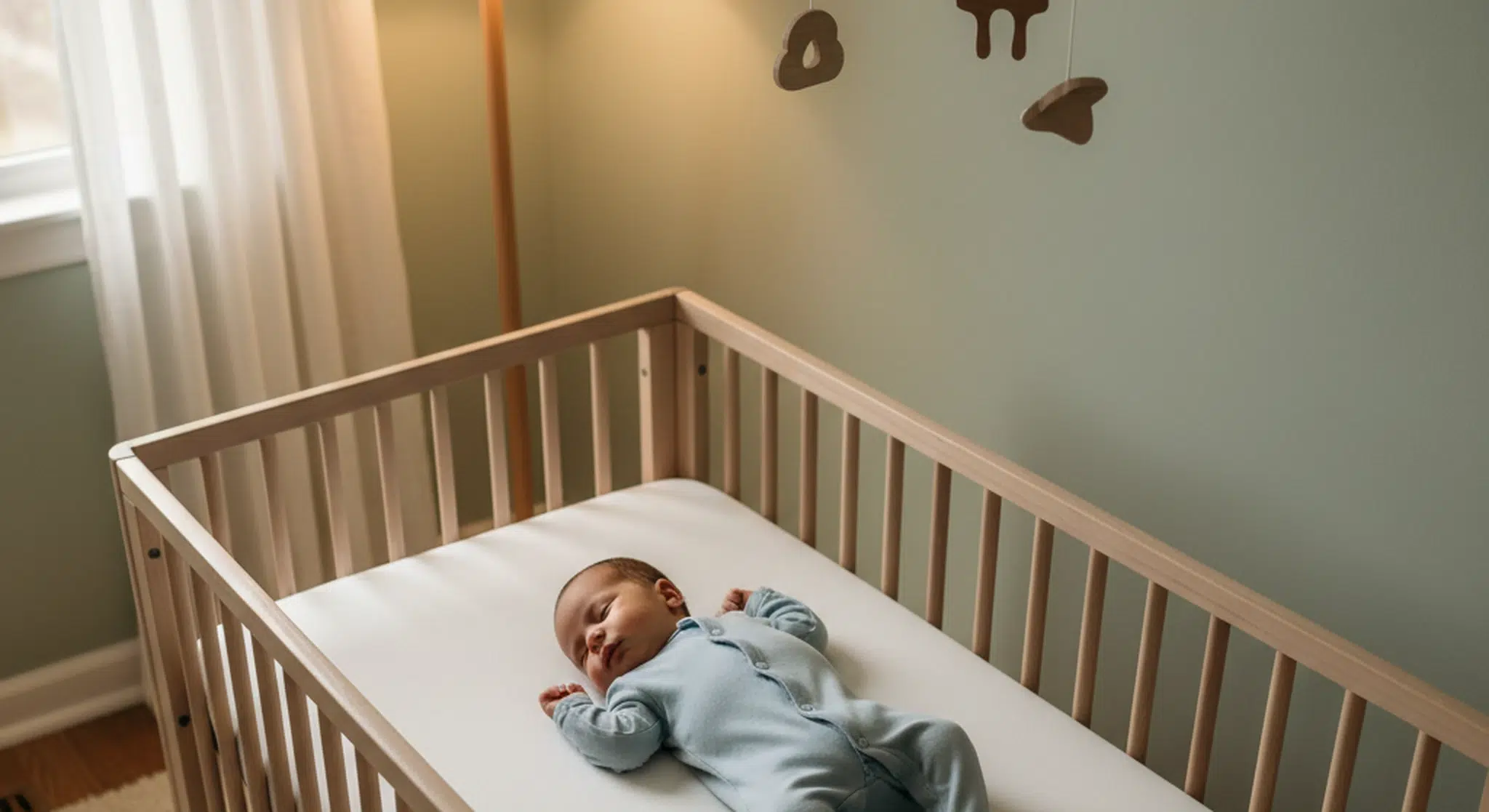
Whichever room your baby sleeps in, the fundamentals do not change: back to sleep, firm flat mattress, fitted sheet only, no pillows, blankets, bumpers, or toys, and no overheating.4
If You Decide to Move Your Baby
Many families transition their baby to a separate room somewhere between six and twelve months, often when the baby has outgrown the bassinet or when everyone’s sleep is suffering from being in the same room. If you make that move, a few things help.
Wait until after the safest room-sharing window if you can, ideally past six months.
Keep the new sleep space just as bare and safe as the old one.
Use a reliable video or audio monitor so you can respond when needed.
Keep the bedtime routine identical so only the room changes, not the ritual.
Give it a week or two. A few unsettled nights during the switch are normal.
Deciding on the room switch?
Get a personalized plan that factors in your baby’s age, safety guidance, and your family’s sleep.
One honest caveat: room sharing can cut both ways. Some parents find that being in the same room means they wake at every grunt and snuffle, and babies are noisy sleepers. If light-sleeping parents are being woken by normal baby sounds, white noise and a little distance within the same room can help without moving the baby out entirely.
Your pediatrician is the best source for personalized safe sleep advice, especially if your baby was born premature, has a medical condition, or if you are weighing a room change earlier than the recommended window.
You are considering moving your baby to their own room before six months.
Your baby snores loudly or has pauses in breathing during sleep.
Sleep problems are severe enough to affect the whole family’s wellbeing.
You have any question about what a safe sleep setup looks like in a separate room.
Frequently Asked Questions
Do babies really sleep better in their own room?
Some studies, including a 2017 study in Pediatrics, find that babies sleeping in their own room by four to nine months have modestly longer sleep stretches on average. The differences are small and vary a lot, and the AAP still recommends room sharing for at least the first six months for safety.
When can a baby move to their own room?
The AAP recommends room sharing without bed sharing for at least six months, ideally twelve. After that window, moving your baby to their own room is a reasonable personal choice. Many families make the switch sometime between six and twelve months.
Is it safe for a baby to sleep in a separate room?
The main SIDS risk reduction from room sharing applies to the earliest months. After six months to a year the risk falls, and a separate room can be safe as long as the crib is bare, the baby sleeps on their back, and you use a monitor. Follow AAP safe sleep rules in any room.
Why does the AAP recommend room sharing?
Room sharing without bed sharing during the first six months to a year is associated with a lower risk of sleep-related infant death. The AAP prioritizes that protection during the highest risk window, even though some babies may sleep slightly longer stretches alone at older ages.
Will moving my baby to their own room help them sleep through the night?
It might help a little for older babies, but it is not a guaranteed fix. Sleeping through the night depends mostly on developmental readiness, wake windows, and settling habits. If you move rooms, keep the bedtime routine identical so only the setting changes.
How do I transition my baby to their own room?
Ideally wait until after the recommended room-sharing window, keep the new crib just as bare and safe, use a monitor, and keep the same bedtime routine. Expect a few unsettled nights and give the change a week or two to settle.
Not sure about the room switch?
Get a personalized plan built around your baby’s age, safety guidance, and your family’s sleep.
American Academy of Pediatrics. Sleep-Related Infant Deaths: Updated 2022 Recommendations for Reducing Infant Deaths in the Sleep Environment. Pediatrics. 2022;150(1). https://pubmed.ncbi.nlm.nih.gov/35726558/
Paul IM, Hohman EE, Loken E, et al. Mother-Infant Room-Sharing and Sleep Outcomes in the INSIGHT Study. Pediatrics. 2017;140(1):e20170122. https://pubmed.ncbi.nlm.nih.gov/28615475/