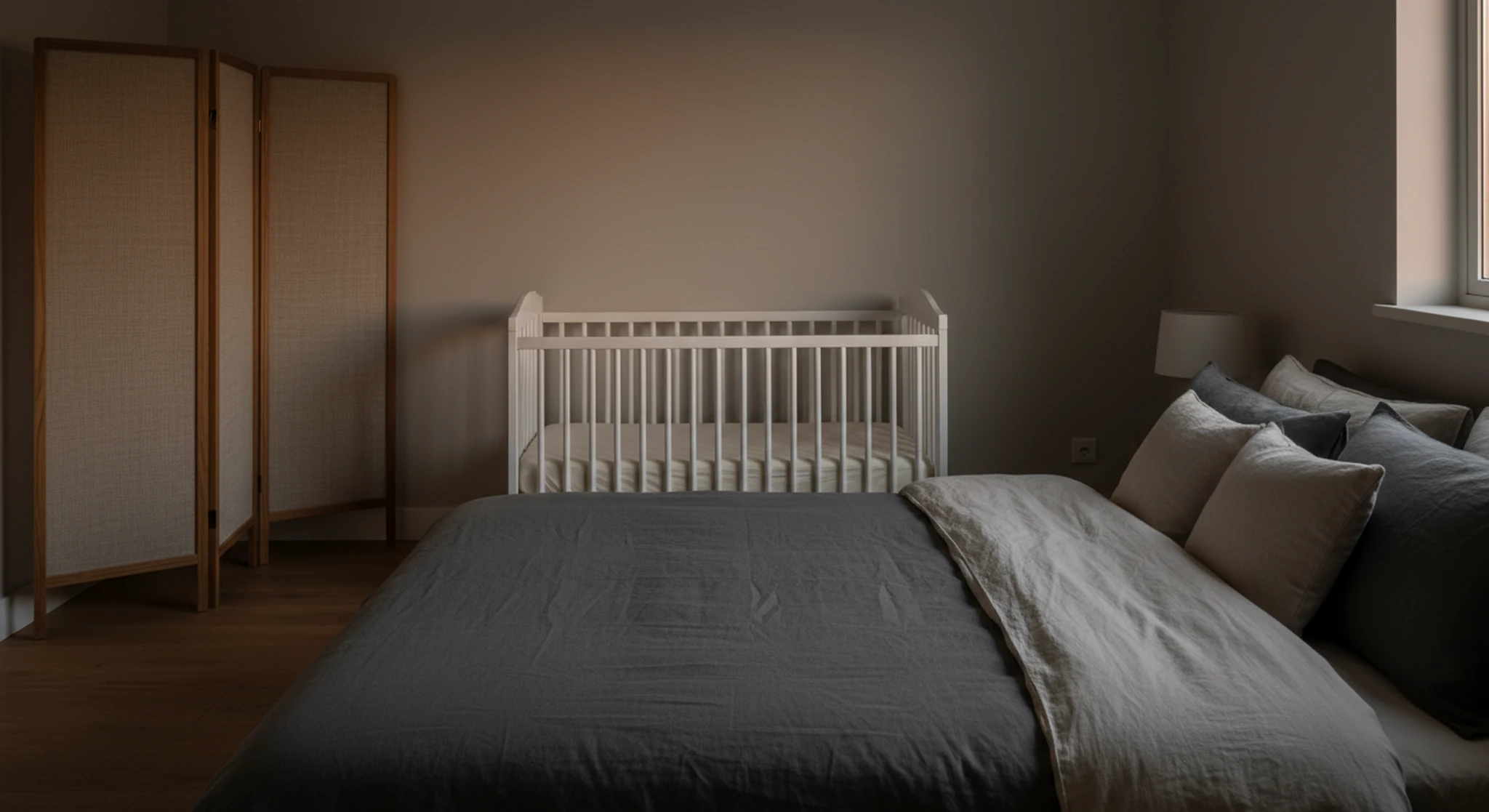
Yes, sleep training while room sharing works: keep your baby in their own crib in your room and use a method where you can stay present, such as the chair method, pick-up/put-down or checking from your bed.
You do not need a separate nursery to sleep train. Sleep training while room sharing comes down to two things: choosing a method that does not depend on leaving the room, and setting up the room so your baby cannot see you and your noise is softened.
Below: a method comparison table, a safe room layout, white noise distance, a seven-step plan, night wakings, small apartments and siblings, and when to move your baby out.
Key Takeaways
You can sleep train in a shared room; the AAP recommends room sharing without bed-sharing, ideally for at least 6 months.
Best fits: the chair method, pick-up/put-down, bedtime fading and checking from your bed. Timed checks are harder.
Block the sight line with distance or a freestanding screen that never touches or covers the crib.
Keep sound machines low and across the room; one study found all 14 tested exceeded nursery limits at 30 cm.
A 5-year follow-up found no harm from behavioral sleep methods, and no lasting benefit either.
As an Amazon Associate, Betteroo earns from qualifying purchases.
Table of Contents
Can You Sleep Train When Your Baby Sleeps in Your Room?
Quick Answer
Yes. You can sleep train while room sharing. Keep your baby in their own crib or bassinet in your room, as the AAP recommends, and choose a method that lets you stay in the room: the chair method (fading), pick-up/put-down, bedtime fading, or checking and consoling from your own bed. Block the sight line with distance or a freestanding screen that never touches the crib. Methods built on leaving the room, like timed checks, are harder.
Room sharing and sleep training are not opposites. The American Academy of Pediatrics (AAP) 2022 safe sleep policy (Moon and colleagues, Pediatrics) recommends that babies sleep in the parents’ room, on their own separate sleep surface and not in the parents’ bed, ideally for at least the first 6 months. Sleep training is about how your baby falls asleep, not where the crib sits.
What changes is the toolkit: most methods assume you can walk out and close a door, so you pick one where your presence is part of the plan. Our overview of common sleep training methods compares them all side by side.
Is Sleep Training Safe, and When Can You Start?
A review for family doctors by Korownyk and Lindblad in Canadian Family Physician (2018) concluded that roughly 1 in 4 to 1 in 10 infants will benefit from sleep training compared with no sleep training, and that no adverse effects were found at 5 years.
In a 5-year follow-up of an Australian randomized trial published in Pediatrics in 2012, Price, Wake, Ukoumunne and Hiscock found no differences between families who used behavioral sleep techniques and families who did not in children’s emotional or behavior scores, chronic stress, child-parent closeness, or maternal mental health. It also found no lasting benefit: the sleep gains were short to medium term. Sleep training is a reasonable tool for a hard stretch, not something that harms your child or something you must do.
The AAP has no formal policy statement on sleep training. Its parent site, HealthyChildren.org, does advise putting babies to bed drowsy but awake so they learn to settle on their own.
When to start. The American Academy of Sleep Medicine (AASM) consensus statement (Paruthi and colleagues, Journal of Clinical Sleep Medicine, 2016) makes no sleep-duration recommendation for babies under 4 months. From 4 to 12 months, it recommends 12 to 16 hours of sleep per 24 hours, including naps, and 11 to 14 hours for children 1 to 2 years old. Because of that, many families wait until at least 4 months; ask your pediatrician about timing and night feeds before you start.
Which Sleep Training Method Works if You Can’t Leave the Room?
The best room-sharing methods are the ones where you stay present and slowly do less.
Method
How it works
Works with you in the room?
Room-sharing notes
Chair method (fading)
You sit beside the crib and comfort mostly with your voice, then move the chair farther away every few nights.
Yes, built for it
Your bed becomes the last chair position.
Pick-up/put-down
You pick your baby up when they cry, calm them, and put them back down awake, repeating as needed.
Yes
Gentle but slow. No randomized or controlled trial has tested it on its own.
Bedtime fading
You temporarily move bedtime later, to when your baby is truly sleepy, then shift it earlier in small steps.
Yes
Pairs well with any other method.
Check and console from your bed
You respond with a calm phrase or a brief shush from your bed, and go to the crib only when needed.
Yes
The most practical night-waking tool in a shared room.
Timed checks (graduated, Ferber-style)
You leave, then return at set, gradually longer intervals for brief reassurance.
Hard
Works only if you can wait in a hallway or another room at bedtime.
Full extinction (cry it out)
You put your baby down awake and do not return until morning, except for safety or a planned feed.
Very hard
You will be in the room listening at night.
Sleep training methods ranked by how well they fit room sharing.
Some babies settle faster with a parent nearby and some get more worked up. Give one method a fair, consistent try before you judge it.
Stuck on night two or three?
Our free two-minute quiz builds a gentle, personalized sleep plan that adapts when progress stalls.
The Chair Method and Pick-Up/Put-Down in a Shared Room
The chair method is the easiest fit because the room-sharing setup is already the plan. You start beside the crib and move a little farther away every few nights until your final position is your own bed. Our full guide to the chair method covers how long to stay at each spot.
Nights 1 to 3: sit next to the crib. Use your voice and a hand on the belly if needed, but avoid picking up unless your baby is very upset.
Nights 4 to 6: move halfway across the room. Use your voice more and touch less.
Nights 7 and on: settle in your own bed or a spot by the door. Reassure with a short phrase, then go quiet.
Pick-up/put-down suits parents who want to stay hands-on: pick your baby up when they cry, hold them only until calm, and put them back down awake. It is a commonly recommended gentle method, but it has never been tested in its own randomized or controlled trial. See our pick-up/put-down guide for scripts and age tips.
How to Set Up the Room for Sleep Training While Room Sharing
Room layout does a lot of the work. The AAP’s HealthyChildren.org says your baby’s sleep area should be in your room, close to your bed but not in your bed.
Break the sight line: position the crib so your baby cannot see your face from their mattress when you are in bed. Angle the crib or put a dresser between you.
Use a divider safely: a folding screen or curtain is fine if it stands on the floor, is stable and cannot tip, is a few feet away from the crib, and is out of your baby’s reach. Never attach anything to the crib, and never drape fabric, a tent or a canopy over or around the crib. Keep any cords well out of reach.
Keep the crib bare: the AAP says to use a fitted sheet only, with nothing else in the crib: no pillows, blankets, bumpers, toys or positioners, and no weighted swaddles, sleepers or blankets.
Make it dark:blackout curtains, plus a dim night light or phone on low brightness on your side, facing away from the crib.
Background sound can mask your coughs and your partner’s snoring, but volume and distance matter.
In a study in Pediatrics (2014), Hugh and colleagues measured 14 infant sleep machines at maximum volume, at 30, 100 and 200 centimeters from the machine. At 30 centimeters (about 1 foot), every machine went above 50 A-weighted decibels, the recommended noise limit for infants in hospital nurseries, and three machines went above 85 A-weighted decibels, which would exceed adult workplace limits if played that loud for more than 8 hours. The authors concluded the machines can produce levels that may damage infant hearing. Summarizing the study, Children’s Hospital of Philadelphia (CHOP) suggests placing machines more than 200 centimeters (about 6.5 feet) from the crib and keeping the volume low.
Put the machine across the room, never in or on the crib.
Keep the volume low, well below maximum, and the cord out of reach.
What to Do When You Go to Bed After Your Baby (and at Night Wakings)
A few habits help when you go to bed after your baby.
Get ready for bed elsewhere: brush teeth, change, and charge your phone outside the room.
Enter quietly with a small light pointed at the floor. Skip the overhead light.
If your baby stirs, pause and stay still. HealthyChildren.org notes it is normal for a 6-month-old to wake during the night and fall back asleep after a few minutes.
Sleep in another room for the first several nights of training if you have the space, such as a couch or air mattress in the living room. That is not a failure.
Night wakings. Pick a response ladder and use it the same way every time.
Wait briefly: give your baby a short pause before you respond. HealthyChildren.org advises not rushing in, since babies need a chance to settle themselves.
Reassure from your bed: use one calm phrase, like “Shh, it’s sleep time,” without sitting up or turning on a light.
Go to the crib if needed: a hand on the belly, a brief shush, then back to bed. Check for a dirty diaper, illness or a stuck arm or leg.
Feed if it is a planned feed: keep it dark, quiet and boring, as HealthyChildren.org suggests, then put baby back down awake.
Sleep Training While Room Sharing With Siblings or in a Small Apartment
Small spaces and siblings can still work.
Studio or one-bedroom: use the step-by-step plan above. A floor-standing screen a few feet from the crib gives your baby a zone of their own.
Baby and big sibling share a room later: many families keep the baby in the parents’ room during training, then move them in with the sibling once nights are steady. Put the older child to bed later for the first week.
Thin walls and neighbors: a short, polite heads-up to the neighbors (“we’re working on sleep this week”) can take the pressure off at 2 a.m.
Never solve space problems with bed-sharing: the AAP advises avoiding bed-sharing under any circumstances, including with twins and multiples, and says the risk is up to 67 times higher when infants sleep with someone on a couch, soft armchair or cushion. Our co-sleeping guide explains the difference between room sharing and bed sharing.
When to Move Your Baby to Their Own Room
The AAP recommends room sharing ideally for at least the first 6 months, and there is no rule that you must move your baby out the moment training ends. Our guide on when to move baby to their own room covers timing and how to make the switch, and do babies sleep better in their own room? looks at what the research says.
If you do move them after training, carry the same routine, sleep sack and sound into the new room.
Help With a Room-Sharing Sleep Plan
If you want a plan built around your room layout and your baby’s age, Betteroo’s free sleep quiz can suggest a personalized approach, including methods that work when you cannot leave the room. Whatever plan you use, the same response every night is what makes it work.
Talk to your pediatrician before you start, especially about which night feeds your baby still needs. Call sooner if you notice any of these:
Loud snoring, gasping or pauses in breathing during sleep.
Poor weight gain, feeding trouble, or signs of reflux or ear pain.
Fever or illness. Pause training until your baby is well.
Crying that seems like pain, or a baby you cannot comfort.
You feel overwhelmed, hopeless or unable to cope.
Sleep training is optional. If it does not feel right for your family right now, it is fine to wait and try again later.
Frequently Asked Questions
Can you do sleep training while room sharing?
Yes. Keep your baby in their own crib or bassinet in your room and pick a method where you can stay present, such as the chair method, pick-up/put-down or reassuring from your bed. Block your baby’s view of you with distance or a floor-standing screen that never touches the crib.
What is the best sleep training method if you share a room?
Methods that keep you in the room fit best. The chair method is the easiest because your bed becomes the final chair position. Pick-up/put-down and bedtime fading also work well. Timed checks and cry it out are harder because they rely on leaving the room.
Should my baby be able to see me when sleep training?
It usually helps if your baby cannot see you from the crib once you are in bed. Angle the crib, use distance, or place a stable, freestanding screen on the floor a few feet from the crib. Never attach anything to the crib or drape fabric over it, and keep any cords out of reach.
How far should a white noise machine be from the baby?
A 2014 Pediatrics study by Hugh and colleagues found all 14 infant sleep machines exceeded hospital nursery noise limits at 30 centimeters at maximum volume. Children’s Hospital of Philadelphia suggests placing machines more than 200 centimeters, about 6.5 feet, from the crib and keeping the volume low. Never put the machine inside the crib.
How long should my baby sleep in my room?
The American Academy of Pediatrics recommends room sharing without bed-sharing, ideally for at least the first 6 months. There is no rule requiring you to move your baby right after that. Many families keep the crib in their room longer because of space.
Does sleep training cause long-term harm?
Research has not found long-term harm. A 5-year follow-up of a randomized trial by Price and colleagues, published in Pediatrics in 2012, found no differences in emotional or behavior problems, stress, child-parent closeness or maternal mental health. It also found no lasting sleep benefit.
Gentle changes, peaceful nights.
Betteroo builds a personalized sleep plan for your baby or toddler. Take the free two-minute quiz to get started.
Moon RY, Carlin RF, Hand I; Task Force on Sudden Infant Death Syndrome. Sleep-Related Infant Deaths: Updated 2022 Recommendations for Reducing Infant Deaths in the Sleep Environment. Pediatrics. 2022;150(1):e2022057990. https://pubmed.ncbi.nlm.nih.gov/35726558/
Paruthi S, et al. Recommended Amount of Sleep for Pediatric Populations: A Consensus Statement of the American Academy of Sleep Medicine. J Clin Sleep Med. 2016;12(6):785-786. https://pubmed.ncbi.nlm.nih.gov/27250809/
Price AM, Wake M, Ukoumunne OC, Hiscock H. Five-year follow-up of harms and benefits of behavioral infant sleep intervention: randomized trial. Pediatrics. 2012;130(4):643-651. https://pubmed.ncbi.nlm.nih.gov/22966034/
Hugh SC, Wolter NE, Propst EJ, Gordon KA, Cushing SL, Papsin BC. Infant sleep machines and hazardous sound pressure levels. Pediatrics. 2014;133(4):677-681. https://pubmed.ncbi.nlm.nih.gov/24590753/