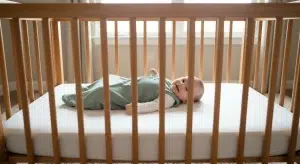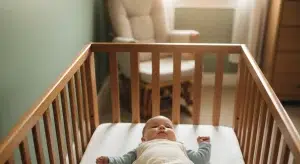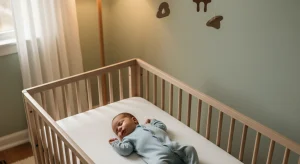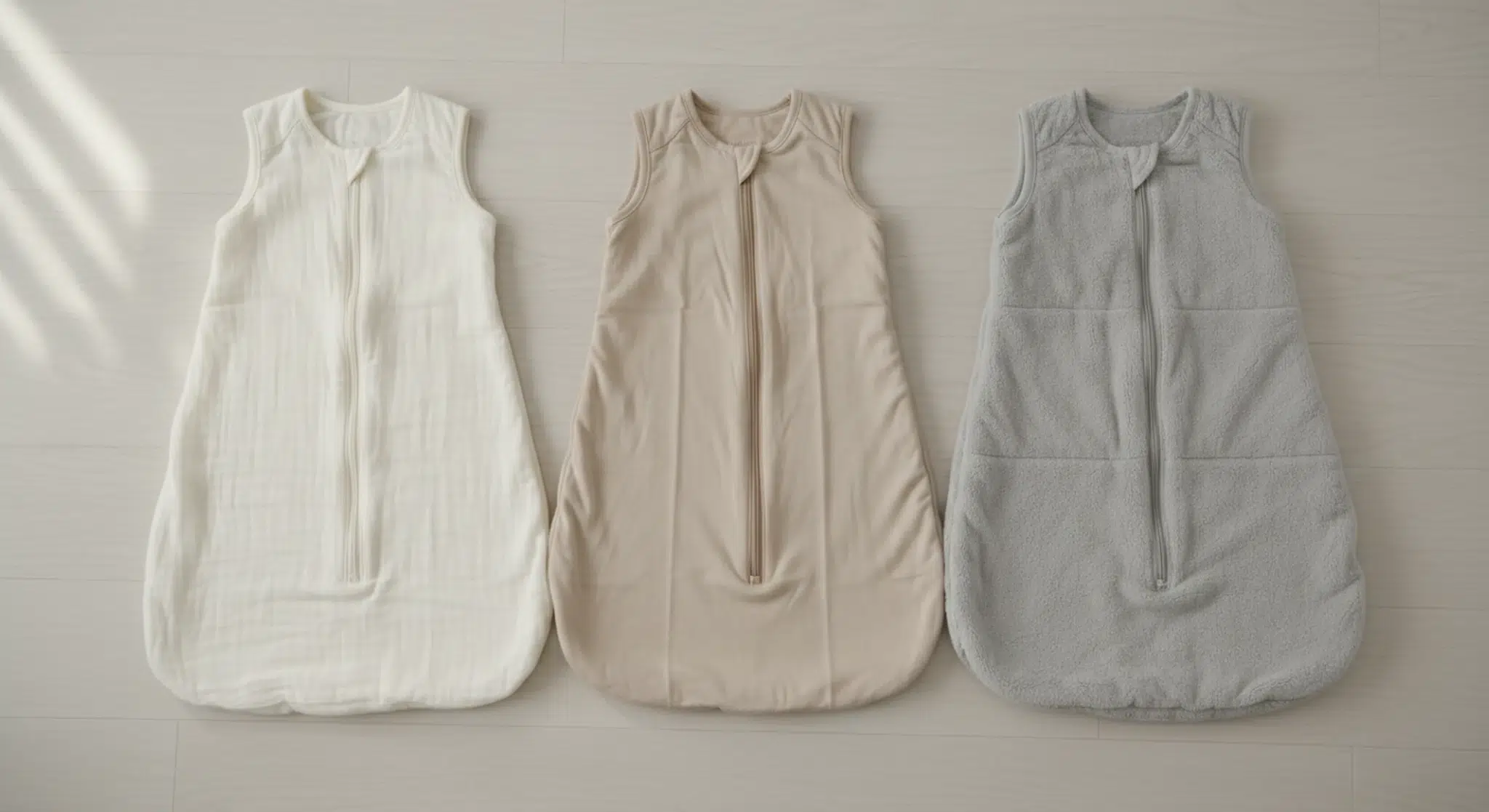


A TOG chart matches a sleep sack’s warmth rating to your room temperature: roughly 0.2 to 0.5 TOG at 75°F and up, 0.5 to 1.0 TOG at 71 to 74°F, 1.0 to 2.0 TOG at 68 to 70°F, 2.0 to 2.5 TOG at 64 to 67°F, and 2.5 to 3.5 TOG below 64°F.
TOG is the number brands print on sleep sacks to show how warm the fabric is: the higher the TOG rating, the more heat it holds in. A sleep sack TOG chart helps you decide what your baby should wear to sleep.
One honest caveat first: TOG charts come from manufacturers, not pediatricians. In the U.S. there is no government TOG rating and no official chart for baby sleepwear, the numbers vary by brand, and the American Academy of Pediatrics does not publish one. Treat the chart below as a typical range, then adjust to your baby.
Key Takeaways
- Lower TOG for warm rooms, higher for cool rooms: about 0.5 at 75°F, 1.0 around 70°F, 2.5 in the mid 60s.
- TOG measures how well fabric holds heat. Higher means warmer, not better.
- Charts come from brands and differ. The AAP publishes no TOG chart and names no single correct room temperature.
- AAP rule of thumb: no more than one layer more than you would wear to be comfortable in the same room.
- Check the chest or back of the neck, not hands and feet. Skip indoor hats, loose blankets under 12 months and anything weighted.
As an Amazon Associate, Betteroo earns from qualifying purchases.
Table of Contents
TOG Chart: Sleep Sack TOG Rating by Room Temperature
Quick Answer
| Room temperature (°F) | Room temperature (°C) | Sleep sack TOG rating | What to wear underneath |
|---|---|---|---|
| 75°F and up | 24°C and up | 0.2 to 0.5 | Diaper only, or a short-sleeve bodysuit |
| 71 to 74°F | 22 to 23°C | 0.5 to 1.0 | Short- or long-sleeve bodysuit |
| 68 to 70°F | 20 to 21°C | 1.0 to 2.0 | Long-sleeve bodysuit or light pajamas |
| 64 to 67°F | 18 to 19°C | 2.0 to 2.5 | Footed pajamas |
| Below 64°F | Below 18°C | 2.5 to 3.5 | Footed pajamas, plus a bodysuit underneath if needed |
Measure the temperature near the crib, not at the hallway thermostat, start mid-range, then check your baby once they are asleep. This baby sleep temperature chart matches our baby sleep sack guide; how to dress a baby for sleep covers outfits in more detail.
What Does TOG Mean? The TOG Rating Explained
A tog is a unit of thermal resistance: how well a fabric slows the escape of heat. One tog equals 0.1 square meter kelvin per watt, so a 2.5 TOG sack resists heat loss two and a half times as much as a 1.0 TOG sack.
The unit came out of the Shirley Institute, a British textile research center in Manchester, England. Its successor, BTTG, dates the tog to 1968 in its company timeline, though some references place it earlier. The name most likely comes from “togs,” an informal word for clothes. You will often see TOG spelled out as “Thermal Overall Grade,” an expansion that appears to have been added later.
Who Sets TOG Ratings, and What the AAP Actually Says
Every sleep sack TOG chart online, including ours, is built from manufacturer guidance. In the U.S., a TOG label is a brand’s own claim, not a government rating. ASTM published a voluntary safety standard for wearable sleep products (F3735) in February 2026. ASTM says it targets hazards such as suffocation, strangulation and choking, and we could not confirm that it sets any rule for TOG testing or labels.
Charts disagree. In the brand charts we compared in October 2026, a 1.0 TOG sack was matched to rooms as cool as 68°F and as warm as the upper 70s. Follow the chart for the sack you own, and treat it as a first guess.
The American Academy of Pediatrics (AAP) does not publish a TOG chart, and its guidance for parents names no single correct room temperature. Its advice: keep the room at a comfortable temperature, dress your baby in no more than one layer more than you would wear to be comfortable there, and watch for overheating. Many guides, including our baby room temperature guide, use 68 to 72°F as a target, while The Lullaby Trust in the United Kingdom recommends 16 to 20°C (61 to 68°F). Neither is an AAP number.
TOG Ratings One by One: 0.2 to 3.5
| TOG rating | Weight | Typical room range on brand charts | Good to know |
|---|---|---|---|
| 0.2 to 0.5 | A single thin layer | About 74°F (23°C) and up | 0.5 TOG sleep sack: the usual summer pick |
| 1.0 | Light | About 68 to 74°F (20 to 23°C) | The everyday weight in many homes |
| 1.5 | Between light and padded | About 64 to 72°F (18 to 22°C) | Not sold by every brand |
| 2.5 | Padded or quilted | About 61 to 68°F (16 to 20°C) | Winter weight for cool rooms |
| 3.5 | Thickly padded | Below about 61 to 64°F (16 to 18°C) | Truly cold rooms only |
The usual 1.0 TOG temperature range is about 68 to 74°F, and the usual 2.5 TOG temperature range is about 61 to 68°F. Most charts would call 2.5 TOG too warm for a 72°F room.
Tired nights don’t have to last forever.
Our free two-minute quiz builds a gentle, personalized sleep plan for your baby’s age and temperament.
How Layers Under the Sleep Sack Change Things
A TOG rating describes the sack alone. Everything under it adds warmth too, which is why charts list a base layer. The AAP’s one-layer rule is the cross-check: count what you wear to be comfortable in that room, then give your baby no more than one layer more.
- Change one thing at a time: the base layer or the sack, not both.
- Fit matters at every TOG. The AAP says a wearable blanket should be the right size and should not cover your baby’s head.
How to Tell If Your Baby Is Too Hot or Too Cold
Feel your baby’s chest or the back of their neck. Hands and feet are usually cooler, which is normal, so they are a poor guide.
- Too hot: the AAP lists sweating, a hot chest and flushed skin as signs of overheating. Take a layer off or drop to a lower TOG.
- Too cold: the chest or the back of the neck feels cool to the touch. Add one layer or move up a TOG.
This check matters because the AAP states that overheating can increase the risk of SIDS (sudden infant death syndrome). When unsure, lean toward fewer layers and check again.
Safe Sleep Rules a TOG Chart Does Not Replace
- No hats indoors: the AAP says not to put a hat on your baby indoors once you are home from the hospital, because of the risk of overheating.
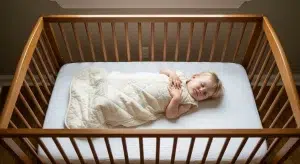
- No loose blankets under 12 months: babies sleep alone, on their back, on a firm, flat, bare surface. A sleep sack is the wearable replacement for a blanket.
- Nothing weighted: the AAP says not to use weighted blankets, sleepers, swaddles or other weighted objects on or near your baby. The U.S. Consumer Product Safety Commission’s safe sleep guidance also says not to use weighted blankets or weighted swaddles. A weighted sleep sack is not recommended at any TOG.
Our safe sleep environment checklist covers the rest of the crib.
TOG for Swaddles and for Toddlers
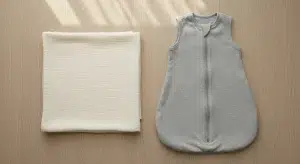
A swaddle is a warmth layer, so read the chart the same way for a rated swaddle sack. A plain swaddle blanket may have no TOG label, and each pass around the chest adds a layer, so use the one-layer rule and the chest check. See how to swaddle a baby, stop as soon as your baby looks like they are trying to roll (when to stop swaddling), and compare the options in sleep sack vs swaddle.
After the first birthday, the same chart still works as a starting point. The AAP’s safe sleep recommendations cover babies up to 1 year of age, so a blanket becomes an option after 12 months, though many families keep the sack longer. See toddler sleep sacks, when babies can sleep with a blanket and when to stop using a sleep sack.
When the Room Is Hotter Than 75°F or Colder Than 64°F
- Hotter than 75°F (24°C): go light: a 0.2 to 0.5 TOG sack over a diaper or short-sleeve bodysuit, or a bodysuit alone, since a sleep sack is optional. The Lullaby Trust suggests a fan to cool the room, not aimed directly at your baby.
- Colder than 64°F (18°C): use a 2.5 to 3.5 TOG sack over footed pajamas, and warm the room if you can. Do not add a blanket or an indoor hat, and check the chest again once the heating has run.
Seasons, Travel and Air Conditioning
- Rooms drift: a nursery can run warmer or cooler than the thermostat setting, so keep a room thermometer near the crib.
- Spring and fall: keep two weights on hand, such as 1.0 and 2.5, and choose by tonight’s reading, not the calendar.
- Air conditioning: dress for the room’s actual temperature, not the weather outside, and keep the crib out of the direct airflow.
- Travel: pack a light and a warmer option plus a small thermometer.
Related Betteroo Guides
- How to dress a baby for sleep
- Baby sleep sack guide
- Baby room temperature for sleep
- Sleep sack vs. swaddle
- Safe sleep environment
- Best toddler sleep sacks
When to Talk to Your Pediatrician
Ask your pediatrician before relying on any TOG chart if your baby was born prematurely or at a low birth weight, or has a medical condition. If your baby is ill, do not bundle them: The Lullaby Trust advises against extra layers for an unwell baby. Call about a fever in a young baby, or if your baby seems very hot, is breathing fast or is hard to wake.
Frequently Asked Questions
Is there an official TOG chart for baby sleep sacks?
No. TOG charts come from sleep sack manufacturers and vary by brand. The American Academy of Pediatrics publishes no TOG chart and no single correct room temperature. It advises no more than one layer more than you would wear, and watching for overheating.
What TOG should a baby sleep in at 70 degrees?
At about 70°F (21°C), most charts suggest a 1.0 TOG sleep sack, some up to 2.0, over a long-sleeve bodysuit or light pajamas. Start with 1.0, then feel your baby’s chest or the back of the neck and adjust one layer at a time.
What does 2.5 TOG mean?
A 2.5 TOG rating means a padded, warmer sleep sack for cool rooms, typically about 61 to 68°F (16 to 20°C). TOG is a unit of thermal resistance, so a higher number holds in more heat. In the low 70s, most charts consider it too warm.
Is 1.0 TOG warm enough for winter?
It depends on the room, not the season. In a heated home at about 68 to 74°F (20 to 23°C), 1.0 TOG over a long-sleeve bodysuit or light pajamas is usually enough. In the mid 60s, move up to 2.0 or 2.5 TOG instead of adding a blanket.
How do I know if my baby is too hot in a sleep sack?
Feel the chest or the back of the neck, since hands and feet normally run cooler. The AAP lists sweating, a hot chest and flushed skin as signs of overheating. Remove a layer or switch to a lower TOG, because overheating can increase SIDS risk.
Can my baby wear a hat or use a blanket to stay warm at night?
Not for sleep. The AAP advises against hats indoors once you are home from the hospital and against loose blankets in the sleep space during the first year. Add warmth with clothing layers or a higher TOG wearable blanket, never weighted products.
Calmer days, better nights.
Betteroo builds a personalized sleep plan for your baby. Take the free two-minute quiz to get started tonight.
6 Sources
- American Academy of Pediatrics (HealthyChildren.org). How to Keep Your Sleeping Baby Safe: AAP Policy Explained.
https://www.healthychildren.org/English/ages-stages/baby/sleep/Pages/a-parents-guide-to-safe-sleep.aspx - American Academy of Pediatrics (HealthyChildren.org). Safe Sleep: 9 Ways to Reduce a Baby’s Risk of SIDS & Suffocation.
https://www.healthychildren.org/English/ages-stages/baby/sleep/Pages/Preventing-SIDS.aspx - U.S. Consumer Product Safety Commission. Safe Sleep: Cribs and Infant Products.
https://www.cpsc.gov/SafeSleep - The Lullaby Trust. Your Baby’s Room Temperature.
https://www.lullabytrust.org.uk/baby-safety/safer-sleep-information/room-temperature/ - ASTM International. New Standard for Wearable Sleep Products (F3735), February 2026.
https://astm.org/news/new-standard-for-wearable-sleep-products - BTTG (formerly the Shirley Institute). Company Timeline.
https://www.bttg.co.uk/about-us/timeline