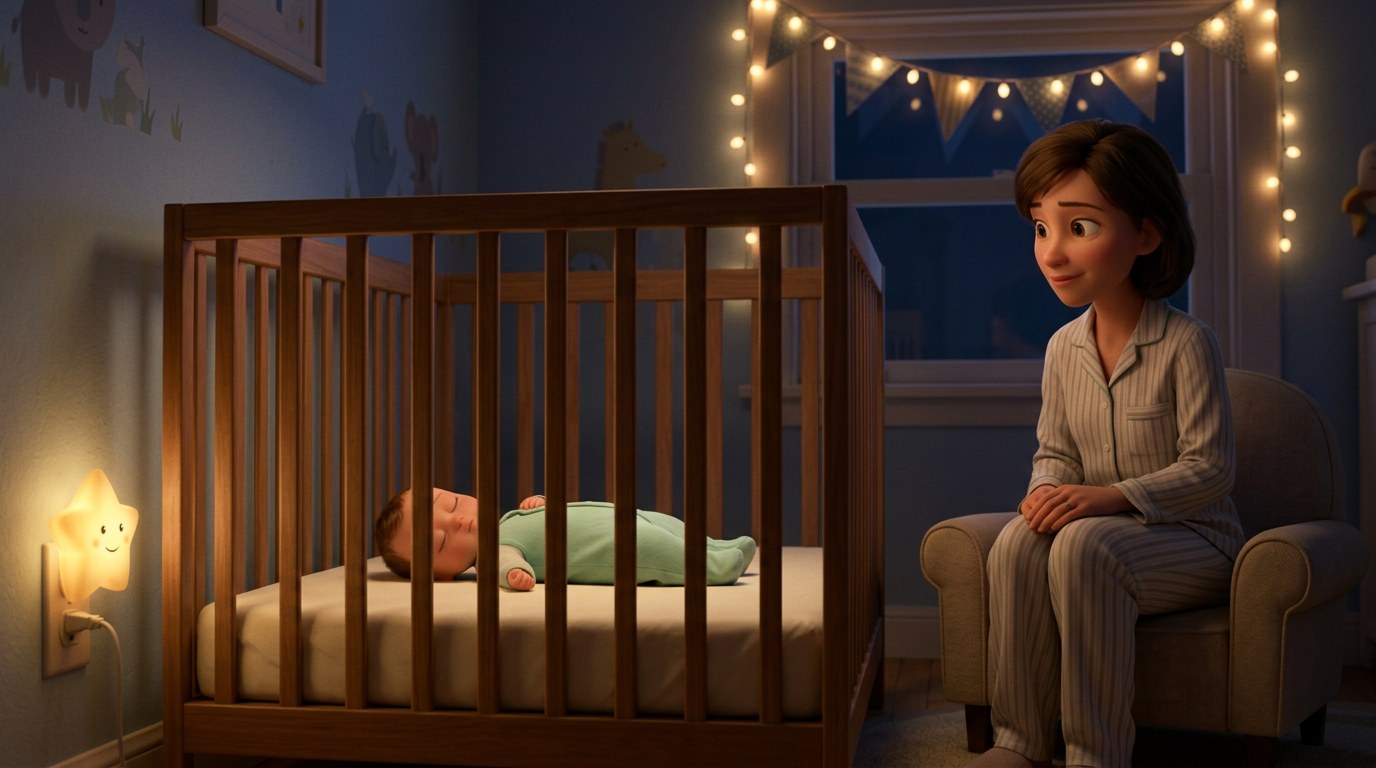
The chair method is a gradual, stay-in-the-room approach to sleep training. You put your baby down awake and sit in a chair beside the crib, then over a week or two you move the chair steadily farther away until you are out of the room. It trades speed for a gentler, more gradual goodbye.
It is popular precisely because it is not cry it out. You stay present, you offer reassurance, and your baby is never simply left. The trade-off is that it can take longer and often involves some protest along the way. This guide covers exactly how to do it, and gives you an honest read on the evidence, which is weaker than most articles admit.
Key Takeaways
The chair method means sitting by the crib as your baby falls asleep, then moving the chair farther away every few nights until you are out of the room.
It usually takes one to two weeks and is chosen by parents who want to stay present rather than leave the room.
The one real trial of this style found it worked about as well as timed check-ins, with both sustained at 6 months.1
There is essentially no trial of the branded chair method itself. Its support is extrapolated from a few small camping-out studies.12
Gentle does not mean the only safe option. Extinction methods also show no proven long-term harm, so this is about preference, not safety.5
Use it from roughly 4 to 6 months, rule out medical causes first, and keep safe sleep: back, empty crib, no incline.810
Table of Contents
How the Chair Method Works
Quick Answer
Put your baby down drowsy but awake and sit in a chair right beside the crib until they fall asleep. Every few nights, move the chair farther from the crib, toward the door and then out of the room, over about one to two weeks. Offer calm reassurance but minimal physical intervention.
The chair method goes by several names: camping out, gradual retreat, and the sleep lady shuffle among them. The common thread is a parent who stays visible and reassuring while slowly, deliberately fading their presence, so the baby learns to fall asleep with less and less direct help.
The appeal is emotional as much as practical. Your baby is never alone, and you get to withdraw at a pace you can both tolerate. The cost is time and consistency: it is slower than extinction, and the gradual fade only works if you actually move the chair on schedule rather than getting stuck close to the crib.
The Chair Method, Step by Step
Stage
Roughly which nights
Where the chair sits
1
Nights 1 to 3
Right beside the crib, within arm’s reach
2
Nights 4 to 6
A few feet from the crib, in the middle of the room
3
Nights 7 to 9
By the doorway
4
Nights 10 to 12
Just outside the door, in sight
5
Around night 13 and on
Out of the room; return only as needed
A typical fade schedule. Move at your baby’s pace, but keep moving. Stalling at stage 1 is the most common way it fails.
Do your normal bedtime routine and put your baby down drowsy but awake.
Sit in the chair at the current stage. Offer quiet, calm reassurance: a soft shush or a few words, not picking up or rocking to sleep.
Stay until your baby is asleep, then leave. If they wake and need you, return to the chair at the same stage.
Move the chair every few nights to the next stage, even if a given night was rocky.
Keep responses consistent so the message stays clear. Mixed signals are what drag the process out.
Want to sleep train without leaving the room?
The chair method is one option. Get a plan matched to your baby and your comfort level.
Here is the honest part that most chair-method articles leave out. There is essentially no clinical trial of the branded chair method itself. Its evidence is borrowed from a small body of research on camping out and parental presence, and that literature is thin.
The strongest single study randomized 91 infants to camping out, where the parent stays present, versus checking in, the timed-interval approach. Both improved sleep and both held up at a 6-month follow-up. Interestingly, babies with high separation anxiety did better with camping out than with checking in, which is a genuinely useful pointer toward who the chair method suits.1 A smaller study of 16 families found parental presence with minimal intervention was about as effective as controlled crying, with no sign of disruption to the infants’ emotional health.2
That is close to the whole evidence base: two small studies plus the camping out component of a larger trial.3 It is enough to say the chair method is plausibly effective and gentle, but not enough to call it proven. Treat the confident, step-perfect promises elsewhere with some skepticism.
The Waking Most Families Are Working Against
Whichever method you choose, it helps to see the baseline. In our State of Baby Sleep 2026 report, a survey of 74,379 parents across 112 countries, frequent night waking is the norm through the first year.
Babies waking 3 or more times a night, by age
Waking peaks at 7 to 9 months, right in the sleep-training window
66.7 percent of babies aged 7 to 9 months wake three or more times a night. The gentler pace of the chair method can be easier to sustain through that stretch, which matters, because consistency is what makes any approach work.
Gentle, but Read the Fine Print
Two honest caveats keep this in perspective. First, gentle is not the same as risk-free-versus-dangerous. Camping out still involves some protest, and the stricter extinction methods have not been shown to cause lasting harm either. So the real choice between the chair method and cry it out is about speed and your own comfort, not about one being safe and the other dangerous.5
Second, if you want a low-crying approach with strong trial support, bedtime fading deserves more attention than it gets. It involves little or no crying and had real evidence in the same randomized trial that tested graduated extinction.5 Most chair-method articles never mention it.
Use the chair method from roughly 4 to 6 months, once you have ruled out medical causes, and keep safe sleep constant: your baby on their back, in an empty crib, on a flat surface, room-sharing without bed-sharing.810 For the wider context, see when babies sleep through the night and the Ferber method for the timed-check-in alternative.
Frequently Asked Questions
What is the chair method for sleep training?
It is a gradual, stay-in-the-room approach. You put your baby down awake and sit in a chair by the crib, offering calm reassurance, then move the chair farther away every few nights over one to two weeks until you are out of the room and your baby falls asleep independently.
How long does the chair method take?
Usually one to two weeks if you keep moving the chair on schedule. The most common reason it drags on is stalling close to the crib. Consistency in both the fade schedule and how you respond is what makes it work.
Is the chair method backed by science?
Only indirectly. There is essentially no trial of the branded chair method itself. The evidence comes from a few small studies of camping out and parental presence, the largest of which randomized 91 infants and found it worked about as well as timed check-ins. It is plausibly effective and gentle, but under-studied.
Is the chair method better than cry it out?
Neither is clearly better. The chair method is gentler and keeps you present, but slower and less studied. Cry it out is faster and has stronger effectiveness evidence. Importantly, extinction methods also show no proven long-term harm, so the choice is about speed and your comfort, not safety.
What age is best for the chair method?
Roughly 4 to 6 months and older, the same floor as other sleep-training methods. Babies do not have settled sleep cycles until around 4 months. Rule out medical causes first and keep safe sleep throughout: back sleeping, empty crib, flat surface.
Not sure which gentle method fits?
Answer a few questions and get a personalized plan built around your baby.
Kahn M, Juda-Hanael M, Livne-Karp E, Tikotzky L, Anders TF, Sadeh A. Behavioral interventions for pediatric insomnia: one treatment may not fit all. Sleep. 2020;43(4):zsz268. https://pubmed.ncbi.nlm.nih.gov/31676910/
Matthey S, Crncec R. Comparison of two strategies to improve infant sleep problems, and associated impacts on maternal experience, mood and infant emotional health. Early Hum Dev. 2012;88(6):437-442. https://pubmed.ncbi.nlm.nih.gov/22115988/
Hiscock H, Wake M. Randomised controlled trial of behavioural infant sleep intervention to improve infant sleep and maternal mood. BMJ. 2002;324(7345):1062-1065. https://pubmed.ncbi.nlm.nih.gov/11991909/
Mindell JA, Kuhn B, Lewin DS, Meltzer LJ, Sadeh A. Behavioral treatment of bedtime problems and night wakings in infants and young children. Sleep. 2006;29(10):1263-1276. https://pubmed.ncbi.nlm.nih.gov/17068979/
Gradisar M, Jackson K, Spurrier NJ, et al. Behavioral Interventions for Infant Sleep Problems: A Randomized Controlled Trial. Pediatrics. 2016;137(6):e20151486. https://pubmed.ncbi.nlm.nih.gov/27221288/
Meltzer LJ, Mindell JA. Systematic review and meta-analysis of behavioral interventions for pediatric insomnia. J Pediatr Psychol. 2014;39(8):932-948. https://pubmed.ncbi.nlm.nih.gov/24947271/
Blunden S, Osborne J, King Y. Do responsive sleep interventions impact mental health in mother/infant dyads compared to extinction interventions? Arch Womens Ment Health. 2022;25(3):621-631. https://pubmed.ncbi.nlm.nih.gov/35380237/