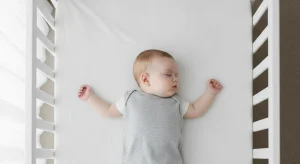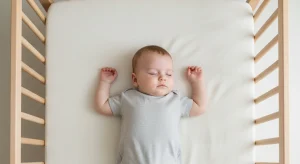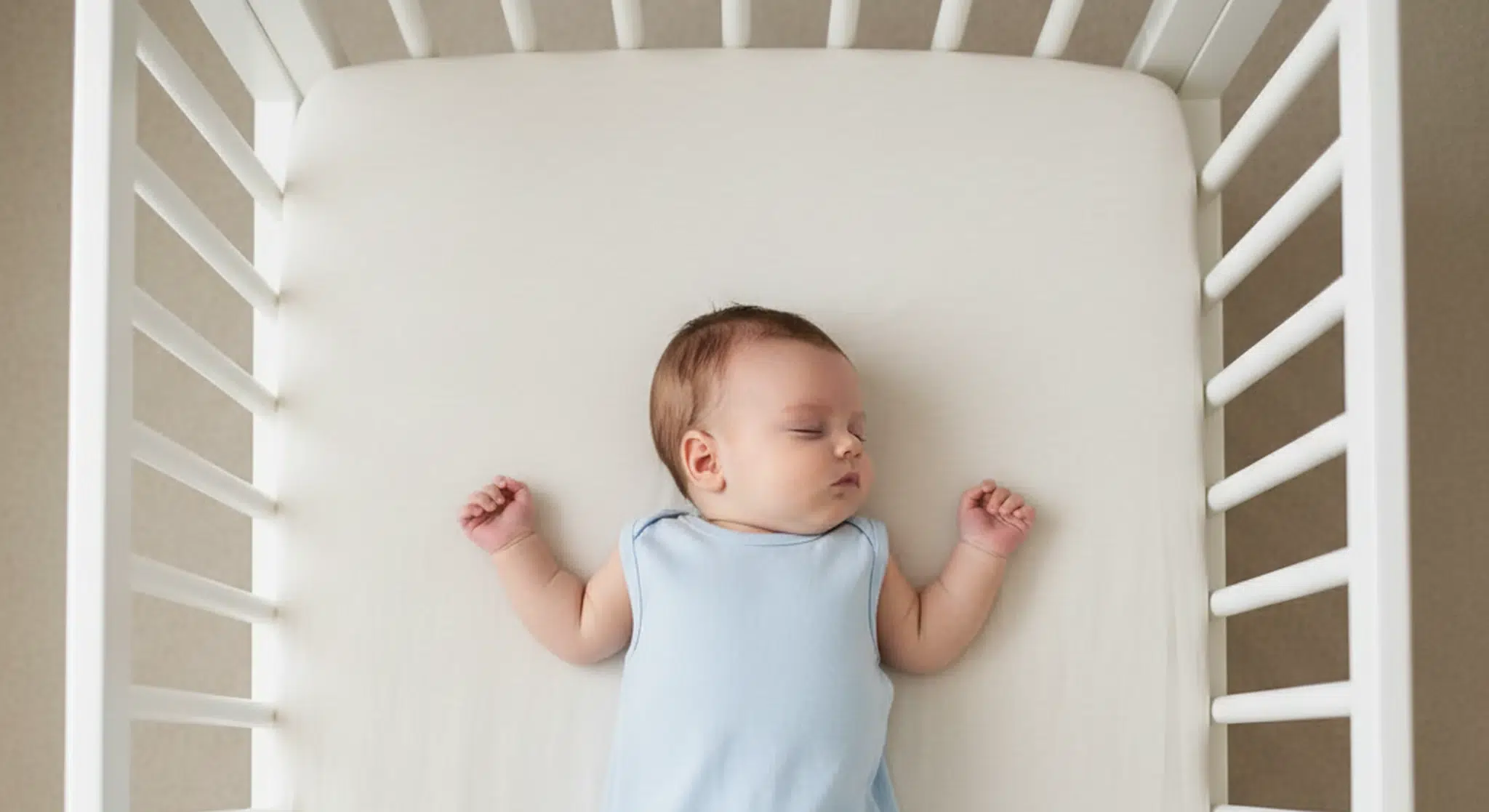


Babies should not be placed on their side to sleep. Side sleeping is not a safe position for a young baby, and the only safe position to place your baby in is flat on their back for every sleep until their first birthday.
Side sleeping feels gentle and natural to many parents, especially for a baby with reflux or a stuffy nose, so it is one of the most common questions new parents ask. The honest answer is that the side is not a middle ground between back and stomach. It is unstable, and a baby placed on their side can easily roll onto their tummy before they have the strength to move back.
This guide explains why side sleeping raises the risk, what changes once your baby can roll on their own, what to do if you keep finding your baby on their side, and how to keep the whole sleep space safe.
Key Takeaways
- Place your baby on their back for every sleep until age 1. The side is not a safe sleep position.
- Side sleeping is unstable and can roll into stomach sleeping, which raises the risk for a young baby.
- Once your baby can roll both ways on their own, usually around 4 to 6 months, you can leave them in the position they choose.
- Stop swaddling at the first sign of rolling so your baby’s arms are free to reposition.
- Never use wedges, bolsters, or positioners to hold a baby on their side. These are not safe.
The short answer
No, you should not put your baby down on their side. Always place your baby on their back to sleep until age 1. Once your baby can roll from back to tummy and tummy to back on their own, usually between 4 and 6 months, it is fine if they settle onto their side or stomach after you place them down on their back.
Table of Contents
Why Side Sleeping Is Not Safe
The American Academy of Pediatrics recommends the back for every sleep, every time, until age 1. Back sleeping keeps a baby’s airway open and clear, and it prevents a young baby from rebreathing trapped air face down in the mattress. Both stomach and side sleeping raise the risk in young babies, which is why the guidance is so firm.
The specific problem with the side is that it does not stay put. A young baby has a rounded back and little control over their body, so a baby placed on their side very easily tips forward onto their stomach. They then end up face down without the strength or coordination to move back to a safe position. In effect, side sleeping is often just stomach sleeping waiting to happen.
This is why pediatric guidance treats side sleeping as unsafe rather than as a compromise. There is no version of intentionally putting a baby down on their side that is considered safe in the first year.
The Rolling Milestone Changes the Rules
Everything shifts once your baby can roll both ways on their own. A baby who can roll from back to tummy and from tummy back to their back has the neck control and motor skill to move out of a position that feels wrong. Most babies reach this two-way rolling somewhere between 4 and 6 months, though the range is wide and completely normal.
At that point, if your baby rolls onto their side or stomach during sleep on their own, you can leave them there. You do not need to stay up all night flipping them back. The key phrase is both ways. A baby who can roll to their side or tummy but cannot yet roll back should be gently returned to their back, because they can get stuck in a position they cannot escape.
Even after your baby can roll well, keep placing them on their back to start every sleep. The starting position is what you control, and the back is still the safest place to begin.
What to Do If Your Baby Keeps Rolling to Their Side
- Keep placing your baby on their back to start every sleep, even once they roll well.
- If your baby can roll both ways and settles onto their side or stomach, let them sleep that way without repositioning.
- If your baby can only roll one way, gently return them to their back when they roll.
- Give plenty of supervised tummy time while awake to build the strength that makes rolling safe.
- Keep the crib completely bare so a rolling baby cannot press their face into anything soft.
Reflux, Stuffy Noses, and the Side-Sleeping Myth
Many parents are told, or assume, that the side is safer for a baby with reflux or congestion because it may reduce the chance of choking. This is a myth. A healthy baby placed on their back has a well-designed airway and automatically swallows or coughs up any fluid. Back sleeping does not raise the risk of choking, even with reflux, and it remains the recommended position for babies with reflux.
For reflux, hold your baby upright for a stretch after feeds, keep feeds calm and unhurried, and talk to your pediatrician if spit-up seems painful or heavy. For congestion, saline drops and a bit of gentle suction help far more than any sleep position. None of these situations makes side sleeping safe.
Skip the Positioners and Wedges
Products that promise to hold a baby on their side or keep them from rolling are not safe and are not recommended. Wedges, bolsters, and side positioners add soft, bulky items to the sleep space and can themselves become a suffocation risk. Safety regulators have warned against these products for years. The safest sleep space has nothing extra in it at all.
A Safe Sleep Checklist
- Back to sleep for every nap and every night until age 1.
- A firm, flat, level sleep surface with a fitted sheet and nothing else.
- No pillows, blankets, bumpers, wedges, positioners, or stuffed toys in the sleep space.
- A sleep sack instead of loose blankets for warmth, and stop swaddling once rolling begins.
- Room-share without bed-sharing for at least the first 6 months.
- A smoke-free environment and, if possible, a pacifier at sleep time once feeding is established.
Positioning connects to several milestones. See our guides on newborn sleeping on their side, when babies can sleep on their stomach, when babies roll over, and when to stop swaddling. For the wider view, see our baby sleep schedule by age guide.
Understand your baby’s sleep
Get a personalized plan built around your baby’s age, patterns, and temperament.
Frequently Asked Questions
Is it safe for a baby to sleep on their side?
No. Side sleeping is not safe for a young baby because it is unstable and can roll into stomach sleeping. Always place your baby on their back for every sleep until age 1.
What should I do if my baby rolls onto their side while sleeping?
If your baby can roll both ways on their own, usually around 4 to 6 months, you can leave them in the position they choose. If they can only roll one way, gently return them to their back. Always start sleep on the back.
Is side sleeping better for a baby with reflux?
No. Back sleeping is safest even for babies with reflux, and it does not raise the risk of choking. Manage reflux with upright holding after feeds and talk to your pediatrician, but keep placing your baby on their back.
Can I use a wedge or positioner to keep my baby on their side?
No. Wedges, bolsters, and side positioners are not safe and are not recommended. They add soft, bulky items to the sleep space and can become a suffocation risk. Keep the crib completely bare.
When can babies safely sleep on their side or stomach?
Once your baby can roll both ways independently, usually between 4 and 6 months, it is fine if they settle onto their side or stomach on their own after you place them down on their back. You still start every sleep on the back.
4 Sources
- American Academy of Pediatrics. Sleep-Related Infant Deaths: Updated 2022 Recommendations for Reducing Infant Deaths in the Sleep Environment. Pediatrics, 2022.
https://publications.aap.org/pediatrics/article/150/1/e2022057990/188304 - NICHD Safe to Sleep. Ways to Reduce Baby’s Risk: Back Sleeping.
https://safetosleep.nichd.nih.gov/reduce-risk/back-sleeping - American Academy of Pediatrics, HealthyChildren.org. How to Keep Your Sleeping Baby Safe.
https://www.healthychildren.org/English/ages-stages/baby/sleep/Pages/A-Parents-Guide-to-Safe-Sleep.aspx - Paruthi S, et al. Recommended Amount of Sleep for Pediatric Populations: A Consensus Statement of the American Academy of Sleep Medicine. Journal of Clinical Sleep Medicine, 2016.
https://jcsm.aasm.org/doi/10.5664/jcsm.5866