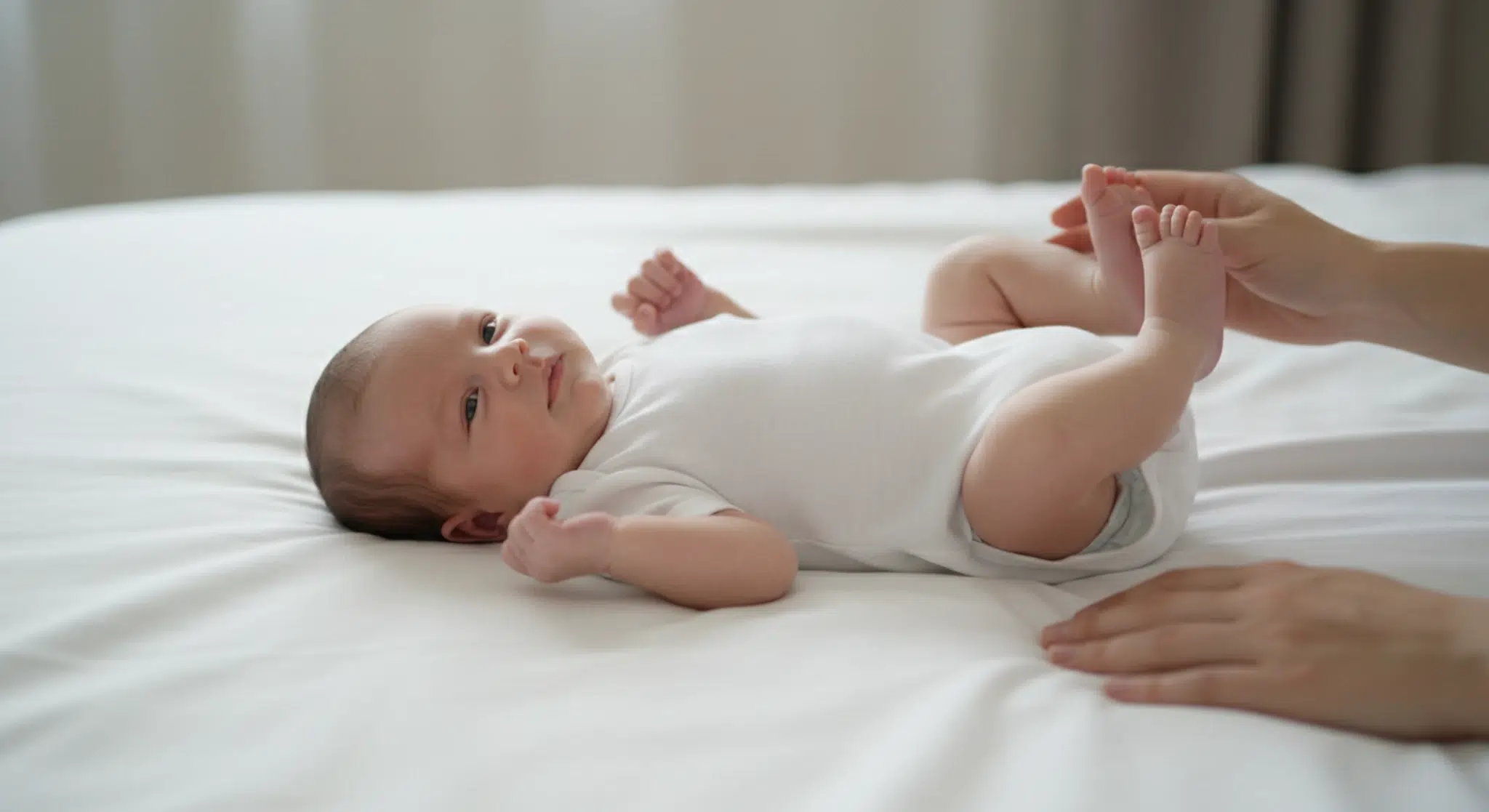
The newborn scrunch is the curled, folded posture most newborns keep after birth, with legs drawn up and arms tucked in, and the AAP says it gradually straightens out over the first weeks to months.
If your baby keeps pulling their knees up to their belly and tucking their fists under their chin, you are seeing the newborn scrunch. It is one of the most recognizable newborn postures, and it has a simple explanation: your baby spent months curled up inside the uterus.
This guide covers why newborns scrunch, how long it usually lasts, the related reflexes you may notice, how to keep the curled posture safe during sleep and swaddling, and which signs mean you should check in with your pediatrician.
Key Takeaways
The newborn scrunch is the curled womb posture: legs pulled up, arms bent, hands in fists.
AAP says the body gradually straightens out over the first weeks; by about 3 months, legs straighten and hands open more.
Startle, stepping and grasp reflexes are normal and fade on their own timelines.
A scrunched baby still sleeps on their back on a firm, flat, bare surface, with no positioners.
Call your pediatrician for floppiness, stiffness, one side moving less or uneven legs and hips.
Table of Contents
Newborn Scrunch: What It Is in Plain Terms
Quick Answer
The newborn scrunch is the curled, folded-up way most newborns rest: legs drawn up toward the belly, arms bent at the elbows and tucked close to the body, and hands held in little fists. The American Academy of Pediatrics (AAP) explains that newborns keep the tightly curled position they held inside the uterus, and that during the first weeks their bodies gradually straighten out. By about the third month, AAP says, the legs are straightening and the hands are no longer clenched all the time.
“Newborn scrunch” is a parent nickname, not a medical term. What it describes is real, though. The University of Utah’s pediatric neurologic exam guide states that for a term newborn, the resting posture is flexion of the arms and legs, with the limbs held close to the trunk. In other words, a curled-up newborn is showing the posture doctors expect to see in a healthy full-term baby.
You may hear it called “physiologic flexion”: flexion that is a normal part of the body at this age, not a problem to fix.
Why Do Newborns Scrunch? The Womb Posture Explained
The short answer is that your baby spent the last weeks of pregnancy folded into a small space. AAP describes the newborn posture as the tightly curled position held inside the uterus, and that position does not disappear the moment your baby is born. It takes time for the muscles and joints to adjust to the open space of the outside world.
What the curled posture usually looks like, per the University of Utah exam guide and AAP:
Legs: pulled up toward the belly with the knees bent. AAP calls this the “pulled-up newborn position” and notes the legs straighten out over the first few months.
Arms: bent and held close to the body. The Utah guide notes that in the first 48 hours the limbs are held especially tightly against the trunk, and that after the first few days they are still mostly flexed, just a bit less snug.
Hands: held in fists. The Utah guide describes a newborn’s hand as fisted with the fingers flexed over the thumb, and says the hand becomes more open over the first 1 to 2 months.
The scrunch is part of how doctors check muscle tone. The Utah guide explains that examiners gently extend a newborn’s arms and legs and watch them recoil; too little or too much resistance can point to low tone (hypotonia) or high tone (hypertonia).
When Does the Newborn Scrunch End?
There is no single date. The sources we read describe a gradual unfolding over roughly the first three months, and AAP notes each baby’s movements may develop at a slightly different pace. Treat this as a general pattern, not a deadline.
Age
What AAP and the Utah exam guide describe
Source
First 48 hours
Arms and legs flexed and held tightly against the trunk
University of Utah
First few days
Limbs still mostly flexed, slightly less tightly tucked
University of Utah
First weeks
The body gradually straightens out from the curled womb position; baby stretches arms and legs and may arch the back now and then
AAP (HealthyChildren)
Month 1
Motions may still be jerky or jittery; hands are kept in tight fists
AAP (HealthyChildren)
Month 2
Movement becomes more fluid and wiggly; hands likely still clenched in tight little fists
AAP (HealthyChildren)
Months 1 to 2
The hand becomes more open
University of Utah
Month 3
Legs straightening out from the pulled-up newborn position; kicking becomes more forceful; hands no longer clenched all the time
AAP (HealthyChildren)
How the newborn scrunch usually relaxes over time. Sources: AAP HealthyChildren.org and the University of Utah Pediatric Neurologic Exam.
In short, the newborn scrunch starts loosening within the first weeks and is usually much less noticeable by around 3 months, based on the AAP pages we read.
If your baby was born early, ask your pediatrician what posture and movement changes to expect and when. See our 1 month old milestones too.
Is the Newborn Scrunch a Milestone?
Not in the usual sense. Milestones are skills a baby gains, like lifting the head or opening the hands on purpose. The scrunch is the starting posture, and the real milestone is the gradual move away from it.
AAP’s movement milestones for the first three months show that shift: newborns need their heads supported because they have little neck control in the first few weeks, most babies can lift their heads during tummy time by month 2, and by month 3 the arms and legs move more smoothly, kicks get stronger and the hands open and close on purpose.
The scrunch rarely shows up alone. Newborns are born with a set of automatic movements called reflexes, and several of them look like the scrunch suddenly opening or closing. AAP lists when each one usually fades:
Reflex
What you see
Present from
Usually disappears by
Moro (startle)
Baby extends arms, legs and neck, then quickly brings the arms together
Birth
2 months
Stepping
Held upright with feet on a flat surface, baby places one foot in front of the other
Birth
2 months
Rooting
Turns toward a touch on the cheek or mouth
Birth
4 months
Palmar grasp
Grips a finger placed in the palm
Birth
5 to 6 months
Tonic neck (“fencing”)
When the head turns to one side, that arm straightens and the opposite arm bends
Birth
5 to 7 months
Plantar grasp
Toes curl when the sole is stroked
Birth
9 to 12 months
Newborn reflexes and typical ages. Source: AAP HealthyChildren.org, Newborn Reflexes.
The startle. The Moro reflex is the moment the scrunch flies open: arms and legs shoot out, then pull back in. AAP’s reflex page says it usually peaks during the first month and disappears around 2 months, while AAP’s movement milestones page says the startle reflex is probably gone by month 3. The two AAP pages give slightly different timing, so think of it as fading somewhere in the 2 to 3 month window.
Jerky or jittery movements. AAP says that in the first month, motions may look jerky or jittery as your baby develops more control. AAP also notes that many newborns have shaky hands or quivery chins, but whole-body shaking could signal a medical problem and should be checked.
Stretching and arching. AAP says that as the body straightens out in the first weeks, your baby will stretch their arms and legs and may arch their back from time to time. A big full-body stretch after a nap is often the scrunch loosening in real time.
Fists. AAP says hands are likely still in tight little fists at month 2 and no longer clenched all the time by month 3. The Utah guide notes doctors watch for a fist that persists, so mention it at a checkup if the hands still seem clenched all the time after about 3 months.
Frog-like legs. On their back, a newborn’s bent knees often fall slightly outward, which parents call “frog legs.” AAP’s swaddling guidance describes legs that bend up and out at the hips as the position to allow (more below).
Is the Newborn Scrunch the Fourth Trimester?
Sort of. “Fourth trimester” is an informal name for the first few months after birth, when a baby is still adjusting to life outside the womb and parents are adjusting to life with a baby. It is not a medical diagnosis or a stage with fixed rules.
The scrunch fits that idea, since AAP describes it as a carryover of the curled womb position that relaxes over the first weeks and months. Our 4th trimester guide covers the bigger picture, and if the nights are wearing you down, see our guide to sleep deprivation for new parents.
Tummy Time and Gentle Movement to Help Your Baby Stretch Out
You do not need to straighten your baby out; the scrunch relaxes on its own. What helps is supervised awake time to move freely.
Start tummy time early: AAP says you can start the day your baby comes home from the hospital, while your baby is awake and closely supervised.
Keep it short and frequent: AAP suggests about 3 to 5 minutes, 2 to 3 times a day at first, working up to 15 to 30 minutes a day by about 7 weeks as your baby enjoys it more.
Use your chest: one AAP play idea is to lie on your back and place your baby on your chest, so they lift their head and push with their arms to look at your face.
Mix up positions: AAP advises varying your baby’s positions and limiting time in swings, bouncy seats and car seats to help prevent flat spots.
A curled-up newborn may look like they would be cozier on their side, but the safe sleep rules do not change for a scrunched baby. AAP’s guidance:
Back for every sleep: place your baby on their back for all naps and at night. AAP says the side position is just as dangerous as the stomach position.
Firm, flat surface: a firm surface should not indent when your baby lies on it, and AAP says any surface inclined more than 10 degrees is not safe for sleep.
Bare crib: use a fitted sheet only. Nothing else should be in the crib with your baby: no pillows, blankets, bumpers, positioners or rolled towels to prop the curled posture.
Room share, not bed share: AAP recommends sharing a room, not a bed, for at least the first 6 months.
Swaddling, Hips and Straightening Your Baby’s Legs
If you swaddle, the scrunch matters for how you wrap. AAP says swaddling that straightens and tightly wraps the legs may raise the risk of hip problems. AAP and the Pediatric Orthopaedic Society of North America promote a method that allows the baby’s legs to bend up and out, with the blanket loose enough at the hips for them to move.
In practice: snug around the arms and chest, roomy at the hips, legs never pulled straight. Our step-by-step how to swaddle a baby guide shows this.
AAP adds three important swaddling rules: place a swaddled baby on their back every time, do not use weighted swaddles or weighted blankets, and stop swaddling as soon as your baby shows any signs of trying to roll over. AAP notes some babies start rolling around 2 months, but timing varies. AAP also points out that swaddling does not reduce the risk of SIDS. See when to stop swaddling.
Do All Babies Do the Newborn Scrunch?
Most full-term babies show some version of it, since the University of Utah exam guide describes flexed arms and legs as the expected resting posture of a term newborn. How tightly and how long a baby curls varies.
The overall picture matters more than the amount of scrunch: does your baby move both arms and both legs, and seem neither stiff nor floppy? A baby who seems very limp, moves one side better than the other, or does not move the way you expect is worth a call to your pediatrician.
Floppiness: your baby seems especially limp or droopy. AAP says this could mean your baby is sick or has an infection.
Stiffness: limbs that feel unusually stiff or hard to bend and straighten. The University of Utah exam guide explains that too much resistance when the limbs are moved can reflect high muscle tone (hypertonia), which doctors check for.
One side moving less: your baby uses only one hand or one side of the body, or the startle or fencing reflex looks different on one side (AAP).
Whole-body shaking: AAP says shaky hands and quivery chins are common, but whole-body shaking could signal a medical problem.
Legs or hips that look uneven: AAP lists one leg shorter than the other, thigh or buttock creases that look uneven or lopsided, or limited range of motion in either leg (for example, a leg that does not move as freely at diaper changes) as signs pediatricians look for in hip dysplasia (DDH).
Fists or reflexes that linger: hands still clenched all the time after about 3 months, or reflexes that seem to hang on past the usual ages in the table above.
Going backward: AAP says development that is going backward or has consistently stopped is a reason to talk with your pediatrician.
Some babies are at higher risk for hip dysplasia. AAP notes risk is higher for girls, firstborn babies, babies who were in a breech position and babies with a family history. AAP says pediatricians check the hips right after birth and at every well-child visit until a child walks normally, and that this gentle exam does not hurt.
If your baby is not moving, is very weak, will not wake up, or is having trouble breathing, call 911. This article is general education, not medical advice.
Frequently Asked Questions
Why do newborns scrunch up?
Newborns scrunch because they keep the tightly curled position they held inside the uterus, as the American Academy of Pediatrics describes it. The University of Utah pediatric exam guide says a term newborn’s normal resting posture is flexion of the arms and legs held close to the body. It relaxes gradually as your baby grows.
When does the newborn scrunch go away?
There is no exact date. AAP says the body gradually straightens out during the first weeks. By about month 3, AAP describes the legs straightening out from the pulled-up newborn position and the hands no longer clenched all the time. Every baby moves at a slightly different pace, so ask your pediatrician if you are unsure.
Is the newborn scrunch a milestone?
Not exactly. The scrunch is the starting posture, and the milestones are the changes that follow it: lifting the head during tummy time, smoother arm and leg movements, stronger kicks and hands that open on purpose. AAP describes these changes across the first three months as muscle control improves.
Do all babies do the newborn scrunch?
Most full-term babies show a curled posture, because flexed arms and legs are the expected resting posture of a term newborn, according to the University of Utah exam guide. How tightly and how long a baby curls varies. If your baby seems very limp or stiff, or moves one side less, talk with your pediatrician.
Should I straighten my baby’s legs?
No. The legs straighten on their own over the first months. AAP warns that swaddling that straightens and tightly wraps the legs may raise the risk of hip problems and recommends letting the legs bend up and out at the hips. Give your baby supervised floor and tummy time so they can stretch and kick freely.
Is it normal for a newborn to keep their hands in fists?
Yes, early on. AAP says babies keep their hands in tight little fists through about the second month, and by month 3 the hands are no longer clenched all the time. The University of Utah guide notes that a fist that persists past the expected window is something doctors watch for, so mention it at a checkup.
Gentle changes, peaceful nights.
Betteroo builds a personalized sleep plan for your baby or toddler. Take the free two-minute quiz to get started.