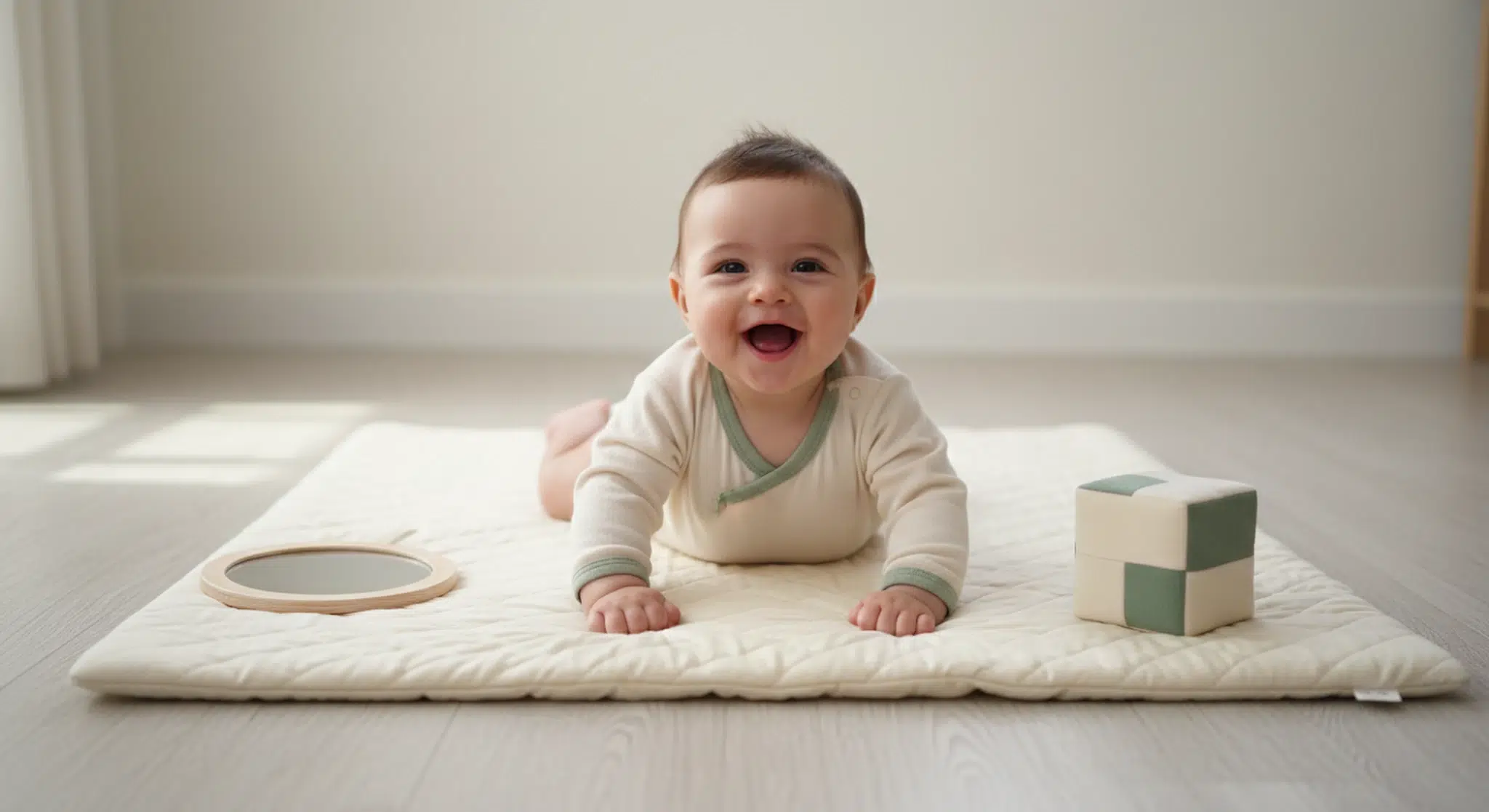
A baby who screams through tummy time is not behind, broken, or doomed to skip crawling. Tummy time is hard physical work in an unfamiliar position, and protest is the most common response. The fix is smaller doses, better timing, and using the positions that count as tummy time without the mat.
Few pieces of baby advice generate more quiet guilt than tummy time. Parents know it matters, the pediatrician asks about it at every visit, and yet the moment the baby lands on the mat, the wailing starts. So sessions get skipped, the guilt compounds, and the mat becomes furniture.
Here is the reframe: hating tummy time is close to the default, especially before 3 months. This guide covers why babies protest, how much tummy time is actually needed at each age, ten concrete ways to lower the resistance, and the alternative positions that build the same muscles while your baby thinks something else is happening.
Key Takeaways
Protesting tummy time is normal and extremely common, especially in the first 3 months. It is hard work, not distress at you.
Aim for 15 to 30 total minutes daily by around 2 months, built from tiny reps: even 1 to 2 minutes counts.
Chest-to-chest, football hold, and lap tummy time all fully count as tummy time.
Timing is everything: after a nap and a diaper change, never right after a feed.
Tummy time builds the neck, shoulder, and core strength behind rolling, sitting, and crawling, and helps prevent flat spots.
Persistent one-sided head preference or extreme intolerance that never improves warrants a pediatrician conversation.
As an Amazon Associate, Betteroo earns from qualifying purchases.
Table of Contents
Why Babies Hate Tummy Time
Put yourself in the position: you can barely control your own head, someone lays you face-down, and gravity, which has never been a problem before, is suddenly the whole problem. Young babies protest tummy time because it is genuinely strenuous, the view is boring (mat, floor, more mat), and the position is unfamiliar in a way back-lying and being held are not.
There are also practical aggravators worth ruling out: a session right after a feed (pressure on a full stomach means spit-up and discomfort), a tired baby at the end of a wake window, a cold hard floor, or a bare mat with nothing to look at. Most tummy time hatred is some mix of too long, too flat, wrong time, and nothing interesting at eye level.
What it almost never is: a sign something is wrong. Strong, healthy babies scream through tummy time every day. The goal is not a baby who loves it; the goal is enough accumulated minutes, gathered however you can get them.
How Much Tummy Time Does a Baby Actually Need?
Start in the first weeks home with 2 to 3 minutes, two to three times a day, and build gradually toward 15 to 30 total minutes daily by around 2 months. By 4 months many babies tolerate longer stretches, and once babies can roll and move on the floor freely, dedicated tummy time dissolves into general floor play.
Quick Answer
Target roughly 15 to 30 total minutes a day by 2 months, accumulated in short reps. Three 2 minute sessions is a fine start. A baby who hits the total across eight micro-sessions is doing exactly as well as one who does it in two long ones.
Why it matters is worth keeping in view on the hard days. Because babies sleep on their backs for safety, tummy time is the counterweight: it builds the neck, shoulder, arm, and core strength that rolling, sitting, crawling, and pulling up are built on, and it reduces the risk of positional flat spots on the back of the head. Our tummy time by age guide breaks down what progress looks like month by month.
10 Ways to Make Tummy Time Less Miserable
1. Shrink the dose. Sixty seconds, six times a day. End sessions before the meltdown, not after, so the mat stops predicting misery.
2. Fix the timing. The sweet spot is 20 to 30 minutes after a feed, early in a wake window, fresh diaper on. Never straight after eating, never when tired.
3. Get down there with them. Your face on the floor at their eye level is the single best tummy time toy ever made. Talk, sing, make faces.
4. Add a mirror. An unbreakable floor mirror gives them the second-best face available: their own.
5. Prop the chest. A rolled towel or small nursing pillow under the chest and armpits, arms forward over it, converts a face-plant into a supported view.
6. Use an incline. Baby on your reclined chest while you lie back at 45 degrees is tummy time on easy mode, and for newborns it is the recommended starting version.
7. Rotate one toy at a time. A single high-contrast toy or crinkle book at eye level, swapped when interest fades, beats a pile of options.
8. Change the scenery. Tummy time on a blanket outside, on the bed (supervised, center, never near edges), or facing a window is a different activity as far as your baby is concerned.
9. Make it a routine tail. Thirty seconds of tummy time after every daytime diaper change turns it into an automatic habit and racks up minutes invisibly.
10. Use motion to reset. If crying starts, scoop up, soothe fully, and try again later rather than pushing through. Tummy time should never be a cry-it-out event.
Strong days, restful nights
The same wake windows that fit tummy time also decide how nights go. Betteroo builds your baby’s full day rhythm in about two minutes.
The mat is one venue, not the definition. Any position where your baby works against gravity on their front builds the same muscles, and mixing venues is the standard advice for tummy-time refusers.
Position
How
Best for
Chest-to-chest
You recline at about 45 degrees, baby prone on your chest
Newborns, comfort-seeking babies
Football hold
Baby prone along your forearm, head at your elbow, carried around
Fussy evenings, gas relief
Lap laying
Baby prone across your thighs, slight downward slope, hand on back
Post-diaper-change micro-sessions
Exercise ball
Baby prone on a yoga ball, held firmly, gentle slow rolls
Babies who love motion
Airplane / superman
Baby prone on your shins as you lie back, holding their trunk
3+ months, giggle extraction
Side-lying play
Baby on their side with a rolled towel behind the back, toy in front
A gentler gravity workout for sore days
Alternative tummy time positions that build the same strength.
A note on equipment: time in bouncers, swings, car seats, and other containers is the opposite of tummy time, and heavy container use is associated with delayed motor skills and flat spots. If tummy time is a battle, the answer is more varied floor and body positions, not more reclined gear.
What Progress Looks Like
Expect the curve to be slow, then sudden. Weeks of grudging 90 second sessions, then one day a baby who props on forearms and looks around like they invented the move. Rough markers: brief head lifts in the first month, head to 45 degrees by around 2 months, head to 90 degrees with forearm propping around 3 to 4 months, pushing up on straight arms and pivoting by 5 to 6 months, and rolling both ways in the same window. From there, tummy time graduates into crawling prep; see when babies start crawling.
Two patterns are worth flagging rather than waiting out. A baby who always turns the head to the same side, on the mat and off it, may have a tight neck muscle (torticollis), which responds best to early treatment. And a baby whose tummy time tolerance never improves at all across weeks, despite the tricks above, deserves a checkup rather than more parental guilt.
When to Talk to Your Pediatrician
Mention tummy time at any visit; it is a standard topic. Call sooner if you notice any of these.
A consistent head turn or tilt to one side, or difficulty turning the head both ways.
A flat spot developing on one side or the back of the head.
No improvement in head control by 3 to 4 months, or a baby who feels unusually stiff or unusually floppy.
Extreme distress in every prone position, including chest-to-chest, that never eases over weeks of gentle practice.
Not pushing up on forearms by around 4 months, or no rolling in either direction by 6 months.
Torticollis and positional plagiocephaly are common, treatable, and respond far better to early referral than to waiting. This is a call-early topic, not a tough-it-out one.
Frequently Asked Questions
Is it OK if my baby hates tummy time?
Yes. Disliking tummy time is one of the most common infant complaints there is, because the position is physically demanding. Your baby still needs the practice, but you can get it in 1 to 2 minute reps and in alternative positions like chest-to-chest and lap tummy time. Aim for accumulated daily minutes, not happy long sessions.
What can I do instead of tummy time if my baby cries?
Use positions that count as tummy time: baby prone on your chest while you recline, the football carry along your forearm, laying baby across your lap, or supervised prone play on an exercise ball. Side-lying play with a toy in front is a gentler supplement. All build the same neck, shoulder, and core strength as mat time.
How much tummy time does a baby need by age?
Start with 2 to 3 minutes a few times daily in the newborn weeks, and build toward 15 to 30 total minutes per day by around 2 months, always awake and supervised. From 4 to 6 months, babies who roll and play freely on the floor increasingly generate their own tummy time, and the formal requirement fades out.
Does hating tummy time mean my baby will be delayed?
No. Protest is about effort and unfamiliarity, not ability, and plenty of tummy-time haters crawl and walk right on schedule. What matters is that the minutes still happen in some form. Raise it with your pediatrician only if head control is not progressing by 3 to 4 months or your baby always turns the head to one side.
When do babies stop needing dedicated tummy time?
Once your baby rolls both ways and independently plays on their front, usually around 6 months, dedicated sessions stop being necessary; free floor play takes over the job. Keep offering plenty of unrestrained floor time and limit stretches in seats, swings, and other containers, which subtract from movement practice.
The whole day is connected
Wake windows, floor play, feeds, and naps all pull on each other. Betteroo builds your baby’s rhythm into one clear plan in about two minutes.