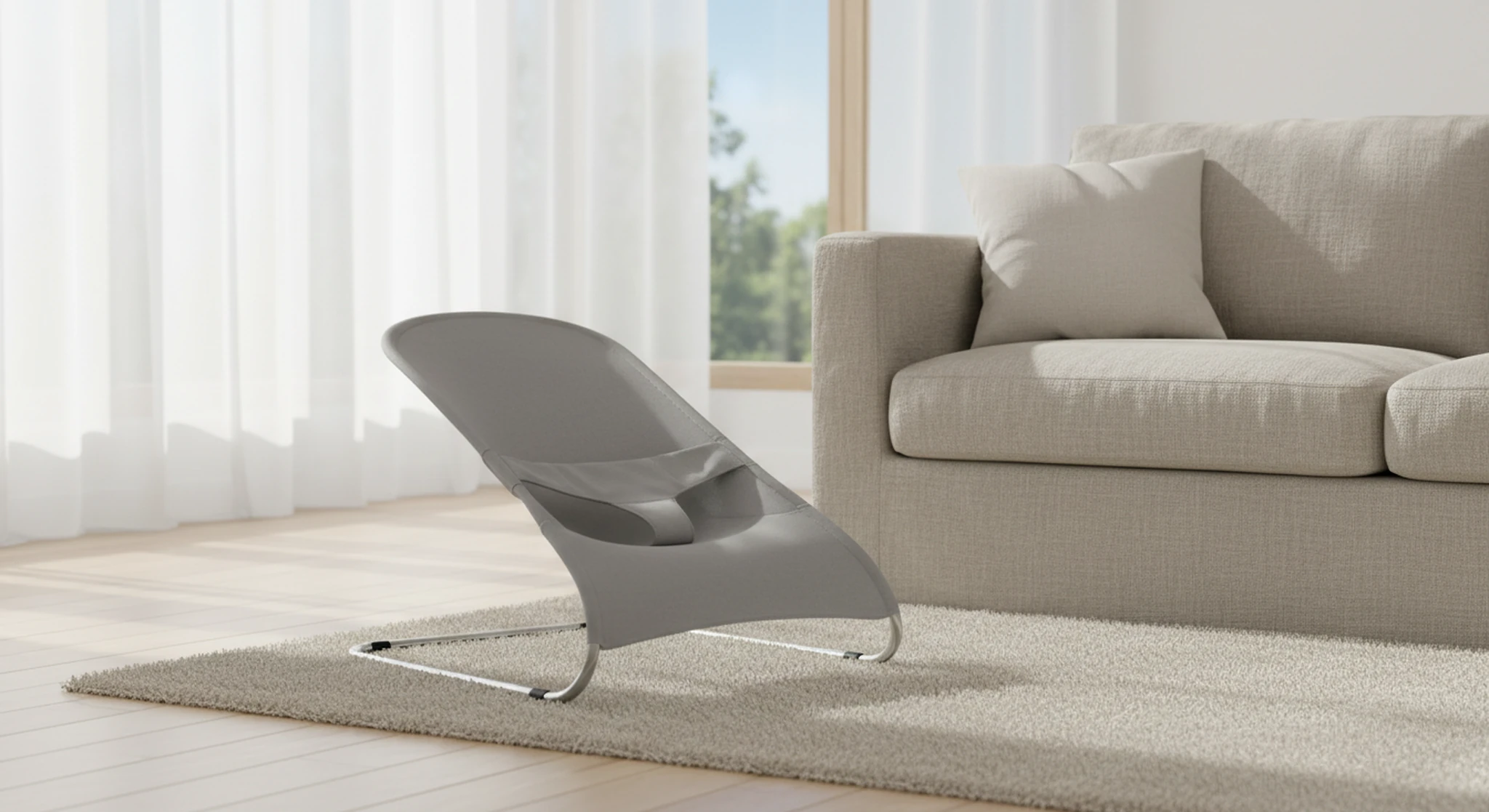
In the baby bouncer vs swing choice, a bouncer is a light, portable floor seat moved by your baby’s kicks, while a swing is a larger, usually powered seat that rocks your baby on its own, and neither is safe for sleep.
Baby bouncer vs swing is one of the first gear questions new parents ask, usually at 6 p.m. with a crying baby in their arms. Both give you a safe place to set your baby down for a few minutes. They differ in how they move, how much room they take up and how long your baby can use them.
Below we compare the two side by side, using the CPSC’s own descriptions and federal warning labels for each product, plus AAP safe sleep guidance. You will also find how long to use them, pros and cons, who should choose which, and what to check before buying used.
Key Takeaways
A bouncer is a light floor seat moved by your baby or you; a swing moves your baby on its own, usually with power.
The CPSC puts bouncers at about 0 to 6 months and infant swings at birth to about 9 months; your label sets the real limits.
Neither is for sleep. If your baby falls asleep in one, move them to a firm, flat crib or bassinet on their back.
Always buckle the straps, keep the product on the floor and stay nearby.
Limit time in either seat and balance it with tummy time and holding to help prevent flat spots.
As an Amazon Associate, Betteroo earns from qualifying purchases.
Table of Contents
Baby Bouncer vs Swing: The Quick Answer
Quick Answer
A bouncer is a small, light, reclined seat that sits on the floor and moves gently when your baby kicks or you nudge it. A swing is a larger, usually powered frame that moves your baby back and forth (or side to side) on its own. Neither one is a place for sleep: if your baby dozes off in either, move them to a firm, flat crib or bassinet on their back as soon as possible.
If you only want one, think about how your baby likes to be soothed, how much floor space you have, and whether you need something you can carry from room to room. Either way, the safety rules are almost the same: straps on, floor only, an adult nearby, and stop at the label’s limits.
What Is a Baby Bouncer?
The U.S. Consumer Product Safety Commission (CPSC) describes an infant bouncer seat as a freestanding product meant to hold a baby in a reclined position. Some have an adjustable back, and some have a toy bar within the baby’s reach. Bouncers are low to the ground, usually have a springy wire or flexible frame, and move when your baby wiggles or when you rock them with a hand or foot. Some models add vibration or sounds.
The CPSC says bouncer seats are intended for babies who cannot yet sit up on their own, which it puts at about 0 to 6 months. The federal standard requires a warning to stop using the bouncer when your baby starts trying to sit up or reaches the manufacturer’s maximum weight, whichever comes first, and the standard caps that maximum at 20 pounds.
Where a bouncer shines: it is light and gives you a spot to set your baby down while you cook or eat, on the floor where you can see them.
What Is a Baby Swing?
A swing is a seat or cradle hung from a frame that moves your baby in a steady rhythm. Most run on batteries or plug into the wall and offer several speeds, and many add music or sounds. The CPSC regulates two types:
Infant swing: a swing that lets a baby in a seated position swing or glide. The CPSC lists the intended user as a baby from birth until they try to climb out, at about 9 months.
Cradle swing: a swing meant for a baby lying flat. The CPSC lists it for babies from birth until they begin pushing up on their hands and knees, at about 5 months.
Swings also come in full-size and compact travel versions. A swing gives a fussy baby continuous motion without you doing the rocking, which is why some parents of babies with colic or a rough witching hour lean on one during the evening stretch. The trade-offs are size, motor noise and the need for power.
Bouncer vs Swing Side by Side
Here is how the two compare on the things that matter day to day. Age ranges below come from the CPSC’s descriptions of each product type; your specific product’s label may set a lower limit, and the label always wins.
Feature
Baby bouncer
Baby swing
How it moves
Gentle bounce from the baby’s own kicks or a push from you; some vibrate
Steady, powered back and forth or side to side motion at set speeds
Power
Often none; vibration or sound features may use batteries
Batteries, a wall plug, or both
Position
Reclined seat
Reclined seat (infant swing) or flat cradle (cradle swing)
Typical age range (CPSC)
About 0 to 6 months, until baby tries to sit up or hits the weight limit
Infant swing: birth to about 9 months, until baby tries to climb out. Cradle swing: birth to about 5 months, until baby pushes up on hands and knees
Weight limit
Set by the maker, not over 20 pounds under the federal standard
Set by the maker; check the label
Footprint
Small; slides under a table or beside the sofa
Larger frame; travel versions are smaller
Portability
Light, easy to carry between rooms (without the baby in it)
Full-size swings mostly stay put
Noise
Usually quiet
Motor hum varies by model
Best for
Short, awake time near you in any room
Calming a fussy baby with hands-free motion
Baby bouncer vs swing compared. Always follow your product’s own label for age and weight limits.
Big days go better with a good night of sleep.
Got a little one at home too? Our free two-minute quiz builds a gentle, personalized sleep plan for babies and toddlers.
No. This is the most important part of the bouncer vs swing decision, because both products are very good at making babies drowsy. The American Academy of Pediatrics (AAP), in its 2022 safe sleep recommendations, says sitting devices such as car seats, strollers, swings, infant carriers and infant slings are not recommended for routine sleep, at home or in the hospital, particularly for babies younger than 4 months.
AAP’s HealthyChildren.org adds that if your baby falls asleep in a car seat, stroller, swing, infant carrier or sling, you should move them to a firm sleep surface on their back as soon as possible. Nemours KidsHealth gives the same advice for baby seats and bouncers: if your baby falls asleep in the seat, move them to their crib. HealthyChildren also notes that any surface inclined more than 10 degrees is not safe for a baby to sleep on.
Safe sleep for every nap and every night looks the same: your baby sleeps alone, on their back, in a crib, bassinet, portable crib or play yard that meets safety standards, with only a fitted sheet. No pillows, blankets, bumpers, positioners or loungers. Our safe sleep environment checklist walks through the setup.
If your baby will only nap while moving or held, you are not alone. That pattern is common in the early months, and there are gentler ways to shift it. See what to do when your baby won’t sleep unless held and our guide to contact naps for ways to move toward the crib without fighting every nap.
Federal Safety Rules Behind Bouncers and Swings
Both products have mandatory federal safety standards in the United States: infant bouncer seats under 16 CFR part 1229 and infant and cradle swings under 16 CFR part 1223. They cover hazards such as stability, restraint systems, small parts and pinch points, and each product must carry a permanent label with the maker’s contact details, the model and the month and year of manufacture, which is what you need for a recall check.
The rules were written in response to real injuries. In the 2017 bouncer seat rule, the CPSC cited hospital emergency department data showing an estimated 22,800 injuries from 2006 to 2015 among children 12 months and younger, and it pointed to falls from elevated surfaces and unrestrained babies as key hazards. In the 2012 swing rule, the CPSC estimated about 1,900 emergency department treated swing injuries in 2011, and restraint problems caused the most injuries among the incident reports it reviewed.
The warning labels the federal rules require tell you a lot about safe use:
Bouncers: “ALWAYS use restraints and adjust to fit snugly, even if baby falls asleep,” and stop using the bouncer when your baby starts trying to sit up or reaches the maximum weight.
Swings with a seat that can sit more upright: keep the seat fully reclined until your baby is at least 4 months old and can hold up their head without help. The required warning explains that if the seat is too upright, a young baby’s head can drop forward and press on the airway.
All swings: always secure your baby in the restraint, never leave your baby unattended in the swing, and stop using it when your baby tries to climb out.
Travel swings: always place the swing on the floor and never use it on any elevated surface.
Safe Use: Placement, Straps and Supervision
These habits apply to both a bouncer and a swing, and they come straight from the warning labels above and from Nemours KidsHealth’s safety tips for baby seats:
Floor only: never set a bouncer or baby seat on a table, counter, bed, sofa or other raised or soft surface. KidsHealth notes a seat on a soft surface may tip over, and the CPSC links bouncer falls to elevated surfaces. Do not put a seat on a washing machine or other vibrating surface.
Straps every time: buckle the harness snugly each time, even for a minute, and even if your baby is already asleep.
Stay close: keep a responsible adult nearby. A bouncer or swing is a place to set your baby down while you are in the room, not a babysitter.
Check fit and limits: stop when your baby outgrows the weight or height limit, tries to sit up (bouncer), tries to climb out (swing), or pushes up on hands and knees (cradle swing).
Nothing extra inside: do not add pillows, blankets or padding the product did not come with. In the 2012 swing rule, the CPSC reviewed the death of a 2-month-old whose airway was blocked by a blanket in a swing.
How Long Should a Baby Be in a Bouncer or Swing?
No U.S. agency gives an exact time limit for either product, so treat both as short, supervised breaks rather than a place your baby spends hours. The National Institutes of Health’s Safe to Sleep campaign advises limiting the time your baby spends in car seats, bouncers, swings and carriers where the back of the head rests against a surface, because regular pressure in one spot can lead to flat spots.
The same campaign recommends balancing that time with tummy time: babies can start a day or two after birth with two or three short sessions of 3 to 5 minutes a day, and pediatricians recommend working up to 15 to 30 minutes of total tummy time a day by about 2 months. Holding your baby upright when they are awake (“cuddle time”) also takes pressure off the back of the head. Our tummy time by age guide has ideas for each stage, and what to do if your baby hates tummy time helps when the floor is a battle.
Watch your baby, not the clock: when they get fussy, sleepy or slump, take them out.
Pros and Cons of Each
Pros
Cons
Bouncer
Light and portable; small footprint; often no batteries needed; quiet; lets your baby watch you from any room
Motion is gentle and stops when your baby is still; shorter usable window (until baby tries to sit up); some babies want more motion
Swing
Hands-free, steady motion; adjustable speeds; can soothe a baby who settles with rhythm; infant swings may be usable for longer
Bulky frame; needs batteries or a plug; motor noise; easy to rely on for naps, which is not safe sleep
Pros and cons of a baby bouncer and a baby swing.
One thing comparison pages often skip: the swing’s biggest selling point, that it can lull a baby to sleep, is also its biggest risk. If you buy a swing, decide ahead of time that you will move your baby to the crib once their eyes close, and tell every caregiver the same rule.
Which Should You Choose?
There is no medical reason to own either one. They are conveniences, so pick based on your home and your baby.
A bouncer may suit you if: you have a small home or several rooms you move between, you want something you can take to a grandparent’s house, your baby is content with gentle motion, or you would rather not buy batteries.
A swing may suit you if: your baby calms best with steady rhythm, you have floor space, and you want a few hands-free minutes during fussy evenings. Plan how you will move a drowsy baby to the crib.
Consider both if: you have room and budget, since a bouncer is easy to move around while a swing stays in one main room.
Consider neither if: space is tight; a play mat on the floor gives your baby room to move and builds in tummy time.
Hand-me-downs can be a smart way to save, but check these first:
Find the label with the model name or number and the date of manufacture, then search that model at cpsc.gov/Recalls. Register a new product with the maker so you hear about recalls.
Make sure the instructions are available and every part, strap and buckle is present and working.
Look for cracks, loose joints, frayed straps and a frame that wobbles or tips when you press on it.
Skip any product that has been modified, is missing its warning labels, or that you cannot identify.
The federal standards for both products have been updated over the years, with the CPSC tying the required version to the date of manufacture. A newer product was built to the more recent version.
A bouncer or swing is a tool, not a fix for every fussy evening. Talk to your pediatrician if your baby cries for long stretches and you cannot settle them, if you notice a flat spot or your baby always turns their head one way, if your baby only sleeps when moving or upright and you are worried about safe sleep, or if you have questions about head control, sitting or other sitting milestones.
And if you are running on empty, say so at the visit. Asking for help with a baby who will not settle is part of good care for both of you.
Frequently Asked Questions
What is the difference between a baby bouncer and a swing?
A bouncer is a small, reclined floor seat that moves gently when your baby kicks or you nudge it, and it often needs no power. A swing is a larger frame, usually battery or plug powered, that moves your baby back and forth on its own at set speeds. Both are for short, supervised awake time, not sleep.
Is a baby bouncer vs swing better for a newborn?
Either can work from birth if the label allows it. A bouncer is lighter and easier to move between rooms, while a swing offers steady, hands-free motion that some fussy newborns like. On swings with an adjustable seat, the federal warning says to keep it fully reclined until your baby is at least 4 months old and has head control.
Can my baby sleep in a swing or bouncer?
No. The AAP says sitting devices such as swings are not recommended for routine sleep, especially before 4 months. If your baby falls asleep in a swing or bouncer, move them as soon as possible to a crib or bassinet with a firm, flat surface and only a fitted sheet, and place them on their back.
At what age can a baby use a bouncer or swing?
Both are designed for use from birth when the label allows. The CPSC describes bouncers as for babies who cannot sit up unassisted, about 0 to 6 months, and infant swings as for babies from birth until they try to climb out, about 9 months. Always follow your product’s specific age and weight limits.
How long can a baby stay in a bouncer or swing?
No U.S. agency sets an exact limit, so keep sessions short and supervised. The NIH Safe to Sleep campaign advises limiting time in bouncers, swings, car seats and carriers where the head rests against a surface, to help prevent flat spots, and balancing it with daily tummy time and upright holding.
When should I stop using a bouncer?
The federal standard requires bouncers to warn you to stop when your baby starts trying to sit up or reaches the maximum weight on the label, whichever comes first, and that maximum cannot be more than 20 pounds. Stop sooner if your product’s instructions give a lower limit.
Gentle changes, peaceful nights.
Betteroo builds a personalized sleep plan for your baby or toddler. Take the free two-minute quiz to get started.