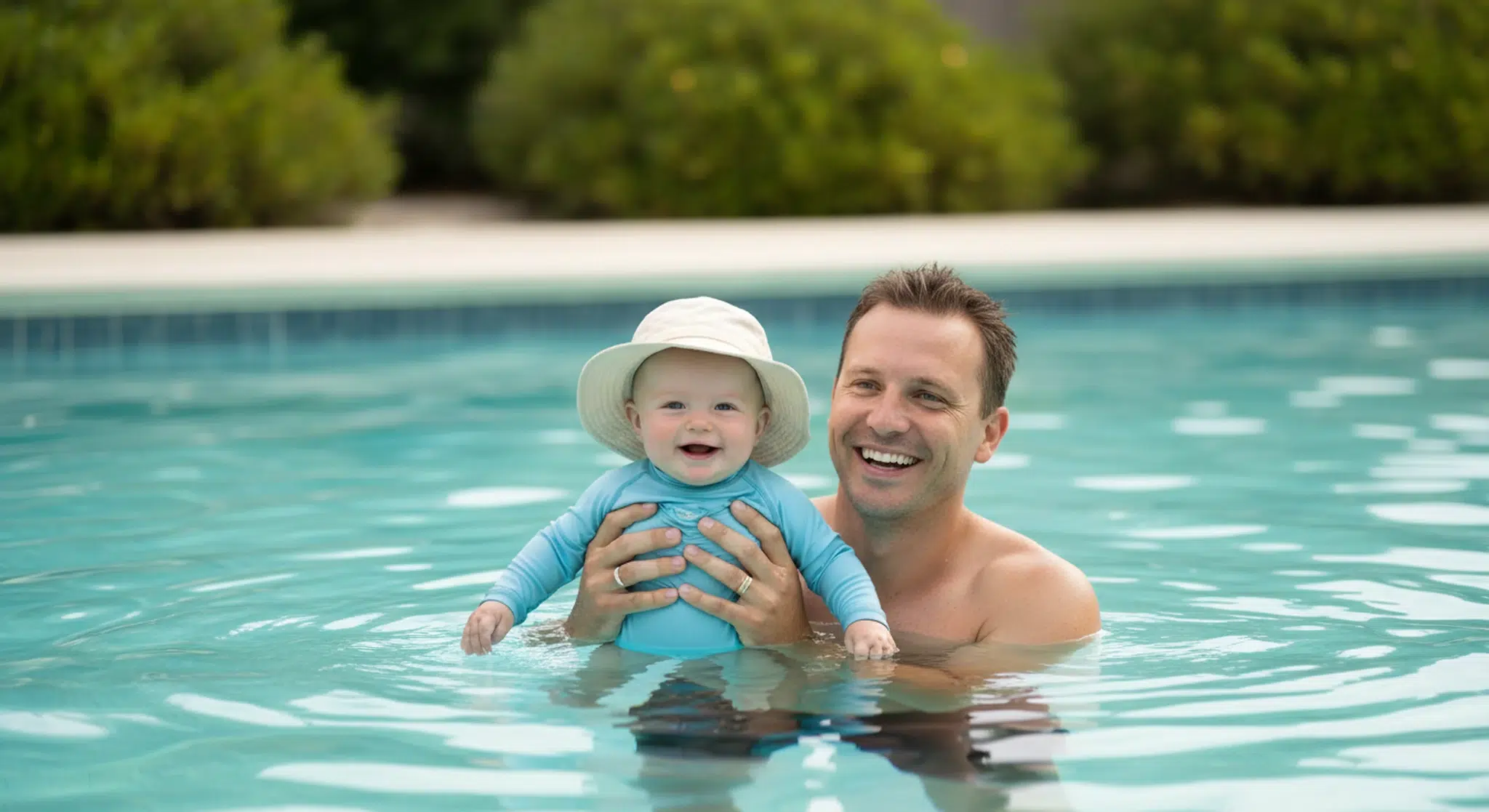
When can a baby go in a pool? There is no single official age, but Cleveland Clinic says most babies can safely go in at about 6 months, and the AAP says swim lessons can begin for many children around age 1.
A vacation or a backyard party can raise the question fast: is my baby old enough for the pool? The answer depends on more than age. Water temperature, sun, chlorine, swim diapers and, above all, supervision all matter.
This guide covers when babies can go swimming by age, water temperature, chlorine, sun, swim diapers, drowning prevention, hot tubs, lakes, baby swim classes and warning signs after a water incident, using AAP, CDC and hospital sources.
Key Takeaways
There is no official minimum age; most babies can go in a pool at about 6 months (Cleveland Clinic).
Swim lessons can start for many children around age 1; there is no evidence lessons under 1 lower drowning risk (AAP).
Babies chill fast: keep dips short and the water warm, ideally 87 to 94 degrees Fahrenheit for under 3s in classes (AAP).
Swim diapers are not leak-proof: check them about every 60 minutes (CDC).
Stay within arm’s reach, fence pools on all 4 sides, and learn CPR.
Table of Contents
When Can a Baby Go in a Pool? The Short Answer
Quick Answer
There is no single official minimum age. Cleveland Clinic says most babies can safely go in a pool at about 6 months, once they have better head control and can handle short, warm dips. The American Academy of Pediatrics (AAP) says swim lessons can begin for many children around age 1, and that there is currently no evidence that swim programs for babies under 1 lower drowning risk. At any age, a baby in or near water needs an adult within arm’s reach the whole time.
So the real question is less “what age” and more “what kind of water time.” A short, warm, closely held splash for a 7 month old is very different from a long afternoon in a cool pool.
Why Many Experts Suggest Waiting Until About 6 Months
Cleveland Clinic gives several reasons to hold off on pool time in the first months:
Head control: babies typically develop better head control around 6 months, which makes holding them safely in water easier.
Body temperature: young babies lose heat quickly. Cleveland Clinic notes that a 78 degree pool that feels pleasant to an adult can chill a baby fast.
Sun: sunscreen is not recommended for most babies under 6 months, so shade and clothing have to do the work (more on this below).
Life jackets: most babies under 6 months will not fit a life jacket properly.
Bath time is water time too; a pool simply adds cold, sun and chemicals that very young babies handle less well. Before the first dip, check that your baby can hold their head up well first.
Baby Pool Readiness by Age
Age
What is reasonable
Why
Newborn to 2 months
Baths at home only; skip the pool
Babies chill quickly and lack head control (Cleveland Clinic)
2 to 6 months
Wait for most babies; keep out of direct sun
Most babies can safely go in at about 6 months (Cleveland Clinic); keep babies under 6 months out of direct sunlight (AAP); most will not fit a life jacket (Cleveland Clinic)
6 to 12 months
Short, warm dips held by an adult; parent and baby water play classes are fine
Keep sessions to about 30 minutes or less (Cleveland Clinic); no evidence that lessons under age 1 lower drowning risk (AAP)
1 to 4 years
Swim lessons can start for many children; touch supervision always
AAP says lessons can begin around age 1 and can help reduce drowning risk at ages 1 to 4; drowning is the leading cause of death in this age group (CDC)
When can babies go swimming: a by-age guide. Sources: Cleveland Clinic; American Academy of Pediatrics; CDC.
If your baby was premature or has a health condition, ask at your next well visit before the first swim.
Water Temperature: How Warm Is Warm Enough?
Warmth matters more for babies than for anyone else in the pool. For swim classes for children age 3 and younger, the AAP says the water should ideally be heated to 87 to 94 degrees Fahrenheit, because hypothermia is a greater risk at this age.
Many backyard and hotel pools are cooler than that, so keep first dips short and wrap your baby in a towel as soon as they come out.
Cleveland Clinic lists these signs that it is time to get out, even if you just got in:
Cool skin, shivering or chattering teeth.
Fussiness.
Sneezing.
Pale, blotchy or bluish skin or lips.
Big days go better with a good night of sleep.
Got a little one at home too? Our free two-minute quiz builds a gentle, personalized sleep plan for babies and toddlers.
Cleveland Clinic says the chlorine in most pools should be safe for babies over 6 months when the pool is properly maintained. Balance is the issue: too little chlorine raises the risk of germs, and too much can irritate sensitive skin. Saltwater pools may be gentler on skin and eyes, but Cleveland Clinic notes they still need proper maintenance.
The AAP adds that young children are more likely to swallow or breathe in water, which is why proper disinfection and chlorine levels matter in the pools used for little ones.
After the swim: rinse your baby with clean, warm water and pat dry. A gentle, fragrance-free moisturizer afterward is a simple habit for dry skin.
Eczema or sensitive skin: if your baby has eczema, ask your pediatrician for a before and after swim skin plan, since Cleveland Clinic notes that too much chlorine can irritate sensitive skin.
Under 6 months: the AAP says to keep babies out of direct sunlight. Find shade under a tree, an umbrella or the stroller canopy, dress your baby in lightweight clothing that covers the body, and use a hat with an all-around brim of about 3 inches to shade the face, ears and back of the neck. If protective clothing and shade are not available, the AAP says you can use sunscreen on small areas of the body, such as the face.
6 months and older: the AAP recommends a broad-spectrum sunscreen with an SPF of at least 15 (up to SPF 50), applied to all areas of the body while being careful around the eyes. Reapply every 2 hours and after swimming, sweating or drying off with a towel.
Swim Diapers: What They Do and Do Not Do
Any baby who is not potty trained needs a swim diaper in a pool. But the CDC is clear that swim diapers are not leak-proof. They can hold in some solid poop, but they do not keep diarrhea-causing germs out of the water. The CDC’s tips:
Check swim diapers often, about every 60 minutes.
Change them in a diaper-changing area, away from the poolside, and wash your hands afterward.
Keep babies and children out of the water when they are sick with diarrhea, whether or not they wear a swim diaper.
Pack a few spare swim diapers, a changing pad and a bag for wet things.
Drowning Prevention: Layers That Protect Babies and Toddlers
The CDC states that drowning is the leading cause of death for children 1 to 4 years old, and that it can happen in seconds and is often silent. The AAP adds that young children can drown in as little as an inch or two of water. No single step is enough, so the AAP describes layers of protection:
Touch supervision: the AAP recommends staying within arm’s length of babies and young children during bath time and swim time.
A designated water watcher: at parties and gatherings, the AAP suggests naming one adult whose only job is to watch the children in the water, and passing the role on every 15 to 20 minutes.
Four-sided pool fencing: the AAP says home pools, including large inflatable and other temporary above-ground pools, should be completely surrounded by a fence on all 4 sides, at least 4 feet high, with a self-closing, self-latching gate that opens away from the pool and stays locked.
Life jackets, not floaties: near lakes, rivers and other natural water, the AAP says children should always wear a properly fitted U.S. Coast Guard-approved life jacket. Floaties, water wings and inflatable toys are not safety devices: the AAP warns they can deflate and do not prevent drowning.
Cover hot tubs: the AAP says to cover and lock hot tubs, spas and whirlpools right after using them.
Learn CPR: the AAP urges parents, caregivers and older children to learn CPR and safe rescue skills. University Hospitals recommends updating CPR training every year or two.
Most child drownings inside the home happen in bathtubs, usually during a lapse in supervision, according to the AAP, which also says children should not bathe alone until at least age 6. Our bath toys guide keeps tub time fun while you stay within reach.
Hot Tubs, Kiddie Pools, Lakes and the Ocean
Hot tubs and spas: Cleveland Clinic says babies and children under 5 should stay out of hot tubs because they can overheat quickly.
Inflatable and kiddie pools: a few inches of water is enough for drowning, so the same touch supervision applies, and the AAP says to empty wading pools, buckets and other open containers after each use and never leave a filled one unattended. Large inflatable pools need the same four-sided fencing as permanent pools (AAP).
Lakes, rivers and the ocean: the AAP says children should always wear a U.S. Coast Guard-approved life jacket that fits near natural bodies of water, and Cleveland Clinic advises treating weight ratings such as “30 pounds and under” with caution and checking the fit yourself.
Baby swim classes are about getting comfortable in water together, not learning to swim. The AAP says it is OK to enroll in a parent-child water play class to help your infant get used to the pool, but it is clear that there is currently no evidence that swim programs for babies under 1 lower drowning risk. Some babies 6 to 12 months old can be trained to float on their backs, the AAP notes, but cannot yet raise their heads out of the water well enough to breathe.
From age 1, the AAP says lessons can help reduce drowning risk for many children, and parent-child classes can build swim readiness and basic water survival skills such as back floating. When you compare classes, the AAP suggests looking for:
Instructors trained and certified through a nationally recognized learn-to-swim curriculum.
A program that lets you watch a class first.
Multiple sessions, continuing at least until your child masters basic water competency skills.
For children under 4, an age-appropriate atmosphere and touch supervision, with an adult within arm’s reach.
Warm water (ideally 87 to 94 degrees Fahrenheit for age 3 and younger) and good water quality.
Lessons are one layer, not a replacement for supervision: the AAP cites CPSC findings that 69% of children under 5 who drowned were not expected to be in the water at the time. For more ways to enjoy water at home, try our water games, or browse activities for 1 year olds and outdoor games for kids.
A Simple Checklist for Baby’s First Pool Day
Your baby is about 6 months or older with good head control.
The water is warm, and you will stay in for short stretches, about 30 minutes or less.
Swim diaper on, spares packed, and a plan to check about every hour.
Shade, a brimmed hat, a long-sleeve swim shirt and (for 6 months and up) sunscreen.
One adult holding your baby at all times, and a named water watcher if there is a group.
A towel within reach, and a phone nearby for emergencies but put away while you watch.
Ask your pediatrician before the first swim if your baby was born early, has a heart or breathing condition, has eczema, or has ear tubes.
Call 911 or go to the nearest emergency room after any time your child went under the water and then has any of these, even if they seemed fine at first. University Hospitals, citing updated American Heart Association and AAP guidelines, lists:
Trouble breathing.
Coughing.
Confusion.
Unusual tiredness or sleepiness (lethargy).
Vomiting.
University Hospitals notes that concerning symptoms usually appear within the first couple of hours, and that any child who was submerged should be taken to a hospital for evaluation even if they seem fine. If a child is pulled from the water and is not breathing normally or responding, call for help and start CPR as soon as possible, with both chest compressions and rescue breaths.
This article is general education, not medical advice. Your own pediatrician’s guidance comes first.
Frequently Asked Questions
When can a baby go in a pool?
There is no single official age. Cleveland Clinic says most babies can safely go in a pool at about 6 months, once head control improves. Keep first dips short and warm, hold your baby the whole time, and ask your pediatrician first if your baby was premature or has a health condition.
Can a newborn go in a pool?
It is best to wait. Young babies lose body heat quickly, lack head control and should be kept out of direct sun, and most will not fit a life jacket. Cleveland Clinic says most babies can safely go in at about 6 months. Until then, warm baths at home are plenty of water time.
What age should a baby start swim lessons?
The AAP says swim lessons can begin for many children around age 1 and can help lower drowning risk for ages 1 to 4. For babies under 1, there is no evidence that swim programs lower drowning risk, but a parent-child water play class is fine for getting used to the pool.
How warm should a pool be for a baby?
For swim classes for children age 3 and younger, the AAP says water should ideally be heated to 87 to 94 degrees Fahrenheit, because young children are at greater risk of hypothermia. A cooler pool, such as 78 degrees, can chill a baby quickly, so keep visits short and watch for shivering or blue lips.
Do babies need swim diapers in the pool?
Yes, babies who are not potty trained should wear one, but the CDC says swim diapers are not leak-proof and do not keep diarrhea germs out of the water. Check them about every 60 minutes, change them away from the poolside, and keep your baby out of the water when they have diarrhea.
Can babies go in hot tubs?
No. Cleveland Clinic says babies and children under 5 should stay out of hot tubs because they can overheat quickly. The AAP also advises covering and locking hot tubs and spas right after each use so curious babies and toddlers cannot get in.
Gentle changes, peaceful nights.
Betteroo builds a personalized sleep plan for your baby or toddler. Take the free two-minute quiz to get started.