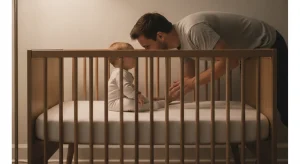
For good baby sleep while traveling, keep your usual bedtime routine, bring the same sleep cues from home, set up a safe crib or play yard, and choose home time or local time based on how long your trip is.
Keeping your baby sleeping well on a trip comes down to four things: the same routine in the same order, familiar sleep cues like the sleep sack and sound, a bare and safe sleep space wherever you stay, and a clear plan for the clock. Baby sleep while traveling is rarely perfect, but it does not have to fall apart.
Below: time zones, car and stroller naps, hotel and play yard safety, room setup, a packing checklist, and getting back on track at home.
Key Takeaways
Keep the same bedtime routine and sleep cues: sleep sack, familiar crib sheet, low steady sound, a dark room.
On short trips, stay close to home time; on longer trips, switch to local time and use morning daylight.
Move your baby from the car seat, stroller or carrier to a firm, flat surface as soon as you can.
In a play yard, use only the mattress it came with and a fitted sheet: no pads, blankets or pillows.
Never bed-share or use a couch, even on vacation.
As an Amazon Associate, Betteroo earns from qualifying purchases.
Table of Contents
How Do I Keep My Baby Sleeping Well When We Travel?
Quick Answer
Keep your baby’s usual bedtime routine, bring the same sleep cues from home (sleep sack, crib sheet, sound, dark room), and set up a safe sleep space as soon as you arrive: a crib or play yard with a firm, flat mattress, a fitted sheet and nothing else. On short trips, stay close to home time. On longer trips across time zones, switch to local time and use morning daylight to help reset your baby’s body clock.
The rules that keep your baby safe come along too. The American Academy of Pediatrics (AAP) says babies should sleep on their back, on a firm, flat surface, in a crib, bassinet, portable crib or play yard that meets federal safety standards, with no soft bedding.
Short Trips of 1 to 3 Days: Should You Stay on Home Time?
For a weekend away, or a trip across one time zone, it is usually simplest to keep your baby on home time, or close to it. The CDC Yellow Book chapter on jet lag (2026 edition) advises keeping home sleep hours on short trips where there is too little time to adapt, and suggests staying on home time for trips under about 2 days. If you will be home before your baby could adjust, shifting their clock just means a second adjustment later.
Keep bedtime and wake time steady: if home bedtime is 7 p.m., aim for 7 p.m. by your baby’s body clock.
Protect one good nap: plan outings around it.
Accept a car or stroller nap: offer an earlier bedtime if your baby gets cranky. See our overtired baby guide for signs to watch.
Do the full routine, even a short one: bath, pajamas, sleep sack, feed, book and song in the same order signals that sleep is coming.
A useful benchmark: the American Academy of Sleep Medicine consensus statement (Paruthi and colleagues, 2016) recommends 12 to 16 hours of sleep per 24 hours, including naps, for babies 4 to 12 months, and 11 to 14 hours for children 1 to 2 years. It makes no recommendation for babies under 4 months.
Crossing Time Zones: How to Help Your Baby Adjust
For longer trips, switch your baby to local time from the first full day. The CDC Yellow Book says adults adapt on average about 1 hour per day after traveling east and about 1.5 hours per day after traveling west, because most people find it easier to push their body clock later than earlier. The chapter does not cover infants, so treat that as a rough guide, not a promise.
Light is your strongest tool. According to the same CDC chapter, bright morning light moves the body clock earlier, which helps after flying east, while evening light moves it later, which helps after flying west.
Trip direction
What it feels like
What helps
Flying east
Not sleepy at local bedtime, hard to wake in the morning.
Morning daylight, wake at a reasonable local time, dim evenings, routine at local bedtime.
Flying west
Sleepy too early, wakes very early.
Afternoon and early evening light, push bedtime later in small steps, dark room in the early morning.
One time zone
Little change.
Stay on home time or split the difference.
Using light and timing after crossing time zones.
Cap long naps on day one: a shorter afternoon nap protects local bedtime.
Handle 2 a.m. wake-ups calmly: keep it dark and quiet, feed if needed, and skip play and screens.
Stuck on night two or three?
Our free two-minute quiz builds a gentle, personalized sleep plan that adapts when progress stalls.
Naps on the Go: Car Seat, Stroller and Carrier Naps
Most babies sleep in the car or stroller at some point on a trip. What matters is what happens when you arrive. On HealthyChildren.org, the AAP’s parent site, Rachel Moon, MD, FAAP, explains that if your baby falls asleep in a car seat, stroller, swing, infant carrier or sling, you should move them to a firm sleep surface on their back as soon as possible.
In the car: keep your baby buckled exactly as the car seat manual says, with an adult watching. When you stop, take your baby out for sleep; do not carry the seat inside as a bed.
In the stroller or carrier: fine while you are with your baby and their face is clear. Transfer to the crib or play yard once you arrive.
Contact naps: holding your baby is fine while you are awake. If you feel yourself dozing, put your baby down on a flat, safe surface. See our contact naps guide.
Safe Sleep in Hotels, Airbnbs and Relatives’ Homes
The biggest risk in a new place is putting your baby in the adult bed or on a couch “just for tonight.” In her HealthyChildren.org article on hotel safety, Claire McCarthy, MD, FAAP, advises resisting that temptation and using a portable crib or packable play yard instead. The AAP says the risk is up to 67 times higher when babies sleep with someone on a couch, soft armchair or cushion.
Situation
What to do
Why
Hotel crib or play yard
Request it when you book. Check for broken or missing parts, loose hardware, and any padding other than the manufacturer’s original mattress.
HealthyChildren.org: cribs should meet current standards and be in good repair.
Vacation rental
Ask the host what crib they provide. Bring your own play yard if unsure.
You cannot check it in advance.
Relatives’ home
Use a crib or play yard that meets current standards, or bring yours. Never a couch, adult bed or recliner.
Soft and sloped surfaces raise suffocation risk.
Sharing a hotel room
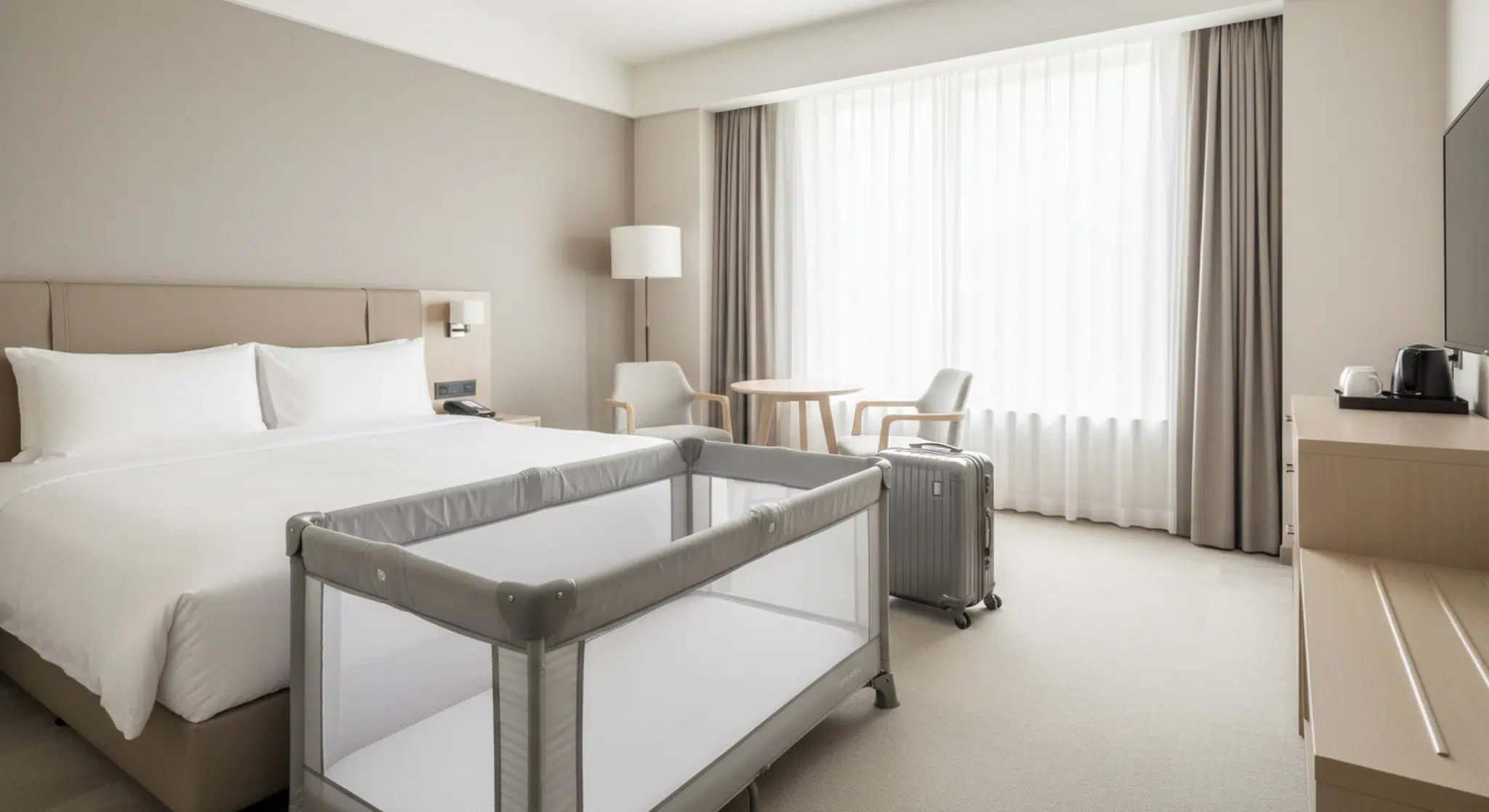
Crib near your bed, not in it, away from cords, lamps, TVs and anything that could fall.
AAP: room share without bed sharing.
Asleep in the car seat
Move to the crib or play yard, on the back, as soon as you can.
AAP: sitting devices are not for routine sleep.
Safe sleep in new places, situation by situation.
On arrival, HealthyChildren.org suggests checking under beds and dressers for pills and small objects, taping up blind and window cords, and covering outlets. Our safe sleep environment checklist covers the full setup.
Travel Crib and Play Yard Rules
A play yard gives your baby the same safe sleep space everywhere. In a March 2025 warning about aftermarket play yard mattresses, the U.S. Consumer Product Safety Commission (CPSC) said babies have suffocated in gaps between an undersized mattress or extra padding and a product’s side walls. Its guidance:
Use only the mattress provided with your play yard, or one that specifically identifies your play yard’s brand and model number.
Do not add supplemental padding, and never stack mattresses.
Use a fitted sheet only, with no blankets, pillows, padded bumpers or other items.
A thin, firm play yard mattress feels hard to adults; that firmness is the point.
Practice at home: use the play yard for a few naps before the trip so it feels familiar.
Check the sheet fit: HealthyChildren.org says bedding should fit the mattress snugly.
How to Set Up a Hotel Room So Your Baby Sleeps
Make it dark: close the curtains and clip any gap on the curtain itself, never on the crib. Dim the lights before bed; per the CDC Yellow Book, evening light pushes the body clock later.
Use steady sound, kept low: in a 2014 Pediatrics study summarized by Children’s Hospital of Philadelphia (CHOP), all 14 infant sound machines tested exceeded 50 decibels, the recommended limit for hospital nurseries, at maximum volume. CHOP suggests placing machines more than 200 centimeters (about 6.5 feet) from the crib with the volume low. More in our white noise guide.
Dress for the room: the AAP says your baby needs only one more layer than you would wear in the same environment; watch for sweating, a hot chest or flushed skin.
Sharing the room. Angle the crib so your baby cannot see you from the mattress and get ready for bed in the bathroom. A floor-standing screen can help if it is stable and never touches or covers the crib. Our guide to sleep training while room sharing has a full layout plan.
Flights and Long Drives
Flights: time it around a nap or bedtime if you can. Our flying with a baby guide covers seats, ears and packing.
Long drives: stop for feeds and diaper changes, and take your baby out of the car seat at each stop.
Arrival: set up the crib or play yard first, before unpacking, so it is ready.
HealthyChildren.org suggests bringing a familiar crib sheet as a reminder of home, especially if your baby is not used to falling asleep in new places.
Only the mattress it came with, plus a fitted sheet.
A baby sleep packing checklist for travel.
Leave at home: pillows, loose blankets, bumpers, sleep positioners, loungers, and inclined or rocking sleepers. None belongs in a baby’s sleep space, at home or away.
Will Travel Ruin My Baby’s Sleep? Getting Back on Track
Usually, no. A few off nights are common, and the fastest way back is to restart your normal routine right away.
Go back to home time on day one: morning light, normal wake time, normal bedtime.
Return to your usual settling: if you rocked or fed to sleep more on the trip, go back to your usual approach. Our guide on keeping the same routine with every caregiver helps if grandparents were involved.
Try an earlier bedtime for a few days: to make up for short travel naps.
Reset the schedule if needed: if sleep is still off after a week or so, use our baby sleep schedule by age as a reset point.
Help With a Travel Sleep Plan
If you want a plan built for your baby’s age, schedule and trip, Betteroo’s free sleep quiz can suggest a personalized routine to take on the road and to use when you get home. Whichever plan you follow, a familiar routine and a safe, bare sleep space carry over best.
Check in before a big trip if your baby was born early, has a health condition or is very young. Call during or after the trip if you notice:
Fever, unusual sleepiness, or a baby who is hard to wake.
Loud snoring, gasping or pauses in breathing during sleep.
Feeding much less than usual, or fewer wet diapers.
Crying that seems like pain and does not settle.
Sleep still badly disrupted 2 weeks after you get home.
Do not give melatonin or any sleep aid for travel without asking your pediatrician. The American Academy of Sleep Medicine advises parents to discuss melatonin with a pediatric health care professional and to treat it like any other medication.
Frequently Asked Questions
How do I keep baby sleep on track while traveling?
Keep the same bedtime routine in the same order and bring familiar sleep cues such as the sleep sack, crib sheet and a quiet sound machine. Make the room dark and set up a safe crib or play yard first. Stay on home time for short trips and switch to local time on longer ones.
Should I keep my baby on home time when traveling?
For short trips, usually yes. The CDC Yellow Book advises keeping home sleep hours on short trips where there is too little time to adapt, roughly under 2 days. On longer trips across time zones, switch to local time from the first full day and use morning daylight.
How long does it take a baby to adjust to a new time zone?
There is no exact figure for babies. The CDC Yellow Book says adults adapt on average about 1 hour per day after flying east and about 1.5 hours per day after flying west. Expect several rough nights after a big change, and use daylight to help.
Can my baby sleep in the car seat or stroller on vacation?
Short naps in the car seat while driving, or in the stroller while you are with your baby, are common. The AAP says that if your baby falls asleep in a car seat, stroller, swing or carrier, move them to a firm, flat surface on their back as soon as possible.
Is a hotel crib or play yard safe for my baby?
It can be. HealthyChildren.org advises checking for broken or missing parts, loose hardware, and padding other than the original mattress. The CPSC says to use only the mattress made for that play yard, never stack mattresses, and use only a fitted sheet.
Can I give my baby melatonin for travel or jet lag?
Talk to your pediatrician first. The American Academy of Sleep Medicine advises parents to discuss melatonin with a pediatric health care professional, to treat it like any other medication, and to keep it out of reach of children. Routine and daylight are the main travel tools.
Gentle changes, peaceful nights.
Betteroo builds a personalized sleep plan for your baby or toddler. Take the free two-minute quiz to get started.
Moon RY, Carlin RF, Hand I; Task Force on Sudden Infant Death Syndrome. Sleep-Related Infant Deaths: Updated 2022 Recommendations for Reducing Infant Deaths in the Sleep Environment. Pediatrics. 2022;150(1):e2022057990. https://pubmed.ncbi.nlm.nih.gov/35726558/
Paruthi S, et al. Recommended Amount of Sleep for Pediatric Populations: A Consensus Statement of the American Academy of Sleep Medicine. J Clin Sleep Med. 2016;12(6):785-786. https://pubmed.ncbi.nlm.nih.gov/27250809/