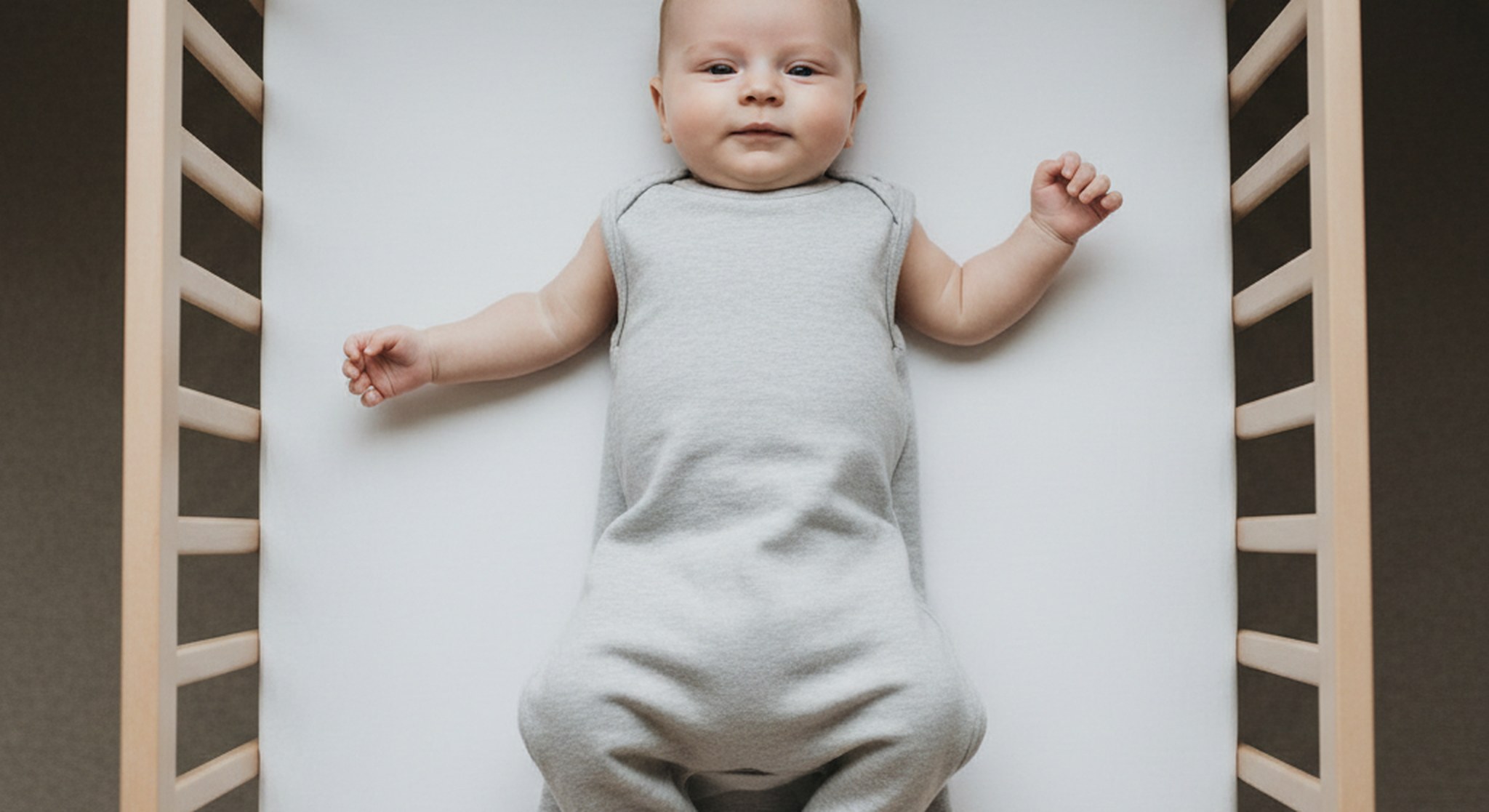
If you are searching for a 2 month old sleep schedule, take a breath first: at this age there is no schedule to fall behind on. Your baby is only just beginning to grow the internal clock that will, in time, sort day from night. What you can build now is a loose rhythm, a gentle shape to the day that follows your baby’s cues rather than the hands of a clock.
The reassuring news is that two months is often when the fog starts to lift a little. Those first social smiles appear, your baby is more alert and engaged between sleeps, and the longest overnight stretch quietly begins to lengthen. It is uneven and it is not linear, but it is progress.
This guide walks through how much a two month old typically sleeps, what a loose daily rhythm can look like, why the evening can feel so hard, and the small, gentle habits worth practicing now, all without pushing your newborn toward a rigid routine they are not ready for.
Table of Contents
At a Glance: 2 Month Sleep Expectations
At two months, most babies sleep 14 to 16 total hours per day: roughly 9 to 10 hours overnight, usually broken by 2 to 3 wakeups for feeds, plus 5 to 7 hours of daytime sleep spread across 4 to 5 naps. Wake windows are still very short at 60 to 90 minutes, and a bedtime is only beginning to emerge, often landing late between 8:00 and 10:00 p.m. and drifting earlier over the coming weeks.
For perspective from Betteroo’s State of Baby Sleep survey: night waking is at its most intense in the first months of life, and frequent overnight waking is simply what this stage looks like for nearly every family. If your two month old is waking multiple times, you are squarely in the normal range, and the trend across the first year is toward longer, calmer nights.
How Much Should a 2 Month Old Sleep?
The American Academy of Sleep Medicine recommends 12 to 16 hours per 24 hours for infants aged 4 to 12 months, and younger babies generally sleep at the higher end of that range 1. Reference studies of infant sleep show wide, healthy variation from baby to baby, so treat any single number as a midpoint rather than a target 2.
Sleep Type
Typical Range at 2 Months
Total Sleep
14–16 hours
Night Sleep
9–10 hours (2–3 wakeups)
Naps
4–5 per day (5–7 hours total)
Wake Windows
60–90 minutes
Notice how much daytime sleep still happens: four or five naps is normal, and many of them are short and irregular. That is exactly right for two months. Your baby’s circadian rhythm, the internal system that eventually anchors sleep to nighttime, is still coming online. A predictable clock-based schedule is genuinely not developmentally possible yet, so a loose 2 month sleep schedule built on wake windows and cues will serve you far better than fixed nap times.
A Sample 2 Month Old Rhythm (A Loose Shape, Not a Rule)
The best sleep schedule for a 2 month old is really a rhythm: eat, a short window of awake time, then back to sleep before overtiredness sets in. Here is what a loose day might look like, knowing that yours will shift by the hour and that is completely fine.
7:00 a.m. – Wake and feed
8:15–9:45 a.m. – Nap 1
11:00 a.m.–12:30 p.m. – Nap 2
1:45–3:15 p.m. – Nap 3
4:30–5:15 p.m. – Nap 4 (a short catnap)
6:30–7:00 p.m. – A brief evening nap, if needed
9:00 p.m. – Into bed for the night, with feeds overnight as needed
Do not chase these exact times. The load-bearing idea is the wake window: after 60 to 90 minutes awake, watch for early tired signs like a glazed stare, turning away, or a first yawn, and offer sleep then. Catching that window before crying starts makes settling far easier. If a nap runs short, simply start the next wake window and try again. There is no failing here.
A true, consistent bedtime is still forming at two months. Many babies have a late “bedtime” of 8:00 to 10:00 p.m. right now, and over the next several weeks it naturally drifts earlier as the longest sleep stretch consolidates toward the front of the night. You do not need to force it. As your baby moves toward the 3 month old sleep schedule, an earlier, more predictable bedtime tends to settle in on its own.
The Longest Stretch Is Lengthening
One of the quiet wins of month two is that the longest continuous stretch of night sleep starts to grow. Where a newborn might wake every two to three hours around the clock, many two month olds string together a longer first stretch after bedtime, sometimes four or five hours, before the wakeups resume. It is not every night, and it can come and go, but it is a real developmental shift.
You can gently support this by helping your baby learn the difference between day and night: keep daytime bright and social, and keep night feeds calm, dim, and quiet, with minimal talking and no play. Over time this contrast helps the body pull more of its sleep into the dark hours. Our wake windows guide explains how those awake stretches slowly grow as your baby matures.
From Betteroo’s State of Baby Sleep
Across our survey of tens of thousands of families, night waking is most frequent in the earliest months and eases steadily as babies grow, with the share of frequent night wakers declining month over month through the first year and into toddlerhood. If your two month old still wakes often to feed, that is exactly what this stage looks like, and it gets easier from here. Explore the full data →
Gentle Habits Worth Starting Now
This is not the age for sleep training, and there is no need to rush independent sleep. But a few soft, low-pressure habits lay a lovely foundation:
Try drowsy but awake, sometimes. Once in a while, lay your baby down calm but not fully asleep. If it turns into a struggle, pick them up and help them off to sleep however works. It is practice, not a test, and rocking or feeding to sleep at this age is completely fine.
Build a tiny wind-down. A short, repeatable sequence before the night sleep, a feed, a fresh diaper, dim lights, a song, signals that sleep is coming. Simple bedtime routines are one of the most evidence-backed sleep tools there is 3.
Follow the wake window, not the clock. Sixty to ninety minutes awake is plenty. Offering sleep at the first tired cues prevents the overtired spiral that makes settling harder.
Keep sleep safe every time. Always place your baby on their back, on a firm, flat surface, with nothing soft in the sleep space, in line with AAP safe sleep guidance 4.
The Evening Witching Hour
If your baby falls apart in the late afternoon and early evening, you are not doing anything wrong. This fussy, hard-to-settle stretch, often called the witching hour, is extremely common in the first months and usually peaks around six to eight weeks. Daytime sleep is often lightest and most broken then, overtiredness builds, and babies simply need extra help.
Lean on comfort during this window without worrying about habits: extra feeds, cluster feeding, holding, motion, a walk outside, white noise, or a warm, dim room all count. A brief catnap in the early evening can also take the edge off before the night sleep. This phase eases as your baby’s rhythm matures over the next month or two.
When to Talk to a Pediatrician
Reach out if your baby consistently sleeps far less than 14 hours or seems constantly overtired, is very difficult to wake for feeds, is not gaining weight as expected, snores or has pauses in breathing, or if inconsolable crying and fussiness feel beyond the usual. Trust your instincts: your pediatrician would always rather hear from you than have you worry alone.
2 Month Old Sleep Schedule FAQ
What is a good sleep schedule for a 2 month old?
At two months, aim for a loose rhythm rather than fixed times: total sleep of 14 to 16 hours, 4 to 5 naps across the day, and short wake windows of 60 to 90 minutes. Follow your baby’s tired cues and offer sleep before overtiredness sets in. A clock-based schedule is not developmentally possible yet.
How long should a 2 month old sleep at night?
Most two month olds sleep about 9 to 10 hours overnight, broken by 2 to 3 wakeups for feeds. Many are also starting to string together a longer first stretch of four to five hours after bedtime, though it comes and goes. Frequent night waking is normal at this age.
How many naps does a 2 month old take?
Usually 4 to 5 naps a day, adding up to roughly 5 to 7 hours of daytime sleep. Many naps are short and irregular right now, which is completely normal. Nap consolidation into fewer, longer naps comes later in the first year.
What are wake windows for a 2 month old?
About 60 to 90 minutes of awake time between sleeps, including feeding. Watch for early tired signs like a glazed stare, looking away, or a first yawn, and offer sleep then. Catching the window before crying starts makes settling much easier.
Should I sleep train my 2 month old?
No. Two months is too early for formal sleep training. Rocking or feeding your baby to sleep is completely appropriate now. You can gently practice putting your baby down drowsy but awake sometimes, and build a short, calming wind-down, but there is no need to push independent sleep at this age.
Short naps, late bedtimes, witching hours: two months is a lot
Get a personalized, gentle sleep plan built around your baby’s age, temperament, and your family’s needs.
A 2 month old sleep schedule is not really a schedule at all, and that is exactly as it should be. Your baby’s clock is still forming. What helps most now is a gentle, cue-led rhythm: short wake windows, plenty of daytime sleep, calm and quiet night feeds, and a soft wind-down before the night. Hold it all loosely. The longest stretch is already lengthening, the evenings will get calmer, and a more predictable day arrives on its own timeline.
Paruthi, S., et al. (2016). Recommended Amount of Sleep for Pediatric Populations: A Consensus Statement of the American Academy of Sleep Medicine. Journal of Clinical Sleep Medicine, 12(6), 785–786.https://pmc.ncbi.nlm.nih.gov/articles/PMC4877308/
Iglowstein, I., Jenni, O.G., Molinari, L., & Largo, R.H. (2003). Sleep duration from infancy to adolescence: Reference values and generational trends. Pediatrics, 111(2), 302–307.https://pubmed.ncbi.nlm.nih.gov/12563055/
Mindell, J.A., Telofski, L.S., Wiegand, B., & Kurtz, E.S. (2009). A Nightly Bedtime Routine: Impact on Sleep in Young Children and Maternal Mood. Sleep, 32(5), 599–606.https://pubmed.ncbi.nlm.nih.gov/19480226/
American Academy of Pediatrics. (2022). Sleep-Related Infant Deaths: Updated 2022 Recommendations for Reducing Infant Deaths in the Sleep Environment.https://pubmed.ncbi.nlm.nih.gov/35726558/