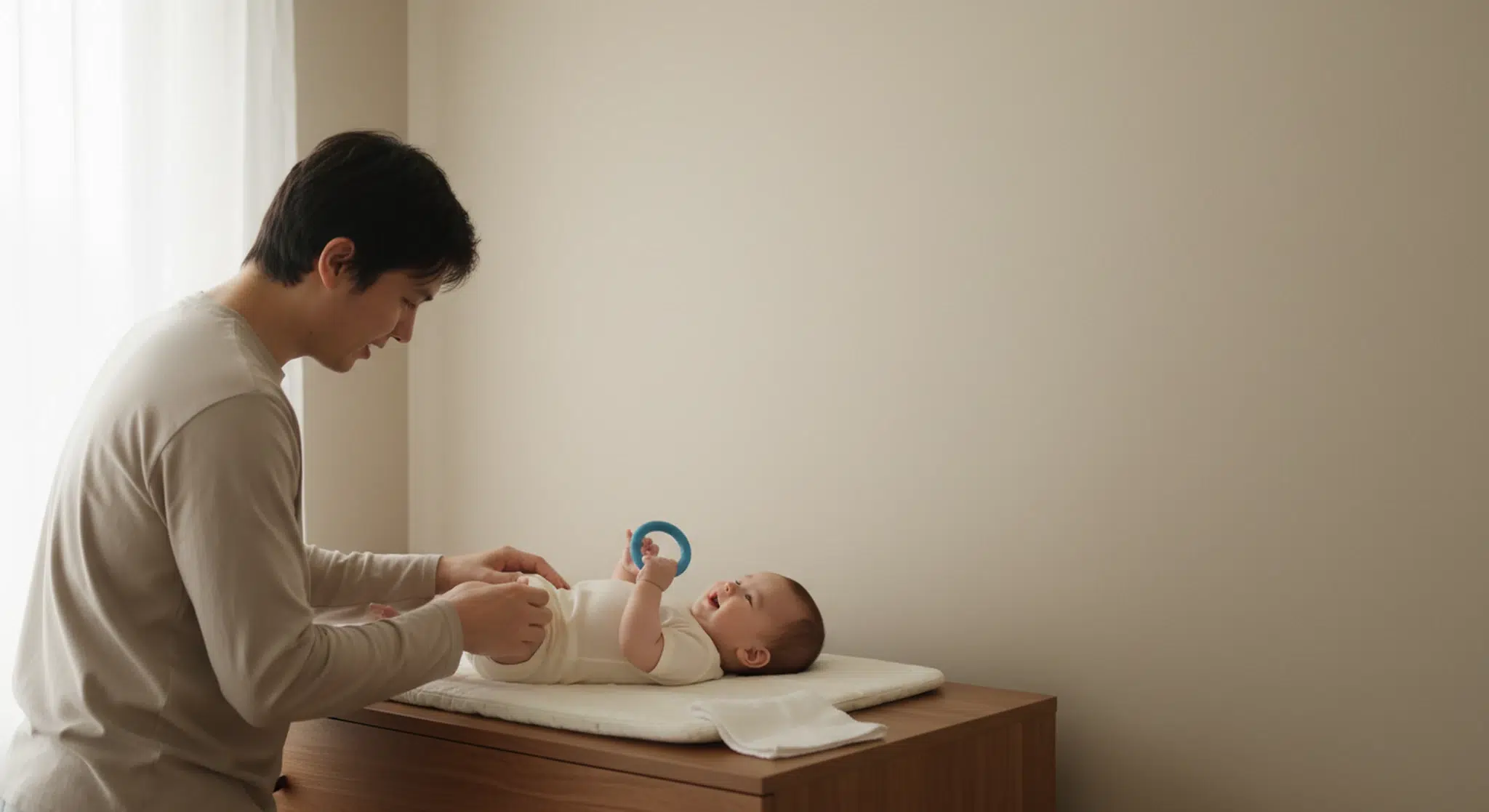
Teething diaper rash is real in the sense that many babies get a sore bottom while teeth come in, but research does not show teething causes diarrhea, so look for other causes like new foods, illness, antibiotics or yeast while you treat the rash.
If your baby is drooling, chewing everything and now has a red, angry bottom, you are not imagining the timing. Teething diaper rash is one of the most common things parents search for in the second half of the first year.
The cause is less certain than the folklore suggests, and the treatment is the same either way. Here is what the AAP, Mayo Clinic, the FDA and the research say.
Key Takeaways
Many babies get diaper rash while teething, but a prospective study found tooth eruption was not associated with diarrhea.
The AAP’s two pages differ: one says swallowed saliva may raise diaper rash risk, the other says teething does not change the gut.
New foods, antibiotics, stomach bugs, yeast and new products are common causes at the same age.
Treat with frequent changes, gentle cleaning, air time and a thick zinc oxide or petroleum jelly barrier.
Call for fever under 3 months, blisters or pus, dehydration signs, or a rash not better in 2 to 3 days.
Table of Contents
Does Teething Cause Diaper Rash? The Short Answer
Quick Answer
Probably not directly, though the timing is real. The American Academy of Pediatrics (AAP) gives two slightly different messages: its diaper rash page says extra saliva swallowed during teething passes through the gut and makes diaper rash more likely, while its teething page says teething does not change the way your baby’s gut works and that any diaper rash has another cause. A prospective study of teething babies (Macknin and colleagues, Pediatrics, 2000) found tooth eruption was not associated with diarrhea. Either way, the rash is treated the same: frequent changes, gentle cleaning, air time and a thick barrier ointment.
Treat the teething diaper rash you can see, and keep an open mind about the cause. Around the age teeth arrive, a lot changes at once: new foods, more mouthing of toys and hands, the first colds and stomach bugs, and sometimes a first course of antibiotics. Any of those can change your baby’s stools and irritate the skin in the diaper.
What Parents Notice While Teeth Come In
The pattern parents describe: a few days of drooling, chewing and fussiness, then a red, tender bottom, sometimes with looser or more frequent stools.
What you are seeing in the diaper is a diaper rash, whatever set it off. Mayo Clinic describes diaper rash as patches of inflamed skin on the buttocks, thighs and genitals. Babies may be fussier than usual, especially during diaper changes.
Teething itself has its own signs. The AAP lists fussiness, drooling, chewing, and a rash around the mouth from drool. That face and chin rash is a different thing from a diaper rash, and we cover it in our teething rash guide and our drool rash guide. If you are not sure your baby is teething yet, the AAP says first teeth typically appear between 6 and 10 months, though discomfort may start as early as 3 months. See when do babies start teething for the usual order.
What the Evidence Says About Teething and Diaper Rash
The prospective study: Macknin and colleagues followed infants and recorded their symptoms as teeth came in (Pediatrics, 2000). The American Family Physician summary reports 475 tooth eruptions in 89 of the 111 children analyzed. Symptoms linked to teething were drooling, gum rubbing, irritability, decreased appetite for solid foods and a small rise in temperature. Tooth eruption was not associated with infection, diarrhea, cough or temperatures higher than 38.9°C (102°F). The summary we reviewed does not report on diaper rash specifically.
AAP, teething page: the AAP Section on Oral Health says teething does not change the way your baby’s gut works and does not make your baby’s skin more sensitive, except possibly around the mouth. It says any diaper rash has another cause and that diarrhea lasting more than a day calls for a call to your pediatrician.
AAP, diaper rash page: the AAP’s diaper rash article says teething means extra saliva is being swallowed and passes through the gut, which increases the chance of diaper rash, and that diarrhea raises the chance even more.
The two AAP pages do not fully agree. Their shared bottom line: loose or frequent stools are what irritate skin, and the study evidence does not support blaming diarrhea on a tooth.
Why does the link feel so real? Teeth arrive over many months, so almost any rash in the second half of the first year lands near a tooth.
Other Causes of Diaper Rash at the Teething Age
Mayo Clinic and the AAP list several causes that are common right when teeth start coming in.
Starting solids: Mayo Clinic notes that when babies start eating solid foods, the content of their stool changes, and new foods can increase how often they poop. Our starting solids guide covers the timing, and baby poop color explains what changes are normal.
Foods in breast milk: Mayo Clinic says breastfed babies can sometimes develop a diaper rash in response to something the mother has eaten.
Antibiotics: Mayo Clinic says antibiotics can upset the balance that keeps yeast in check, and can also cause diarrhea. The AAP notes yeast rashes can follow a course of antibiotics.
Illness and diarrhea: frequent stools or diarrhea raise the risk, according to Mayo Clinic. The AAP teething page points out that babies pick up more germs by mouthing objects at this age, and that diarrhea can be a sign of infection.
Yeast: the warm, moist diaper area is a breeding ground for bacteria and yeast, Mayo Clinic explains, and the AAP says a yeast rash is usually worse in the groin folds. For the full side-by-side, see diaper rash vs yeast infection.
New products: new wipes, diapers, detergents or creams can irritate the skin (Mayo Clinic), and the AAP says some babies react to dyes, elastics, fragrances or preservatives.
Big days go better with a good night of sleep.
Got a little one at home too? Our free two-minute quiz builds a gentle, personalized sleep plan for babies and toddlers.
These home care steps come from the AAP and Mayo Clinic.
Change diapers often: remove wet or dirty diapers as soon as you can (Mayo Clinic).
Clean gently: Mayo Clinic suggests rinsing with warm water, or using fragrance-free, alcohol-free wipes. The AAP suggests water with a gentle, non-soap cleanser, and for a severe rash, a squirt bottle so you can rinse without rubbing.
Pat dry, then air dry: pat the skin dry rather than rubbing, and let it air dry before the next diaper (AAP, Mayo Clinic).
Use a thick barrier: the AAP names zinc oxide and petrolatum (petroleum jelly) as good choices and says fragrance-free products are best. Apply a thick layer, which the AAP compares to icing on a cupcake. Mayo Clinic says a cream, paste or ointment with petroleum jelly or zinc oxide can be used at each change if rashes keep coming back.
Give bare time: letting your baby go without a diaper for short stretches helps the skin dry (Mayo Clinic).
Give the skin room: fasten diapers snugly but not tightly, and limit plastic or tight diaper covers (Mayo Clinic). The AAP suggests highly absorbent diapers and no tight fits overnight.
Bathe daily if irritated: the AAP says a daily bath can help. Reapply the barrier afterward.
Skip: talcum powder (Mayo Clinic) and over-the-counter antibiotic ointment, which the AAP says can worsen irritation. If you suspect an allergy, the AAP suggests switching products for about 2 weeks.
Learn more about a gentle routine in how to change a diaper. Give steady care a few days. The AAP says to call if it is not clearing or is getting worse after two to three days of treatment.
Is It Irritant, Yeast, Bacterial or Allergic? A Comparison
Rash type
What it tends to look like
Common clues
Usual next step
Irritant (most common)
Pink or red patches on skin the diaper covers; the groin folds usually look normal
Follows loose or frequent stools, diarrhea or a diaper left on too long
Home care: frequent changes, air time, thick zinc oxide or petrolatum barrier
Yeast
Shiny, bright red or pink patches with sharp edges, sometimes little pink bumps or pimples; worse in the groin folds
Lasts despite home care; may follow antibiotics; scaling can spread to the thighs and belly
Call your pediatrician, who may prescribe an antifungal cream
Bacterial (such as impetigo)
Bright red skin around the anus (may suggest strep) or yellow crusting, weeping or pimples (may suggest staph)
Crusts, oozing or pus; an especially painful rash can signal cellulitis
Call your pediatrician; it may need prescription treatment
Allergic or contact
Rash wherever a product touches the skin
Shows up after every use of a certain diaper, wipe or cream
Stop the suspected product; the AAP suggests switching for about 2 weeks
How diaper rash types tend to differ. Source: American Academy of Pediatrics (HealthyChildren.org), Diaper Rash. Only a clinician can diagnose the cause.
Teething Diaper Rash Prevention
Barrier at every change during flare-prone weeks: when stools are looser (new foods, illness, antibiotics), a thin layer of zinc oxide or petroleum jelly at each change protects the skin before it gets red (Mayo Clinic).
Introduce foods one at a time: new foods change stool, so going slowly makes it easier to notice which food seems to bother your baby’s skin.
Wash hands after each change: Mayo Clinic says this helps limit the spread of bacteria or yeast.
Keep the face and chin dry too: wipe drool gently and keep a dry bib on to protect the skin around the mouth, which is the one place the AAP says teething may affect the skin.
Safe Teething Relief (and What to Avoid)
Easing teething will not cure a diaper rash, but it helps. The AAP and the U.S. Food and Drug Administration (FDA) recommend:
Gum massage: rub sore gums gently with a clean finger (AAP, FDA).
A firm teether: offer a solid rubber teething ring. The FDA says to make sure it is not frozen and to supervise your child. The AAP advises against liquid-filled teethers, which can leak or tear.
Cold, not frozen: a chilled, damp washcloth works, and the AAP says babies over 6 months can have cold water in a sippy cup. Do not let your baby chew on anything frozen solid.
Medicine: ask your pediatrician before giving acetaminophen or any pain reliever.
For teething safety, skip these:
Benzocaine gels and liquids: the FDA says benzocaine products should not be used for teething pain in children because they can cause methemoglobinemia, a serious and sometimes fatal blood condition.
Homeopathic teething tablets or gels: the AAP says products with belladonna or coffea cruda may be dangerous for infants.
Amber and other teething necklaces or bracelets: the FDA has received reports of death and serious injury, including strangulation and choking, linked to teething jewelry, and the AAP warns that necklaces of amber, wood, marble or silicone pose serious risks.
Call right away (or seek urgent care if you cannot reach the office):
Fever in a baby younger than 3 months: the AAP says to call for a temperature of 100.4°F (38.0°C) or higher in a baby under 3 months (12 weeks).
Signs of dehydration: the AAP lists fewer than six wet diapers a day, fewer tears, a dry mouth, a sunken soft spot, very fussy or excessively sleepy behavior, and sunken eyes, and says to notify your pediatrician immediately.
Blisters, pus, oozing, crusty sores or bleeding: the AAP lists pimples, peeling, blisters, pus, oozing or crusty sores, and Mayo Clinic lists a rash that bleeds, itches or oozes.
A very painful rash: the AAP says a rash that is especially painful could be a sign of cellulitis, a skin infection.
Fever with the rash: at any age (AAP, Mayo Clinic). The AAP also says to call if a fever lasts more than 24 hours in a child younger than 2.
Call the office soon if:
The rash is not improving after two to three days of home care: or is getting worse (AAP).
The rash spreads beyond the diaper area: the AAP notes scaling that spreads to the thighs and belly is typical of a yeast rash, and Mayo Clinic says to seek care for a severe or unusual rash.
Your baby is on an antibiotic: and develops a bright pink or red rash with red spots at the edges (AAP).
Diarrhea lasts more than a day: the AAP teething page says to call, since teething does not explain it.
This article is general education and does not replace advice from your baby’s own doctor.
Frequently Asked Questions
Can teething cause diaper rash?
Not directly, as far as the evidence shows. A prospective study in Pediatrics found tooth eruption was not associated with diarrhea, and the AAP teething page says teething does not change how the gut works. The AAP diaper rash page does say swallowed saliva may make rash more likely, so treat the rash and look for other causes.
What does a teething diaper rash look like?
It looks like any irritant diaper rash: pink or red patches on the skin the diaper covers, often with the groin folds looking normal, according to the AAP. Mayo Clinic adds that the skin can be tender and babies may fuss at changes. Bright red rash worse in the folds may be yeast.
Does teething cause diarrhea or loose stools?
Research does not support it. In the Macknin study published in Pediatrics, tooth eruption was not associated with diarrhea. The AAP says teething does not change the way your baby’s gut works and advises calling your pediatrician if diarrhea lasts more than a day, since it can be a sign of infection.
How long does a teething diaper rash last?
It varies with the cause. Mayo Clinic advises frequent changes, gentle cleaning, air time and a barrier ointment, and the AAP says to call your pediatrician if the rash is not clearing or is getting worse after two to three days of treatment, since yeast or bacteria may be involved.
How do I get rid of diaper rash fast?
Change wet or dirty diapers right away, rinse with warm water instead of rubbing, pat dry and let the skin air dry. Then apply a thick layer of zinc oxide or petroleum jelly, as the AAP and Mayo Clinic advise. Give diaper-free time and avoid tight diapers or plastic covers.
When should I worry about a diaper rash?
Call your pediatrician if your baby has a fever with the rash, or any fever under 3 months, blisters, pus, oozing or bleeding, a very painful rash, signs of dehydration, or a rash spreading beyond the diaper. Also call if it is not better after two to three days of home care.
Gentle changes, peaceful nights.
Betteroo builds a personalized sleep plan for your baby or toddler. Take the free two-minute quiz to get started.
Huffman GB. Which Symptoms Are Actually Associated with Teething? Am Fam Physician. 2000;62(7):1653. Summary of Macknin ML, et al. Symptoms associated with infant teething: a prospective study. Pediatrics. 2000;105:747-752. https://www.aafp.org/afp/2000/1001/p1653.html