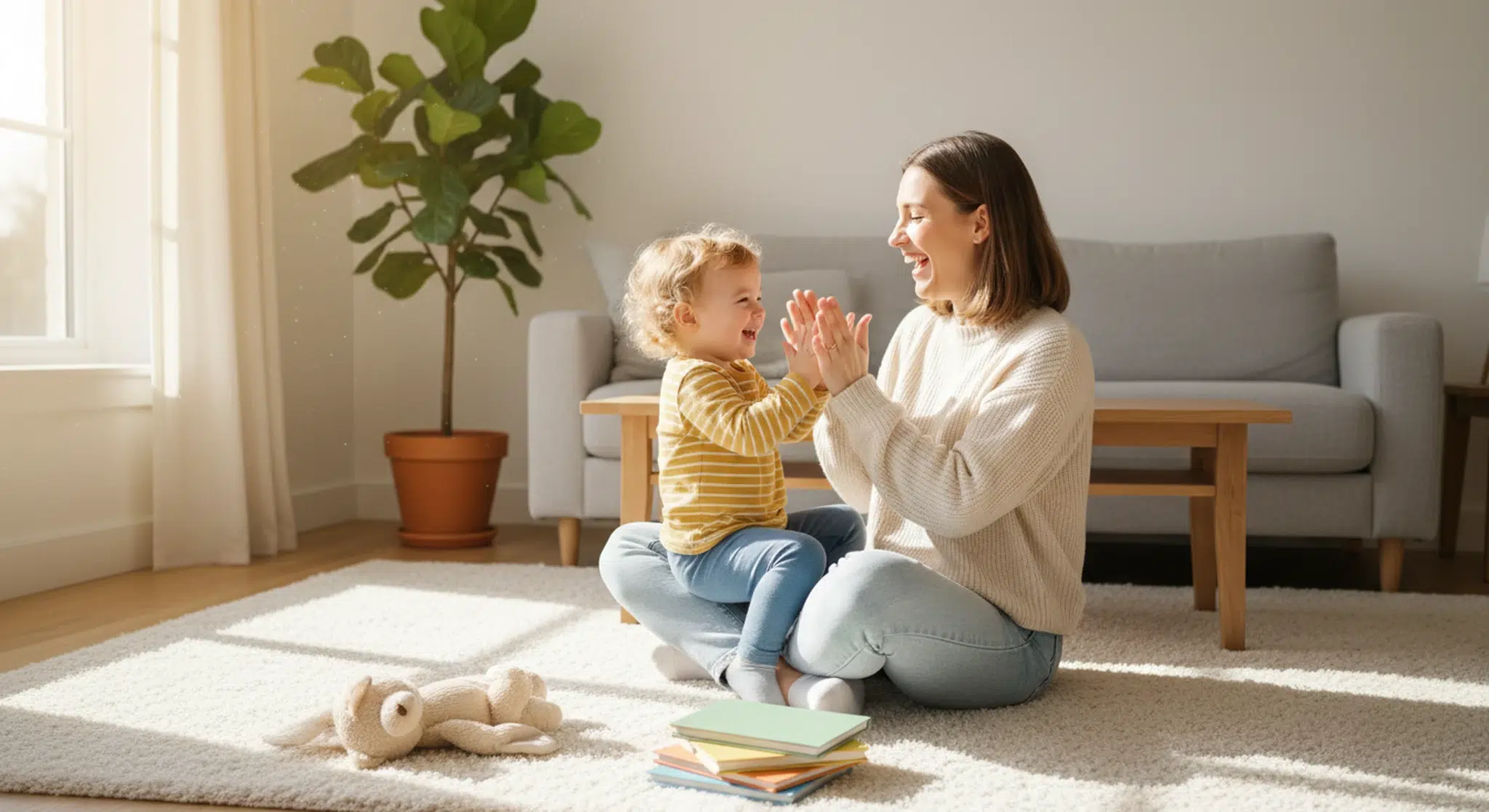
Nursery rhymes are short traditional verses and songs, like Humpty Dumpty, Pat-a-Cake and Twinkle, Twinkle, Little Star, and saying them with your child every day builds rhythm, early language and a little extra time together.
Nursery rhymes are often the very first poems and songs a child learns. They are short enough for a diaper change, silly enough for a toddler, and packed with rhythm, rhyme and repetition that little ears love.
Below are 40 classic rhymes with their words, taken from public-domain books on Project Gutenberg, grouped into Mother Goose classics, counting rhymes, action and finger plays, bedtime rhymes and animal rhymes. Each one comes with a quick note on how to play it, followed by what experts say about why rhymes help and how to use them at every age.
Key Takeaways
Start with a few classics and repeat them daily. Repetition is how babies and toddlers learn.
Add actions: clapping, toe wiggles, knee bounces and falling down make rhymes stick.
ZERO TO THREE links rhyming songs to phonemic awareness, a skill tied to later reading.
The CDC lists saying some words from a song, story or nursery rhyme as a milestone by age 4.
Folklorists reject the story that Ring Around the Rosie is about the plague.
Table of Contents
Nursery Rhymes at a Glance
Quick Answer
Nursery rhymes are short traditional verses and songs for young children. The best ones to start with are the classics: Humpty Dumpty, Jack and Jill, Hey Diddle Diddle, Pat-a-Cake, This Little Pig, Baa, Baa, Black Sheep, Hickory, Dickory, Dock and Twinkle, Twinkle, Little Star. This page prints 40 nursery rhymes with words, grouped by what they are good for: everyday classics, counting, clapping and finger play, bedtime and animals.
Every rhyme text below is copied from an old public-domain book that we read on Project Gutenberg in October 2026: The Real Mother Goose (1916, illustrated by Blanche Fisher Wright) and, for Twinkle, Twinkle, Little Star, the 1831 edition of Rhymes for the Nursery by Ann and Jane Taylor. We only tidied punctuation, so a few words may differ from the version you grew up with. That is normal: these rhymes were passed along by voice for generations, and families everywhere sing slightly different lines.
Group
Rhymes on this page
Good for
Great ages
Classic Mother Goose
Humpty Dumpty, Jack and Jill, Little Miss Muffet, Old King Cole and 9 more
Rhythm, rhyme, first stories
Birth and up
Counting rhymes
One, Two, Buckle My Shoe, Hickory, Dickory, Dock, Hot Cross Buns and 3 more
Numbers, order, patterns
Toddlers and preschoolers
Action and finger-play rhymes
Pat-a-Cake, This Little Pig, Pease Porridge Hot, Ring a Ring o’ Roses and 5 more
Clapping, touch, coordination, turn-taking
Babies to preschoolers
Bedtime rhymes
Twinkle, Twinkle, Little Star, Wee Willie Winkie, Bye, Baby Bunting and 3 more
Winding down, routine
Birth and up
Animal rhymes
Baa, Baa, Black Sheep, Three Blind Mice, Pussy-Cat, Pussy-Cat and 3 more
Animal sounds, pretend play
Babies to preschoolers
The 40 nursery rhymes on this page, by group.
Classic Mother Goose Nursery Rhymes
These are the rhymes most English-speaking grandparents can still recite. Start here if you only learn a handful. Say them slowly, lean on the beat, and pause before the last rhyming word so your child can fill it in once they know it.
1. Humpty Dumpty Humpty Dumpty sat on a wall, Humpty Dumpty had a great fall; All the King’s horses, and all the King’s men Cannot put Humpty Dumpty together again.
Why kids love it: the big “fall” is a perfect moment for a gentle lap drop (hold on tight) or a dramatic tumble with a stuffed toy.
2. Jack and Jill Jack and Jill went up the hill, To fetch a pail of water; Jack fell down, and broke his crown, And Jill came tumbling after.
Then up Jack got and off did trot, As fast as he could caper, To old Dame Dob, who patched his nob With vinegar and brown paper.
Why kids love it: a tiny story with a beginning, middle and end. Walk two fingers up your child’s arm for the hill and let them tumble back down.
3. Hey, Diddle, Diddle(The Cat and the Fiddle) Hey, diddle, diddle! The cat and the fiddle, The cow jumped over the moon; The little dog laughed To see such sport, And the dish ran away with the spoon.
Why kids love it: pure silliness, which is exactly why toddlers love it. Ask “Can a cow really jump over the moon?” and enjoy the giggles.
4. Little Miss Muffet(Miss Muffet) Little Miss Muffet Sat on a tuffet, Eating of curds and whey; There came a big spider, And sat down beside her, And frightened Miss Muffet away.
Why kids love it: a built-in surprise. Creep your fingers like a spider on “sat down beside her” and let your child squeal at “away.”
5. Little Bo-Peep(first verse) Little Bo-Peep has lost her sheep, And can’t tell where to find them; Leave them alone, and they’ll come home, And bring their tails behind them.
Why kids love it: the first verse is all little ones need. Hide a toy sheep and “find” it at the end.
6. Little Jack Horner Little Jack Horner Sat in the corner, Eating of Christmas pie: He put in his thumb, And pulled out a plum, And said, “What a good boy am I!”
Why kids love it: the thumb action is easy for toddlers to copy, and the proud last line is fun to say in a big voice.
7. Mary, Mary, Quite Contrary Mary, Mary, quite contrary, How does your garden grow? Silver bells and cockle-shells, And pretty maids all of a row.
Why kids love it: a question and answer, so two people can take turns. Swap in your child’s name for “Mary.”
8. Old King Cole Old King Cole Was a merry old soul, And a merry old soul was he; He called for his pipe, And he called for his bowl, And he called for his fiddlers three! And every fiddler, he had a fine fiddle, And a very fine fiddle had he. “Twee tweedle dee, tweedle dee,” went the fiddlers. Oh, there’s none so rare As can compare With King Cole and his fiddlers three.
Why kids love it: the “tweedle dee” line invites air-fiddling and silly sound play.
9. Little Boy Blue Little Boy Blue, come, blow your horn! The sheep’s in the meadow, the cow’s in the corn. Where’s the little boy that looks after the sheep? Under the haystack, fast asleep!
Why kids love it: a pretend horn (cupped hands) at the start and a pretend snore at the end.
10. Sing a Song of Sixpence(first three verses) Sing a song of sixpence, A pocket full of rye; Four-and-twenty blackbirds Baked in a pie!
When the pie was opened The birds began to sing; Was not that a dainty dish To set before the king?
The king was in his counting-house, Counting out his money; The queen was in the parlor, Eating bread and honey.
Why kids love it: rich, old-fashioned words to hear long before your child knows what they mean. Open your hands like a pie crust when the birds start to sing.
11. Polly, Put the Kettle On(Polly and Sukey) Polly, put the kettle on, Polly, put the kettle on, Polly, put the kettle on, And let’s drink tea.
Sukey, take it off again, Sukey, take it off again, Sukey, take it off again, They’re all gone away.
Why kids love it: the repeated lines make it one of the easiest songs for a toddler to join. Act it out at a toy tea party.
12. The Queen of Hearts(first verse) The Queen of Hearts, She made some tarts, All on a summer’s day; The Knave of Hearts, He stole the tarts, And took them clean away.
Why kids love it: a tiny mystery. Older preschoolers like guessing who took the tarts before you get there.
13. Rain, Rain, Go Away(Rain) Rain, rain, go away, Come again another day; Little Johnny wants to play.
Why kids love it: the perfect window-side chant on a wet afternoon. Use your child’s name in the last line.
Counting Rhymes
Counting rhymes put numbers in order with a beat, so children hear the sequence again and again. Hold up fingers as you go, or tap the numbers on your child’s toes.
14. One, Two, Buckle My Shoe One, two, Buckle my shoe; Three, four, Knock at the door; Five, six, Pick up sticks; Seven, eight, Lay them straight; Nine, ten, A good, fat hen; Eleven, twelve, Dig and delve; Thirteen, fourteen, Maids a-courting; Fifteen, sixteen, Maids in the kitchen; Seventeen, eighteen, Maids a-waiting; Nineteen, twenty, My plate’s empty.
Why kids love it: each pair of numbers comes with an action (buckle, knock, pick up, lay straight). Stop at ten for little ones.
15. One, Two, Three, Four, Five(One, Two, Three) One, two, three, four, five, Once I caught a fish alive. Six, seven, eight, nine, ten, But I let it go again. Why did you let it go? Because it bit my finger so. Which finger did it bite? The little one upon the right.
Why kids love it: counting to ten plus a question and answer at the end. Give a gentle “bite” to the right pinky.
16. Hickory, Dickory, Dock(The Mouse and the Clock) Hickory, dickory, dock! The mouse ran up the clock; The clock struck one, And down he run, Hickory, dickory, dock!
Why kids love it: run your fingers up your child’s arm for the mouse, clap once for “struck one,” and race back down.
17. Hot Cross Buns(first verse) Hot-cross Buns! Hot-cross Buns! One a penny, two a penny, Hot-cross Buns!
Why kids love it: short, chanty and easy to clap, with a built-in “one a penny, two a penny” count.
18. Thirty Days Hath September Thirty days hath September, April, June, and November; February has twenty-eight alone, All the rest have thirty-one, Excepting leap-year, that’s the time When February’s days are twenty-nine.
Why kids love it: a memory rhyme for older preschoolers and school-age kids, and proof that rhyme helps facts stick.
19. As I Was Going to St. Ives(Going to St. Ives) As I was going to St. Ives I met a man with seven wives. Every wife had seven sacks, Every sack had seven cats, Every cat had seven kits. Kits, cats, sacks, and wives, How many were going to St. Ives?
Why kids love it: a riddle rhyme for older kids. The classic answer is “just one”: the speaker was going to St. Ives and met the others coming the other way.
Action and Finger-Play Rhymes
Finger plays and action rhymes pair words with movement: clapping, tickling, bouncing and falling down. ZERO TO THREE notes that finger plays support fine motor skills, and that music and movement build balance and body awareness. These are the rhymes to reach for when your child needs to wiggle.
20. Pat-a-Cake Pat-a-cake, pat-a-cake, Baker’s man! So I do, master, As fast as I can.
Pat it, and prick it, And mark it with T, Put it in the oven For Tommy and me.
Why kids love it: the classic clapping game. Clap your hands together, then your baby’s, then “mark” the letter of your child’s own name on their tummy and use their name instead of Tommy.
21. This Little Pig(Five Toes) This little pig went to market; This little pig stayed at home; This little pig had roast beef; This little pig had none; This little pig said, “Wee, wee! I can’t find my way home.”
Why kids love it: wiggle one toe per line, starting with the big toe, and finish with a tickle up the leg. Babies learn to anticipate the ending.
22. Pease Porridge Hot(Pease Porridge) Pease porridge hot, Pease porridge cold, Pease porridge in the pot, Nine days old. Some like it hot, Some like it cold, Some like it in the pot, Nine days old.
Why kids love it: a partner clapping rhyme: clap your own hands, then each other’s. Start slowly and speed up as your preschooler gets the pattern.
23. Ring a Ring o’ Roses Ring a ring o’ roses, A pocketful of posies. Tisha! Tisha! We all fall down.
Why kids love it: hold hands in a circle, walk around and tumble down together. Many families sing it as “Ring Around the Rosie” with different middle words.
24. Here We Go Round the Mulberry Bush(The Mulberry Bush, first two verses) Here we go round the mulberry bush, The mulberry bush, the mulberry bush, Here we go round the mulberry bush. On a cold and frosty morning.
This is the way we wash our hands, Wash our hands, wash our hands, This is the way we wash our hands, On a cold and frosty morning.
Why kids love it: make up your own verses for daily tasks (brush our teeth, put on our shoes). It turns routines into a game.
25. Jack Be Nimble(Jack) Jack be nimble, Jack be quick, Jack jump over the candlestick.
Why kids love it: two lines and a jump. Use a block or a book on the floor as the “candlestick” (never a real candle).
26. Ride a Cock-Horse to Banbury Cross(Banbury Cross) Ride a cock-horse to Banbury Cross, To see an old lady upon a white horse. Rings on her fingers, and bells on her toes, She shall have music wherever she goes.
Why kids love it: a knee-bouncing rhyme. Bounce gently to the beat while holding your child securely, and wiggle fingers and toes at the end.
27. To Market, to Market(To Market) To market, to market, to buy a fat pig. Home again, home again, jiggety jig. To market, to market, to buy a fat hog, Home again, home again, jiggety jog. To market, to market, to buy a plum bun, Home again, home again, market is done.
Why kids love it: another knee ride. “Jiggety jig” begs for a little bounce, and the rhyme ends calmly, which makes it a nice wind-down.
28. Here Sits the Lord Mayor(Forehead, Eyes, Cheeks, Nose, Mouth, and Chin) Here sits the Lord Mayor, Here sit his two men, Here sits the cock, Here sits the hen, Here sit the little chickens, Here they run in. Chin-chopper, chin-chopper, chin chopper, chin!
Why kids love it: a face rhyme. Touch the forehead, eyes, cheeks, nose and mouth in turn, then tap the chin at the end. Babies often watch your face closely through the whole thing.
Big days go better with a good night of sleep.
Got a little one at home too? Our free two-minute quiz builds a gentle, personalized sleep plan for babies and toddlers.
Quiet, repetitive rhymes make a natural last step in a toddler bedtime routine. Say or sing them in a low, slow voice and use the same one every night so it becomes a cue that sleep is coming. This page sticks to spoken and sung rhymes; for full lullabies, see our lullaby lyrics and best lullabies for babies.
29. Twinkle, Twinkle, Little Star(“The Star,” all five verses as printed in the 1831 edition) Twinkle, twinkle, little star, How I wonder what you are! Up above the world so high, Like a diamond in the sky.
When the blazing sun is gone, When he nothing shines upon, Then you show your little light, Twinkle, twinkle, all the night.
Then the trav’ller in the dark, Thanks you for your tiny spark: He could not see which way to go, If you did not twinkle so.
In the dark blue sky you keep, And often through my curtains peep, For you never shut your eye Till the sun is in the sky.
As your bright and tiny spark Lights the trav’ller in the dark, Though I know not what you are, Twinkle, twinkle, little star.
Why kids love it: most people only know the first verse, but the original poem has five. Open and close your hands to make the star twinkle.
30. Wee Willie Winkie Wee Willie Winkie runs through the town, Upstairs and downstairs, in his nightgown; Rapping at the window, crying through the lock, “Are the children in their beds? Now it’s eight o’clock.”
Why kids love it: a gentle “it’s bedtime” signal. Knock softly on the bedroom door frame on “rapping at the window.”
31. Hush-a-Bye, Baby(the “Rock-a-Bye, Baby” most families know) Hush-a-bye, baby, on the tree top! When the wind blows the cradle will rock; When the bough breaks the cradle will fall; Down will come baby, bough, cradle and all.
Why kids love it: the slow, swaying beat is made for rocking in your arms. It is a song, not sleep advice: when you lay your baby down, they sleep alone, on their back, on a firm, flat, bare surface (see our safe sleep environment checklist).
32. Bye, Baby Bunting Bye, baby bunting, Father’s gone a-hunting, Mother’s gone a-milking, Sister’s gone a-silking, And brother’s gone to buy a skin To wrap the baby bunting in.
Why kids love it: swap in the names of the real people in your house to make it personal.
33. Diddle, Diddle, Dumpling Diddle diddle dumpling, my son John Went to bed with his breeches on, One stocking off, and one stocking on; Diddle diddle dumpling, my son John.
Why kids love it: a funny one for pajama time. Pull off one sock and leave one on, then fix it together.
34. The Man in the Moon(Bedtime) The Man in the Moon looked out of the moon, Looked out of the moon and said, “‘Tis time for all children, on the earth To think about getting to bed!”
Why kids love it: short enough to say at the window while you say goodnight to the moon.
Animal Rhymes
Animal rhymes come with ready-made sound effects. Pause for your child to add the baa, the mew or the cluck.
35. Baa, Baa, Black Sheep Baa, baa, black sheep, Have you any wool? Yes, marry, have I, Three bags full;
One for my master, One for my dame, But none for the little boy Who cries in the lane.
Why kids love it: a question and answer plus counting to three. Many families sing newer words (“Yes sir, yes sir” and a gentler last line), and either version is fine.
36. Three Blind Mice Three blind mice! See how they run! They all ran after the farmer’s wife, Who cut off their tails with a carving knife. Did you ever see such a thing in your life As three blind mice?
Why kids love it: a fast, tumbling tune that older kids can try singing as a round. Skip it for a sensitive toddler if the tail line worries them.
37. Pussy-Cat, Pussy-Cat(Pussy-Cat and Queen) “Pussy-cat, pussy-cat, Where have you been?” “I’ve been to London To look at the Queen.”
“Pussy-cat, pussy-cat, What did you there?” “I frightened a little mouse Under the chair.”
Why kids love it: a back-and-forth dialogue. You ask the questions and let your child answer as the cat.
38. Little Robin Redbreast(Robin Redbreast, first verse) Little Robin Redbreast sat upon a tree, Up went Pussy-Cat, down went he, Down came Pussy-Cat, away Robin ran, Says little Robin Redbreast: “Catch me if you can!”
Why kids love it: “Catch me if you can!” is an invitation to a short chase around the living room.
39. Once I Saw a Little Bird(The Little Bird) Once I saw a little bird Come hop, hop, hop; So I cried, “Little bird, Will you stop, stop, stop?”
And was going to the window To say, “How do you do?” But he shook his little tail, And far away he flew.
Why kids love it: hop, hop, hop and stop, stop, stop are great for practicing stopping on cue, a fun early movement game.
40. Hickety, Pickety, My Black Hen(The Black Hen) Hickety, pickety, my black hen, She lays eggs for gentlemen; Gentlemen come every day To see what my black hen doth lay.
Why kids love it: the bouncy nonsense opening is fun to say and easy to clap.
More Songs Kids Love (Titles Only)
Some of the most popular songs for little kids are newer, or their words come in many modern versions, so we name them here without printing the words. You will find them in children’s music collections and at library story times. Our kids songs guide has a longer playlist.
The Wheels on the Bus: an action song where each verse names a part of the bus and a motion to go with it.
Itsy Bitsy Spider: a finger play about a spider climbing a spout, with finger-climbing motions.
If You’re Happy and You Know It: a call-and-response action song that names a motion in each verse.
Head, Shoulders, Knees and Toes: a body-parts song where children touch each part as they sing it.
Five Little Monkeys Jumping on the Bed: a count-down rhyme with fingers, one monkey at a time.
Baby Shark: a modern counting and family song with big arm motions.
Old MacDonald Had a Farm: a farm song built around animal sounds, verse by verse.
Mary Had a Little Lamb: a gentle story song about a lamb that follows a girl to school.
Row, Row, Row Your Boat: a rocking song that works for rowing back and forth together on the floor.
Bingo: a spelling song where letters are swapped for claps, one per verse.
Why Rhymes Help Kids Learn
Rhymes look like simple fun, and they are. They also pack a lot into a few seconds of play. Here is what the experts we checked actually say.
Language and the sounds of words: ZERO TO THREE describes music as an easy-to-enter window into practicing language, and points out that most songs include rhyming, which supports phonemic awareness, a skill linked to later reading. Rhymes let children hear how words can sound alike and different.
Reading later on: in a randomized study published in Developmental Psychology in 2022, kindergarteners who recited or repeatedly listened to nursery rhymes for ten sessions over two months read faster a year later than a control group, and the children who recited the rhymes did best on reading and spelling. It is one study (with rhymes in Modern Standard Arabic), so treat it as encouraging rather than a guarantee.
Memory and routine: ZERO TO THREE cites research in which babies as young as 8 months recognized familiar music after a two-week break, and suggests repeating the same song at the same time of day, such as nap time, so babies link it with the routine.
Bonding: the American Academy of Pediatrics (AAP), in its literacy promotion guidance, encourages parents to share books and language from infancy, and its lead author describes linking reading with lap time, security, stories, rhymes and entertainment. ZERO TO THREE adds that the pleasure of sharing music builds connections between parent and child.
Movement and coordination: finger plays support fine motor skills, and dancing or being rocked to music supports gross motor skills, balance and body awareness, according to ZERO TO THREE.
A milestone to watch for: the CDC’s milestone checklist for age 4 includes “Says some words from a song, story, or nursery rhyme.” CDC milestones describe what most children (75% or more) can do by that age.
None of this needs flash cards or apps. A rhyme in the bath, a knee bounce after diaper changes, or a counting chant on the stairs is plenty. If you are curious about first words, our guide to when babies start talking covers the typical timeline.
How to Use Rhymes by Age
You do not need a good singing voice: your child cares about you, not your pitch. Match the rhyme to your child’s stage:
Age
Try these rhymes
How to play
Newborn to 6 months
Hush-a-Bye, Baby, Bye, Baby Bunting, Twinkle, Twinkle, Little Star
Sing softly while you rock, feed or change. Keep your face close so your baby can watch your mouth.
6 to 12 months
This Little Pig, Pat-a-Cake, Here Sits the Lord Mayor, To Market
Touch toes, clap hands and tap the face. Pause before the tickle so your baby learns to expect it.
12 to 24 months
Humpty Dumpty, Ring a Ring o’ Roses, Jack Be Nimble, Hickory, Dickory, Dock
Add big moves: falling down, jumping, running fingers up an arm. Let your toddler do the action word.
2 to 3 years
Baa, Baa, Black Sheep, Polly, Put the Kettle On, Little Miss Muffet, Pussy-Cat, Pussy-Cat
Stop before the last word of a line and let your child fill it in. Act rhymes out with toys.
3 to 5 years
One, Two, Buckle My Shoe, Pease Porridge Hot, As I Was Going to St. Ives, Thirty Days Hath September
Partner clapping, counting with fingers, swapping in silly new words and making up extra verses.
Nursery rhymes by age, with action ideas.
Babies: repetition is the point. The same five rhymes every day are better than fifty rhymes once. For more baby play, see our infant activities.
Toddlers: let them lead. If they ask for Humpty Dumpty twelve times in a row, that is practice, not boredom. Pair rhymes with movement and touch, like the ideas in our sensory activities for toddlers.
Preschoolers: play with the words. Change Jack and Jill to your child’s name and a friend’s, rhyme nonsense words with their name, or ask what happens next in the story.
Everyone: turn the screen off and make it face to face. Rhymes work best as a back-and-forth game between you and your child.
Where These Rhymes Come From (and the Myths to Skip)
Most nursery rhymes have no known author. They were sung and said aloud long before anyone wrote them down, which is why collections disagree on the exact words. The Real Mother Goose, the 1916 book we used for most of the texts on this page, gathers about 300 of them with color illustrations by Blanche Fisher Wright, and its words often differ a little from what families sing today. Twinkle, Twinkle, Little Star is different: it began as a poem called “The Star” in Rhymes for the Nursery by Ann and Jane Taylor, and the old edition has five verses, not one.
You will also hear plenty of dark “secret meanings” online. Treat them with care. The best known is that Ring Around the Rosie is about the plague. Stephen Winick of the Library of Congress American Folklife Center writes that this interpretation emerged in the mid-twentieth century and has never been accepted by folklorists. He notes that the rhyme does not turn up in English print until 1881, in Kate Greenaway’s Mother Goose or the Old Nursery Rhymes, and that folklorists Iona and Peter Opie mentioned the plague idea in 1951 only to say they were not convinced. Folklorist Steve Roud, as Winick reports, called the plague origin “complete nonsense.”
Stories about what Humpty Dumpty, Baa, Baa, Black Sheep or Mary, Mary, Quite Contrary “really” mean go around too. We could not confirm any of them with a reliable source, so we leave them out. Your toddler only needs the rhythm and the fun.
Some old versions also include lines that feel harsh today (scoldings, punishments, the odd unlucky animal). We printed the verses that suit little kids and marked where we stopped. If a line bothers you, change it. Families have always adapted these rhymes, and that is part of the tradition. Want stories to go with your rhymes? Try our bedtime stories for kids or the gentle songs in lullaby songs for babies.
Nursery rhymes are free, quick and endlessly repeatable. Pick three or four from this list, say them every day with actions and eye contact, and add new ones as your child grows. Clapping to Pat-a-Cake, counting with One, Two, Buckle My Shoe and winding down with Twinkle, Twinkle, Little Star give your child rhythm, rhyme and time with you, all at once. If you notice your child is not joining in with sounds, words or songs the way you expected for their age, mention it at the next well-child visit.
Frequently Asked Questions
What are the most popular nursery rhymes?
Some of the most widely known nursery rhymes are Humpty Dumpty, Jack and Jill, Hey Diddle Diddle, Little Miss Muffet, Baa, Baa, Black Sheep, Hickory, Dickory, Dock, Pat-a-Cake, This Little Pig, Ring Around the Rosie and Twinkle, Twinkle, Little Star. They appear in old Mother Goose collections and are still sung by families and at library story times today.
Why are nursery rhymes important for child development?
Rhymes give children repeated practice hearing how words sound, which ZERO TO THREE links to phonemic awareness and later reading. They also build memory, rhythm and coordination when paired with actions, and they create warm, face to face time between you and your child. A daily rhyme or two is enough to make a difference.
At what age should a child know nursery rhymes?
There is no test age, and you can start at birth. Babies enjoy hearing rhymes long before they can join in, and toddlers start filling in words and doing the actions. The CDC milestone checklist for age 4 includes saying some words from a song, story or nursery rhyme. Ask your pediatrician if you have concerns.
Is Ring Around the Rosie about the plague?
Folklorists say no. The Library of Congress American Folklife Center explains that the plague interpretation appeared in the mid-twentieth century and has never been accepted by folklorists. The rhyme first appears in English print in 1881, and folklorist Steve Roud called the plague origin complete nonsense. It is simply a circle game that ends with everyone falling down.
What is the difference between a nursery rhyme and a lullaby?
A nursery rhyme is a short traditional verse or song for young children, often playful, with actions, counting or a funny story. A lullaby is a soothing song sung to help a baby settle and fall asleep. Some rhymes, like Hush-a-Bye, Baby and Twinkle, Twinkle, Little Star, work as both and fit nicely into a bedtime routine.
Are nursery rhymes songs or poems?
Both. Many nursery rhymes are spoken chants, like This Little Pig or Humpty Dumpty, while others are usually sung to a familiar tune, like Baa, Baa, Black Sheep or Twinkle, Twinkle, Little Star. Twinkle, Twinkle began as a written poem called The Star by Ann and Jane Taylor before it became a song. Either way, rhythm and rhyme are what count.
Gentle changes, peaceful nights.
Betteroo builds a personalized sleep plan for your baby or toddler. Take the free two-minute quiz to get started.
Taylor, Ann and Jane Taylor. Rhymes for the Nursery (London: Harvey and Darton, 1831). Project Gutenberg eBook #77549. https://www.gutenberg.org/ebooks/77549