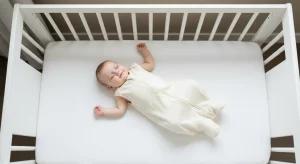
Every culture on earth sings its babies to sleep. Long before sound machines and sleep apps, there were lullabies: slow, repetitive, slightly melancholy songs that parents have hummed in dark rooms for thousands of years. And it turns out the instinct is backed by science. Singing to your baby is one of the simplest, cheapest, most portable sleep tools you have.
In Betteroo’s State of Baby Sleep survey, 33% of families use singing to settle their baby, making it one of the most common soothing tools after feeding and rocking. Unlike those two, a lullaby never needs to be weaned, never wakes a baby during the put-down, and works in the car, at grandma’s, and through a closed door.
Here is what the research says about why lullabies work, the classic and modern songs that parents swear by, and how to build singing into a bedtime routine that actually improves sleep.
Table of Contents
Why Lullabies Work: The Science
They lower arousal, measurably. In a landmark study of 272 premature infants, live lullaby singing slowed heart rates and improved sleep, and parent-sung lullabies also decreased parents’ own stress 1. Your nervous system calms alongside your baby’s, which is half the magic.
Your voice beats any recording. Babies prefer and respond more strongly to their own parent’s voice. The technically imperfect, slightly off-key version of you is the premium product.
They are a powerful sleep cue. Repetition is how babies learn that sleep is coming. The same song, in the same spot in the routine, becomes a conditioned signal: when this melody starts, sleep follows. Consistent bedtime routines are among the best-evidenced sleep interventions in young children 2, and a lullaby is the easiest routine step to keep identical every night.
The form is engineered for sleep. Lullabies across cultures share traits: slow tempo (roughly 60 to 100 beats per minute, near a resting heart rate), simple repeated melodies, gentle descending lines. Your baby’s breathing tends to entrain toward the rhythm.
The Classic Lullabies (and Why They Last)
Twinkle, Twinkle, Little Star. Six notes of range, endless repetition, universally known. The melody (from a French folk tune) has survived 250 years because it works.
Brahms’ Lullaby (Wiegenlied). The genre’s anthem, written in 1868. The gentle 3/4 sway mimics rocking.
Hush, Little Baby. A list song: the repetitive structure makes it easy to sing on autopilot at 2 a.m., and easy to extend forever.
Rock-a-Bye Baby. Slow, swaying, and ancient. Nobody is parsing the lyrics about the falling cradle, least of all your baby.
You Are My Sunshine. Technically not a lullaby, universally used as one. Slow it down and it is perfect.
Somewhere Over the Rainbow. The long, settling phrases reward a slow tempo, and most parents already know every word.
Modern Songs That Make Great Lullabies
The real rule: any song you love, slowed down and sung softly, becomes a lullaby. Songs parents told us they use include Can’t Help Falling in Love, Blackbird, Here Comes the Sun, Stand by Me, Landslide, and Coldplay’s Yellow. Picking a song that means something to you has a hidden benefit: you will not resent singing it 4,000 times, and your calm genuinely transfers.
How to Use Lullabies in the Bedtime Routine
Anchor it in the same slot every night. Feed, pajamas, dim lights, song, crib. The lullaby works best as the final cue before the put-down.
Keep it short and consistent. One or two songs, the same ones, every night. Variety is for playtime; repetition is for sleep.
Sing low, slow, and quieter as you go. Start at speaking volume and fade toward a hum. The decrescendo itself signals wind-down.
Put the baby down awake when you can. The lullaby’s job is to calm, not to be the thing your baby needs until the final second of consciousness. Singing a verse with your hand resting on their chest after the put-down bridges the gap beautifully.
Recordings are a supplement, not a replacement. A quiet playlist or a sound machine with lullaby modes can extend the mood, but switch to plain white noise for the actual night: continuous, boring sound supports sleep cycles better than music that changes. See our sound machine guide.
From Betteroo’s State of Baby Sleep
How babies fall asleep in our survey: feeding 63%, rocking 60%, a parent sitting nearby 42%, singing 33%, falling asleep alone 10%. Singing pairs naturally with the others, and unlike feeding or rocking to sleep, it is an association you will never need to break. Explore the full data →
What If My Singing Is Terrible?
Your baby disagrees, and they are the only critic in the room. Infants orient to their parents’ voices over professionally produced music, pitch accuracy irrelevant. If you truly cannot bring yourself to sing, humming works, slow speech in a sing-song rhythm works, and so does a quiet recorded lullaby with you present. But give your own voice a chance first. It is the one instrument your baby has been listening to since before birth.
What is the most effective lullaby for putting a baby to sleep?
The one you sing consistently. Research points to live parental singing, slow tempo, and repetition as the active ingredients, not any specific song. Twinkle Twinkle and Brahms’ Lullaby endure because they are simple and easy to repeat identically every night.
Should I leave lullaby music playing all night?
No. Music that shifts and changes can disturb light sleep phases. Use lullabies for the wind-down, then switch to continuous white noise (or silence) for the night itself.
When should I start singing lullabies to my baby?
From day one, and even before: babies hear and learn their parents’ voices in the womb. Newborns will not understand the routine yet, but the calming effect on both of you starts immediately.
Do lullabies actually help babies sleep better?
As part of a consistent routine, yes. Studies show lullaby singing lowers infant arousal and stress, and consistent bedtime routines reduce night waking and settling time. A lullaby alone will not fix a broken schedule, but it strengthens every routine it joins.
Is white noise better than lullabies?
They do different jobs. Lullabies are a wind-down cue and a bonding tool before sleep; white noise is an environment tool that masks household sounds during sleep. Most families do best using both, in that order.
A lullaby is one piece. Here’s the whole puzzle.
Get a personalized sleep plan built around your baby’s age, temperament, and your family’s needs.
You do not need the perfect song, the perfect voice, or a curated playlist. You need one slow melody, sung by you, in the same dim room, at the same point every night. That is the whole technology, and it has outlasted every gadget for a reason. For where the song fits in the bigger picture, see our newborn sleep routine and baby sleep schedule by age guides.
2 Sources
Loewy, J., Stewart, K., Dassler, A.M., Telsey, A., & Homel, P. (2013). The Effects of Music Therapy on Vital Signs, Feeding, and Sleep in Premature Infants. Pediatrics, 131(5), 902–918. https://pubmed.ncbi.nlm.nih.gov/23589814/
Mindell, J.A., Telofski, L.S., Wiegand, B., & Kurtz, E.S. (2009). A Nightly Bedtime Routine: Impact on Sleep in Young Children and Maternal Mood. Sleep, 32(5), 599–606. https://pubmed.ncbi.nlm.nih.gov/19480226/
Lullabies pair beautifully with a few quiet words at lights-out. See our bedtime prayers for kids by age for more calming bedtime rituals.