How many words should an 18 month old say? The CDC’s 2022 milestone checklist says most toddlers try to say three or more words besides “mama” or “dada” by 18 months, and many say far more.
If you are asking how many words should an 18 month old say, you are in good company. It is one of the most searched toddler questions, and the answers online are all over the place. Some lists say 10 words, some say 20, and some still use milestones that changed in 2022.
This guide sticks to the current CDC and AAP milestones and ASHA’s guidance on late talkers. You will find a month-by-month word table from 12 to 24 months, what counts as a word, how to help, and how to ask for an evaluation if you are worried.
Key Takeaways
CDC: by 18 months, most toddlers try to say three or more words besides mama or dada.
CDC milestones show what 75% or more of children can do, so missing one is a reason to check in.
The AAP says toddlers learn about one new word a week from 18 months and say about 50 to 100 words by 2.
ASHA defines late talking as fewer than 50 words and no word combinations by 24 months.
You can request a free early intervention evaluation without a doctor’s referral if your child is under 3.
Table of Contents
How Many Words Should an 18 Month Old Say? The Short Answer
Quick Answer
By 18 months, the CDC’s milestone checklist (updated with the American Academy of Pediatrics in 2022) says most toddlers try to say three or more words besides “mama” or “dada” and follow one-step directions without gestures. Many children say far more. The AAP adds that toddlers learn about one new word per week between 1 1/2 and 2 years and can say about 50 to 100 words by age 2. If your child is not trying to say three words at 18 months, talk to your pediatrician and ask about a developmental screening.
Three words can sound like a low bar, and it is meant to be. The CDC milestones describe what most children (75% or more) can do by a given age, so they work as a “time to check in” line, not an average. A typical 18 month old may say anywhere from a handful of words to many more.
Words are also only part of the picture. Understanding, pointing, gestures and turn-taking all count, and doctors look at them together.
What the CDC 18 Month Milestone Checklist Says
Here are the communication-related milestones from the CDC’s “Milestones by 18 Months” checklist, in plain terms:
Language: tries to say three or more words besides “mama” or “dada”.
Understanding: follows one-step directions without any gestures, such as giving you a toy when you say “Give it to me.”
Social communication: points to show you something interesting, and looks at a few pages in a book with you.
Play and imitation: copies you doing chores, like sweeping, and plays with toys in a simple way, like pushing a toy car.
For comparison, the CDC’s 15 month checklist says most children try to say one or two words besides “mama” or “dada” (like “ba” for ball or “da” for dog), look at a familiar object when you name it, and point to ask for something or to get help. By 2 years, the CDC lists saying at least two words together, like “More milk,” and pointing to things in a book when you ask.
In 2022 the CDC and the AAP revised the “Learn the Signs. Act Early.” checklists. The work was published in the journal Pediatrics (Zubler and colleagues, 2022). The key change: each milestone is now one that most children (75% or more) would be expected to reach by that health supervision visit age.
According to that paper, the revision cut the number of previous milestones by 26.4% and replaced 40.9% of them. About one third of the milestones that stayed were moved to a different age, and 67.7% of those moves were to an older age.
What this means for you:
A milestone is not the average. If your child has not reached one, they are behind most peers, which is why the CDC advises acting early rather than waiting.
Meeting a milestone is a minimum, not a goal. Many 18 month olds say well over three words.
Older lists you may find online use different ages and numbers. When in doubt, use the current CDC checklist and your pediatrician’s screening.
Big days go better with a good night of sleep.
Got a little one at home too? Our free two-minute quiz builds a gentle, personalized sleep plan for babies and toddlers.
There is no official word count for each month. The CDC sets checkpoints at 15, 18 and 24 months, and the AAP describes a general pace. The table below shows what those sources say and how to read the months in between. Treat it as a guide, not a test.
Age
What sources say
How to read it
12 months
Says at least 1 word (AAP)
First words are just starting
13 to 14 months
Between the CDC’s 12 and 15 month checkpoints
Expect a slow trickle of new words and lots of babble, pointing and gesturing
15 months
Tries to say one or two words besides “mama” or “dada” (CDC)
A couple of real or approximate words, like “ba” for ball
16 to 17 months
Between the 15 and 18 month checkpoints
Words keep slowly adding up; understanding grows faster than speech
18 months
Tries to say three or more words besides “mama” or “dada” (CDC)
The CDC checkpoint; many children say more
19 to 22 months
About 1 new word per week between 1 1/2 and 2 years (AAP)
New words should be showing up regularly; some children have a sudden burst
24 months
Says at least two words together (CDC); about 50 to 100 words (AAP)
Two-word phrases like “more milk” appear
Word milestones from 12 to 24 months. Sources: CDC milestone checklists; American Academy of Pediatrics (HealthyChildren.org).
Parents often undercount. A “word” does not have to be pronounced perfectly. The CDC’s own 15 month example counts “ba” for ball and “da” for dog. In general, a sound usually counts as a word when your child:
Uses the same sound for the same thing, again and again.
Uses it on purpose, to name, ask or comment.
Uses it without simply copying you in that moment.
Animal sounds (“moo”), exclamations (“uh-oh”) and names of people or pets often count when they are used consistently. Signs and gestures do not count toward the CDC’s spoken-word milestone, but they matter: ASHA, the American Speech-Language-Hearing Association, reports research finding that late talkers who caught up used more communicative gestures than those who stayed delayed. If you use baby sign language, keep saying the word every time you sign it.
Bilingual toddlers: ASHA says bilingual children learn vocabulary at the same rate as children who speak one language when the vocabularies in both languages are counted together, and that late language emergence is not a result of learning two languages. Count words in every language your child uses, and do not drop a home language to “help” speech; ASHA says monolingualism should not be advised as a response to late talking.
Late Talker or Speech Delay?
“Late talker” is an everyday term for a toddler whose spoken language is behind expectations. ASHA calls this late language emergence and describes it with these numbers:
Common benchmark: an expressive vocabulary of fewer than 50 words and no two-word combinations by 24 months.
How common: an estimated 13.5% of 18 to 23 month olds, and mostly between 10% and 20% of 2 year olds.
Boys: about 3 times more likely than girls.
Outlook: about 50% to 70% catch up to their peers.
The AAP similarly notes that 1 out of 5 children learn to talk or use words later than other children their age. Simple speech delays are sometimes temporary, the AAP says, but delays can also be a sign of hearing loss, another developmental delay or autism spectrum disorder, which is why evaluation matters.
ASHA lists warning signs that point toward a bigger issue: not starting to use words, no “vocabulary spurt,” and not starting to combine words in the second year. It also notes that children whose understanding is delayed tend to have a harder road than children whose delay is mainly in talking. Other risk factors ASHA lists include a parent with a history of late talking and being born at less than 85% of optimal birth weight.
No one can tell you on day one which late talker will catch up on their own, so the safest move is to get a screening early rather than wait and see.
How to Help Your 18 Month Old Say More Words
The CDC suggests these activities around 18 months:
Add to their words: if your child says “ball,” you say “Big ball!” or “Roll the ball.”
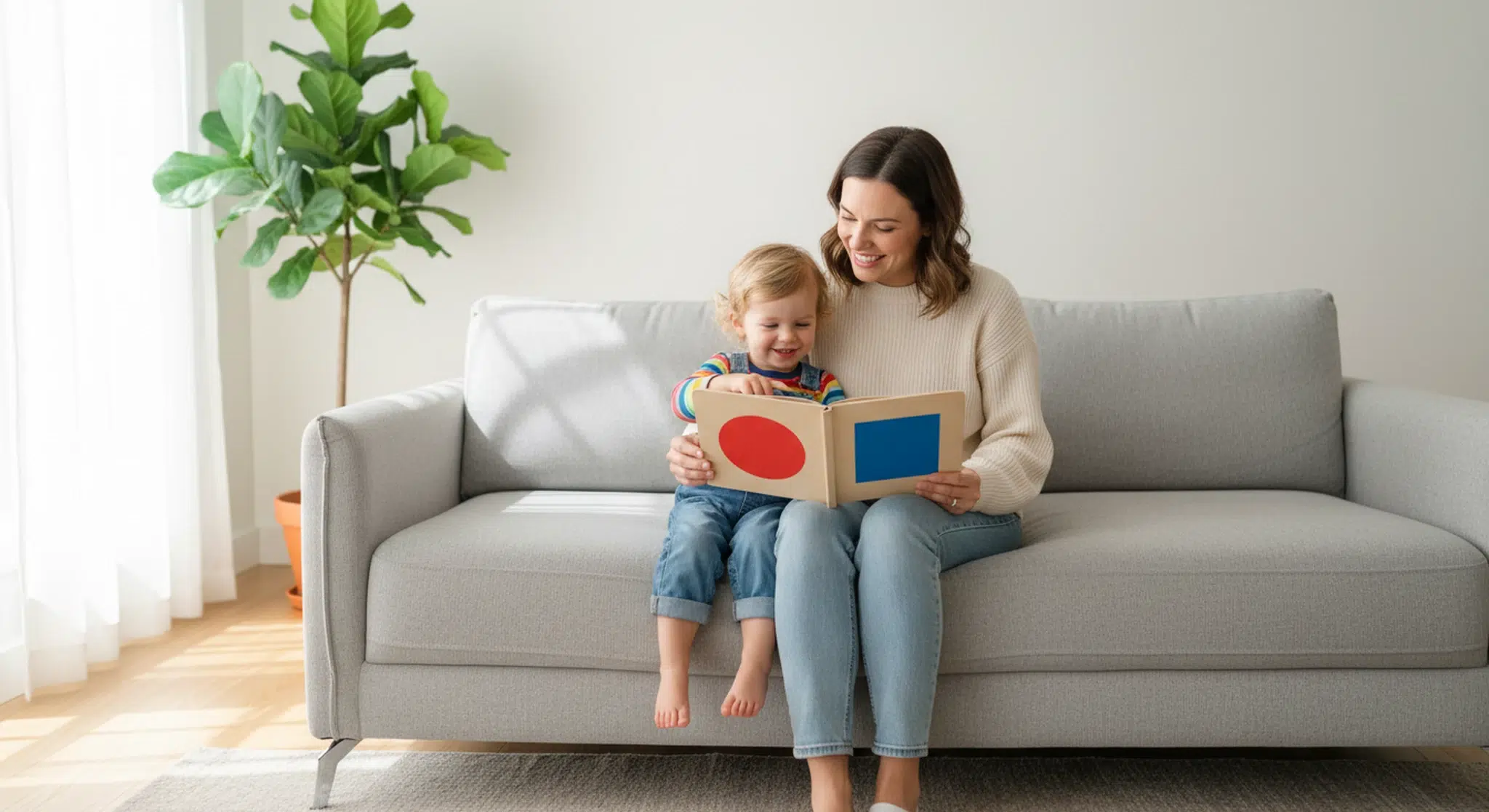
Read and talk about pictures: use simple words and point as you name things.
Ask simple questions: about what is around you, and wait for a response.
Get face to face: talk at your child’s eye level when you can.
Name body parts: point them out during bath or dressing.
Limit screens: the CDC says screen time is not recommended for children under 2, apart from video calls, and suggests limiting your own screen use around your child.
The AAP adds to spend lots of time playing with, reading to and talking with your toddler, and to encourage your child to “talk” to you with gestures or sounds. A few other habits make these tips easier:
Narrate daily routines: “Shoes on. One shoe, two shoes.”
Pause and give your child time to fill a gap, even if it is only a sound or a point.
Offer choices (“Apple or banana?”) so your child has a reason to use a word.
For more play ideas that build words naturally, see our toddler activities.
You do not need to wait for a problem to be obvious. The CDC notes that the AAP recommends developmental screening with standardized tools at 9, 18 and 30 months, and autism screening at 18 and 24 months or whenever a parent or provider has a concern. The 18 month checkup is a natural time to bring up talking.
If there is a concern, the AAP says the doctor may order a hearing test and refer your child to a speech and language therapist. ASHA also recommends a hearing screening to rule out hearing loss as a contributing factor.
How to request Early Intervention:
If your child is younger than 3, the CDC says to contact your state’s early intervention program and request a free evaluation.
You do not need a doctor’s referral or a medical diagnosis to make that call, per the CDC.
The AAP notes early intervention is federally and state funded and that a child does not need a diagnosis to receive services.
At age 3 and older, the CDC says to contact your local public elementary school about an evaluation for preschool services.
You know your child best, and the CDC is clear: if you are concerned, do not wait. Language worries are rarely emergencies, but some signs deserve a prompt call.
Call your pediatrician promptly (do not wait for the next checkup) if your child:
Loses words or other skills they used to have (CDC, AAP).
Stops responding to their name or to sounds, or you wonder whether they can hear.
Bring it up soon, or at the 18 month visit, if your child:
Is not trying to say three or more words besides “mama” or “dada” by 18 months (CDC).
Does not follow simple one-step directions, or point to show you things (CDC).
Is not adding new words, or uses few gestures (ASHA).
Does not combine two words by 2 years (CDC), or says fewer than 50 words at 24 months (ASHA).
Ask about a developmental screening and a hearing check, and if you are still worried, call your state’s early intervention program directly. The AAP notes you can seek a second opinion if you are told not to worry but remain concerned. Getting help early is never wasted.
Frequently Asked Questions
How many words should an 18 month old say?
The CDC’s milestone checklist says most children try to say three or more words besides mama or dada by 18 months, and follow one-step directions without gestures. That is a minimum most children reach, not an average, so many toddlers say more. If your child is not there yet, ask your pediatrician about a screening.
Is it normal for an 18 month old to not talk?
Some toddlers talk later than others, but not trying to say any words at 18 months is a reason to talk to your pediatrician now. ASHA estimates late language emergence in about 13.5% of 18 to 23 month olds, and about 50% to 70% catch up. Screening helps find children who need support.
How many words should a 2 year old say?
The AAP says children can say about 50 to 100 words by age 2, and the CDC milestone is saying at least two words together, like more milk. ASHA describes late language emergence as fewer than 50 words and no two-word combinations at 24 months.
What is a late talker?
A late talker is a toddler whose spoken language is behind expectations while other development may be on track. ASHA calls this late language emergence and often uses fewer than 50 words and no word combinations at 24 months as a benchmark. Boys are about three times more likely to be late talkers.
Do baby signs and animal sounds count as words?
Animal sounds and approximations often count if your child uses them consistently and on purpose; the CDC counts ba for ball. Signs and gestures do not count toward spoken words, but ASHA notes that late talkers who catch up tend to use more gestures. Keep saying the word whenever you sign.
When should I worry about my toddler’s speech?
Talk to your pediatrician if your child is not trying to say three words at 18 months, does not point or follow simple directions, stops adding words, or loses skills. Under age 3, you can also call your state’s early intervention program for a free evaluation without a referral, per the CDC.
Gentle changes, peaceful nights.
Betteroo builds a personalized sleep plan for your baby or toddler. Take the free two-minute quiz to get started.