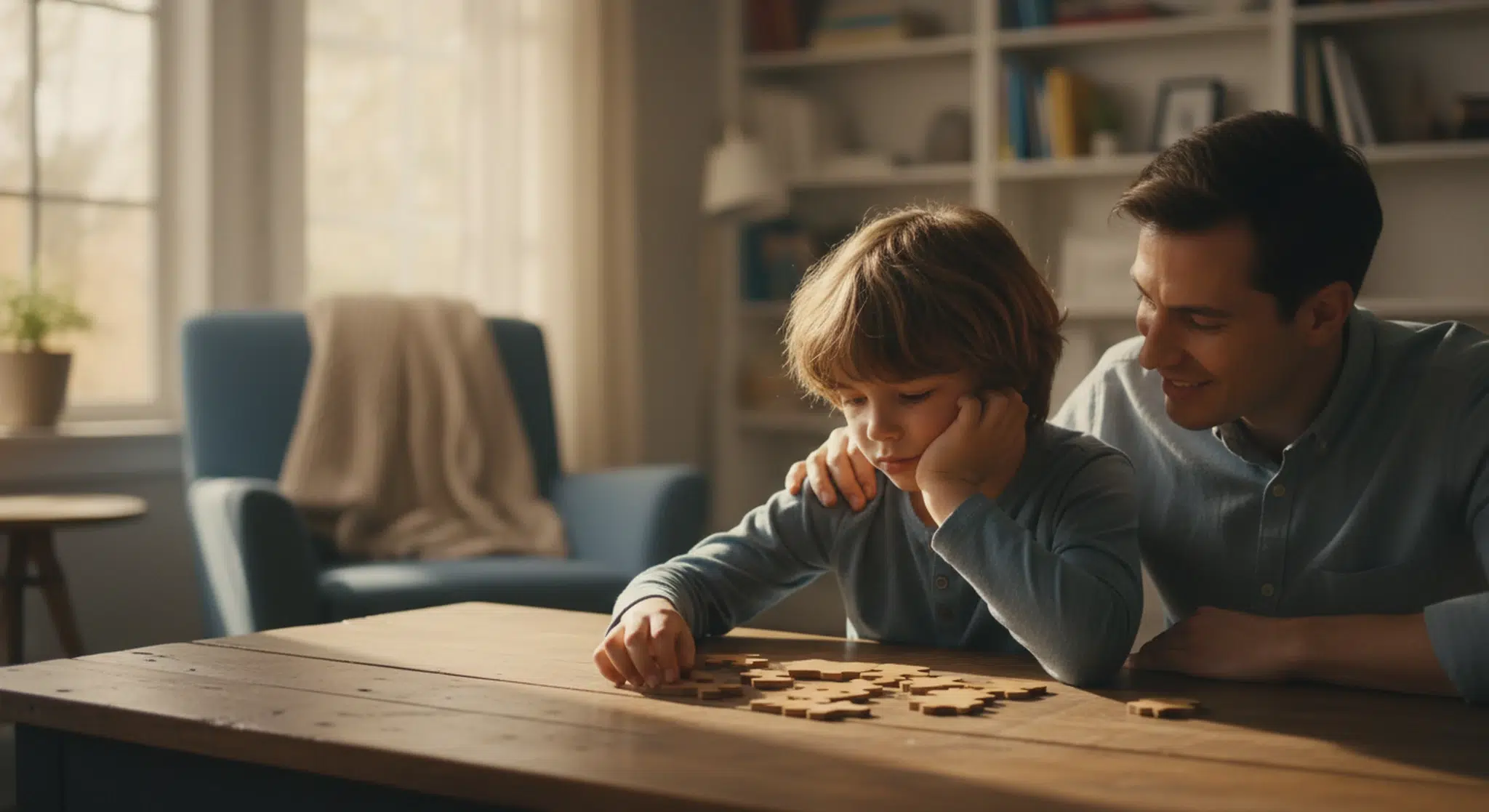
Brain teasers for kids are the puzzles that make a child pause, argue, try again, and finally light up when the answer clicks, and every one of those steps is quietly building real thinking skills.
Unlike a quick riddle, a good brain teaser rewards patience and a willingness to question your first assumption. That makes teasers some of the best screen-free tools for growing logic, persistence, and creative problem-solving.
Below are 20 of the best brain teasers for kids with answers, sorted into logic puzzles, number teasers, word tricks, and lateral-thinking challenges, so you can pick the right kind for the moment and the age.
Logic and math teasers build the habit of questioning a too-fast first answer.
Lateral-thinking puzzles teach kids to notice hidden assumptions.
Give hints early: the goal is stretched thinking, not defeat.
Praise the reasoning process, which matters more than any single right answer.
Table of Contents
Logic Brain Teasers for Kids
Logic teasers hand a child a small set of facts and ask them to reason their way to an answer. There is no trick word to spot, just careful thinking, one step at a time. Read the puzzle twice, let your child ask questions, and resist the urge to jump in with the answer.
A rooster lays an egg on the very top of a slanted roof. Which side does it roll down? Neither, roosters do not lay eggs.
Two mothers and two daughters go out for ice cream. Each buys one cone, but only three cones are bought. How? They are a grandmother, a mother, and a daughter, three people in total.
A man was outside in the pouring rain with no umbrella or hat, yet not a single hair on his head got wet. How? He was bald.
You see a boat filled with people, but there is not a single person on board. How is that possible? Everyone on board is married, so no one is single.
If you have me, you want to share me. If you share me, you no longer have me. What am I? A secret.
Number and Math Brain Teasers
Math teasers reward kids who slow down instead of racing to the obvious answer. They are a wonderful confidence builder, because the “gotcha” is usually a small assumption the solver made too quickly.
I am a three-digit number. My tens digit is five more than my ones digit, and my hundreds digit is eight less than my tens digit. What number am I? 194.
Using only addition, how do you add eight 8s to get the number 1,000? 888 + 88 + 8 + 8 + 8 = 1,000.
A clock strikes six in five seconds. How long does it take to strike twelve? Eleven seconds (there are eleven gaps between twelve strikes, not twelve).
If it takes five machines five minutes to make five widgets, how long would 100 machines take to make 100 widgets? Five minutes.
A bat and a ball cost $1.10 together. The bat costs $1.00 more than the ball. How much is the ball? Five cents (not ten).
If your child loves the number puzzles, our riddles for kids list has a whole batch of sneaky math riddles too.
Word and Picture Brain Teasers
Word teasers play with spelling, hidden meanings, and the shapes of words themselves. They are fantastic for readers who love language, and they often produce the loudest groan-and-grin when the answer lands.
Big kids keep you busy, little ones keep you up.
If a younger sibling is still fighting sleep, our free quiz builds a personalized plan in a few minutes.
What word is spelled incorrectly in every single dictionary? The word “incorrectly.”
What word becomes a palindrome when you view it upside down and backward? Try to think of a short one. “SWIMS” reads the same rotated 180 degrees.
There is a word in the English language in which the first two letters signify a male, the first three a female, the first four a great person, and the whole word a great woman. What is it? Heroine.
What English word has three consecutive double letters? Bookkeeper.
Which word in the dictionary is always spelled wrong when spoken? “Wrong.”
Lateral-Thinking Teasers (Think Outside the Box)
Lateral-thinking puzzles are the ones where the answer feels obvious in hindsight but impossible at first, because the trick is to question an assumption you did not notice you were making. These spark the best family debates.
A woman shoots her husband, then holds him underwater for five minutes, and finally hangs him. Ten minutes later they enjoy a lovely dinner together. How? She is a photographer: she shot his photo, developed it underwater, and hung it up to dry.
What can fill a room but takes up no space? Light (or sound).
A girl kicks a ball. It goes ten feet, then comes back to her all on its own. How? She kicked it straight up.
What has to happen before you can eat breakfast? Hint: it is very simple. You have to wake up.
How can a person go eight days without sleep? They sleep at night.
Brain teasers pair beautifully with a screen-free afternoon. See our indoor activities and rainy-day activities for more ways to keep growing minds busy.
Why Brain Teasers Are Worth the Effort
Brain teasers do something a worksheet cannot: they make a child want to keep thinking after the first wrong answer. That persistence, the willingness to sit with a hard problem and try a new approach, is one of the strongest predictors of success in school and beyond. And because the reward is a satisfying click of understanding rather than a grade, kids build that grit without even noticing.
Teasers also teach children that being wrong is part of the process, not the end of it. Every good puzzle is a small, safe rehearsal for the bigger problems they will face later, where the first idea rarely works and the answer comes to those who keep poking at it from new angles.
How to Use Brain Teasers Without the Frustration
Give hints early and generously. A brain teaser is meant to stretch a child, not defeat them, so if you see real frustration building, offer a nudge toward the key assumption they need to question. The insight still feels like theirs, and they stay in the game.
Celebrate the reasoning, not just the right answer. When a child explains how they got there, or even how they got it wrong, praise the thinking out loud. That is the skill you are actually building, and it matters far more than whether they landed on the exact answer to any single puzzle.
Frequently Asked Questions
What is a good brain teaser for kids?
A classic is: “A bat and a ball cost $1.10 together, and the bat costs $1.00 more than the ball, so how much is the ball?” The answer is five cents, not ten, because the bat must cost $1.05. It is a perfect teaser because the wrong answer feels obviously right, which teaches kids to slow down and check their reasoning.
What age are brain teasers appropriate for?
Simple logic teasers suit kids around ages 6 to 8, while multi-step math and lateral-thinking puzzles are better for ages 9 and up. Match the difficulty to the child: a puzzle that is too hard frustrates, and one that is too easy bores. When unsure, start easier and build up as their confidence grows.
What is the difference between a riddle and a brain teaser?
Riddles are usually short questions with clever, often word-based answers that reward a flash of insight. Brain teasers tend to be longer logic, math, or lateral-thinking puzzles that require reasoning through several steps. Both grow thinking skills, but teasers specifically build patience and multi-step problem-solving.
Do brain teasers actually make kids smarter?
Brain teasers strengthen logical reasoning, working memory, and persistence, and they teach children that being wrong is part of solving a problem rather than the end of it. While no single puzzle transforms a child, the habit of sticking with a hard problem and trying new approaches carries directly into schoolwork and everyday challenges.
How do I help a child who gives up on hard puzzles?
Offer a hint that points to the key assumption they need to question, break the puzzle into smaller steps, and praise their effort and reasoning rather than only the right answer. Framing teasers as cooperative fun, and modeling your own out-loud thinking, keeps a child engaged and willing to try the next one.
Fun by day, rest by night.
Betteroo helps the whole family sleep better. Take the free two-minute quiz for a plan tailored to your child.