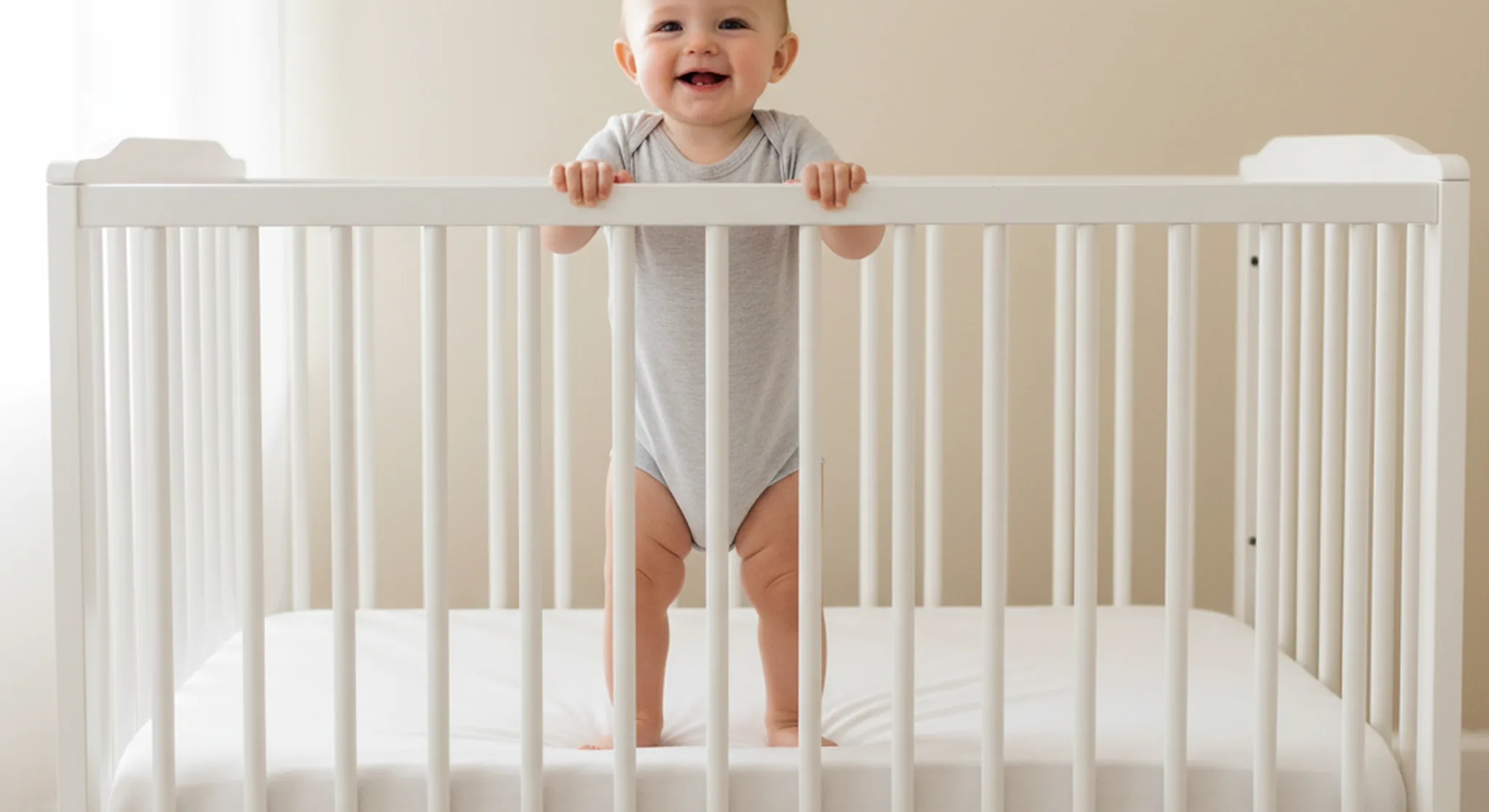


At nine months, most babies can stay awake for about 2.75 to 3.5 hours between sleeps, on a steady two nap day.
Nine months is often a more settled stretch. Many babies are crawling well, cruising along furniture, babbling with intent, and playing little games like peekaboo as object permanence deepens. Two naps are usually well established, which makes the day easier to predict.
Getting the awake stretch right keeps those two naps solid. Below are realistic wake window ranges for a nine month old, how many naps to expect, the tired cues to watch, and a flexible sample day you can adapt to your own baby.
Key Takeaways
- A 9 month old’s wake windows are typically about 2.75 to 3.5 hours, shortest in the morning and longest before bed.
- Most 9 month olds are on a steady 2 nap schedule.
- Total sleep is about 13 to 15 hours per 24 hours including naps.
- Practicing new skills like cruising in the crib can briefly disrupt naps and nights.
- Wake windows are a guide. Your baby’s tired cues always win over the clock.
Table of Contents
9 Month Old Wake Windows at a Glance
Awake time at nine months is longer and fairly consistent, but it still shifts across the day. The first window after morning waking is usually the shortest, and the last window before bedtime is often the longest.
| Time of day | Typical wake window |
|---|---|
| Morning (first of the day) | About 2.75 to 3 hours |
| Midday | About 3 to 3.25 hours |
| Before bedtime | About 3.25 to 3.5 hours |
If a nap shortens or your baby resists going down, the awake window before that sleep is the first thing to adjust. Overtiredness is still the most common culprit behind short naps at this age.
How Much Sleep and How Many Naps at 9 Months
Nine month olds need a good amount of sleep. The AASM recommends 12 to 16 hours per 24 hours for infants 4 to 12 months, and most nine month olds land around 13 to 15 hours including naps.1 Many are sleeping longer stretches at night, though a burst of new skills can bring temporary waking.
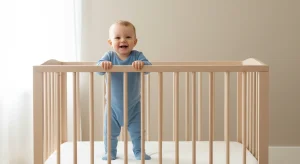
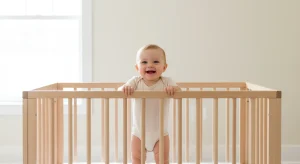
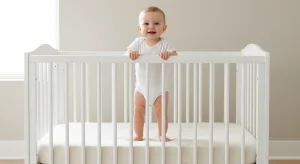
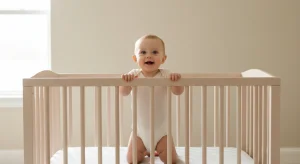
Expect 2 naps a day, usually a mid morning nap and an early afternoon nap. If your baby is standing and cruising in the crib at nap time, that is developmentally normal. Give lots of practice during awake windows so the crib feels less like a place to rehearse new tricks.
Reading Your 9 Month Old’s Tired Cues
Wake windows are only a starting estimate. The real signal is your baby. At nine months, early tired cues include slowing down, zoning out, rubbing the eyes, getting fussy with toys, and the first yawn.
- Catch sleep at early cues: staring off, eye rubbing, losing interest, first yawn.
- Late cues mean overtired: arching, frantic crying, clinginess, hard to settle.
- A baby put down at early cues usually settles faster and naps longer.
If your nine month old fights a nap, nudge it ten to fifteen minutes earlier for a few days. Small adjustments beat a big schedule overhaul, especially when the two nap day is otherwise working.
A Sample 9 Month Old Day
This is one common shape for a nine month old day on two naps. Read the clock times as illustrative. A baby who wakes at 6 a.m. and one who wakes at 7:30 a.m. will run the whole day shifted.
| Time | What is happening | Wake window |
|---|---|---|
| 7:00 AM | Wake and feed | Start of day |
| 9:45 AM | Nap 1 | After about 2.75 hours |
| 1:00 PM | Feed, play, Nap 2 | About 3 hours awake |
| 3:00 PM | Wake from Nap 2 | Nap free until bedtime |
| 6:30 to 7:30 PM | Bedtime routine and bed | After about 3.25 to 3.5 hours |
Short naps wearing you down?
Get a personalized plan that adjusts wake windows and naps to your baby’s temperament.
Nap Practice and Night Waking
Some families notice a bumpy patch around nine to ten months as babies practice new motor skills. It is usually short lived. Our sleep regression ages guide maps which windows are truly common, and our 9 month old sleep schedule shows how the full day fits together.
For the long view of how awake time grows across the first year, see our wake windows by age pillar. And keep the crib bare and baby on the back for every sleep, in line with AAP safe sleep guidance.4
When to Talk to Your Pediatrician
- Total daily sleep is consistently well below about 12 hours.
- Your baby is extremely difficult to settle at any window length.
- Snoring, breathing pauses, or feeding and growth concerns.
- Your own exhaustion is affecting your wellbeing.
A few rough days do not mean anything is wrong. But your pediatrician is the right person for persistent worries about sleep, feeding, or development.
Frequently Asked Questions
What are wake windows for a 9 month old?
Most 9 month olds can stay awake for about 2.75 to 3.5 hours between sleeps. The morning window is usually the shortest and the window before bed is often the longest. Tired cues help you fine tune the timing.
How many naps does a 9 month old take?
Almost all 9 month olds are on 2 naps a day, typically a mid morning nap and an early afternoon nap. It is far too early to drop to one nap at this age.
How long should a 9 month old sleep in total?
About 13 to 15 hours per 24 hours including naps, within the AASM’s 12 to 16 hour recommendation for infants 4 to 12 months.
Why does my 9 month old stand up in the crib instead of napping?
Practicing pulling to stand and cruising is a normal part of this stage. Give plenty of practice during awake time, and gently help them lie back down at nap time without turning it into a game. It usually passes as the skill becomes automatic.
What time should a 9 month old go to bed?
Bedtime commonly lands between about 6:30 and 7:30 PM, timed so the last wake window is not too long. An earlier bedtime for a few nights helps if naps were short.
Why does my 9 month old fight the afternoon nap?
Usually the awake window before it ran a little long, or the morning nap was too long or too short. Try trimming the pre nap window by ten to fifteen minutes and keeping the morning nap from stretching too late.
Want a schedule that fits your 9 month old?
Get a personalized, adaptive plan instead of a one-size chart.
4 Sources
- Paruthi S, Brooks LJ, D’Ambrosio C, et al. Recommended Amount of Sleep for Pediatric Populations: A Consensus Statement of the American Academy of Sleep Medicine. J Clin Sleep Med. 2016;12(6):785-786.
https://pubmed.ncbi.nlm.nih.gov/27250809/ - Centers for Disease Control and Prevention. About Sleep.
https://www.cdc.gov/sleep/about/index.html - Mindell JA, Telofski LS, Wiegand B, Kurtz ES. A Nightly Bedtime Routine: Impact on Sleep in Young Children and Maternal Mood. Sleep. 2009;32(5):599-606.
https://pubmed.ncbi.nlm.nih.gov/19480226/ - American Academy of Pediatrics. Sleep-Related Infant Deaths: Updated 2022 Recommendations for Reducing Infant Deaths in the Sleep Environment. Pediatrics. 2022;150(1).
https://pubmed.ncbi.nlm.nih.gov/35726558/