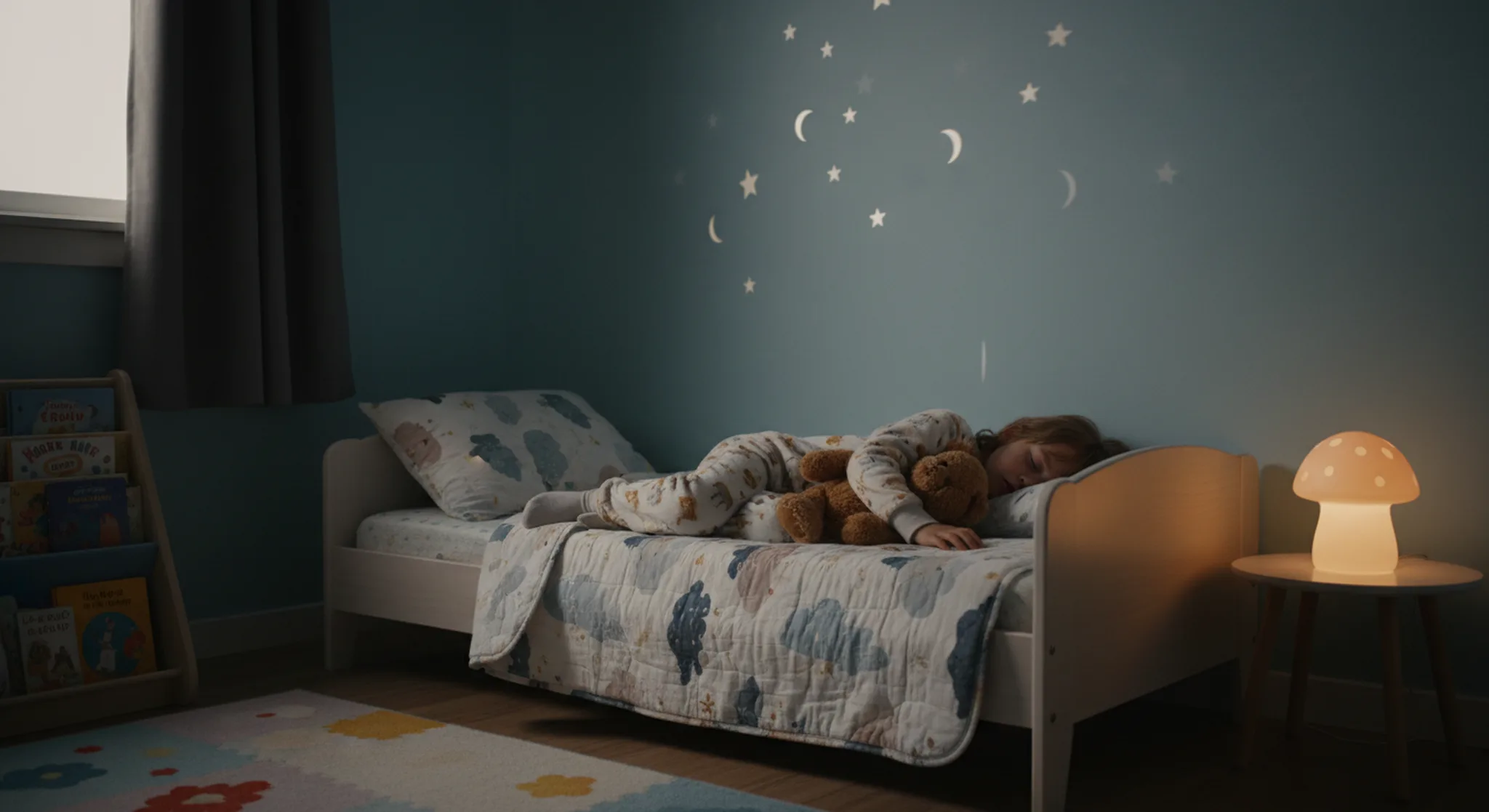
A 3 year old needs 10 to 13 hours of sleep per 24 hours, per the American Academy of Sleep Medicine and the AAP. For nappers, that usually means 10 to 12 hours overnight plus a 1 to 1.5 hour afternoon nap; for the growing crowd of non-nappers, it means an earlier bedtime that protects 11 to 12.5 hours at night. Bedtime between 6:30 and 8:30 fits most 3 year olds, shifted earlier on no-nap days.
Age 3 is the year sleep gets interesting: roughly half of children give up the nap somewhere between 3 and 4, imagination arrives with opinions about the dark, and many kids move to a big-kid bed with walking-out privileges. The total sleep requirement barely moves; how it gets distributed changes a lot.
This guide covers exactly how much sleep a 3 year old needs, sample schedules for nappers, non-nappers, and the in-between quiet-rest phase, how to spot a too-little-sleep 3 year old (hint: it usually looks like too much energy), and fixes for the classic bedtime stalling this age perfects.
Key Takeaways
Official target: 10 to 13 hours per 24 hours including naps, from the AASM consensus endorsed by the AAP.
Nappers: about 10 to 12 hours at night plus a 60 to 90 minute nap ending by 3:00 p.m. Non-nappers: 11 to 12.5 hours at night with bedtime pulled 30 to 60 minutes earlier.
Half of kids drop the nap between 3 and 4: replace it with mandatory quiet time rather than powering straight through the afternoon.
Undersleep at 3 looks like wired hyperactivity, meltdowns, and 5 a.m. wakeups more often than it looks like sleepiness.
Bedtime stalling is developmentally on-brand: contain it with a fixed routine, limited choices, and a bedtime pass, not negotiation.
Table of Contents
The Official Numbers (and What They Mean in Practice)
The American Academy of Sleep Medicine’s consensus recommendation for ages 3 to 5 is 10 to 13 hours of sleep per 24 hours, including naps, and the AAP endorses the same range. Most 3 year olds land in the middle: around 11.5 to 12 total hours. A small tail of kids genuinely thrives at 10; a small tail genuinely needs 13. The tell is daytime function, not the clock alone.
Two practical implications. First, if your 3 year old still naps 90 minutes, an 8:00 bedtime with a 7:00 wakeup lands you at 12.5 total, comfortably in range. Second, if the nap has died, that same 8:00 bedtime yields only 11 hours total, near the bottom for many kids, which is why no-nap days call for lights out closer to 7:00. For comparison with the year before, see how much sleep a 2 year old needs.
Sample 3 Year Old Sleep Schedules
Still napping
7:00 a.m. wake, 1:00 to 2:15 p.m. nap, 8:00 p.m. lights out (about 12.4 total hours).
Keep the nap capped around 90 minutes and finished by 3:00 p.m., or bedtime drifts late and night sleep shrinks to compensate.
Dropped the nap
6:45 to 7:00 a.m. wake, 45 to 60 minutes of quiet time after lunch, 6:45 to 7:15 p.m. lights out (11.5 to 12.5 night hours).
Expect a cranky 4:00 to 6:00 p.m. window for a few months; an earlier dinner and bedtime absorbs it.
Transitioning (naps some days)
Run a two-bedtime system: nap day means 8:00 bedtime, no-nap day means 7:00. Judge each day by 3:00 p.m.: asleep by then counts as a nap day, awake through quiet time triggers the early bedtime. The full playbook for this messy season is in our guide to when kids stop napping.
Get the schedule that fits your kid
Napper, non-napper, or in between: Betteroo’s free quiz builds a personalized sleep schedule for your 3 year old.
Wired, not tired: revved-up hyperactivity and impulsiveness in the late afternoon and evening, which parents often misread as not needing much sleep.
Meltdown density: more frequent, longer, lower-trigger tantrums than usual for your child.
Falling asleep on short car rides, at dinner, or instantly at lights out (healthy-slept kids take 10 to 20 minutes to drift off).
Early wakeups (5:00 to 5:30 a.m.) and night waking: overtired children sleep worse, not better.
Hard-to-wake mornings and marathon weekend catch-up sleep.
If several of those describe your week, move bedtime 30 minutes earlier for a week and reassess. Early bedtime is the cheapest experiment in pediatric sleep and the one most likely to pay off. If sleep worsened abruptly around the third birthday with fine totals before, you may be in the short-lived 3 year old sleep regression instead.
The Age 3 Complications: Stalling, Fears, and Big Beds
Three-year-olds are natural litigators: one more book, one more water, one more very important fact about dinosaurs. Contain the curtain calls structurally: a visual routine chart, every negotiable folded inside the routine, two limited choices (which pajamas, which two books), and a one-token bedtime pass the child can spend on a single extra request per night. After the pass is spent, every callback gets the same 10 second boring response. The full method is in how to get a toddler to sleep through the night.
New fears of the dark are normal as imagination blooms: validate briefly, add a dim warm night light, do a calm confidence ritual if it helps, and avoid feeding the fear with long searches for monsters. Screaming episodes an hour or two after bedtime where your child seems awake but unreachable are likely night terrors, which peak in the preschool years, are harmless, and are worsened by undersleep, one more argument for the earlier bedtime. And if a new big-kid bed turned bedtime into a jack-in-the-box show, our toddler bed guide covers walking-back protocols.
Finally, the snoring caveat: loud nightly snoring, gasping, breathing pauses, or chronic mouth breathing at this age can signal sleep apnea (enlarged tonsils and adenoids peak in preschoolers) and deserve a pediatrician visit, because apnea steals sleep quality no schedule can restore.
Sleep Hygiene at 3: The Checklist That Does the Heavy Lifting
Same wake time every day, weekends included, within about 30 minutes; the morning anchor sets the whole clock.
Bright outdoor light in the morning, dim warm light after dinner: light is the master control on a preschooler’s body clock.
Screens off at least an hour before bed, and no TV or tablets in the bedroom, ever; evening screen light delays sleepiness and shaves total sleep.
The same 20 to 30 minute routine nightly: bath, teeth, two books, song, into bed awake, with a consistent goodnight phrase.
Cool (68 to 72 degrees F), dark, boring bedroom with white noise if the household is loud; a dim warm night light is fine for fears.
Big meals, sugar, and wild roughhousing end an hour before the routine begins; caffeine (including chocolate and some teas) has no place in a preschooler’s afternoon.
Daily physical activity, ideally outdoors: preschoolers who burn real energy by daylight fall asleep faster at night.
None of these items is glamorous, and together they are the treatment plan pediatric sleep clinics start with, because they work. Run the checklist honestly before concluding your child is a low-sleep-needs outlier; true short sleepers exist, but a wired 9:30 p.m. preschooler with a tablet and a bright bathroom routine is not one of them.
Frequently Asked Questions
How much sleep does a 3 year old need?
10 to 13 hours per 24 hours, including naps, per the American Academy of Sleep Medicine and AAP. Most 3 year olds do best around 11.5 to 12 total hours: either 10 to 12 overnight plus a 60 to 90 minute nap, or, for non-nappers, 11 to 12.5 hours overnight with an earlier bedtime.
What time should a 3 year old go to bed?
Between 6:30 and 8:30 p.m. for most children, anchored to wake time and nap status. A napping 3 year old who wakes at 7:00 a.m. suits an 8:00 bedtime; the same child on a no-nap day needs lights out closer to 7:00 to keep totals in range.
Is it normal for a 3 year old to stop napping?
Yes. Roughly half of children give up napping between ages 3 and 4, and only a minority still nap at 5. Replace the nap with 45 to 60 minutes of quiet rest and move bedtime 30 to 60 minutes earlier. Some children flip between nap and no-nap days for months, which is normal.
How do I know if my 3 year old is overtired?
Look for evening hyperactivity, more frequent meltdowns, falling asleep on short car rides, instant sleep onset at bedtime, early morning wakeups, and worse night waking. Overtired preschoolers usually look wired rather than sleepy. A 30 minute earlier bedtime for one week is the simplest diagnostic test.
Should a 3 year old still nap every day?
Only if they still need it. A 3 year old who naps easily and also falls asleep well at a reasonable bedtime should keep napping, capped around 90 minutes and done by 3:00 p.m. If bedtime has become an hour-long battle, the nap is the usual culprit: shorten it or convert it to quiet time.
Right hours, right bedtime, calmer nights
Take Betteroo’s free 2 minute quiz for a personalized sleep schedule built for your 3 year old.