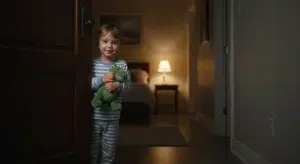


The 2.5 year old sleep regression is a very real, very common stretch of bedtime battles, night wakings, and nap strikes that hits between roughly 2 and 3 years old. It is fueled by exploding language and imagination, new fears, potty training, big-kid-bed transitions, and a toddler who has just discovered the power of “no.”
You thought you were done with regressions. Then your 2.5 year old, who has slept beautifully for a year, suddenly needs one more hug, one more song, one more sip of water, and appears at your bedside at 3:00 a.m. like a tiny, polite ghost.
This guide covers why sleep unravels at two and a half, how this regression differs from the 2 year sleep regression that may have come before it, and a firm-but-warm plan to get everyone sleeping again without hour-long bedtime negotiations.
Key Takeaways
- The 2.5 year old sleep regression usually lasts 1 to 4 weeks and shows up as stalling, curtain calls, night wakings, early mornings, and nap resistance.
- Big drivers: language and imagination leaps, new nighttime fears, separation anxiety, potty training, two-year molars, and a premature move to a toddler bed.
- Most 2.5 year olds still need the nap; keep offering it, capped so it does not push bedtime past 8:30 p.m.
- Boundaries are the treatment: a predictable routine, limited and defined choices, and calm, boring responses to every curtain call.
- Do not rush into a toddler bed during the regression; the crib is your friend until closer to 3 if your child is not climbing out.
Table of Contents
Is There a Sleep Regression at 2.5 Years?
Yes. While the famous regression ages are 4 months, 8 to 10 months, 18 months, and 2 years, many families report the roughest patch of toddler sleep somewhere between 2.5 and 3. Pediatric sleep specialists see it constantly: a toddler with mature language, vivid imagination, and strong opinions suddenly treats bedtime as the day’s main event.
A regression at this age is defined by a sudden change in a previously good sleeper: bedtime resistance and stalling, repeated curtain calls (requests for water, another story, a different stuffed animal), new night wakings, showing up in your room overnight, waking before 6:00 a.m., or refusing the nap. Our overview of all sleep regression ages shows where this one fits in the sequence.
What Causes the 2.5 Year Old Sleep Regression
Imagination and fears arrive together. Between 2.5 and 3, pretend play takes off, and the same imagination that turns a cardboard box into a rocket turns a shadow into a monster. Fear of the dark typically makes its first appearance in this window, and it is developmentally right on time.
Separation anxiety has a second act. Many toddlers get a resurgence around 2.5, especially with a new sibling, a daycare change, or a parent traveling. See our guide to separation anxiety in toddlers for the daytime side of this.
Potty training collides with bedtime. Newly trained toddlers discover that “I need to go potty” is the one request no parent refuses at 8:00 p.m. Some of it is real, some of it is the world’s most effective stalling tactic, and both are normal. Our nighttime potty training guide explains what to expect overnight.
Two-year molars. The last baby teeth erupt anywhere from 23 to 33 months and can cause genuinely uncomfortable nights before you ever see them.
The toddler bed came too early. Moving out of the crib before about age 3 is one of the most common triggers of a months-long regression, because toddlers this age lack the impulse control to stay in an open bed. If the move already happened, do not panic; the plan below still works. If it has not, read when to transition to a toddler bed before you unscrew anything.
Sleep pressure is shifting. Total sleep needs drop toward 11 to 13 hours across 24 hours, and a long afternoon nap can leave too little pressure for a 7:30 bedtime. The nap is not usually ready to die at 2.5, but it often needs a cap.
How Long Does It Last?
Handled consistently, most 2.5 year regressions resolve in 1 to 4 weeks. The regressions that drag on for months are almost always being maintained by something: a new habit (falling asleep with a parent lying in the room), a bed transition that came too early, or wildly inconsistent responses that teach a toddler that persistence pays. Tighten those three and the regression loses its fuel.
Remember that a chunk of what looks like regression at this age is actually a schedule mismatch. A 2.5 year old sleeping 12.5 hours total who naps 2.5 hours cannot also do a 7:00 p.m. to 7:00 a.m. night. The math never works, and the “regression” is just the extra hour showing up at midnight or 5:00 a.m.
Bedtime turned into a negotiation?
Take Betteroo’s free sleep quiz and get a personalized toddler sleep plan, including exactly how to handle curtain calls and night visits.
The Plan: 8 Fixes That Actually Work
- Run the same routine every night, visibly. A simple chart with pictures (bath, pajamas, teeth, two books, song, lights out) turns the routine into the boss, so you do not have to be. Toddlers argue with parents; they rarely argue with charts.
- Offer two choices, both acceptable. Red pajamas or dinosaur pajamas, this book or that one. Autonomy is the developmental need underneath most bedtime battles; feed it in small, controlled doses before lights out.
- Pre-empt the requests. Water bottle by the bed, potty trip as the last routine step, “last hug” announced and delivered warmly. When the request has already been met, the curtain call loses its script.
- Handle curtain calls like a broken record. Walk them back calmly, minimal words, zero drama, every single time: “It’s bedtime. I love you. Goodnight.” The consistency is the message.
- Take fears seriously without feeding the monster. Validate the feeling (“the dark can feel scary”), add a dim warm nightlight, do a cozy room check together before bed, and avoid elaborate monster-spray rituals that confirm there is something to spray.
- Cap the nap, keep the nap. Aim for a nap that ends by 3:00 p.m. and does not exceed about 2 hours. Only consider dropping it if your child is consistently taking over an hour to fall asleep at night for 2+ weeks; see when kids stop napping.
- Use an OK-to-wake light for early mornings. Green means morning. Before green, every appearance gets the same boring walk back. It takes 3 to 7 consistent mornings to stick.
- Refill the connection tank by day. Ten to fifteen minutes of one-on-one, child-led play each afternoon reduces the bedtime clinginess that comes from a busy day apart.
If Your Toddler Is Already in a Bed
An open bed plus a regression means night visits. Decide your policy in daylight and hold it: either walk them back silently every time (effective, exhausting for 3 to 5 nights, then done), or set up a “sleepover rule” like a small mattress on your floor they may use without waking you. What maintains months of 3:00 a.m. visits is inconsistency: sometimes walked back, sometimes welcomed into the warm middle of the bed. Toddlers will happily play those odds.
A door that stays open as long as they stay in bed is a powerful, gentle lever. If leaving the room repeatedly is the pattern, some families use a toddler-proofed room with a gate at the door, treating the whole room as the crib. Safety first either way: anchor furniture, cover outlets, and clear cords.
2.5 Year Regression vs. Night Terrors and Nightmares
New night wakings at this age are sometimes not a regression at all. A child who wakes crying, is fully alert, and wants you is having ordinary wakings or a nightmare; comfort works. A child who screams 1 to 2 hours after falling asleep, looks awake but does not register you, and cannot be comforted is likely having a night terror; these peak in the toddler and preschool years, are worse with overtiredness, and children do not remember them. If that sounds familiar, read our night terrors in toddlers guide, and protect the nap, because lost daytime sleep makes terrors more frequent.
When to Talk to Your Pediatrician
Check in with your pediatrician if snoring, mouth breathing, gasping, or pauses in breathing accompany the bad nights, since obstructive sleep apnea peaks in the preschool years; if night wakings come with fever, ear pain, or a limp; if fears seem extreme, spread into daytime, or come with regression in language or social skills; or if nothing improves after 4 to 6 weeks of a genuinely consistent plan. Persistent loud snoring in particular deserves an exam, not a sleep plan.
Frequently Asked Questions
Is there a 2.5 year old sleep regression?
Yes. Between roughly 2.5 and 3 years old many toddlers hit a rough sleep patch driven by imagination and new fears, a second wave of separation anxiety, potty training, two-year molars, and shifting sleep needs. It typically lasts 1 to 4 weeks when handled consistently.
How long does the 2.5 year sleep regression last?
Most resolve within 1 to 4 weeks. Regressions that last months are usually being maintained by a habit that took root (like a parent lying with the child until asleep), a too-early toddler bed transition, or inconsistent responses to curtain calls and night visits.
Should my 2.5 year old still nap during the regression?
Almost always yes. Most children keep a nap until at least 3, and an overtired toddler sleeps worse at night, not better. Cap the nap at about 2 hours and end it by 3:00 p.m. Only test dropping it after 2+ weeks of consistent, extreme bedtime resistance despite a good schedule.
Should I move my 2.5 year old to a toddler bed?
Not during a regression, and ideally not until closer to age 3 unless your child is climbing out of the crib unsafely. Toddlers under 3 rarely have the impulse control to stay in an open bed, and an early transition is one of the most common causes of months of disrupted nights.
Why does my 2.5 year old suddenly hate bedtime?
Autonomy and imagination arrived at the same time. Your toddler wants control over the day’s last act and now has fears the dark makes worse. A visible routine chart, two acceptable choices, pre-empted requests, a nightlight, and calm broken-record responses to stalling address both needs at once.
Toddler sleep, decoded
Betteroo builds a personalized plan for your toddler’s schedule, temperament, and bedtime battles, with step-by-step scripts for the hard nights.
Related Betteroo Guides
4 Sources
- American Academy of Pediatrics, HealthyChildren.org: Toddler
https://www.healthychildren.org/English/ages-stages/toddler/Pages/default.aspx - Nemours KidsHealth: Toddler Sleep, 1 to 2 Years
https://kidshealth.org/en/parents/sleep12yr.html - Nemours KidsHealth: How Much Sleep Do Kids Need?
https://kidshealth.org/en/parents/sleep.html - Mayo Clinic: Potty Training
https://www.mayoclinic.org/healthy-lifestyle/infant-and-toddler-health/in-depth/potty-training/art-20045230