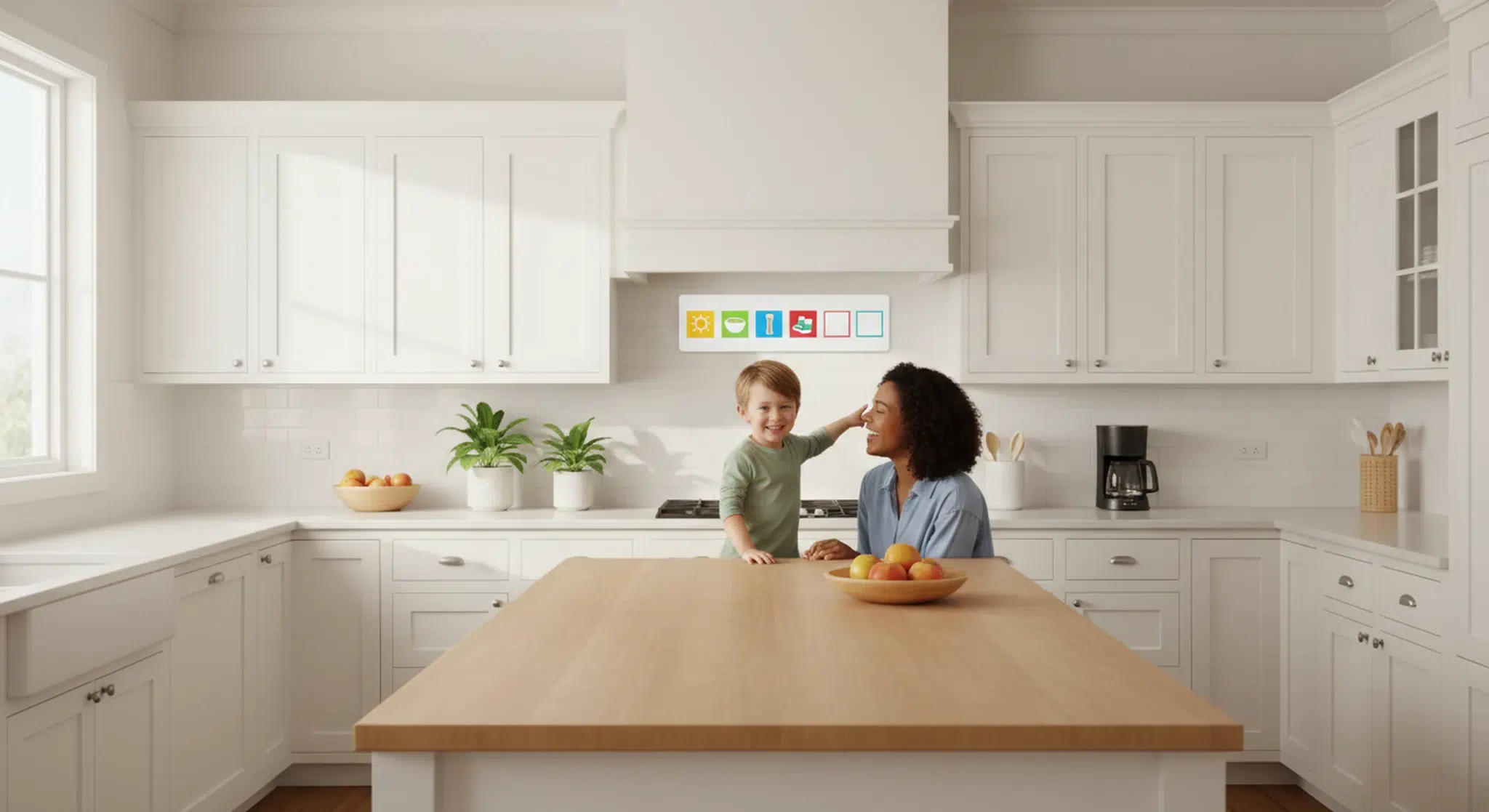
A visual schedule for kids is a sequence of pictures showing each step of a routine in order, and you can make one in an afternoon by picking one hard routine, choosing 3 to 6 simple pictures, and letting your child move each card as they finish.
A visual schedule for kids shows the day, or one part of it, as a row of pictures: wake up, potty, dressed, breakfast, shoes. Your child checks the next picture, does that step, and marks it done. It works because young children understand pictures long before they can read, and seeing what comes next makes a routine feel predictable.
Below: types, first-then boards, how to make one, sample schedules, introducing and fading it, transitions and troubleshooting.
Key Takeaways
A visual schedule is a picture-by-picture sequence that shows a child what comes next.
Start with one hard routine and only 2 to 6 steps, depending on age.
Use the same picture for the same activity everywhere, and let your child mark each step done.
Visual supports are an established evidence-based practice for autistic learners, and routines help all young children.
Teach it, use it daily, then fade it as your child becomes independent.
As an Amazon Associate, Betteroo earns from qualifying purchases.
Table of Contents
What Is a Visual Schedule?
Quick Answer
A visual schedule is a row or column of pictures that shows your child, step by step, what happens next: for example toilet, wash hands, get dressed, breakfast, shoes. Your child looks at the next picture, does that step, then moves or checks off the card. Pictures replace spoken reminders, so children who cannot read yet can follow a routine.
Researchers define a visual activity schedule as a series of images, pictures, photographs or line drawings used to show a sequence of events (Knight, Sartini and Spriggs, 2015). In plain words: the picture does the reminding, so you do less of it.
A good visual schedule answers four questions for your child, as the National Center for Pyramid Model Innovations puts it: What am I supposed to be doing? How do I know I am making progress? How do I know when I am done? What will happen next?
Type
What it looks like
Best for
Object schedule
A real item stands for each step: a cup for snack, a diaper for changing, a book for story time.
Young toddlers
First-then board
Two boxes only: the task first, then something your child enjoys.
Beginners and hard moments
Photo schedule
Photos of your child, or of your own home, doing each step.
Toddlers and preschoolers
Picture or icon schedule
Simple drawings or clip-art style icons in a row.
Preschoolers and early school-age kids
Word or checklist schedule
Written steps, sometimes with a small icon beside each.
Confident readers
Common types of visual schedules for kids.
Who a Visual Schedule Helps
Almost every young child benefits from a predictable day. The American Academy of Pediatrics (AAP) says children do best when routines are regular, predictable and consistent, and the CDC’s parenting guidance for toddlers and preschoolers says routines help children feel safe and know what to expect.
Toddlers and preschoolers: the National Center for Pyramid Model Innovations notes that children as young as 12 months can benefit from visual tools.
Autistic children: visual supports are one of 28 evidence-based practices in the 2020 National Clearinghouse on Autism Evidence and Practice report, which counted 65 supporting research articles for visual supports. A 2015 review of visual activity schedules in the Journal of Autism and Developmental Disorders concluded they can be considered an evidence-based practice, especially when paired with systematic teaching.
Children with ADHD: the AAP says daily routines are an absolute necessity for many children with ADHD and that written lists of chores or daily tasks help children keep track of what to do.
Kids going through change: a new sibling, a move, starting daycare or school, or time split between two homes.
Be clear about what a visual schedule is not. It is not a treatment for autism, ADHD, anxiety or any other condition, and it does not replace an evaluation or therapy. If your child works with a therapist, ask them to help design the home version so the pictures match.
First-Then Boards: The Simplest Visual Schedule
If a full routine feels like too much, start with a first-then board. It has two spaces: on the left, the thing that needs to happen; on the right, something your child likes. “First shoes, then park.” “First bath, then bubbles.”
Make it: a small card or laminated sheet with two boxes. A tip sheet from the Vanderbilt Kennedy Center suggests one piece of hook-and-loop tape in the middle of each box so you can swap pictures, plus a strip on the back to store the pictures you are not using.
Use what your child understands: photos, line drawings or words.
Keep the ‘then’ worth it: change the reward often or let your child choose it. A song or a chase game counts.
Deliver right away: give the ‘then’ as soon as the ‘first’ is done, so your child learns the board tells the truth.
Once your child reliably follows a first-then board, you can extend it to three steps (first, next, then) and from there build a full visual schedule.
Big days go better with a good night of sleep.
Got a little one at home too? Our free two-minute quiz builds a gentle, personalized sleep plan for babies and toddlers.
How to Make a Visual Schedule for Kids, Step by Step
You need card, a printer or pen, and tape.
1. Pick one hard part of the day: the National Center for Pyramid Model Innovations suggests starting with a tricky time, such as getting ready for school or bedtime, rather than the whole day at once.
2. Break it into steps: write the routine down as it really happens in your house, in order. Then cut it to the steps that matter. The CDC suggests keeping routines for young children short because of their attention spans.
3. Choose your pictures: photos of your child doing each step are the clearest for toddlers. Simple drawings or icons are faster to make and reuse. Use the same picture for the same activity every time, on every schedule, so the meaning stays fixed.
4. Make it with your child: let them draw a step, pose for the photo, or pick the icon. The National Center for Pyramid Model Innovations recommends making the visual together.
5. Decide the direction: left to right or top to bottom both work. Pick one and keep it the same so your child always knows where to look next.
6. Make it sturdy and movable: laminate the cards or cover them with clear packing tape. Attach them with hook-and-loop dots, magnets on the fridge, or clothespins on a ribbon.
7. Add a ‘done’ system: a pocket or envelope for finished cards, flipping each card over, or sliding it to a ‘done’ strip.
8. Put it where the routine happens: at your child’s eye level: by the bathroom sink, inside the front door, beside the bed. A phone photo works on outings.
How many steps? There is no official number. Use the table below as a rough starting point, begin at the low end, and add steps once your child follows the schedule with little help.
Age
Steps to start with
Picture type
Who moves the cards
About 1 to 2
2 (a first-then pair)
Real objects or photos
You, while naming each step
2 to 3
3 to 4
Photos of your child and home
Your child, with your help
3 to 5
4 to 6
Photos or simple icons
Your child
5 to 7
5 to 8, or one strip per part of the day
Icons, with words added under them
Your child, checks it themselves
8 and up
A full checklist or daily plan
Words, with optional icons
Your child, as a planning tool
A starting point for visual schedule length by age (adjust to your child).
Sample Visual Schedules You Can Copy
Use these as templates. Swap in your own steps and order. Each row is one picture card.
Card
Picture idea
Tip
1. Wake up
Child stretching in bed or a sunrise icon
A wake-up light or clock signal can mark this step for early risers.
2. Potty or diaper
Toilet or diaper
Pairs well with a potty chart if you are training.
3. Get dressed
Shirt and pants laid out
Lay clothes out the night before.
4. Breakfast
Bowl and spoon
Offer two choices to avoid standoffs.
5. Brush teeth
Toothbrush
Same spot, same toothbrush, every morning.
6. Shoes and coat
Shoes by the door
Keep them in the same spot every day.
Sample toddler morning visual schedule (about ages 2 to 3).
Card
Picture idea
Tip
1. Tidy up toys
Toy bin
A short tidy signals that play is ending.
2. Bath
Tub
Skip on non-bath nights and flip the card over.
3. Pajamas
Pajamas
Let your child pick between two pairs.
4. Brush teeth
Toothbrush
No snacks or milk after this card.
5. Potty
Toilet
Covers the ‘I need to go’ stall.
6. Books
Open book
Agree on the number of books in advance.
7. Song or cuddle
Two hearts or a moon
A predictable, short closing ritual.
8. Lights out
Bed in a dark room
Same words every night.
Sample preschool bedtime visual schedule (about ages 3 to 5).
Card
Picture idea
Tip
1. Shoes off, bag on hook
Hook and backpack
Saves morning searches.
2. Snack
Plate
Part of the AAP’s suggested after-school routine.
3. Active play
Ball or bike
The AAP notes kids need active play after a long school day.
4. Homework or reading
Pencil or book
Short, at the same table each day.
5. Helper job
Spray bottle or laundry basket
Link to the family chore system.
6. Free time
Puzzle or blocks
Something your child chooses.
7. Dinner
Table setting
Family meal without screens if you can.
Sample school-day after-school visual schedule (about ages 5 to 8).
Card
Picture idea
1. Breakfast together
Pancake or bowl
2. Outing
Park, library or store
3. Lunch
Sandwich
4. Quiet time or nap
Bed or book
5. Family activity
Bikes, a game or visiting relatives
6. Dinner
Table setting
7. Bedtime routine
Moon
Sample weekend visual schedule (flexible days need pictures too).
Bedtime Visual Schedule: Making Nights Smoother
The CDC’s guidance for toddlers and preschoolers uses a simple ‘brush, book, bed’ example (brush teeth, read aloud, tuck in), and the AAP recommends a regular bedtime with calming rituals such as reading aloud, conversation and songs. Build your strip around those anchors.
Put the strip in the bedroom or bathroom: where your child can see and touch the next card.
Build in the usual stalls: a drink of water, a potty trip, and a set number of books each get a card. When your child asks for one more, point to the strip: the cards are done. Our guide to bedtime stalling covers more ideas.
End on the same card every night: lights out, a goodnight phrase, and you leave. If your child gets up again, see how to get a toddler to stay in bed.
Add a morning signal for early risers: a picture of the morning, plus an ok-to-wake clock, shows when it is time to get up.
For timing, length and a sample half-hour routine, read our full toddler bedtime routine guide and our guide to preschooler sleep. A short, kind phrase on the last card can double as a bedtime affirmation; our affirmations for kids list has ideas you can say together.
How to Introduce a Visual Schedule (and When to Fade It)
Children do not follow a schedule just because it is on the wall. The National Center for Pyramid Model Innovations recommends referring to the schedule often so your child learns to follow it as a skill.
Introduce it at a calm time: show your child the cards during play, not in the middle of a meltdown. Walk through them together: ‘First we…, then we…’.
Point, say, wait: at each step, point to the next picture, say it in a few words, and give your child time to process.
Let your child move the card: pulling it off is part of the reward.
Praise the effort, not just the finish: ‘You checked your schedule all by yourself.’
Use it every day: the CDC suggests keeping routines the same from day to day.
Fading it. When your child follows a routine without looking, stop prompting, shrink it to a few key cards, move to a small checklist, then keep it only for new or hard routines. The AAP describes routines for children with ADHD as scaffolding that you gradually step back from as independence grows. Bring it back during big changes or travel.
Transitions, Timers and Changes to the Plan
Switching activities is hard for many young children, and the National Center for Pyramid Model Innovations notes that challenging behavior often happens when children do not understand what is expected. A schedule shows what comes next before it arrives.
Give a warning before the switch: point to the next card a few minutes ahead: ‘Two more slides, then shoes.’
Use a visual timer: a timer that shows time shrinking lets a child see how long is left instead of just hearing ‘five minutes’.
Ask ‘What’s next?’: instead of telling, ask your child to check the schedule.
Show changes in advance: add a ‘change’ or ‘surprise’ card, or swap the picture while your child watches. The CDC suggests explaining a change calmly when your child is not upset, giving the reason, and saying whether it is temporary or permanent.
For hard drop-offs, a photo card for ‘Mom or Dad comes back’ at the end of the daycare strip can help; see separation anxiety in toddlers.
Troubleshooting: When the Visual Schedule Isn’t Working
Problem
Likely cause
Try this
Ignores the schedule
Too long, or not taught yet
Cut to 2 or 3 cards, practice when calm, point at every step.
Rips cards off or plays with them
Cards are new and exciting
Mount higher, make spares, give a separate set to play with.
Argues about the order
Wants some control
Build in a choice: ‘Teeth or pajamas first?’ or let them pick the last activity.
Works at home, not at daycare or grandma’s
Different pictures or no schedule there
Share copies so every place uses the same images.
Melts down when plans change
Change was a surprise
Use a ‘change’ card and preview it before the moment.
Used to work, now ignored
Bored, or ready for more independence
Refresh the pictures, add a choice, or start fading.
Common visual schedule problems and fixes.
Change one thing at a time so you can tell what helped.
Visual Schedule vs Chore Chart: What’s the Difference?
They look similar on a fridge, but they do different jobs, and many families use both.
Visual schedule
Chore chart
Purpose
Shows the order of a routine so a child knows what comes next
Tracks jobs and responsibilities
Typical age
From toddlerhood, before reading
Often preschool and up
Format
Pictures in sequence, moved or checked off one by one
A grid of tasks across the week
Rewards
Usually none beyond finishing; the routine itself is the point
Sometimes stickers, points or allowance
When it ends
Fades as the routine becomes automatic
Grows with the child as jobs get bigger
Visual schedule vs chore chart.
If your child is ready for regular jobs, our chore chart for kids guide has age-by-age ideas, and a potty chart is a focused tracker for toilet training.
A visual schedule for kids is one of the simplest tools you can make: a few pictures in order, a way to mark them done, and a habit of pointing to them instead of repeating yourself. Start with one hard routine and only a few steps, make the cards with your child, use them every day, and fade them as your child takes over. It is not a treatment for any condition, but it can turn daily battles into steps a child can see and own.
If routines stay very hard despite a consistent schedule, or you have questions about your child’s development, attention or behavior, talk to your pediatrician.
Frequently Asked Questions
What is a visual schedule for kids?
A visual schedule for kids is a set of pictures, photos, icons or objects arranged in order to show the steps of a routine or the parts of a day. Your child looks at the next picture, does that step, then removes or checks off the card. It helps children who cannot read yet follow routines with fewer spoken reminders.
At what age can a child use a visual schedule?
Very young children can start with simple visuals. The National Center for Pyramid Model Innovations notes that children as young as 12 months can benefit from visual tools. Toddlers usually start with real objects, photos or a two-picture first-then board, and preschoolers can follow longer picture schedules of four to six steps.
What are the different types of visual schedules?
Common types are object schedules, where a real item stands for each step; first-then boards with two pictures; photo schedules; picture or icon schedules; and written checklists for readers. Choose the type your child understands most easily, and move to icons or words as they grow.
How many pictures should be on a visual schedule?
There is no fixed rule. Start small: two pictures for young toddlers, three or four for two and three year olds, and four to six for preschoolers. Add steps once your child follows the schedule with little help. A long schedule can be split into separate morning, afternoon and bedtime strips.
Do visual schedules help children with ADHD or autism?
Visual supports are listed as an evidence-based practice for autistic children, youth and young adults in the 2020 National Clearinghouse on Autism Evidence and Practice report. The AAP says routines are essential for many children with ADHD. A visual schedule is a support, not a treatment, and works best alongside your child’s care plan.
What is a first-then board?
A first-then board shows two pictures: the task that comes first and the activity that follows it, such as first shoes, then park. It is the simplest visual schedule and a good starting point for toddlers. Give the ‘then’ right after the task is done so your child learns that the board can be trusted.
Gentle changes, peaceful nights.
Betteroo builds a personalized sleep plan for your baby or toddler. Take the free two-minute quiz to get started.
Steinbrenner JR, Hume K, Odom SL, et al. Evidence-Based Practices for Children, Youth, and Young Adults with Autism. FPG Child Development Institute, University of North Carolina at Chapel Hill, National Clearinghouse on Autism Evidence and Practice Review Team, 2020. https://ncaep.fpg.unc.edu/wp-content/uploads/EBP-Report-2020.pdf
Knight V, Sartini E, Spriggs AD. Evaluating visual activity schedules as evidence-based practice for individuals with autism spectrum disorders. J Autism Dev Disord. 2015;45(1):157-178. https://pubmed.ncbi.nlm.nih.gov/25081593/