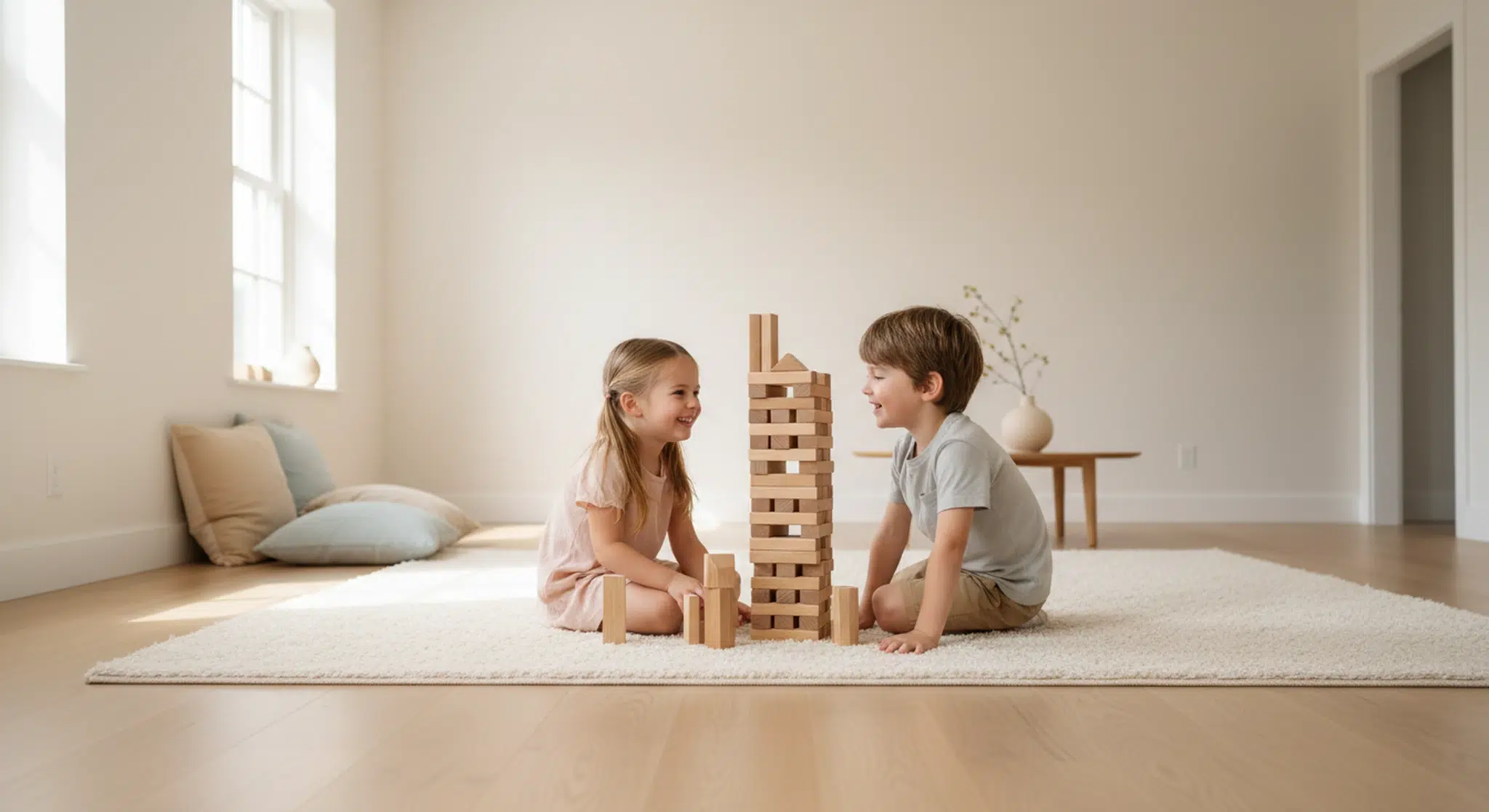
Cooperative play is when two or more children play together toward a shared goal, with roles or rules they agree on, and it usually begins around ages 4 to 5.
Think of two preschoolers building one tower, running a pretend bakery, or carrying a blanket across the room without dropping the teddy bear. Cooperative play is the most social of the six stages of play described by researcher Mildred Parten in 1932, and it grows out of years of playing alone, watching and playing side by side.
Below: how it differs from parallel and associative play, when it typically appears (with CDC and AAP milestones), examples by age, why it matters, games to try, what to do when play turns into an argument, and when to check in with your pediatrician.
Key Takeaways
Cooperative play means playing together toward a shared goal, with roles or agreed rules.
It usually emerges around ages 4 to 5; associative play comes a bit earlier.
Parten’s six stages are rough guides, and children move between play types all the time.
Peer play builds social, language and self-regulation skills, according to the AAP.
Little interest in playing with other children at 4 to 5, or lost skills, is worth raising with your pediatrician.
As an Amazon Associate, Betteroo earns from qualifying purchases.
Table of Contents
What Is Cooperative Play?
Quick Answer
Cooperative play is when two or more children play together toward a shared goal, with roles, rules or a plan they agree on, such as building one tower together or acting out a pretend restaurant. It is the most social of the six types of play described by researcher Mildred Parten in 1932, and it usually starts to show up around ages 4 to 5, after years of playing alone, watching, and playing side by side.
In cooperative play, the children are not just near each other or using the same toys. They are working on the same thing. One child is the chef and one is the customer. One holds the bridge steady while the other adds the roof.
Parten’s 6 Stages of Play (With Typical Ages)
The best-known way to describe how social play develops comes from Mildred Parten, an American researcher who observed preschool children at nursery schools and playgrounds. She published her six categories of social participation in 1932 in the Journal of Abnormal and Social Psychology, and child development textbooks still use them. The ages below are rough guides, not deadlines.
Stage
What it looks like
Rough age it shows up
1. Unoccupied play
Random movements and looking around, with no clear play activity
Birth to about 3 months
2. Solitary play
Playing alone, focused on their own toys, not paying attention to other children
From about 3 months, common through the toddler years
3. Onlooker play
Watching other children play with interest, maybe talking to them, but not joining in
Around 2 to 2.5 years
4. Parallel play
Playing beside another child with similar toys, without playing together
Especially common in the toddler years
5. Associative play
Playing with other children, sharing materials and talking, but without a common goal or set roles
Around 3 to 4 years
6. Cooperative play
Playing together toward a shared goal, with roles or rules the group agrees on
Around 4 to 5 years
Parten’s six types of social play. Ages are approximate and vary from child to child and from source to source.
References give slightly different ages for each stage, so treat them as averages, not a schedule. Modern child development texts note that although play tends to become more social with age, children move fluidly between these types depending on the situation, the materials and how well they know the other children.
Associative vs Cooperative: What’s the Difference?
These two are easy to mix up because in both, children are clearly playing with each other. The difference is organization.
Associative play
Cooperative play
Interaction
Children talk, share toys and join in each other’s activity
Children coordinate closely and depend on each other
Goal
No single shared goal; each child does their own version
One shared goal everyone is working toward
Roles and rules
Loose or none
Clear roles or agreed rules
Example
Three kids each drawing their own picture at one table and swapping markers
Three kids making one mural and deciding who draws the sky, the house and the dog
Typical age
Around 3 to 4
Around 4 to 5
How associative play and cooperative play differ.
A 3 year old who mostly plays alongside or loosely with other kids is right on track.
Big days go better with a good night of sleep.
Got a little one at home too? Our free two-minute quiz builds a gentle, personalized sleep plan for babies and toddlers.
When Does Cooperative Play Start? Ages and Milestones
Most children start around 4 to 5. The CDC’s milestone checklists give clues:
By 4 years: The CDC lists pretending to be something else during play (a teacher, superhero or dog), asking to go play with children if none are around, comforting others who are hurt or sad, and liking to be a “helper.”
By 5 years: The CDC lists following rules or taking turns when playing games with other children.
The American Academy of Pediatrics describes a similar arc on HealthyChildren.org: around age 3, children begin to really play with other children instead of just playing side by side, can often work out disputes by taking turns or trading toys, and gradually compete less and cooperate more. By 4 to 5, the AAP notes that children want to please and be like their friends, are more likely to agree to rules, and engage in well-developed imaginative play.
Cooperative play does not need special toys. It needs a shared idea.
Age
What you might see
Around 3 to 4 (early versions)
Filling one bucket together at the sandbox; rolling a ball back and forth; a simple “you be the baby, I’ll be the parent” game; carrying a big box together
Around 4 to 5
Pretend restaurant, store, doctor’s office or vet clinic with roles; building one block tower or train track together; making a blanket fort; a chase game with agreed rules
Around 5 to 6
Cooperative board games where everyone wins or loses together; a puppet show; a group art mural; planting and watering a garden together
Cooperative play examples, from early versions to more complex group play.
Pretend play is a common door in: when two children agree that the couch is a pirate ship and one of them is the captain, they have already set a goal, assigned roles and made a rule.
Why Playing Together Matters: Benefits for Kids
The American Academy of Pediatrics clinical report “The Power of Play” (Yogman and colleagues, Pediatrics, 2018) explains that play with parents and peers supports social-emotional, cognitive, language and self-regulation skills. It notes that peer play involves negotiating rules and cooperating.
Social skills: Cooperative play is practice for joining a group, taking turns, compromising, and winning and losing gracefully. The AAP report links social skills to resolving disputes with words.
Language: Children have to explain ideas, ask questions and persuade each other. The report notes that children use more sophisticated language when playing with peers.
Self-regulation: Pretend play requires children to agree on roles and rules and stick to them, which the AAP describes as building self-regulation. Waiting for a turn and staying in character take real impulse control.
Executive function: The report describes three parts of executive function (cognitive flexibility, inhibitory control and working memory) and calls play a core way to build them.
None of this requires expensive equipment. The same report notes that play with traditional toys was linked to better quantity and quality of language than play with electronic toys.
How to Encourage Kids to Play Together
You can’t force cooperation, but you can make working together the easiest, most fun choice.
Start with you: Your child’s first cooperative play partner is usually a grown-up. Build a tower together, taking turns adding blocks, or play restaurant and let your child be the chef.
Offer one shared project: One big box, one long roll of paper, one set of train tracks. Shared materials invite shared goals more than two identical sets do.
Suggest roles: “Who wants to be the builder and who wants to be the truck driver?” Roles give younger kids a clear way in.
Use pretend play props: Dress-up clothes, play food, empty boxes and toy animals spark games with natural roles.
Practice turn taking: Simple games with a clear turn structure (rolling a ball, adding a block, adding the next line of a made-up story) teach the rhythm of cooperation. A visual schedule or a timer can make turns feel fair.
Keep playdates small and short: One friend for an hour is often easier than a big group for an afternoon, especially at 3 or 4. Stay nearby, join for the first few minutes if needed, then fade out so the play belongs to the kids.
For more ideas, our indoor activities for kids include many projects that work with two children, and affirmations for kids has short kindness and friendship phrases to use while they play.
Teamwork Games and Activities to Try
In these cooperative play games the group wins or loses together, so there is a reason to help each other.
Ball keep-up: Everyone works together to keep a soft, light ball in the air.
Blanket carry: Two to four children hold the edges of a blanket and carry a stuffed animal across the room without dropping it.
Cooperative musical chairs: When the music stops, everyone has to find a spot, even if that means sharing a cushion. Remove seats and see how the group solves it. Nobody is out.
Pretend shop or restaurant: Assign roles, make a picture menu, use play money and switch roles halfway through.
Cooperative board games: Look for games where players work together against the game rather than against each other, with simple picture-based rules for preschoolers.
Both have a place. Competitive games teach kids to follow rules, try their best and cope with losing. Cooperative games teach sharing ideas and helping others, and are a gentler start for 3 to 5 year olds.
Cooperative games
Competitive games
Goal
Everyone works together against a challenge
Players or teams try to beat each other
Who wins
The whole group, or nobody
One player or team
Skills practiced
Communication, helping, shared planning
Rule following, persistence, coping with losing
Cooperative and competitive games side by side.
A mix works well: start with cooperative games, then add simple competitive ones like card games for kids once your child can handle a loss with a little support.
When Group Play Breaks Down: Sharing, Bossiness and Conflict
Expect arguments. Cooperative play is where kids practice disagreeing, and practice is messy. Your job is coaching, not refereeing every dispute.
Name the problem neutrally: “You both want to be the doctor.” This shows you heard both sides without choosing one.
Ask for ideas: “How could we solve this?” Kids often come up with creative fixes: two doctors, taking turns, or one doctor and one nurse.
Give simple words: Teach reusable scripts: “Can I have a turn when you’re done?” “Can I play too?” “I don’t like that. Please stop.”
Use fair turns: The AAP suggests helping kids see that each gets an equal turn.
Stop hurting right away: If a child hits, calmly step in and separate them. The AAP is clear that hitting is not an acceptable way to show anger, and suggests asking for an apology only once the child understands what they did.
Coach the bossy one, include the shy one: Help a child who directs everything ask, “What do you want to do?” Offer a quieter child a clear entry role, like delivery driver.
A gentle parenting approach, with firm limits and warm connection, fits naturally here. If one child needs a break, a calm down corner gives them a place to reset before rejoining.
Children reach social milestones at different times, and plenty of 4 year olds still prefer playing alone or with one familiar friend. Still, the AAP lists these among possible developmental concerns for 4 to 5 year olds:
Shows little interest in playing with other children
Rarely uses fantasy or imitation in play
Avoids or seems aloof with other children and adults
Shows extremely aggressive behavior
The CDC’s guidance is simple: if your child is not meeting one or more milestones, has lost skills they once had, or you have other concerns, act early. Talk with your child’s doctor, share your concerns and ask about developmental screening. If speech is part of your worry, our guide on when babies start talking covers early language milestones.
Frequently Asked Questions
What is cooperative play?
Cooperative play is when two or more children play together toward a shared goal, using roles, rules or a plan they agree on. Examples include building one block tower together, acting out a pretend restaurant, or playing a game where the group wins together. It is the sixth and most social of Mildred Parten’s stages of play.
At what age does cooperative play begin?
Cooperative play usually begins to show up around ages 4 to 5, with simpler forms earlier. The CDC lists following rules or taking turns when playing games with other children as a milestone by 5 years. Ages vary, so a 3 or 4 year old who mostly plays alongside or loosely with other kids is still on track.
What are the 6 stages of play?
The six stages of play described by Mildred Parten in 1932 are unoccupied, solitary, onlooker, parallel, associative and cooperative play. Play tends to become more social with age, but children move between these types depending on the situation, and solitary play stays healthy at every age.
What is the difference between associative and cooperative play?
In associative play, children play with each other, share toys and talk, but each child does their own version of the activity with no single shared goal. In cooperative play, the children work toward one goal together, with clear roles or agreed rules, such as building one fort or acting out one story.
What are some examples of cooperative play?
Common examples include pretend play with roles like store, doctor or restaurant, building one block tower or train track together, making a blanket fort, putting on a puppet show, cooperative board games where everyone wins or loses together, relay races, and shared cooking or gardening jobs.
How can I encourage cooperative play?
Play cooperatively with your child yourself first, then offer one shared project such as a big box or long roll of paper. Suggest roles, practice turn taking, keep early playdates small and short, and step back once play is going. Coach with simple words during conflicts and praise specific teamwork.
Gentle changes, peaceful nights.
Betteroo builds a personalized sleep plan for your baby or toddler. Take the free two-minute quiz to get started.
Yogman M, Garner A, Hutchinson J, Hirsh-Pasek K, Golinkoff RM; Committee on Psychosocial Aspects of Child and Family Health; Council on Communications and Media. The Power of Play: A Pediatric Role in Enhancing Development in Young Children. Pediatrics. 2018;142(3):e20182058. PubMed. https://pubmed.ncbi.nlm.nih.gov/30126932/