

Put a group of kids in a room with nothing to do and you get chaos. Give them a good game and you get belly laughs, teamwork, and tired kids.
These group games for kids work for birthday parties, classrooms, playdates, scout meetings, family reunions, and backyard get-togethers. You will find classic circle games, outdoor running games, indoor games for small spaces, cooperative games where no one is out, and icebreakers for kids who do not know each other yet.
Each game includes quick rules and a suggested age, plus a table to help you pick the right game for your crowd and tips for keeping things fair and fun.
Key Takeaways
- Match the game to the space: running games outdoors, four corners or charades indoors.
- Classic group games like duck duck goose, Simon says, and red light green light are perfect for preschoolers.
- Older kids love strategy games like capture the flag and sharks and minnows.
- Cooperative games and re-entry rules keep everyone playing instead of sitting out.
- Group games build turn-taking, teamwork, and physical activity at the same time.
Table of Contents
Quick Picks: Best Group Games for Kids by Situation
| Situation | Try these |
|---|---|
| Big group outdoors | Sharks and minnows, capture the flag, red light green light |
| Small space indoors | Four corners, telephone, heads up seven up, charades |
| Preschoolers | Duck duck goose, Simon says, freeze dance, ring around the rosie |
| Classroom brain break | Silent ball, would you rather, rock paper scissors tournament |
| Mixed ages | Charades, scavenger hunt, relay races, Pictionary |
| No winners or losers | Parachute games, human knot, cooperative musical chairs |
Classic Circle Games
- Duck, duck, goose: Kids sit in a circle. One walks around tapping heads saying “duck” until they say “goose” and run, and the goose chases them around the circle. Ages 3 to 7.
- Hot potato: Pass a ball around the circle while music plays. Whoever holds it when the music stops does a silly action instead of sitting out. Ages 3 and up.
- Telephone: Whisper a sentence around the circle and compare the final version to the original. Ages 5 and up.
- Zip zap zop: Players point and pass the words “zip,” “zap,” and “zop” in order as fast as possible. Great for focus. Ages 7 and up.
- Pass the squeeze: Holding hands, send a squeeze around the circle and time how fast it travels. A calm, cooperative game. Ages 4 and up.
- Doggy, doggy, where’s your bone?: One child sits with eyes closed while another hides the “bone” behind their back; the doggy guesses who has it. Ages 3 to 6.
Running and Outdoor Group Games
- Red light, green light: The leader calls green (go) and red (freeze). Anyone caught moving goes back to the start. Ages 3 and up.
- Sharks and minnows: Minnows run across the field while sharks try to tag them. Tagged minnows become seaweed who can tag from where they stand. Ages 5 and up.
- Capture the flag: Two teams each guard a flag and try to steal the other’s without getting tagged. Ages 7 and up.
- Freeze tag: Tagged players freeze until a teammate crawls through their legs. Ages 4 and up.
- What time is it, Mr. Fox?: Kids ask the time and take that many steps toward Mr. Fox until he shouts “lunchtime!” and chases. Ages 3 to 8.
- Relay races: Split into teams for egg-and-spoon, sack, crab-walk, or three-legged relays. All ages.
- Kickball: Baseball rules with a big rubber ball. Ages 6 and up.
- Mother, may I?: Players ask permission to take giant, baby, or bunny steps toward the leader. Ages 4 to 8.
For even more ideas outside, see our outdoor games for kids and field day games.
Indoor Group Games for Kids
- Four corners: Number the corners of the room. Kids tiptoe to a corner while “it” counts with eyes closed, then calls a number; that corner is out. Ages 5 and up.
- Heads up, seven up: Seven kids tap seven thumbs-down classmates, who then guess who tapped them. Ages 6 and up.
- Charades: Act out animals, movies, or everyday actions with no talking. Ages 5 and up.
- Simon says: Only follow directions that start with “Simon says.” Ages 3 and up.
- Freeze dance: Dance while the music plays; freeze when it stops. Ages 2 and up.
- Musical chairs: Add a cooperative twist: when a chair is removed, kids must share, until everyone is piled on a few chairs. Ages 4 and up.
- Silent ball: Toss a soft ball around without talking. A drop or a sound means you sit down. Ages 6 and up.
- Pictionary: Teams guess the drawing before the timer runs out. Ages 6 and up.
- Hide and seek, sardines style: One person hides and everyone who finds them squeezes into the hiding spot too. Ages 4 and up.
Stuck inside? Our indoor activities for kids and rainy day activities for kids have plenty more.
Big days of fun go better with a good night of sleep.
Got a little one at home too? Our free two-minute quiz builds a gentle, personalized sleep plan for babies and toddlers.
Cooperative Group Games (No One Is Out)
Cooperative games are great for younger kids, mixed ages, and groups that are still getting to know each other, because everyone works toward a shared goal and nobody sits on the sidelines.
- Human knot: Stand in a circle, grab two different people’s hands across the circle, and try to untangle without letting go. Ages 7 and up.
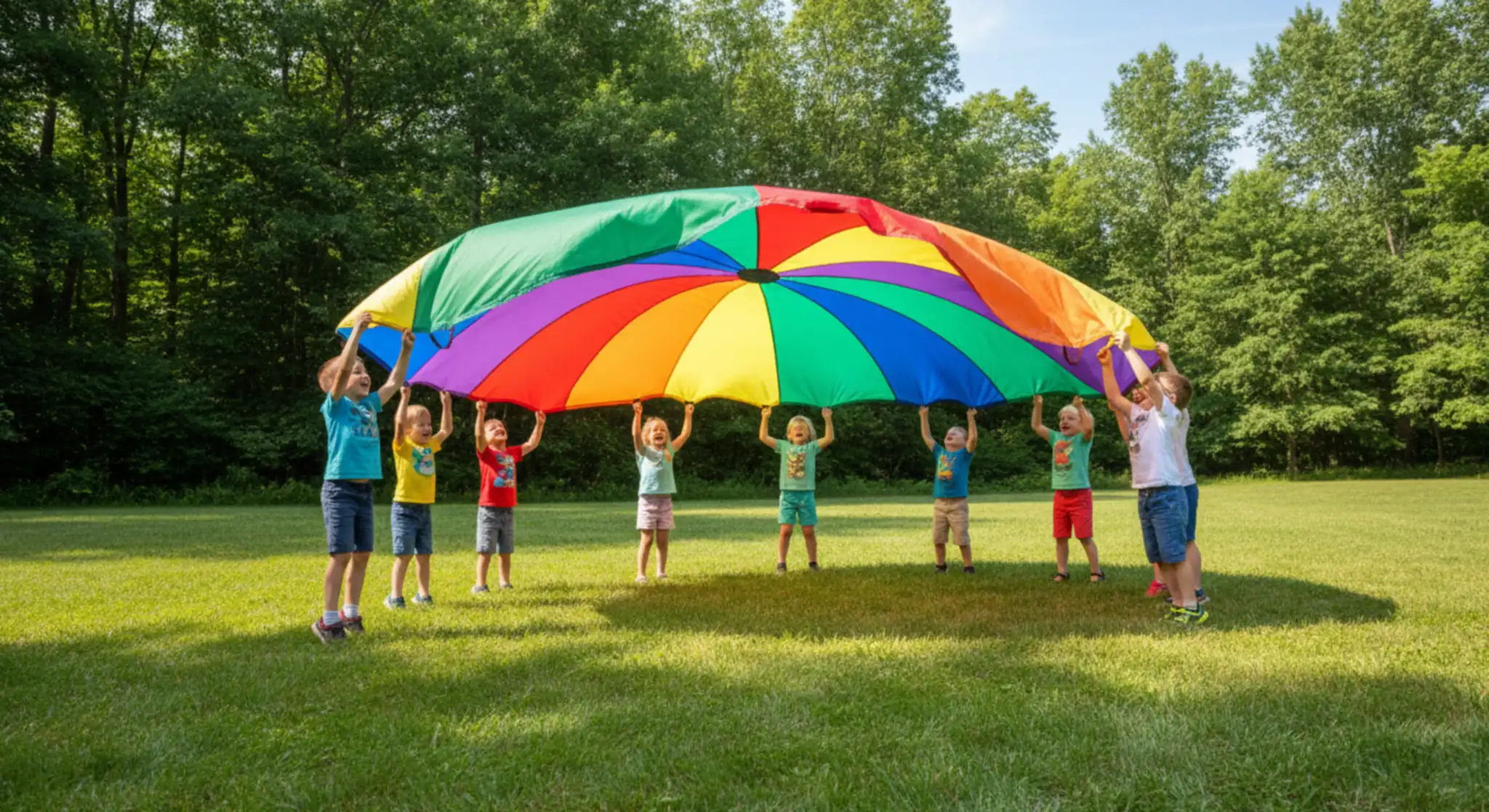
- Parachute games: Make waves, bounce balls, and run underneath while the parachute floats. Ages 2 and up.
- Keep it up: The whole group tries to keep a balloon from touching the floor. Count the hits. Ages 3 and up.
- Group story: Each person adds one sentence to a story. Ages 5 and up.
- Cross the river: The group must cross the room using only a few “stepping stone” mats. Ages 6 and up.
- Mirror, mirror: Pairs copy each other’s slow movements like a mirror. Ages 4 and up.
Icebreaker Games for Groups of Kids
- Two truths and a lie: Each child shares three facts about themselves; the group guesses the fib. Ages 7 and up.
- Would you rather: Kids move to one side of the room or the other. Try our would you rather questions for kids.
- Find someone who: A bingo card with squares like “has a pet” or “loves pizza” that kids fill in by talking to each other. Ages 6 and up.
- Name ball: Say someone’s name before tossing them the ball. Ages 5 and up.
- Line up by birthday: Without talking, line up in birthday order using only gestures. Ages 7 and up.
Group Games by Age
| Age | Good fits | Why |
|---|---|---|
| 2 to 3 | Freeze dance, ring around the rosie, parachute, bubble chasing | Short, musical, and no complicated rules |
| 4 to 5 | Duck duck goose, Simon says, red light green light, Mr. Fox | Simple rules they can learn quickly |
| 6 to 8 | Sharks and minnows, four corners, relays, charades | Enjoy teams and a little strategy |
| 9 to 12 | Capture the flag, silent ball, human knot, Pictionary | Longer games, more strategy, more teamwork |
Tips for Running Group Games Smoothly
- Explain the rules in under a minute, then demonstrate. Kids learn by playing.
- Swap elimination for re-entry: tagged players do five jumping jacks and rejoin.
- Mix up teams yourself (count off by twos) so no one is picked last.
- Have a clear start and stop signal, like a whistle or a raised hand.
- Keep each game short and switch while kids are still having fun.
- Pair little kids with older buddies in mixed-age groups.
- Talk about good sportsmanship before the competitive games start.
Active group play is an easy way to help kids get moving. Public health guidelines recommend that school-age kids get at least 60 minutes of moderate to vigorous physical activity every day, and preschoolers should be active throughout the day.
Related Betteroo Guides
Why Group Games Matter
Group games are more than a way to fill an afternoon. Pediatricians describe play as essential for development: games with rules teach kids to take turns, handle losing, cooperate, solve problems, and read other people’s cues. If your child consistently avoids group play, struggles with turn-taking far more than peers, or seems very anxious in groups, it is worth mentioning to your pediatrician or teacher.
Frequently Asked Questions
What are good group games for kids?
Popular group games for kids include duck duck goose, red light green light, Simon says, sharks and minnows, capture the flag, four corners, charades, freeze dance, relay races, and the human knot.
What games can a large group of kids play?
For large groups, try sharks and minnows, capture the flag, parachute games, relay races, red light green light, and silent ball. These games work with 15 to 30 or more kids and need little equipment.
What are some indoor group games for kids?
Good indoor group games include four corners, heads up seven up, charades, Simon says, freeze dance, silent ball, telephone, and cooperative musical chairs.
What group games are good for preschoolers?
Preschoolers do best with short, simple games like duck duck goose, Simon says, ring around the rosie, freeze dance, parachute games, and What time is it, Mr. Fox?
How do you keep group games fair?
Make teams yourself instead of having captains pick, use re-entry rules instead of elimination, keep games short, and pair younger kids with older buddies.
Gentle changes, peaceful nights.
Betteroo builds a personalized sleep plan for your baby or toddler. Take the free two-minute quiz to get started.
4 Sources
- Yogman M, et al. The Power of Play: A Pediatric Role in Enhancing Development in Young Children. Pediatrics. 2018.
https://publications.aap.org/pediatrics/article/142/3/e20182058/38649/The-Power-of-Play-A-Pediatric-Role-in-Enhancing - Centers for Disease Control and Prevention. Physical Activity Guidelines for Children.
https://www.cdc.gov/physical-activity-basics/guidelines/children.html - Nemours KidsHealth. Teaching Your Child Good Sportsmanship.
https://kidshealth.org/en/parents/sportsmanship.html - Center on the Developing Child, Harvard University. Serve and Return.
https://developingchild.harvard.edu/science/key-concepts/serve-and-return/