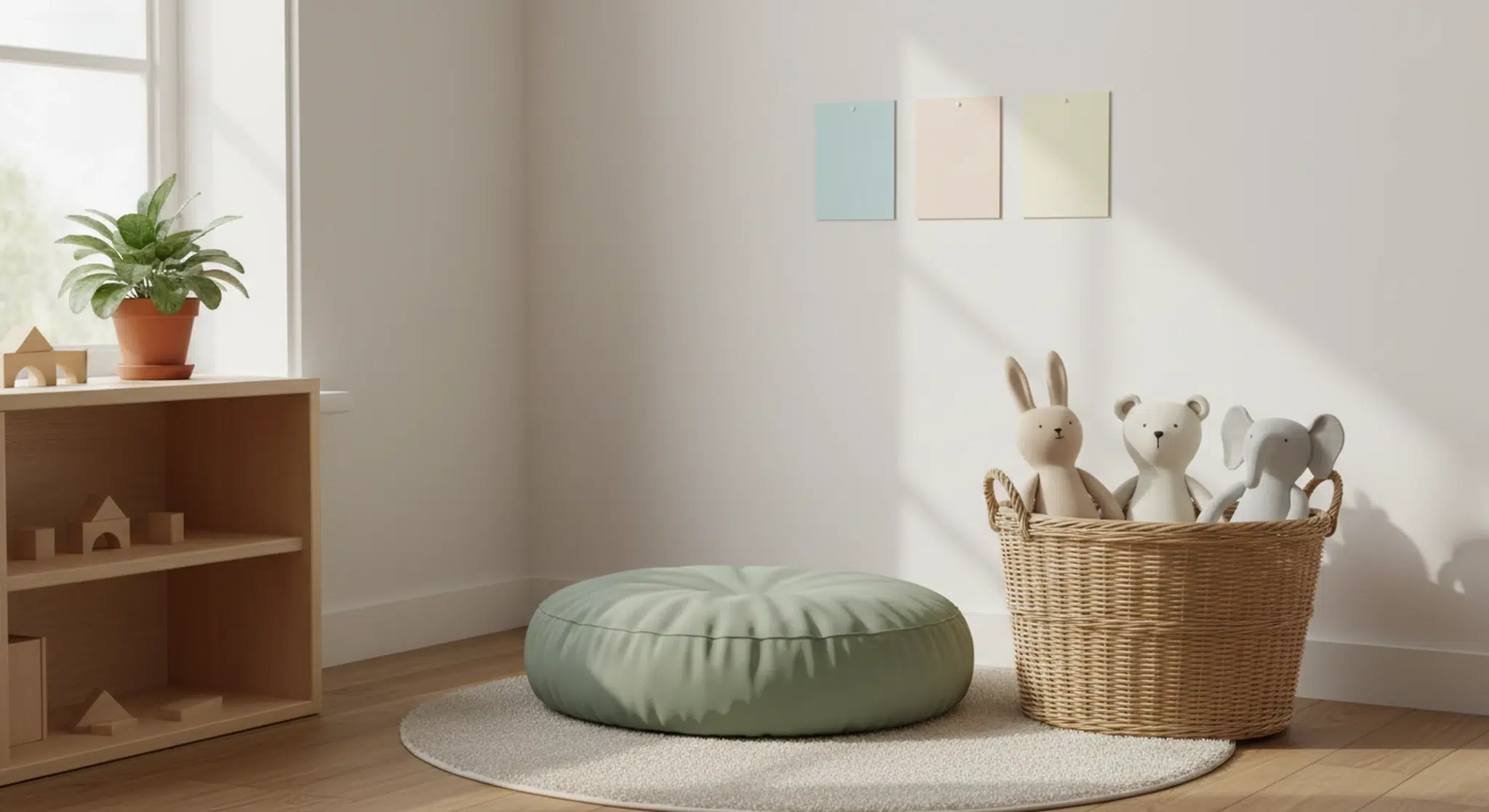
A calm down corner is a cozy, quiet spot where a child goes, with you nearby at first, to settle big feelings using a few soothing tools, and it works best when you build it together, practice it on calm days, and offer it as help rather than punishment.
A calm down corner is a small space in your home or classroom set up to help a child calm their body when feelings get too big: a soft seat, a feelings chart, a few breathing cards and a book. It is not a place for punishment. It is where you and your child practice the skill of calming down, until one day your child can do it on their own.
Below: the science of co-regulation in plain words, calm down corner vs time-out, a what-to-include checklist with safety notes, set-up steps, ideas by age, how to introduce it, scripts, common mistakes and when to talk to your pediatrician.
Key Takeaways
A calm down corner is a cozy, low-key spot for settling big feelings, offered as help, not punishment.
Children learn to calm themselves through co-regulation: an adult who stays close, names feelings and models calm.
Keep it simple: soft seating, a feelings chart, breathing cards, a book and one or two safe sensory items.
Toddlers need you beside them in the corner; school-age children can learn to use it alone.
Practice on calm days, model it yourself, and talk about the feeling once your child is calm.
As an Amazon Associate, Betteroo earns from qualifying purchases.
Table of Contents
What Is a Calm Down Corner?
Quick Answer
A calm down corner is a small, cozy, quiet spot in your home or classroom where a child goes to settle big feelings before talking about what happened. It holds a few soothing things (a soft seat, a feelings chart, breathing cards, a book or two) and it is offered as help, not as punishment. Young children use it with an adult beside them; older children learn to use it on their own.
Think of it as a physical reminder of a skill: when my body feels too big, I can go somewhere quiet, breathe, and come back. Other names you will see include calming corner, calm space, peace corner, cozy corner and calm-down area. The name matters less than how you use it.
The corner is not magic furniture. It works because it gives you and your child a predictable place and a predictable plan for the hardest moments of the day, and because you practice that plan when everyone is calm.
The Idea Behind It: Co-Regulation Comes Before Self-Regulation
Self-regulation is the ability to manage thoughts and feelings so you can act toward a goal. Children are not born with it. A practice brief from the Administration for Children and Families (Rosanbalm and Murray, 2017) describes how it grows through co-regulation: the supportive process between caring adults and children that fosters self-regulation development. The brief names three things adults provide: a warm relationship, a structured environment, and teaching and coaching of skills.
A calm down corner is one piece of that structure. The same brief lists, for preschoolers, providing external structure for calming down, including a calm-down space and materials, alongside modeling, prompting and reinforcing calming strategies such as taking a deep breath. In other words, the corner supports the skill; you still do the teaching.
Age
What co-regulation looks like (Rosanbalm and Murray, 2017)
What that means for the corner
Toddlers
Model waiting and self-calming, label emotions, coach simple words for feelings, redirect attention
You sit in the corner with your child and name the feeling for them
Preschoolers
Model, prompt and reinforce calming strategies like deep breaths; provide a calm-down space and materials; coach simple problem solving
You suggest the corner, breathe together, then help solve the problem
School-age children
Prompt and coach coping skills, self-talk and relaxation; teach words for more complex feelings
Your child goes on their own, then checks in with you
How adult support shifts with age, and how the calm down corner fits.
The brief also asks adults to notice their own feelings during stressful moments and use strategies to calm themselves first. A calm down corner works best when the adult in the room is the calmest thing in it.
Calm Down Corner vs Time-Out: What Is the Difference?
Both involve a break from the situation, so they are easy to confuse. The difference is purpose and tone. A time-out is a consequence for a specific behavior; a calm down corner is a coping tool a child can use before, during or after a big feeling, with or without having done anything wrong.
Calm down corner
Time-out (as the AAP describes it)
Main purpose
Help a child settle a big feeling and learn calming skills
Help a child cool down and learn good behavior after a specific behavior
Who starts it
Child chooses it, or an adult offers it as an invitation
Adult gives a warning, then starts the time-out
Where
A cozy spot with comfort items
A quiet, boring place such as a corner of a room, not the bedroom or playroom
How long
Until the child feels ready, often with an adult nearby
About 1 minute per year of age, or child-led for kids 3 and up
Adult role
Stays close, co-regulates, helps name the feeling
Stays calm, keeps it brief, uses it the same way each time
Afterward
Talk about the feeling and solve the problem together
Return to the activity and start over
Calm down corner vs time-out at a glance.
The American Academy of Pediatrics (AAP) lists time-outs as one of ten positive discipline strategies, alongside setting limits, praising good behavior, redirecting and others. Its HealthyChildren guidance suggests about one minute per year of age, warning your child first, and, for children at least 3, letting them end their own time-out by coming back when they feel ready and in control. The same guidance cautions that time-outs can be used too much and should be used the same way each time.
So this is not a choice between a good tool and a bad one. Many families use both: the calm down corner for feelings, and a short, calm time-out or other consequence for behaviors like hitting. What the AAP does advise against is spanking, yelling and shaming; its 2018 policy statement on discipline says harsh discipline is minimally effective in the short term and not effective in the long term.
Less is more. A corner crammed with toys becomes a play area, and a play area is exciting, not calming. Pick one or two items from each category, and rotate them if your child loses interest.
Category
Ideas (no specific brands needed)
Safety and age notes
Soft seating
Floor cushion, small rug, low upholstered chair, a corner of a reading nook
Keep it low to the floor. For toddlers, avoid anything with ties, drawstrings or loose covers they can open.
Sensory items
Soft stuffed animal, textured fabric square, squeeze ball sized for your child, sealed calm-down jar
Only age-appropriate items. For children under 3, nothing small enough to be a choking hazard.
Feelings chart
Pictures of faces showing happy, sad, angry, scared, frustrated, calm
Use photos or simple drawings; pre-readers rely on pictures.
Breathing and calming cards
Picture cards for breathing games, stretches, counting, hugging a pillow
Mount at your child’s eye level, out of reach of chewing toddlers if laminated corners are sharp.
Books
Two or three picture books about feelings or calming down
Board books for toddlers.
Fidgets
Smooth stone too large to swallow, stretchy fabric loop, sensory bottle with a glued lid
Check sizes for under 3s; supervise anything a young child might mouth.
Quiet extras
Child-size headphones (no music required), a timer with no sound, paper and crayons for older kids
Avoid cords for young children; keep screens out of the corner.
Calm down corner checklist by category.
A word on small parts. The U.S. Consumer Product Safety Commission (CPSC) bans small parts that pose a choking, aspiration or ingestion hazard in toys and products intended for children under 3, and tests them with a small parts cylinder that approximates a young child’s throat. Homemade items and adult fidgets have not been through that testing, so if a toddler uses the corner, leave out anything small, anything that comes apart, and loose beads, buttons or glitter.
Also keep the corner clear of window blind cords, heavy items on high shelves and furniture that is not anchored. For more calm, low-key sensory ideas that also work outside the corner, see our sensory activities for toddlers.
How to Set Up a Calm Down Corner, Step by Step
1. Choose the spot: a quiet, low-traffic corner in the room where your family spends the most time, not a bedroom down the hall. Young children should be able to see you, and you should be able to see them.
2. Make it a little enclosed: a bookshelf, a corner, or a draped play tent helps a child feel tucked away. It should never be a closet or anywhere with a door that shuts.
3. Build it together: let your child help pick the cushion, the books and the name. Children are more likely to use a space they helped make.
4. Add the visuals: a feelings chart and three or four calming picture cards. If you already use a visual schedule, use the same style of pictures.
5. Keep it small: one cushion, a few sensory items, a couple of books. Add more only if your child needs it.
6. Agree on the rules: for example: it is always okay to go there; we use gentle hands with the things in it; one person at a time (or with a grown-up); when you feel ready, come find me.
7. Practice before you need it: more on this below. Introducing the corner in the middle of a meltdown rarely works.
Short on space? A basket you carry to wherever the feelings happen, a folded blanket that marks the spot, or a single cushion in the corner of the living room is enough. Some families also keep a small calm kit in the car or diaper bag.
Calm Down Corner Ideas by Age
Age
How it works
Adult role
Tips
Toddlers (about 2 to 3)
A cozy spot you go to together
Stay right beside your child; hold, rock or sit with them; name the feeling
Keep items very simple and safe for mouthing. Expect it to be a place to calm with you, not alone.
Preschoolers (3 to 5)
Child can be invited, or go on their own, with you nearby
Suggest it, breathe together, then help solve the problem
Picture cards for breathing and feelings work well. Praise them for choosing it.
School-age (5 and up)
Child uses it independently
Check in afterward and talk it through
Add drawing or writing, a feelings scale, and space for their own calming ideas.
Classroom
A shared calm space in the room
Teacher introduces it through lessons before using it
Some teachers use a short timer and a check-in so the space stays a calming break, not an escape from all work.
How a calm down corner changes from toddlerhood to school age.
Toddlers deserve a special note. Tantrums are most common between about 1 and 3, according to the AAP, and MedlinePlus notes they usually begin between 12 months and age 3. At that age your child cannot yet calm down alone, so sending a 2 year old to a corner by themselves is closer to a time-out than a calm down corner. Go with them. Your calm body is the main tool.
For preschoolers, the corner pairs well with other regulation skills like turn taking and group play; our guide to cooperative play covers how those skills grow between about 3 and 5. For school-age children, short movement resets can help too; see our list of brain breaks for kids.
How to Introduce the Calm Down Corner
Teach it the way you would teach any new skill: when your child is calm, in small steps, with lots of practice.
Introduce it on a good day: walk over together and explore. ‘This is our calm corner. Anyone can come here when they have big feelings.’
Practice with pretend feelings: act out being grumpy, then go to the corner, breathe, and come back. Let a stuffed animal practice too.
Model it yourself: when you feel frustrated, say so and use the corner: ‘I’m feeling frustrated. I’m going to sit here and take three big breaths.’ The co-regulation brief lists modeling calming strategies as a core adult role.
Name feelings all day: label your child’s feelings in ordinary moments so the words are ready when the big ones arrive.
Praise using it: notice when your child chooses the corner on their own, even if they still melt down afterward.
Breathing games that work for young kids:
Smell the flower, blow out the candle: breathe in slowly through the nose as if smelling a flower, then breathe out slowly through the mouth as if blowing out a candle.
Birthday candles: hold up five fingers and blow them out one by one.
Breathing buddy: lie down with a stuffed animal on the belly and watch it rise and fall.
Square breathing (older kids): breathe in for four, hold for four, breathe out for four, hold for four.
Balloon breath: put hands on the belly and fill it up like a balloon, then let the air out slowly.
Pair a breathing game with a short, kind phrase your child can say to themselves. Our list of affirmations for kids has simple ones like ‘I can calm my body.’
Scripts: What to Say in the Moment
When feelings are big, fewer words are better. Get down to your child’s level, use a quiet voice, and keep it short.
Moment
What you can say
Feelings are building
‘Your body looks really mad. Want to go to the calm corner with me?’
Child says no
‘Okay. I’ll be right here. The corner is there if you want it.’
In the corner (toddler)
‘You’re sad. I’m here. Let’s smell the flower together.’
In the corner (preschooler)
‘Which picture shows how you feel? Let’s try the candle breath.’
Child is hitting or throwing
‘I won’t let you hit. I’m moving you somewhere safe so you can calm down.’
Calm again
‘You did it. Your body is calm now. What happened?’
Solving the problem
‘You wanted the blue truck. What could we try next time?’
Older child going alone
‘Take the time you need. Come find me when you’re ready to talk.’
Short calm down corner scripts for parents.
If your child refuses the corner, do not drag them there. Offering it and staying calm still counts as co-regulation. Safety comes first: the AAP says to stop hitting, kicking, biting or throwing right away, and MedlinePlus advises keeping your child safe until a tantrum ends.
Common Calm Down Corner Mistakes (and Fixes)
Mistake
Why it backfires
Try this instead
Sending a child there angrily
It turns the corner into a punishment, so your child avoids it
Offer it as an invitation, in a calm voice
Introducing it mid-meltdown
Nothing new can be learned during a big feeling
Practice on calm days first
Too many toys or screens
It becomes a play area, which is exciting, not calming
Keep a few soothing items; rotate them
Expecting toddlers to go alone
Toddlers cannot yet calm down by themselves
Sit with them every time
Skipping the talk afterward
The feeling passes but nothing is learned
Reconnect, name the feeling, and solve the problem
Using it to escape every limit
The corner starts to replace follow-through
Calm down first, then the limit still stands
Giving up after a week
New skills take many repetitions
Keep modeling and practicing for several weeks
Common calm down corner mistakes and fixes.
Remember that calming down is a skill your child will keep building for years. Big feelings at the end of a long day, or around a new sibling, a move or daycare drop-offs, are normal; see separation anxiety in toddlers for help with goodbyes. A predictable toddler bedtime routine can also prevent the overtired meltdowns that make evenings hardest, since MedlinePlus lists regular eating and sleeping times as a way to help prevent tantrums.
Tantrums and big feelings are a normal part of development, and they usually become less frequent with age. MedlinePlus notes that children 3 to 5 still have tantrums, though less often, and that after age 5 tantrums rarely occur. A calm down corner can help, but it is not a treatment for any condition and it does not replace an evaluation.
MedlinePlus says the AAP recommends contacting your child’s provider if:
Tantrums get worse or happen often after age 5.
Your child injures themselves or others, or destroys property, during tantrums.
Your child holds their breath during tantrums, especially if they faint.
Your child also has nightmares, a reversal of toilet training, headaches or stomachaches, anxiety, refuses to eat or go to bed, or clings to you.
Also reach out if you find it hard to control your own anger or shouting, or worry you might respond with physical punishment. Asking for help is part of good parenting, and your pediatrician can connect you with support.
Frequently Asked Questions
What is a calm down corner?
A calm down corner is a quiet, cozy spot at home or in a classroom where a child can go to settle big feelings. It usually has soft seating, a feelings chart, breathing cards, a few books and safe sensory items. It is offered as a coping tool rather than a punishment, and young children use it with an adult nearby.
Is a calm down corner the same as a time-out?
No. A time-out is a short consequence after a specific behavior, about one minute per year of age according to AAP guidance. A calm down corner is a comforting space a child can choose whenever feelings get big, often with an adult beside them. Many families use both, for different situations, and keep the tone calm for each.
What age is a calm down corner for?
Children from about age 2 can start using one, but toddlers need an adult in the corner with them because they cannot calm down alone yet. Preschoolers can be invited to go, with you nearby, and school-age children can learn to use it on their own and talk about it afterward. Adjust the items and rules as your child grows.
What should I put in a calm down corner?
Start small: a floor cushion or soft seat, a feelings chart with faces, picture cards for breathing games, two or three books about feelings, and one or two sensory items such as a soft toy or a sealed calm-down jar. For children under 3, leave out anything small enough to choke on, items that come apart, and cords.
How do you introduce a calm down corner to a toddler?
Introduce it on a calm day. Show your toddler the space, explore the items together, and practice pretend feelings and simple breathing games like smelling a flower and blowing out a candle. Model it yourself when you feel frustrated. When a real meltdown comes, go to the corner with your toddler and stay close.
What if my child refuses to go to the calm down corner?
Do not force it. Stay calm, keep your child safe, and say something like I will be right here, and the corner is there when you want it. Staying close and calm still helps your child regulate. Keep practicing on calm days, praise them when they choose it, and make sure the corner never feels like a punishment.
Gentle changes, peaceful nights.
Betteroo builds a personalized sleep plan for your baby or toddler. Take the free two-minute quiz to get started.
Sege RD, Siegel BS; Council on Child Abuse and Neglect; Committee on Psychosocial Aspects of Child and Family Health. Effective Discipline to Raise Healthy Children. Pediatrics. 2018;142(6):e20183112. https://pubmed.ncbi.nlm.nih.gov/30397164/