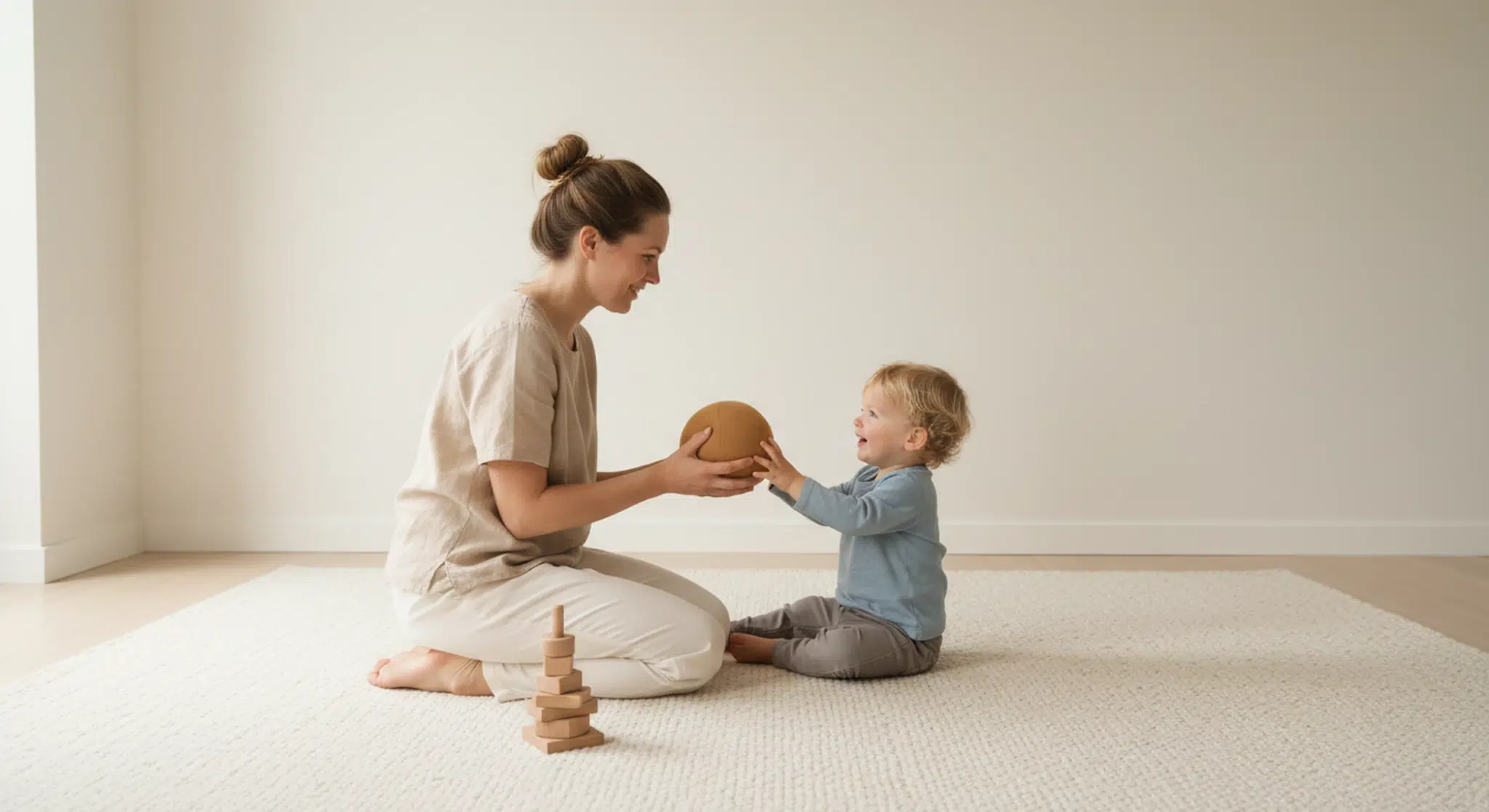
Redirection techniques guide a child’s attention or energy away from an unsafe or unwanted behavior and toward an acceptable one, such as offering soft balls to throw when your toddler starts throwing blocks.
Redirection techniques are simple ways to stop a behavior and point your child toward something they can do instead. Rather than a string of “no” and “stop,” you show the next step: “Gentle hands with the dog. You can pet her like this.” For toddlers, whose self-control is still a work in progress, this is often the fastest and kindest way through the day.
Below you will find what redirection is and why it works, how it differs from distraction, 15 techniques with example scripts, a chart for common behaviors like hitting, biting and climbing, how redirection changes by age, and the moments when you need something more.
Key Takeaways
Redirection stops an unwanted behavior and offers a specific, acceptable alternative that meets the same need.
It works well for toddlers because self-control and memory for rules are still developing.
Distraction swaps the focus; redirection channels the same urge somewhere safe.
Safety comes first: stop dangerous behavior immediately, and comfort a very upset child before redirecting.
As children reach preschool age, add short problem-solving talks, limits and natural consequences.
As an Amazon Associate, Betteroo earns from qualifying purchases.
Table of Contents
What Is Redirection?
Quick Answer
Redirection means steering your child’s attention or energy away from something unsafe or off limits and toward something they can do. It works well for toddlers because their self-control is still developing, and it is one of the 10 healthy discipline strategies the American Academy of Pediatrics (AAP) lists for parents.
Redirection has two parts. First you stop or block the behavior. Then you offer a clear, specific alternative that meets the same need. A toddler climbing the bookshelf wants to climb, so you lift them down and take them to a pile of floor cushions.
The AAP’s guide to healthy discipline, on HealthyChildren.org, puts it simply: children often misbehave because they are bored or do not understand what is expected, so find something else for them to do.
Why Redirection Techniques Work So Well With Toddlers
According to ZERO TO THREE, children between 12 and 24 months still lack self-control and cannot yet hold rules in memory, which is why adults need to repeat the same rules patiently. Even at 2 to 3, they may be unable to stop themselves when they know an action is not allowed.
That gap between knowing and doing is where redirection helps: a redirect does the stopping for them and gives the energy behind the behavior somewhere to go. ZERO TO THREE also notes that interrupting a behavior without offering another option often means the behavior simply continues.
The AAP’s 2018 policy statement on effective discipline (Sege and Siegel, Pediatrics) concluded that aversive discipline, including spanking, yelling and shaming, is minimally effective in the short term and not effective in the long term. The AAP advises against spanking. Redirection teaches instead: it shows a child what to do. It fits naturally with gentle parenting and authoritative parenting, which pair warmth with clear limits.
Distraction vs Redirection (and Verbal vs Physical Redirection)
Distraction
Redirection
What it does
Swaps your child’s focus to something completely different
Channels the same urge into an acceptable outlet
Example
Your child is grabbing your phone, so you point out a bird outside
Your child is throwing blocks, so you offer soft balls to throw into a laundry basket
Best for
Babies and young toddlers, short waits, moments when the urge itself is not useful
Toddlers and preschoolers with a strong drive to throw, climb, bang, bite or move
Distraction and redirection compared.
Distraction is fine for a 12-month-old reaching for your phone. As your child grows, move toward true redirection, because it respects the need behind the behavior and teaches where it is okay.
Verbal redirection uses words alone: “Feet on the floor. You can stand on the step stool.” Physical redirection means gently guiding your child with your hands, such as walking them away from the stairs or moving their hand from a sibling’s hair to a stuffed animal. With young toddlers you will use both together; always pair guidance with calm words, and lean more on words as language grows.
Big days go better with a good night of sleep.
Got a little one at home too? Our free two-minute quiz builds a gentle, personalized sleep plan for babies and toddlers.
15 Redirection Techniques for Toddlers (With Example Scripts)
Use the scripts as starting points.
1. Say what to do, not only what not to do: Replace “Don’t run” with the action you want. “Walking feet inside. Running is for the backyard.”
2. Offer a same-urge swap: Match the outlet to the urge: throwing, climbing, banging, pouring. “Blocks are for building. Let’s throw these beanbags into the bucket.”
3. Give two choices you are happy with:“Do you want to walk to the car or hop like a bunny?”
4. Move the body, change the scene: A new room or a trip outside resets a toddler fast. “Let’s go see what the birds are doing.”
5. Name the feeling, then redirect:“You’re mad your tower fell. You can stomp your feet with me.”
6. Make it a game: Silly beats bossy. “Can you tiptoe to the bath so quietly the fish don’t hear you?”
7. Give a job:“I need a strong helper to carry the napkins to the table.”
8. Use “when, then”:“When the toys are in the bin, then we can go outside.”
9. Bring in pretend play:“Your car seat is a rocket ship. Buckle up, astronaut.”
10. Sing it: A made-up tune works when your hands are busy.
11. Show them gentle hands: Model the safe version. “Touch the baby like this, soft as a feather.”
12. Lower your voice: Whispering often stops a shouting toddler better than shouting back. “Can you use your whisper voice like me?”
13. Point to a fun thing that comes next:“After we leave the park, we get to choose a book for the car.” A visual schedule makes this concrete.
14. Hand them a “yes” object: Keep a few safe stand-ins ready: an old (switched-off) remote, a set of measuring cups, a toy phone. “That’s my phone. This one is yours.”
15. Say yes to the idea, no to the place: Many behaviors are fine somewhere else. “Drawing is great. Walls aren’t for drawing. Let’s tape paper to the wall so you can draw standing up.”
How to Redirect Common Toddler Behaviors
For anything that could hurt someone, stop it first, then redirect.
Situation
What your child may need
A redirect that fits
Hitting
To express anger or frustration, or to get a toy back
Block the hit. “I won’t let you hit. You can squeeze this pillow or stomp your feet.”
Biting
Teething relief, or a way to show upset
Calm, firm “No biting. Biting hurts.” Offer a teether or a crunchy safe snack, and check in on the feeling.
Throwing toys
To practice throwing
“Trucks stay on the floor. Let’s throw soft balls into the basket.”
Climbing furniture
Big movement, gross motor practice
Lift them down. “Couch is for sitting. Let’s climb the cushions on the floor.”
Grabbing toys
The toy right now
“Ava is using it. Let’s set a timer. You can drum while you wait.”
Screaming indoors
Noise, attention, excitement
“Inside we use a quiet voice. Want to roar like a lion outside?” Or try a whisper game.
Running off in a parking lot
Freedom and movement
Safety first: hold their hand or pick them up. “In parking lots we hold hands. At the park you can run.”
Refusing to leave the park
More fun, help with transitions
“Two more slides, then you can lead us to the car.”
Drawing on walls
Creative play, big arm movements
“Walls aren’t for crayons. Here’s a big paper taped to the door.”
Touching a hot stove or unsafe item
Curiosity
Move them away now. “Hot! You can stir this cold pot with me.”
Common toddler behaviors and a redirect that matches the need.
For biting and hitting, the American Academy of Child and Adolescent Psychiatry (AACAP) advises responding right away with a calm, firm “no,” never biting or hitting back, and, when one child hurts another, separating them and comforting the hurt child first. AACAP also warns that a child who gets the toy by hitting is being rewarded for it.
Redirection by Age: 12 Months to 5 Years
Age
What is happening
Redirection that fits
12 to 18 months
Exploring everything, very little impulse control, few words
Physical redirection and distraction; childproof to reduce redirects
18 months to 2 years
More words, strong opinions, lots of “No!”
Short phrases plus a swap (“Gentle. Like this.”), two simple choices, songs and games
2 to 3 years
Big feelings, tantrums common, starting to follow simple rules
Name the feeling, then a same-urge outlet; “when, then”
3 to 5 years
Better language, can begin to think back on what happened with help
More problem-solving: “What could you do instead next time?”
Moving beyond redirection
Around preschool age, kids can help plan
Talk when calm, brainstorm alternatives, practice in play
How redirection changes as your child grows.
ZERO TO THREE notes that around age 3, children can start to reflect on past situations with an adult’s help. That is your cue to add a short follow-up conversation after a hard moment. Reading together helps too: our guide to feelings books for children lists picture books that give kids words for anger, worry and frustration. For sharing and turn-taking, see cooperative play.
When Redirection Is Not Enough
Safety comes first: If your child is about to get hurt or hurt someone, stop the action immediately: pick them up, hold their hands, or move them. The CDC is clear that dangerous and destructive behaviors should not be ignored.
When your child is truly upset: A child in a meltdown needs comfort, not a new toy. The CDC advises against shifting attention away from a child who is genuinely upset and suggests time-in or emotion coaching instead. A cozy calm down corner gives them a place to do that with you nearby.
When the behavior keeps happening: Redirecting the same thing many times a day? Look for patterns. The CDC advises meeting needs like hunger, tiredness or illness rather than treating the behavior as misbehavior.
Add limits and consequences: The AAP lists setting limits, giving consequences and using time-outs alongside redirection. It suggests about one minute of time-out per year of age as a general guideline. ZERO TO THREE notes that time-outs are often not effective for 2 and 3 year olds, so many families start with time-in (staying with your child while they calm down). Small natural consequences also teach: if crayons go on the wall again, the crayons take a break for the day.
Common Redirection Mistakes (and What to Do Instead)
Mistake
Why it backfires
Try this instead
Redirecting every feeling away
Kids learn that sadness or anger is not welcome
Name the feeling first, then redirect the behavior, not the emotion
Using treats or screens as the redirect
It can turn into a bribe, and kids learn that misbehaving earns rewards
Redirect to an activity or a job, and save treats for unrelated moments
No follow-through
If the climbing continues after the redirect, the message gets lost
Calmly repeat once, then help your child do it (lift them down, walk them away)
Giving in to stop the noise
Yelling gets the reward, so yelling grows
Hold the limit kindly, and give your attention back when the behavior you want shows up
Redirection mistakes and better alternatives.
Consistency plus warmth keeps redirection from sliding into permissive parenting. The CDC suggests that when a minor misbehavior stops, you return your attention right away and praise the behavior you want to see. Fewer redirects are needed when you set up a childproofed “yes space” with go-to outlets such as soft balls, a pillow pile and paper taped to a low table; our sensory activities for toddlers add more ideas. Take a slow breath first, and borrow kind phrases from affirmations for kids for yourself too.
Hitting, biting and tantrums are common in toddlers. According to the Merck Manual, tantrums usually start near the end of the first year, peak between about ages 2 and 4, and become infrequent after age 5. Check in with your pediatrician if:
Tantrums often last more than 15 minutes or happen several times a day.
Tantrums or aggression are still frequent after age 5.
Hitting, biting or other aggression is frequent or severe, especially if daycare or preschool raises concerns.
You feel overwhelmed or worried you might lose control.
AACAP recommends talking to your pediatrician if these strategies are not working and asking for a referral to a mental health professional who specializes in young children if aggression persists.
Frequently Asked Questions
What is redirection in parenting?
Redirection is a discipline technique where you steer a child away from an unsafe or unwanted behavior and toward an acceptable one. You stop or block the behavior, then offer a specific alternative that meets the same need, such as soft balls to throw instead of blocks. The AAP lists redirecting as one of its healthy discipline strategies for young children.
What are some redirection techniques for toddlers?
Useful redirection techniques include saying what to do instead of what not to do, offering a same-urge swap, giving two acceptable choices, changing the scene, naming the feeling before redirecting, turning a task into a game, giving your toddler a job, using when then statements, singing, and previewing a fun next step. Keep words short and act early.
What is the difference between distraction and redirection?
Distraction switches a child’s attention to something completely different, like pointing out a bird when a baby grabs your phone. Redirection channels the same urge somewhere acceptable, like throwing a soft ball into a basket instead of throwing blocks. Distraction suits babies and quick moments, while redirection teaches toddlers and preschoolers where a behavior is okay.
At what age should you start redirecting a child?
You can start as soon as your baby begins to crawl and explore, often with gentle physical redirection and distraction around the end of the first year. Between 12 and 24 months toddlers still lack self-control and need rules repeated often, so redirection is especially useful then. By preschool age you can add short problem-solving talks.
Does redirection work for hitting and biting?
It helps, but safety comes first. Stop the hit or bite right away with a calm, firm no, comfort the child who was hurt, and then offer an acceptable way to show the feeling, such as stomping or squeezing a pillow. Never hit or bite back. If aggression is frequent or severe, talk with your pediatrician.
When does redirection not work?
Redirection may not work when a child is very upset, tired, hungry or sick, or when they have already hurt someone. In those moments, meet the need, keep everyone safe, and offer comfort or a calm space first. It can also backfire if the redirect is a treat or screen, which may reward the behavior you want to stop.
Gentle changes, peaceful nights.
Betteroo builds a personalized sleep plan for your baby or toddler. Take the free two-minute quiz to get started.