The best sleepover ideas for kids pair one hands-on activity, one active game and a cozy wind-down with easy food, a set lights-out and a quick safety check with every guest’s parent.
These sleepover ideas for kids are written for parents of 6 to 12 year olds: 21 activities sorted into crafts, games, movie and spa nights, campouts, scavenger hunts and kitchen fun, plus snacks and breakfast for a group.
You will also find how to tell if your child is ready, themes by age, a sample schedule from arrival to pickup, checklists for host and guest parents, and how to handle phones, homesickness and a late night.
Key Takeaways
Plan one craft, one active game and one wind-down activity instead of a packed agenda.
There is no magic age for a first sleepover; readiness matters more, and a late-over is a great first step.
Ask every guest’s parent about food allergies, medicines and bedtime needs before you shop.
Before your child sleeps over, ask who is supervising and whether there are guns in the home and how they are stored.
Set a lights-out, turn screens off an hour before it, and plan a quiet next day.
As an Amazon Associate, Betteroo earns from qualifying purchases.
Table of Contents
Sleepover Ideas for Kids: The Quick Answer
Quick Answer
The best sleepover ideas for kids mix one hands-on activity (a craft or a fort), one active game, a movie or campout to wind down, food kids help make and an easy breakfast. Before anyone arrives, ask each guest’s parent about food allergies, medicines and bedtime needs, agree on screens and phones, and share your number. Below are 21 sleepover activities, plus snacks, themes by age, a sample schedule and checklists for host and guest parents.
A great sleepover for 6 to 12 year olds is about rhythm, not a packed agenda: energy after arrival, food, a cozy middle and a reasonable lights-out.
Is Your Child Ready for a First Sleepover?
There is no single right age. Henry Ford Health pediatrician Dr. Stacy Leatherwood says there is no magical age when a child is old enough for an overnight, and that maturity matters more than age.
They want to go: Eagerness beats going along because friends are.
They can handle bedtime: Brushing teeth, changing into pajamas and falling asleep without you there are all part of the night.
They have practiced: A good night at a grandparent’s house is a natural stepping stone.
They can speak up: Henry Ford Health says kids should be able to make sensible choices under peer pressure and reach you to explain if something goes wrong.
Try a late-over first. The American Academy of Pediatrics (AAP) suggests a “lateover” (sometimes called a sleep-under) if you feel uneasy: pajamas, games or a movie, then home to sleep. The AAP calls it perfectly fine playdate etiquette. Still at the daytime stage? See our guide to play dates.
Sleepover Ideas for Crafts and Creative Fun
Crafts make the best opener: kids can start the moment they arrive, and nobody wins or loses. Set up the station before the first doorbell.
1. Pillowcase decorating: give each guest a plain pillowcase and fabric markers. Friends sign each other’s, and it goes home as the party favor.
2. Friendship bracelets: embroidery floss, tape to anchor the ends to the table and a simple pattern sheet. Faster crafters can teach the others.
3. Sleepover memory book: a few stapled blank pages per child for drawings, funny quotes from the night and a group signature page.
4. Make-your-own slime: a favorite for 8 to 11 year olds, done at the kitchen table with an adult nearby and hands washed afterward. Our homemade slime guide has recipes and safety notes.
5. Mini talent show: kids sign up for a two minute act (jokes, a magic trick, a dance) and the host child plays announcer.
Sleepover Games Kids Love
Put the active games early in the evening and the quieter ones after dinner.
6. Classic party games: charades, freeze dance and Simon says get a group moving early. Our party games for kids guide has more with almost no supplies.
7. Card and board game corner: set out two or three games for four or more players. Fast card games for kids fill the gap between dinner and the movie.
8. Would you rather: no setup, lots of giggles, and an easy icebreaker for kids who do not know each other well. Print a list from our would you rather questions for kids.
9. Flashlight tag or hide and seek: set boundaries first: no hiding in garages, cars, locking closets or anywhere near a pool.
10. Glow-in-the-dark bowling:glow sticks dropped into plastic bottles turn a hallway into a bowling lane. Glow sticks stay whole: no chewing or cutting them open.
Big days go better with a good night of sleep.
Got a little one at home too? Our free two-minute quiz builds a gentle, personalized sleep plan for babies and toddlers.
Movie Night, Spa Night, Campout and Scavenger Hunt Ideas
These are your wind-down and transition activities.
11. Movie night with a ticket booth: kids vote between two or three pre-approved films and get a paper ticket and snack bag at the door. See our family movie night ideas and our list of movies for 9 to 12 year olds.
12. Movie bingo: before the film, everyone fills a grid with things they predict will happen. It keeps restless kids engaged.
13. Spa night: warm washcloths, nail polish and a hair-braiding station. Ask about skin sensitivities first.
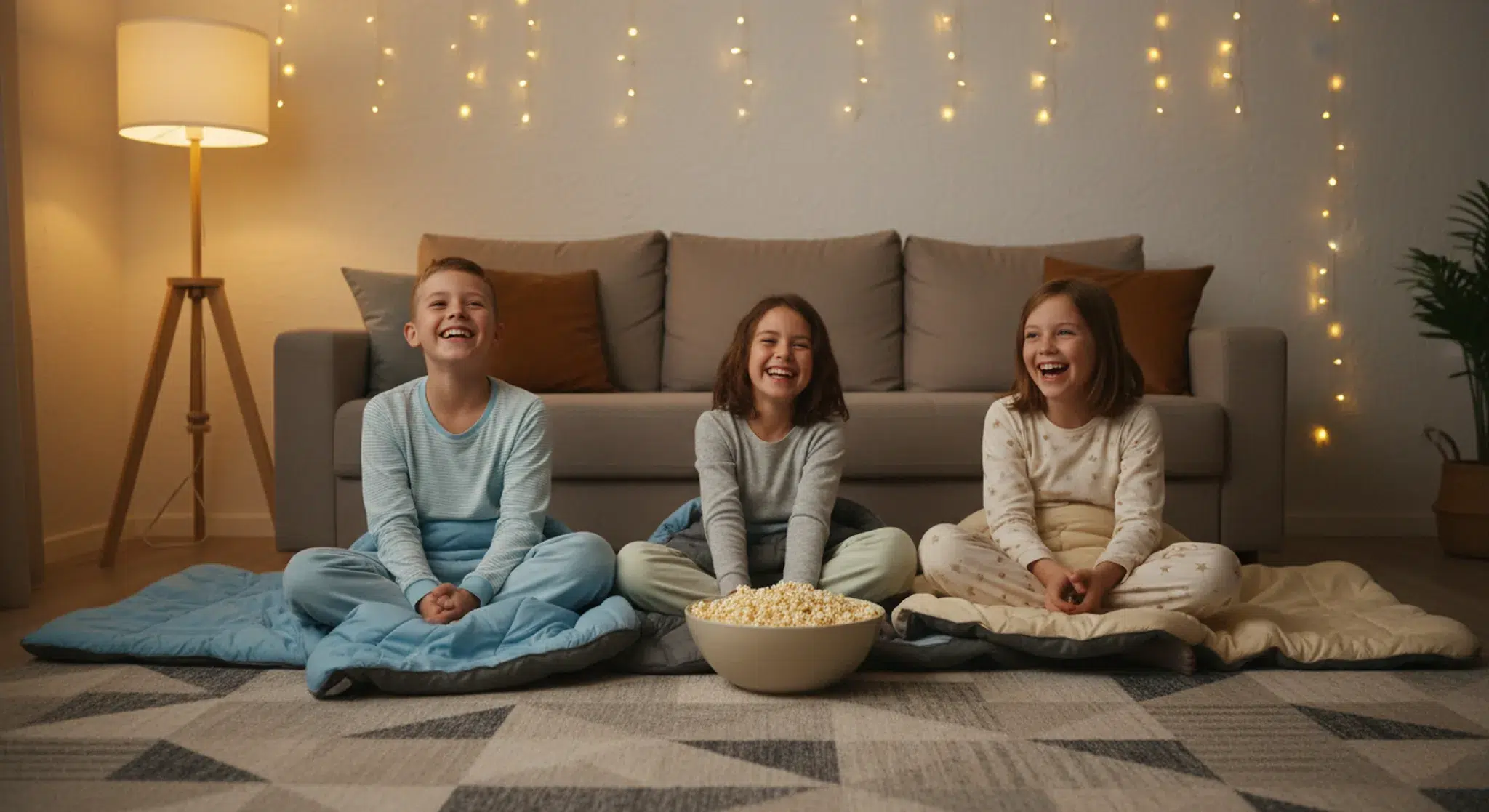
14. Indoor campout: sleeping bags in a circle around a battery lantern with the room lights off. Use flashlights or battery string lights, not real candles.
15. Blanket fort: chairs, clips and sheets make a fort that doubles as the sleeping area. Our fort ideas guide has 35 designs and fort safety rules.
16. Clue scavenger hunt: ten clues hidden around the house, each leading to the next. Use drawings for younger kids and riddles for older ones.
17. Glow-stick hunt: hide glow sticks in one room, turn off the lights and let kids find them.
Check ratings with each guest’s parent first: the AAP suggests parents tell hosts if they do not want their child watching movies above PG or PG-13 or playing games above E.
Sleepover Snacks and Breakfast Ideas
Before you shop, ask each guest’s parent about food allergies and diet rules. The AAP says parents should tell the host about health needs, including food and pet allergies, so as host, ask first. For a serious allergy, Michigan Medicine’s food allergy team advises checking with the parent before any food is eaten, skipping anything without a label (“when in doubt, don’t eat”), and making sure the child’s epinephrine auto-injector comes along and an adult knows how to use it.
Meal
Easy ideas
Host tips
Dinner
Build-your-own pizza, tacos with toppings in bowls, pasta bar
Kids assemble, an adult handles the heat
Movie snacks
Popcorn, fruit kebabs, pretzels, veggie sticks with dip
One cup or bag per child
Sweet treat
Pre-baked cookies to decorate, ice cream sundaes
No tasting raw dough or batter (CDC)
Breakfast
Pancakes or waffles, yogurt parfaits, scrambled eggs, fruit
Start about an hour before pickup
Kids sleepover snacks and breakfast ideas.
Food kids help make doubles as an activity:
18. Build-your-own pizza: pre-made crusts, sauce and toppings in bowls. Kids assemble; an adult handles the oven.
19. Cookie or cupcake decorating: bake ahead, then set out frosting and sprinkles. The CDC warns against tasting raw dough or batter, because most flour is raw and raw eggs can carry Salmonella, so the fun starts after baking.
20. Popcorn or trail mix bar: bowls of popcorn, cereal, pretzels and dried fruit; each guest fills a cup. Include only ingredients every guest can safely eat.
21. Pancake breakfast bar: an adult runs the griddle while kids pick toppings and set the table.
Sleepover Themes by Age
A theme is optional, but it makes choosing activities and snacks easier.
Age
Themes
Activities that fit
Group size to start
6 to 7
Pajama party, dinosaurs, outer space
Fort, glow-stick hunt, pillowcase decorating, a short movie
Spa night, movie bingo, card game tournament, karaoke
3 or 4 friends
Sleepover themes by age. Group sizes are practical starting points, not rules.
Sample Sleepover Schedule: Arrival to Pickup
Time
What happens
Notes
5:30 PM
Arrival and craft station
Collect parents’ numbers and any medicine; show the bathroom
6:00 PM
Active game or scavenger hunt
Burn off energy before food
6:45 PM
Build-your-own dinner
Kids assemble, adult cooks
7:30 PM
Dessert decorating or spa night
Calmer after dinner
8:00 PM
Pajamas, teeth brushed, sleeping bags out
Before the movie, while kids are still awake enough
8:15 PM
Movie or campout in the fort
Screens off when it ends
10:00 PM
Lights out (a bit later for older kids)
An adult checks in
8:00 AM
Breakfast bar
Early risers start a quiet card game
9:30 to 10:00 AM
Pickup
Leaves time to rest at home
A sample kids sleepover schedule. Shift it to your family’s usual bedtime.
Kids stay up later at sleepovers; just keep a set lights-out. The American Academy of Sleep Medicine recommends 9 to 12 hours of sleep per 24 hours for children 6 to 12, as summarized by the CDC, so a 10 PM lights-out and a 7 AM wake-up already lands at the low end. See how much sleep kids need for the full chart.
Host and Guest Parent Checklists
If you are hosting, run through this a few days before:
Get every parent’s phone number and the pickup time.
Ask about food allergies, medicines, fears, bedtime routines and bedwetting (privately; a guest who uses a nighttime pull-up can pack it in a regular bag).
Tell parents who will be home and supervising, what pets you have, and your screen, phone and movie plan.
Store any guns locked and unloaded, with ammunition locked separately, as the AAP recommends.
Keep pools and trampolines off-limits; the AAP recommends never using trampolines at home.
Check in on the group regularly and step in early on teasing or leaving someone out.
If your child is the guest, ask the questions the AAP recommends before any visit to another home. Most hosts are glad you asked.
Who will be home?: The AAP suggests asking who will be watching the children and whether older siblings or other adults will be there. Henry Ford Health adds asking who else is invited and whether there are enough adults for the number of kids.
Are there guns in the house, and how are they stored?: The AAP recommends asking about guns and safe storage at homes your child visits, even if you have none at home. If you are uncomfortable with the answer, it suggests offering to host instead.
Is there a pool or trampoline?: The AAP says even children who can swim need an adult supervising them in the water.
What are the screen rules?: Ask about movies, games and phones, and (as Henry Ford Health suggests) about alcohol and how it is stored. Mention any pet allergies or fears.
Then pack pajamas, a toothbrush, a change of clothes, a sleeping bag if asked, a familiar comfort item, and any medicine with written instructions for the host.
Phones, Homesickness and Calling Home
Screens and phones: The AAP recommends turning off all screens at least an hour before bedtime and keeping screens out of children’s bedrooms at night. Many hosts use a phone basket at lights-out.
Talk about homesickness ahead of time: Tell your child it is okay to miss home, and that they can tell the host parent or call you.
Agree on a code word: Henry Ford Health suggests a code phrase (such as “I forgot to feed the cat”) your child can use if they want to come home but feel embarrassed in front of friends.
Promise a no-trouble pickup: Henry Ford Health suggests promising to answer and pick up at any hour, and not punishing a child for calling about an unsafe situation.
If a guest wants to go home: Stay calm, call their parent and let the parent decide.
Tweens and teens want more independence, but the same questions apply: who is home, the rules, phones and social media, and how your child reaches you. Teens need 8 to 10 hours of sleep per 24 hours under the same American Academy of Sleep Medicine recommendations; see how much sleep teenagers need.
The best sleepover ideas for kids are simple: one craft or fort, one active game, a movie or campout to wind down, food kids help make and a calm breakfast. Choose readiness over age, start with a late-over if you are unsure, and ask about allergies, supervision, guns, pools and screens before anyone packs a sleeping bag.
Expect a later night and plan a quiet next day. The AAP notes that regular sleep deprivation can lead to irritability and trouble concentrating, so a gentle wind-down, a set lights-out and an easy afternoon afterward help everyone bounce back.
Frequently Asked Questions
What are good sleepover ideas for kids?
Good sleepover ideas for kids include pillowcase decorating, friendship bracelets, a blanket fort, an indoor campout, a glow-stick hunt, movie night with paper tickets, spa night, cookie decorating and a pancake breakfast bar. Pick one craft, one active game and one wind-down activity rather than trying to do everything.
What age is appropriate for a first sleepover?
There is no single right age. Pediatricians say maturity matters more than age: your child should want to go, manage bedtime without you, and be able to speak up or call you if something feels wrong. Many families start with a late-over, where kids leave in pajamas before bedtime.
What is a late-over?
A late-over, sometimes called a sleep-under, is a sleepover without the overnight. Kids eat dinner, put on pajamas and play games or watch a movie, then go home to sleep in their own beds. The American Academy of Pediatrics calls it perfectly fine playdate etiquette and a good option when anyone feels unsure.
What should you ask before letting your child sleep over?
Ask who will be home and supervising, who else is invited, whether there are guns in the home and how they are stored, whether there is a pool or trampoline, what the screen and movie rules are, and what pets live there. Share your child’s allergies, medicines and pickup plan.
What time should kids go to bed at a sleepover?
Most hosts set lights out an hour or two after the usual bedtime, often around 10 PM for younger school-age kids. Children 6 to 12 need 9 to 12 hours of sleep per 24 hours, so set a clear lights-out, turn screens off before it and plan a quiet next day.
How many friends should you invite to a sleepover?
For a first sleepover, one or two friends is easiest to supervise and least likely to leave someone out. Older kids often enjoy three or four guests. Choose a number you can comfortably watch, feed and fit on the floor, and match it to how well the kids know each other.
Gentle changes, peaceful nights.
Betteroo builds a personalized sleep plan for your baby or toddler. Take the free two-minute quiz to get started.