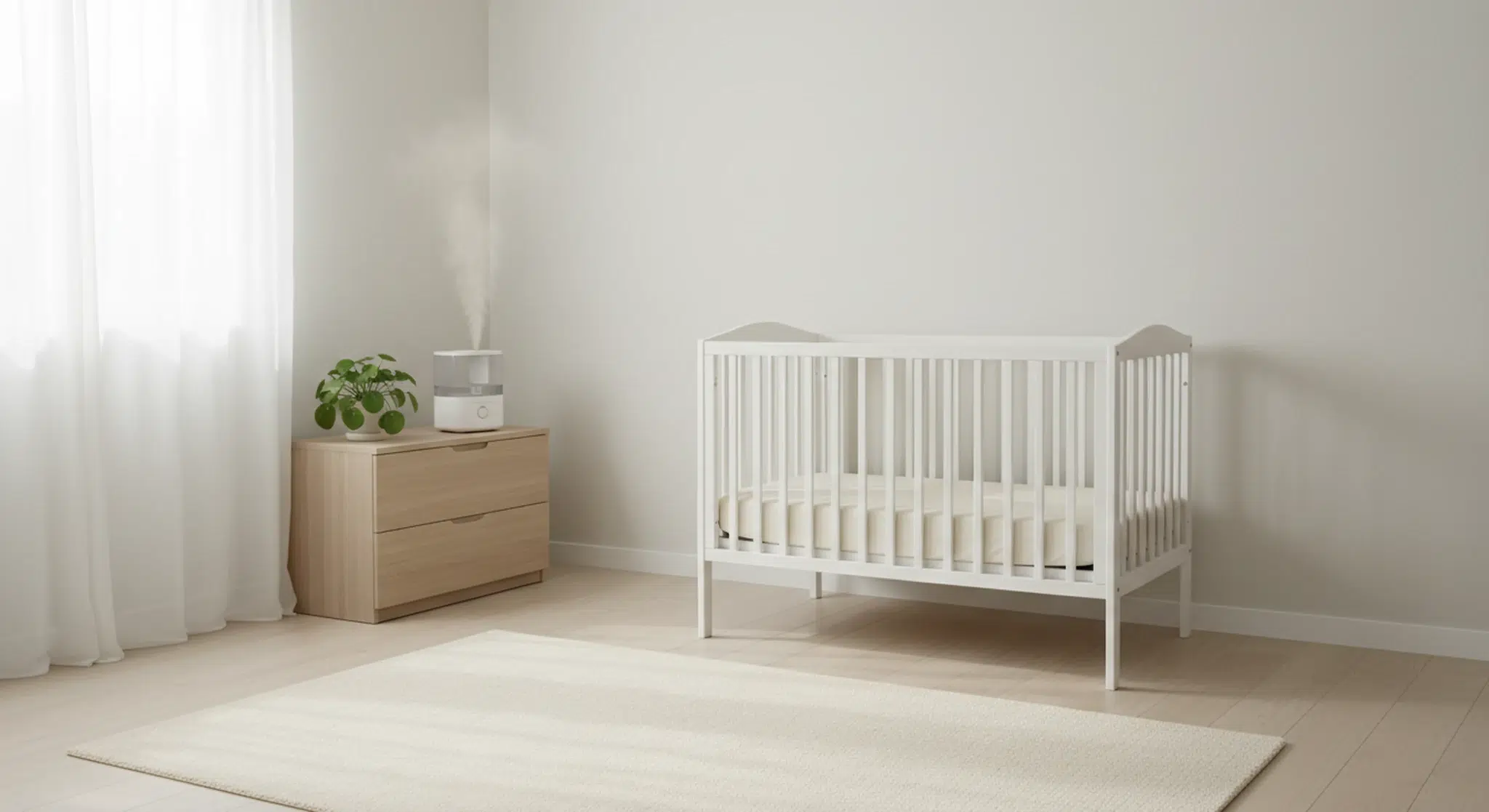


The ideal humidity for baby is a relative humidity of about 30% to 50%, the indoor range the EPA and Mayo Clinic recommend: enough moisture to keep skin and noses comfortable without feeding dust mites and mold.
Dry winter air, a baby with a crusty nose, a humidifier humming in the corner: the good news is that the target is wide, and an inexpensive meter tells you where you stand.
This guide covers the number, what it means, signs the room is too dry or too damp, how to raise or lower humidity safely, and how humidity connects to colds, eczema and overheating.
Key Takeaways
- Aim for 30% to 50% relative humidity. The EPA says keep indoor air below 60%, ideally 30% to 50%.
- There is no separate baby target: the same range is the best humidity level for sleeping.
- Measure with a hygrometer placed in the nursery, away from the humidifier and out of the crib.
- If you add moisture, use a cool-mist humidifier out of reach, with distilled water, emptied daily and cleaned every third day.
- Overheating matters more than humidity for safe sleep: one more layer than you wear, and a bare crib.
As an Amazon Associate, Betteroo earns from qualifying purchases.
Table of Contents
Ideal Humidity for Baby: The Short Answer
Quick Answer
There is no special “baby number.” None of the health sources we reviewed sets a different target for infants. A reading anywhere in the 30s or 40s is fine.
What Relative Humidity Means (and Why It Swings With the Seasons)
Humidity meters show relative humidity (RH): how much water vapor the air holds compared with the most it could hold at that temperature, written as a percentage. Because warm air can hold more water than cool air, the same amount of moisture reads as a lower percentage when you heat a room, and a higher one when the room cools.
That is why nursery humidity is rarely constant. Mayo Clinic notes that indoor humidity tends to run higher in summer and lower in winter. The American Academy of Pediatrics (AAP), on its parent site HealthyChildren.org, points out that forced-air heating in winter creates dry air and low humidity in the home.
- Winter: heating pulls humidity down; this is when a humidifier is most useful.
- Summer: humid weather can push indoor levels above 50%, so you may need to dry the air instead.
Nursery Humidity Levels at a Glance
| Humidity level | What tends to happen | What to do |
|---|---|---|
| Below 30% | Dry air. Mayo Clinic links low humidity to dry skin and irritation of the nose, throat and eyes, plus bloody noses and cracked lips | Add moisture: a clean cool-mist humidifier, shorter baths, moisturizer for skin |
| 30% to 50% | The range the EPA and Mayo Clinic recommend | Nothing. Keep checking as the seasons change |
| 50% to 60% | Above where the EPA says to humidify. Air may feel stuffy, and dust mites thrive as humidity rises | Turn off or turn down the humidifier, ventilate, use AC or a dehumidifier in damp weather |
| Above 60% | Above the EPA’s upper limit. Condensation on windows and walls, a higher chance of mold growth | Dry the air and fix the moisture source: ventilation, dehumidifier, AC, dry any wet surfaces |
The Best Humidity Level for Sleeping (for Baby and for You)
The best humidity level for sleeping is the same 30% to 50% range. The EPA and Mayo Clinic do not set a separate figure for bedrooms, and we did not find an authoritative source that does. If you are aiming for a single target in a winter nursery, about 40% sits comfortably in the middle: the AAP mentions that a whole-house humidifier can help a home stay around 40% humidity.
Humidity is one small piece of the safe sleep environment, alongside a bare crib, back sleeping and a room that is not too warm.
Stuck on night two or three?
Our free two-minute quiz builds a gentle, personalized sleep plan that adapts when progress stalls.
Signs the Nursery Is Too Dry or Too Humid
Signs the air may be too dry (based on what Mayo Clinic and the AAP describe):
- Dry, rough or flaky skin, or eczema that flares every winter
- Chapped lips
- Dry, crusty mucus in the nose, or a nose that seems stuffy without other cold symptoms
- Occasional nosebleeds
Signs the air may be too humid (based on the EPA and Mayo Clinic):
- Condensation (water droplets) on windows, walls or cold pipes. The EPA calls condensation a sign of high humidity
- A room that feels stuffy or clammy
- Damp spots on the floor, carpet or curtains near a humidifier
- Visible mold growth, often in corners, around windows or on the humidifier itself
A stuffy nose is often just a cold, so look at the whole picture. Our baby congestion guide walks through the common causes.
How to Measure Humidity in Your Baby’s Room
Mayo Clinic says the best way to test humidity at home is with a hygrometer, and the EPA calls these meters inexpensive and widely sold at hardware stores. Some humidifiers have one built in (a humidistat).
- Put the meter where your baby sleeps: on a dresser or shelf in the nursery, not in a hallway or another room.
- Keep it away from the humidifier: a meter right next to the mist will read high. Across the room gives a truer picture.
- Keep it out of the crib: fitted sheet only, no gadgets.
- Check at different times: evening, overnight and morning for a few days before changing anything.
How to Raise Humidity Safely
If your nursery reads below about 30%, a room humidifier is the usual fix. For choosing one, see our guide to picking a baby humidifier. Here we focus on using it safely.
- Choose cool mist: HealthyChildren.org says cool-mist humidifiers are generally considered safer for young children than warm-mist humidifiers or steam vaporizers, because there is no risk of burns. Mayo Clinic says not to buy a steam vaporizer if you have children.
- Place it out of reach: the AAP suggests putting the humidifier near your child but out of their reach. Use a stable surface away from the crib, with the cord out of reach.
- Do not let the area get damp: the EPA warns against letting the area around a humidifier become damp or wet, including carpet and curtains. If it does, turn the output down or run it only part of the time.
- Use distilled or demineralized water: tap water minerals can come out as a fine “white dust” on furniture. The EPA notes ultrasonic and impeller models can disperse minerals and microorganisms from the tank into the air, and Mayo Clinic recommends distilled or demineralized water.
- Empty and refill it every day: the EPA says to empty the tank, wipe surfaces dry and refill portable humidifiers daily.
- Clean it every third day: both the EPA and Mayo Clinic say to clean portable units every three days. Mayo Clinic suggests a 3% hydrogen peroxide solution to remove scale; if you use bleach or another disinfectant, follow the manufacturer’s instructions and rinse the tank well.
- Turn it off when you reach range: the EPA advises not humidifying above 50%. A humidistat or a quick look at your meter keeps you from overshooting.
The AAP warns that a humidifier that is not kept clean can build up mold, bacteria and minerals, and breathing that in can irritate the lungs. A dirty humidifier is worse than none. Mayo Clinic also advises checking with a health care professional first if your child has asthma or allergies.
Skip homemade steam: a pot of boiling water or a hot bowl in the nursery carries the same burn risk the AAP and Mayo Clinic warn about with steam vaporizers.
How to Lower Humidity in a Damp Nursery
If the nursery stays above 50% to 60%, or you see condensation, dry it out. The EPA’s moisture guidance lists simple steps:
- Use air conditioning or a dehumidifier: when needed. Keep AC drip pans clean and drain lines flowing.
- Ventilate: run the bathroom fan or open a window when showering, and use exhaust fans when cooking or running the dishwasher.
- Deal with condensation quickly: dry wet windows, walls or pipes, and cover cold water pipes with insulation.
If you find mold, the EPA says to clean it up and also fix the water problem, because otherwise the mold will most likely come back. The EPA says you can usually handle an area smaller than about 10 square feet yourself; for more than that, it points to its professional remediation guidance. If you have health concerns, it advises talking to a health professional before you start.
Humidity, Colds and a Stuffy Nose
HealthyChildren.org explains that a stuffy nose can be especially uncomfortable for babies, because their nasal passages are much smaller than an adult’s, so even a little mucus can interfere with sleep and feeding. The AAP says moist air from a humidifier can help relieve a stuffy nose and dry coughs.
A humidifier is a comfort measure, not a treatment. The AAP’s basics:
- Saline drops: to loosen sticky or dried mucus. They are sold without a prescription. If you make saline at home, the AAP says to use sterile, distilled or previously boiled water.
- Gentle suction: a bulb syringe or nasal aspirator after the saline.
- Fluids: to thin mucus and prevent dehydration. For babies, that means feeding often.
- No over-the-counter cough and cold medicines: the AAP says to avoid them for children under 4, and never to give honey to babies under 12 months.
Do not raise the head of the crib or add a wedge or pillow for congestion: babies should sleep flat on their back. Our guides to sleep and a stuffy nose, coughing in sleep and baby sleep when sick cover what to do at night.
Humidity and Dry Skin or Eczema
Dry air dries out skin, and the AAP notes that winter dryness can be especially tough for children with atopic dermatitis, a form of eczema. HealthyChildren.org suggests a whole-house humidifier set to around 40% humidity, or a cool-mist room humidifier if that is not an option.
The AAP pairs humidity with skin care:
- Keep baths short. The AAP suggests less than 10 minutes, since long baths can dry skin out.
- Moisturize right after the bath, while skin is still damp, and at least twice a day even when skin looks fine.
If your baby’s skin is still dry and irritated after these changes, the AAP says to talk with your pediatrician, who may suggest further steps, including prescription treatment.
Room Temperature, Humidity and Overheating
Temperature and humidity work together: hot, humid air feels heavier, and warmer air reads drier on a meter. But the main safety concern at night is overheating, which the AAP lists among its safe sleep cautions. Its guidance is that babies only need one more layer than you would wear in the same environment, and that you should check for sweating, a hot chest or flushed skin.
The AAP’s safe sleep page does not give a specific room temperature. For ranges, a room-by-room checklist and how to adjust, see our full guide to the best baby room temperature for sleep, plus how to dress baby for sleep and our TOG chart. If your baby wakes damp, read why babies sweat while sleeping.
Related Betteroo Guides
- how to tell if baby is cold
- How to Choose a Baby Humidifier
- Best Baby Room Temperature for Sleep
- Safe Sleep Environment for Baby
- Baby Congestion
- How to Dress Baby for Sleep
- Baby Sleep When Sick
When to Talk to Your Pediatrician
Humidity is a comfort setting, not a cure. Call your pediatrician’s office if:
- Your baby’s dry or irritated skin does not improve after you adjust humidity, bathing and moisturizing (AAP).
- A stuffy nose or cough keeps your baby from feeding or sleeping, or is not getting better (AAP).
- Your child has asthma or allergies and you are thinking about adding a humidifier (Mayo Clinic).
- Anything else seems wrong. HealthyChildren.org’s advice: when in doubt, call your pediatrician’s office.
Go to the emergency room or call 911 if your baby has any of the signs HealthyChildren.org lists for emergency care:
- Lips, tongue or face that look blue or gray
- Skin pulling in between the ribs or at the collarbone with each breath, or breathing much faster than normal
- A temperature of 100.4 F (38 C) or higher in a baby under 3 months old
- Unresponsiveness or extreme sleepiness (hard to wake)
- Vomiting that keeps any fluids from staying down
This article is general education, not medical advice.
Frequently Asked Questions
What is the ideal humidity for baby’s room?
The ideal humidity for baby is about 30% to 50% relative humidity. That is the indoor range the EPA and Mayo Clinic recommend for everyone, and no major health source sets a different number for infants. In winter, around 40% is a comfortable middle, and the AAP mentions that level for homes with dry skin troubles.
Is 60% humidity too high for a baby’s room?
Yes, 60% is at the top of the range. The EPA advises keeping indoor humidity below 60% and says not to humidify above 50%, because higher humidity encourages dust mites and mold. If your nursery often reads 60% or more, turn off any humidifier and use ventilation, air conditioning or a dehumidifier.
Is 30% humidity too low for a baby?
Thirty percent is the bottom of the recommended range, so it is acceptable, but rooms often dip lower in winter when the heat runs. Below that, Mayo Clinic says dry air can irritate the nose, throat and eyes and dry the skin. A clean cool-mist humidifier can bring the room back up toward 40%.
What is the best humidity level for sleeping?
The best humidity level for sleeping is the same 30% to 50% recommended for the whole home. Neither the EPA nor Mayo Clinic sets a separate figure for bedrooms. Many families aim for around 40% in winter. Keep the room from getting too warm as well, since overheating is a bigger concern for baby sleep.
Should I run a humidifier in my baby’s room every night?
Only if the room is actually dry. Check a hygrometer first. If the nursery sits below about 30%, a cool-mist humidifier can help, but turn it off once the room is in range. The EPA says to empty and refill it daily and clean it every third day, because a dirty humidifier can spread germs.
Can I use tap water in a baby humidifier?
You can, but distilled or demineralized water is better. Mayo Clinic recommends it because tap water minerals can leave white dust and encourage bacterial growth. The EPA notes that ultrasonic and impeller humidifiers can release minerals and microorganisms from the tank into the air, so distilled water and regular cleaning both matter.
Gentle changes, peaceful nights.
Betteroo builds a personalized sleep plan for your baby or toddler. Take the free two-minute quiz to get started.
7 Sources
- US Environmental Protection Agency. A Brief Guide to Mold, Moisture and Your Home.
https://www.epa.gov/mold/brief-guide-mold-moisture-and-your-home - US Environmental Protection Agency. Indoor Air Facts: Use and Care of Home Humidifiers.
https://www.epa.gov/system/files/documents/2022-07/Use+and+Care+of+Home+Humidifiers.pdf - Mayo Clinic. Humidifiers: Ease skin, breathing symptoms.
https://www.mayoclinic.org/diseases-conditions/common-cold/in-depth/humidifiers/art-20048021 - American Academy of Pediatrics, HealthyChildren.org. Cough and Cold Survival Kit: Symptom-Relief Essentials for Families.
https://www.healthychildren.org/English/health-issues/conditions/chest-lungs/Pages/cough-and-cold-survival-kit-top-symptom-relief-essentials-for-families.aspx - American Academy of Pediatrics, HealthyChildren.org. Avoiding Dry Winter Skin in Babies and Toddlers.
https://www.healthychildren.org/English/health-issues/conditions/skin/Pages/Avoiding-Dry-Winter-Skin-in-Babies-and-Toddlers.aspx - American Academy of Pediatrics, HealthyChildren.org. How to Keep Your Sleeping Baby Safe: AAP Policy Explained.
https://www.healthychildren.org/English/ages-stages/baby/sleep/Pages/a-parents-guide-to-safe-sleep.aspx - American Academy of Pediatrics, HealthyChildren.org. Urgent Care, ER or Pediatrician? A Parent Guide.
https://www.healthychildren.org/English/family-life/health-management/Pages/urgent-care-ER-or-pediatrician-a-parent-guide.aspx