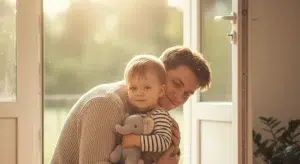
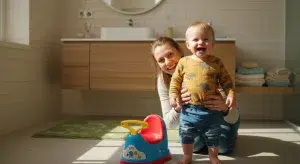
Signs of secure attachment in toddlers include using you as a safe base to explore, coming to you for comfort when hurt or scared and calming with your help, protesting when you leave but recovering, and greeting you warmly when you return.
The signs of secure attachment in toddlers show up in small moments: the glance back from the slide, the run into your arms after a fall, the big grin at pickup. Secure attachment means your child trusts you will be there and uses that trust to explore.
Below: what secure attachment means, 12 signs to look for at ages 1 to 3, how the four patterns compare, which worrying-looking behaviors are normal, how to build the bond (including at daycare), common myths, and when to talk to your pediatrician.
Key Takeaways
Secure attachment means your toddler uses you as a secure base to explore and a safe haven for comfort.
Crying at drop-off, clingy phases and tantrums are normal and are not signs of insecure attachment.
Attachment is a quality of a relationship, not a fixed trait, and toddlers can attach to several caregivers.
The Strange Situation is a research tool; attachment cannot be diagnosed at home from a checklist.
Sensitive, predictable care and repair after hard moments build secure attachment.
Table of Contents
What Secure Attachment Means (and What It Does Not)
Quick Answer
Secure attachment is a trusting bond in which your toddler counts on you to be there when they need you. Your child uses you as a home base to explore, comes to you when hurt or scared, protests when you leave but settles, and is glad when you return. It is not something you diagnose at home from a checklist.
Attachment theory began with John Bowlby, who saw a child’s tie to a caregiver as a built-in system whose job is protection: staying close to a trusted adult keeps young children safe. Mary Ainsworth, his colleague, added two key ideas, according to Inge Bretherton’s 1992 history of the field in Developmental Psychology. A securely attached child uses the caregiver as a secure base to explore from and a safe haven to return to for reassurance.
Picture a toddler who wanders to the sandbox, glances back to find you, and runs to you when a dog barks. That loop is the heart of it.
Three things secure attachment is not:
Not a trait your child is born with: It is a quality of a relationship; a child can relate differently to a parent and a grandparent.
Not “attachment parenting”: Attachment theory is research; it does not prescribe practices, and secure bonds form under many parenting styles.
Not a sign that your child never cries: Secure toddlers still cry, cling and have tantrums; they turn to you and can be comforted.
12 Signs of Secure Attachment in Toddlers
These signs draw on attachment research and on milestones the CDC lists for 15 months to 3 years. No single sign is a test: look for the pattern over weeks, not one hard afternoon.
1. Uses you as a secure base: Your toddler explores but checks in with a look or a quick trip back to you. The CDC lists “moves away from you, but looks to make sure you are close by” as a milestone by 18 months.
2. Comes to you when hurt, scared or sick: After a bump or a loud noise, your child heads for you or reaches up to be held.
3. Can be comforted by you: A hug, your voice or your lap helps your child calm down.
4. Protests separation, then recovers: Crying when you leave is common. By age 3, the CDC lists calming down within 10 minutes after you leave, such as at a childcare drop off.
5. Greets you on reunion: In Ainsworth’s research, secure babies sought closeness or contact when the parent came back.
6. Prefers familiar caregivers: Your child may warm up to a new adult but turns to familiar caregivers for comfort.
7. Looks to you in new situations: The CDC lists “looks at your face to see how to react in a new situation” as a milestone by 2 years.
8. Shows you things: The CDC lists showing you a favorite object by 15 months and pointing to show you something by 18 months.
9. Shows affection: Hugs and kisses are on the CDC’s 15-month checklist.
10. Expresses a full range of feelings: Joy, frustration and fear show up with you rather than being hidden.
11. Notices when others are upset: Pausing or looking sad when someone cries is an early empathy skill the CDC lists by 2 years.
12. Plays with curiosity and confidence: When your child feels safe, energy goes into play. The CDC lists noticing other children and joining them to play by age 3. See our guide to cooperative play for how this develops.
Temperament, illness and tiredness all change how a toddler acts; our 2-year-old milestones guide shows what is typical.
Where the Signs Come From: Ainsworth’s Strange Situation
Much of this comes from the Strange Situation, a lab procedure Mary Ainsworth designed for 1-year-olds. Bretherton describes it as about 20 minutes and eight short episodes in a playroom: a stranger joins parent and child, the parent leaves briefly and returns, the child is briefly alone, then the stranger and finally the parent come back. The reunions matter most.
A 2019 review in Children and Youth Services Review by White, Gibson and Wastell notes it is designed to cause mild distress in infants about 12 to 18 months old, and that its categories are technical research terms for coding behavior in that one situation. It is a research tool, not a home test or a diagnosis.
In Ainsworth’s Baltimore families, the majority of babies were classified as secure. She described two insecure patterns, avoidant and ambivalent (also called resistant). Later, Mary Main and Judith Solomon described a fourth category, disorganized, for children who showed brief contradictory or fearful behavior that did not fit the other three patterns.
Big days go better with a good night of sleep.
Got a little one at home too? Our free two-minute quiz builds a gentle, personalized sleep plan for babies and toddlers.
Secure vs Insecure Attachment: How the Patterns Compare
The right-hand column is a careful everyday translation with a big caveat: each behavior also shows up in secure toddlers who are tired, sick, shy or having a bad day.
Pattern
What researchers saw at reunion
What it can look like day to day (only as a repeated pattern)
Secure
Some distress at separation; seeks closeness on reunion and is comforted quickly
Comes to you when upset, settles with your help, explores when calm
Avoidant
Little visible distress; avoids the parent on reunion, even after searching for them
Rarely seeks comfort when hurt, turns away when distressed
Resistant or ambivalent
Distress even before separation; wants contact on reunion but cannot settle, may kick or push away
Very hard to soothe, clings and resists at once
Disorganized
Brief contradictory behavior such as freezing, approaching then backing off, or showing fear of the caregiver
Seems frightened or confused about approaching a caregiver; rare, and needs a professional, not a guess
Attachment patterns from research, with everyday examples that must be read with caution.
White, Gibson and Wastell note that disorganized behaviors are usually brief and tend to be relationship specific rather than a fixed trait of the child. ZERO TO THREE adds that the original research was culturally narrow and that labeling a child from one stressful interaction can mislead. Talk with a professional instead of self-diagnosing.
Normal Toddler Behavior That Is Not a Sign of Insecure Attachment
The American Academy of Pediatrics (AAP) calls separation anxiety “entirely normal behavior and a beautiful sign of a meaningful attachment.” Many toddlers start having trouble at 15 or 18 months, the AAP notes.
Crying at daycare or preschool drop-off: Expected, especially in the first weeks. Watch how your child does after you leave.
Clinginess during change: A move or a new sibling often brings a clingy stretch: your child is using you as a safe haven.
Stranger shyness: Hiding behind your leg with a new adult is typical.
Tantrums: A child who falls apart with you and lets you help them recover is showing trust.
Ignoring you at pickup for a moment: A short delay is not avoidance; researchers mean a consistent pattern of turning away when upset.
The AAP suggests a short, consistent goodbye ritual, full attention before you go, always coming back when you promised, and explaining your return in your child’s terms, such as after nap. More in separation anxiety in toddlers.
How to Build Secure Attachment With Your Toddler
Secure attachment grows out of ordinary daily care, not special products or programs.
Respond sensitively and reliably: Bretherton explains that attachment quality depends on everyday interaction, especially the caregiver’s sensitivity to the child’s signals.
Play serve and return: When your toddler points or brings you a toy, respond with a look or words. ZERO TO THREE lists these back-and-forth exchanges as a building block of secure attachment.
Repair after hard moments: ZERO TO THREE explains that missed cues can rupture trust, and intentional repair, acknowledging what happened and responding warmly, can restore it. “I yelled, and that was scary. I’m sorry. I’m here.” is repair.
Keep routines predictable: ZERO TO THREE also lists following through on routines and promises and setting clear boundaries.
Toddlers can form attachments to more than one person. Bretherton describes a hierarchy of attachment figures that can include fathers, grandparents, siblings and daycare providers, and notes that attachment theory does not require caregiving to be done by mothers.
The NICHD Study of Early Child Care, run by a National Institutes of Health institute, found that family and parenting factors were generally stronger predictors than child care, and the quality of mother and child interaction was one of the most consistent predictors, including of attachment security. Its 2006 summary reports that children were somewhat more likely to be insecurely attached when lower-quality care, or more than 10 hours of care a week, was combined with lower maternal sensitivity. It also stresses that these findings are associations, not proof of cause.
Choose warm, consistent care, keep drop-offs short, and protect connected time at pickup and bedtime. For low-key social time, see what a play date is and how to host one.
Myths About Attachment
Myth
What the evidence says
You can spoil a baby by responding too much
Research points the other way. In Ainsworth’s Baltimore study, babies whose mothers responded promptly to crying in the early months cried less later, not more.
Sleep training ruins attachment
A 5-year follow-up of a randomized trial (Price and colleagues, Pediatrics, 2012) found no long-term harm and no long-term benefit from behavioral sleep techniques on children’s emotional and behavioral outcomes or the parent and child relationship.
Attachment is set for life by age 1
Attachment is relationship specific, and White, Gibson and Wastell note that classifications are only modestly stable over the early years.
You must be perfectly attuned
ZERO TO THREE emphasizes rupture and repair: missed moments happen, and repair restores trust.
Secure attachment means a calm, easy child
Secure toddlers can be intense, shy or loud. What matters is whether they turn to you.
Common attachment myths and what the research shows.
Whatever you decide about sleep, babies under 12 months should sleep alone, on their back, on a firm, flat, bare surface.
Can You Tell if Your Toddler Is Securely Attached at Home?
You can notice patterns, but you cannot classify your child; researchers caution against using attachment categories as a diagnosis. ZERO TO THREE notes that secure attachment is optimal but not the only indicator of a healthy child.
Ask instead: When my child is upset, do they come to me, and does my comfort help? If often not, raise it with your pediatrician.
Most clingy or teary phases are normal. Talk with your pediatrician if, over several weeks:
Your child rarely seeks comfort from any familiar caregiver when hurt, scared or sick.
Your child shows little response to caregivers, or rarely looks to you, shares things or shows affection.
Your child seems frightened of a caregiver, or freezes or seems confused when approached.
Your child has lost skills they once had, such as words, play or affection.
You are concerned your child is not adapting to time apart, even with consistent routines.
Your child has been through a major separation, loss, hospital stay, foster care or other trauma, and you want support.
The CDC advises: if your child is not meeting milestones, has lost skills, or you have other concerns, talk with your doctor, ask about developmental screening, and, if needed, ask for a referral and contact your state’s early intervention program. Do not wait. Also tell your pediatrician if you feel depressed or overwhelmed.
Frequently Asked Questions
What are the signs of secure attachment in toddlers?
Common signs include using you as a base to explore, coming to you when hurt or scared, being comforted by you, protesting separation but recovering, greeting you warmly on reunion, and sharing things with you. Look for the overall pattern over weeks, not one moment.
What does insecure attachment look like in a toddler?
Researchers describe avoidant children who rarely seek comfort, resistant or ambivalent children who want contact but cannot settle, and a rare disorganized pattern with freezing or fear of a caregiver. These are research categories, not home diagnoses, so discuss a persistent pattern with your pediatrician.
Is crying at daycare drop-off a sign of insecure attachment?
No. The American Academy of Pediatrics describes separation anxiety as normal and a sign of a meaningful attachment. Many toddlers cry at goodbyes, especially in new settings. What matters more is settling after you leave; the CDC lists calming within 10 minutes by age 3.
What are the 4 attachment styles in children?
The four research patterns are secure, avoidant, resistant or ambivalent, and disorganized. Mary Ainsworth described the first three using the Strange Situation, and Mary Main and Judith Solomon later added disorganized. These describe a relationship, so a child can differ across caregivers.
Can insecure attachment become secure over time?
Yes, relationships can change. Researchers describe attachment as relationship specific rather than a fixed trait, and classifications are only modestly stable in early childhood. Sensitive, predictable care, back and forth play and repair after hard moments all support a more secure bond.
Can a toddler be securely attached to more than one person?
Yes. Attachment research shows young children can form attachments to several caregivers, including fathers, grandparents, siblings and child care providers, and the attachment can look different with each person. Warm caregivers outside the home add to, rather than replace, a parent.
Gentle changes, peaceful nights.
Betteroo builds a personalized sleep plan for your baby or toddler. Take the free two-minute quiz to get started.
Centers for Disease Control and Prevention. CDC’s Developmental Milestones (Learn the Signs. Act Early.), milestone checklists by 15 months, 18 months, 2 years and 3 years. https://www.cdc.gov/act-early/milestones/index.html
Price AM, Wake M, Ukoumunne OC, Hiscock H. Five-year follow-up of harms and benefits of behavioral infant sleep intervention: randomized trial. Pediatrics. 2012;130(4):643-651. https://pubmed.ncbi.nlm.nih.gov/22966034/