SIDS risk by age peaks between 1 and 4 months, and more than 90% of SIDS deaths happen before 6 months, but SIDS can occur any time in the first year, so safe sleep practices continue until your baby turns 1.
If you are checking SIDS risk by age, you probably want to know when you can stop worrying. The official answer from the NIH and the American Academy of Pediatrics is reassuring and firm at the same time: risk falls a lot after the early months, but it does not end until the first birthday.
Below: what each age range looks like using official figures, why risk peaks when it does, and what changes once your baby rolls or turns 1.
Key Takeaways
Most SIDS deaths happen between 1 and 4 months; more than 90% happen before 6 months (NICHD).
SIDS is less common after 8 months, but safe sleep continues until the first birthday.
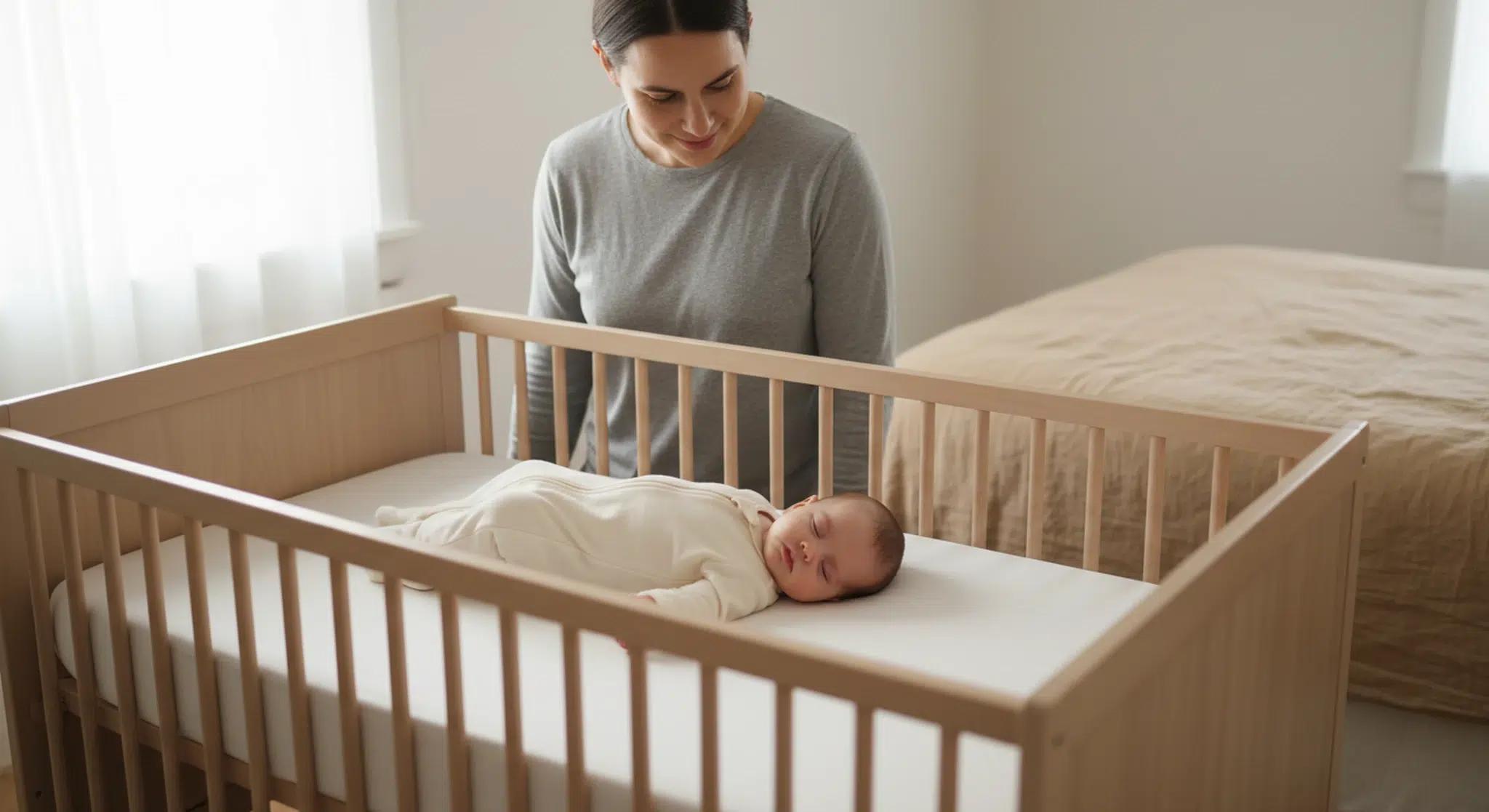
Back to sleep on a firm, flat, bare surface, in your room but not your bed, is the core routine.
Once your baby rolls both ways, you can leave them in the position they choose, but always place them on their back.
No monitor or product prevents SIDS. After age 1, sudden unexplained death is called SUDC and is rare.
Table of Contents
SIDS Risk by Age: The Short Answer
Quick Answer
According to the NIH’s Safe to Sleep campaign (NICHD), most SIDS deaths happen between 1 and 4 months of age, 72% happen in months 1 to 4, and more than 90% happen before 6 months. SIDS is less common after 8 months, but it can happen at any point in the first year, so NICHD says to keep following safe sleep practices until your baby’s first birthday.
So when does SIDS risk decrease? It drops a lot after 6 months and becomes less common again after 8 months, but it does not reach zero until your baby turns 1. That is why the American Academy of Pediatrics (AAP) says its safe sleep recommendations apply to babies up to 1 year old unless a specific rule says otherwise.
NICHD is clear that there is no known way to prevent SIDS outright, only ways to lower the risk. The steps that lower it are simple, free and the same every night.
SIDS vs SUID vs Accidental Suffocation
SUID (sudden unexpected infant death): the CDC’s umbrella term for the sudden and unexpected death of a baby younger than 1 year, where the cause is not obvious before an investigation. These deaths often happen during sleep or in the baby’s sleep area.
SIDS (sudden infant death syndrome): one type of SUID. NICHD defines it as the sudden, unexplained death of an infant younger than 1 year that stays unexplained after a complete investigation, which can include an autopsy, a review of the death scene, and family and medical histories.
Accidental suffocation and strangulation in bed: another type of SUID that the CDC lists separately, tied to the sleep environment itself.
Unknown cause: deaths that cannot be classified even after investigation.
Category (CDC, 2024)
Approximate U.S. deaths
All SUID
About 3,400
SIDS
1,351
Unknown cause
1,099
Accidental suffocation and strangulation in bed
947
Sudden unexpected infant deaths in the United States, 2024. Source: CDC, Data and Statistics for SUID and SIDS.
The AAP’s 2022 policy statement (Moon and colleagues, Pediatrics) groups these together as sleep-related infant deaths, and the same safe sleep steps target all of them.
SIDS Risk by Age: Month-by-Month Table
This table includes only figures that NICHD, the AAP or the NIH publish, so some rows describe guidance rather than a percentage.
Age
What the sources say
What to keep doing
Birth to 1 month
SIDS can occur any time in the first year (NICHD). The AAP says bed-sharing risk is 5 to 10 times higher for babies under 4 months.
Back to sleep on a bare, flat surface in your room; no bed sharing
1 to 4 months
Peak window: most SIDS deaths happen between 1 and 4 months, and 72% happen in months 1 to 4 (NICHD).
Every safe sleep step, every sleep, including naps
4 to 6 months
More than 90% of SIDS deaths happen before 6 months (NICHD). The AAP says rolling usually starts around 3 to 4 months, sometimes earlier.
Stop swaddling at the first signs of rolling; still place on back
6 to 8 months
Risk is lower than in the peak months, but SIDS still occurs (NICHD).
Back to sleep, bare crib, no blankets or pillows
8 to 12 months
SIDS is less common after 8 months, but safe sleep should continue until the first birthday (NICHD).
Keep the full routine until 12 months
12 months and older
The term SIDS no longer applies. A sudden unexplained death at 1 year or older is called SUDC, which is rare (NIH).
Follow your pediatrician’s toddler sleep advice
SIDS risk by age. Sources: NICHD Safe to Sleep, SIDS by Baby’s Age; AAP (HealthyChildren.org); NIH.
There is no official “safe date” when SIDS risk switches off. The 6 and 8 month markers describe where most deaths fall, not a point after which a baby is protected.
Stuck on night two or three?
Our free two-minute quiz builds a gentle, personalized sleep plan that adapts when progress stalls.
Nobody knows exactly what causes SIDS. The AAP’s 2022 policy statement describes the leading explanation, called the triple risk model: SIDS happens when a vulnerable infant meets an outside trigger, such as an unsafe sleep setting, during a critical developmental period.
A vulnerable baby: a hidden difference in how the baby’s body controls things like breathing, heart rate or waking, which NICHD says cannot currently be detected while a baby is alive.
A critical developmental period: NICHD notes that in the first 6 months babies go through fast growth and changes in breathing, blood pressure and sleep patterns.
An outside stressor: something in the sleep environment, such as stomach sleeping, soft bedding, overheating or secondhand smoke.
NICHD explains that one or even two of these factors is usually not enough; the risk rises when all three line up. Outside stressors are the only part parents can change, which is why Safe to Sleep focuses on them.
SIDS Risk Factors
Risk factor
What the source says
Can you change it?
Stomach or side sleeping
Stomach sleeping carries higher risk than back sleeping, and side-lying also raises risk (NICHD). The AAP says the side is just as dangerous as the stomach.
Yes
Soft bedding and loose items
Keep pillows, quilts, comforters, toppers, blankets and bumper pads out of the sleep area (AAP).
Yes
Bed sharing and couches
The AAP says to avoid bed sharing in all circumstances, and that risk is up to 67 times higher when sleeping with someone on a couch, armchair or cushion.
Yes
Smoke exposure
Smoking in pregnancy and smoke in the baby’s environment raise risk (NICHD).
Yes
Overheating
An environmental stressor that can contribute to risk (NICHD).
Yes
Preterm birth
Babies born before 37 weeks have higher risk than full-term babies (NICHD).
NICHD also reports that African American and American Indian/Alaska Native babies face higher SIDS risk, and the CDC notes that large racial and ethnic differences in SUID rates persist. The same safe sleep steps apply to every baby.
Products marketed for sleep can be a hidden risk too. The AAP says sleep surfaces must be firm and flat and that any incline over 10 degrees is unsafe. See whether baby loungers are safe.
Protective Factors That Lower SIDS Risk
These are the steps NICHD and the AAP say lower the risk. They apply from the first night home until your baby turns 1.
Back to sleep, every sleep: NICHD says back sleeping carries the lowest risk and is the most effective thing caregivers can do. This includes naps and babies born preterm or with reflux.
A firm, flat, bare surface: a crib, bassinet or play yard that meets federal safety standards, with only a fitted sheet. Our safe sleep environment guide walks through the setup.
Room sharing without bed sharing: the AAP recommends sharing a room, not a bed, for at least the first 6 months and says room sharing can lower SIDS risk by as much as 50%. See co-sleeping risks and safer options.
Breastfeeding or breast milk: the AAP says breast milk reduces SIDS risk and the protection grows the longer it is given.
A pacifier at sleep time: offering one at naps and bedtime lowers risk even if it falls out. Wait until breastfeeding is well established, and never attach it to clothing. More in can babies sleep with a pacifier.
A smoke-free home and car: no smoking or vaping near your baby, even outdoors (AAP).
No overheating: dress your baby for the room, keep the head and face uncovered, and skip hats indoors. Use a wearable blanket instead of a loose one; see baby sleep sacks and baby room temperature for sleep.
Immunizations and well-child visits: NICHD says research shows vaccinated babies are at lower risk for SIDS, and the AAP lists routine immunization among its recommendations.
SIDS After 6 Months: What Changes and What Doesn’t
After 6 months, the numbers are on your side: NICHD says more than 90% of SIDS deaths happen before this age. But a lower risk is not no risk, and a few things about this stage need attention.
Room sharing decisions: the AAP’s “at least 6 months” is a minimum, not a deadline. If you are deciding when to switch, read when to move baby to their own room.
Falling asleep on the go: the AAP says if your baby falls asleep in a car seat, stroller, swing or carrier, move them to a firm, flat surface on their back as soon as you can.
Rolling Over and Stomach Sleeping
Rolling is often when parents start asking whether SIDS is still a concern.
Always start on the back: NICHD and the AAP say to place babies on their backs for every sleep until age 1, even after they can roll.
Rolls both ways: once your baby can roll from back to tummy and tummy to back on their own, NICHD says you can leave them in the position they choose.
Rolls only one way: if your baby rolls onto their stomach but cannot yet roll back, NICHD says to gently return them to their back.
Stop swaddling: NICHD says to stop swaddling when your baby starts rolling, usually around 3 months, because a swaddled baby who rolls is at higher risk of suffocation. The AAP says rolling usually begins around 3 to 4 months but can happen earlier. See when to stop swaddling.
No. NICHD states plainly that no product can prevent SIDS. It advises against using heart, breathing, motion or other monitors as a way to reduce SIDS risk because they are not effective at detecting or preventing it.
The AAP’s 2022 policy statement says home cardiorespiratory monitors should not be used as a strategy to reduce SIDS risk. HealthyChildren.org adds that consumer wellness devices are not held to medical device standards. A monitor can never replace safe sleep practices.
The same goes for wedges, positioners and anything else that claims to prevent SIDS: NICHD warns that many do not meet federal sleep safety guidelines.
Is SIDS a Risk After 1 Year?
By definition, no. SIDS only describes deaths of babies younger than 1 year. When a child aged 1 year or older dies suddenly and the cause stays unexplained, the NIH says it is called sudden unexplained death in childhood (SUDC).
SUDC is a separate condition, and it is rare. The NIH notes that SIDS cases outnumber SUDC cases by about four to one.
What does change at 12 months is the guidance. The AAP’s infant recommendations apply up to age 1, so after your baby’s first birthday your pediatrician can talk you through toddler sleep. Until then, keep the crib bare.
Call 911 right away if your baby is not breathing, is limp or unresponsive, or is turning blue or gray. If you are trained in infant CPR, start it right away and have someone else call if anyone is nearby.
Consider taking an infant CPR class before your baby arrives or in the first weeks; ask your hospital or pediatrician where one is offered.
Call your pediatrician’s office if:
Your baby was born preterm or has a health condition and you want advice on sleep position or a home monitor prescribed for a medical reason.
Your baby has reflux and you are tempted to raise the mattress. The AAP says babies with reflux should still sleep flat on their backs.
You are struggling to keep your baby out of your bed because of night feeds or exhaustion. Your pediatrician can help you plan safer options.
Your baby is behind on immunizations or well-child visits.
If a baby has ever had an episode where they stopped breathing, went limp or changed color, even briefly, get medical care the same day, even if they seem fine now. This article is general education, not medical advice.
Frequently Asked Questions
What is SIDS risk by age?
NICHD’s Safe to Sleep campaign says most SIDS deaths happen between 1 and 4 months of age, with 72% in months 1 to 4 and more than 90% before 6 months. SIDS is less common after 8 months but can still occur, so safe sleep practices should continue until your baby’s first birthday.
When does SIDS risk decrease?
Risk drops after the peak window of 1 to 4 months, and NICHD reports that more than 90% of SIDS deaths happen before 6 months. It becomes less common again after 8 months. There is no official date when risk ends, so keep putting your baby on their back on a bare, flat surface until age 1.
When is SIDS no longer a risk?
SIDS only applies to babies younger than 1 year, so the term no longer applies after the first birthday. Before that, risk is lower after 6 months and after 8 months but never zero. The AAP’s safe sleep recommendations apply to all babies up to 1 year old unless a rule says otherwise.
Can SIDS happen after 6 months?
Yes. Fewer than 1 in 10 SIDS deaths happen after 6 months, according to NICHD, but it can still happen until the first birthday. Older babies are also more mobile, so keeping blankets, pillows and bumpers out of the crib and placing your baby on their back still matters every night.
Is SIDS a risk after 1 year?
SIDS is defined as a death before age 1. A sudden, unexplained death in a child 1 year or older is called sudden unexplained death in childhood, or SUDC. The NIH says SUDC is far less common than SIDS. Ask your pediatrician about toddler sleep setup after the first birthday.
Can my baby sleep on their stomach once they roll over?
You should still place your baby on their back for every sleep until age 1. NICHD says once your baby can roll both ways on their own, you can leave them in the position they choose. If they only roll one way, gently turn them back. Stop swaddling once rolling starts.
Gentle changes, peaceful nights.
Betteroo builds a personalized sleep plan for your baby or toddler. Take the free two-minute quiz to get started.
Moon RY, Carlin RF, Hand I; AAP Task Force on SIDS. Sleep-Related Infant Deaths: Updated 2022 Recommendations for Reducing Infant Deaths in the Sleep Environment. Pediatrics. 2022;150(1):e2022057990. PubMed. https://pubmed.ncbi.nlm.nih.gov/35726558/