When do babies smile? Most babies give their first real social smile, a smile in response to you, by the end of the second month, while the fleeting grins of the first weeks are usually reflex smiles.
The first time your baby looks right at you and smiles is one of the best moments of early parenthood. If you are wondering when do babies smile for real, the short answer is by about 2 months, and the CDC lists it as a 2 month milestone. But plenty of newborns grin in their sleep long before that, which leaves many parents unsure whether those early smiles count.
This guide explains the difference between reflex and social smiles, how smiling develops month by month, simple ways to encourage it, how to use adjusted age for premature babies, and when it makes sense to check in with your pediatrician. Everything is based on CDC milestone checklists and AAP guidance.
Key Takeaways
Most babies smile socially by the end of month 2. The CDC lists it as a 2 month milestone.
Newborn grins in the first weeks, often in sleep, are usually reflex smiles.
By 4 months, babies smile on their own to get your attention and may start to chuckle.
Premature babies reach smiling milestones by adjusted age, not birth date.
If your baby is not smiling by about 2 months adjusted, mention it to your pediatrician. Don’t wait.
Table of Contents
When Do Babies Smile? The Short Answer
Quick Answer
Most babies give their first social smile (a smile aimed at you) by the end of the second month, according to the American Academy of Pediatrics (AAP). The CDC’s “Learn the Signs. Act Early.” checklist lists “smiles when you talk to or smile at” your baby as a 2 month milestone. Earlier grins in the first weeks, often during sleep, are usually reflex smiles that are not a response to you. By 4 months, the CDC says most babies smile on their own to get your attention. If your baby was born early, use their adjusted age.
Those first newborn grins are real and lovely, but they work differently from the smile you are waiting for. The AAP describes early first-month grins as seeming to respond to some internal signal, like gas or hunger, and notes that where they come from is not fully clear. The social smile comes later, once your baby is awake for longer stretches and starts paying attention to people.
Age (adjusted for prematurity)
What you may see
Source
First weeks
Fleeting grins, often in sleep or when drowsy, not aimed at anyone
AAP
By the end of month 2
First social smiles: your baby smiles when you talk to or smile at them
AAP, CDC
By 4 months
Smiles on their own to get your attention; chuckles when you try to make them laugh
CDC
Around 4 to 6 months
Laughs aloud; pats or smiles at their own reflection
AAP
By 9 months
Smiles or laughs at peek-a-boo; may be shy or fearful with strangers
CDC
Typical smiling timeline. Sources: AAP HealthyChildren.org and CDC Learn the Signs. Act Early. milestone checklists.
Reflex Smile vs Social Smile: How to Tell the Difference
To tell whether a smile “counts,” look at what happens around it.
Question to ask
Reflex smile (early weeks)
Social smile (by about 2 months)
When does it happen?
Often in sleep, while drowsy, or at random moments
When your baby is awake and alert
Is it aimed at someone?
No clear target; eyes may be closed or unfocused
Usually follows your face, voice or smile
How long does it last?
Brief, a flicker that comes and goes
Longer, and it often comes back when you smile again
What else is going on?
Little else; the face may relax right away
Whole body joins in: wiggling, bright eyes, soft sounds
Can you repeat it?
Hard to bring on again
You can often get another one by talking or smiling
How to tell a reflex smile from a social smile. These are common patterns, not strict rules.
A useful test: get face to face when your baby is fed, rested and alert, smile and talk softly, then pause. If a smile appears in response, and shows up again the next time you try, that is a social smile.
Do not worry if your baby looks past you at a lamp or a window, even mid-smile. The AAP says this is normal: babies are still learning your face, voice and touch, and they hold eye contact longer with practice. A glance away is often a mini break, not a rejection.
Newborn Smiling in Sleep
Smiling during sleep is one of the most common newborn expressions, and it is usually a reflex smile. Many parents first notice it in the early weeks, as their baby drifts off after a feed. It is harmless, and sleep smiles often continue for months, long after your baby smiles at you while awake.
Wherever those sleepy smiles happen, keep the sleep space safe: babies under 12 months sleep alone, on their back, on a firm, flat, bare surface, with no pillows, blankets, bumpers or positioners.
When Do Babies Start Smiling at You? Month by Month
Smiling grows in clear stages over the first year. Use adjusted age if your baby was born early.
Month 1: grins come and go, many of them during sleep.
Month 2: the AAP says early expressions begin to turn into genuine signals of pleasure by the second month. The CDC 2 month checklist lists smiling when you talk to or smile at your baby, looking at your face and seeming happy to see you when you walk up. See 2 month old milestones.
Month 4: your baby starts the conversation. The CDC 4 month checklist lists smiling on their own to get your attention, chuckling (not yet a full laugh) when you try to make them laugh, and looking, moving or making sounds to get or keep your attention. See 4 month old milestones.
Months 4 to 6: laughter arrives. The AAP lists laughing aloud at 4 months and patting or smiling at their own reflection at 6 months. Our guide to when babies start laughing covers the first giggles.
The social smile is your baby’s first real tool for connection. The AAP describes how babies discover that just by moving their lips they can have “conversations” with you. When you smile back, your baby learns that their signals get a response. The AAP says responding warmly and reliably to these cues helps build your baby’s sense that their feelings matter.
Researchers at the Center on the Developing Child at Harvard University call these exchanges “serve and return.” Your baby serves a signal (a look, a sound, a smile), and you return it by responding. The Center says these back-and-forth moments help build social and thinking skills and support healthy brain development.
How to Encourage Your Baby to Smile
The Harvard Center on the Developing Child offers five simple steps for serve and return that fit smiling perfectly:
Notice the serve: watch what your baby is focused on: your face, a sound, their own hands. Their cue may be a look, a wiggle or a coo.
Return it: respond with a smile, a soft word or a touch. Mirror their expression back to them.
Give it a name: describe what is happening: “You’re smiling! You like that song.” This builds language links long before your baby talks.
Take turns and wait: pause after you smile or speak. Babies need a few seconds to answer, and the wait is part of the game.
Practice endings and beginnings: when your baby looks away, arches or fusses, they may be done. Let them rest and try again later.
A few more ideas that work well in the early months:
Pick the right moment: try when your baby is fed, rested and calm. A tired or hungry baby is less likely to engage.
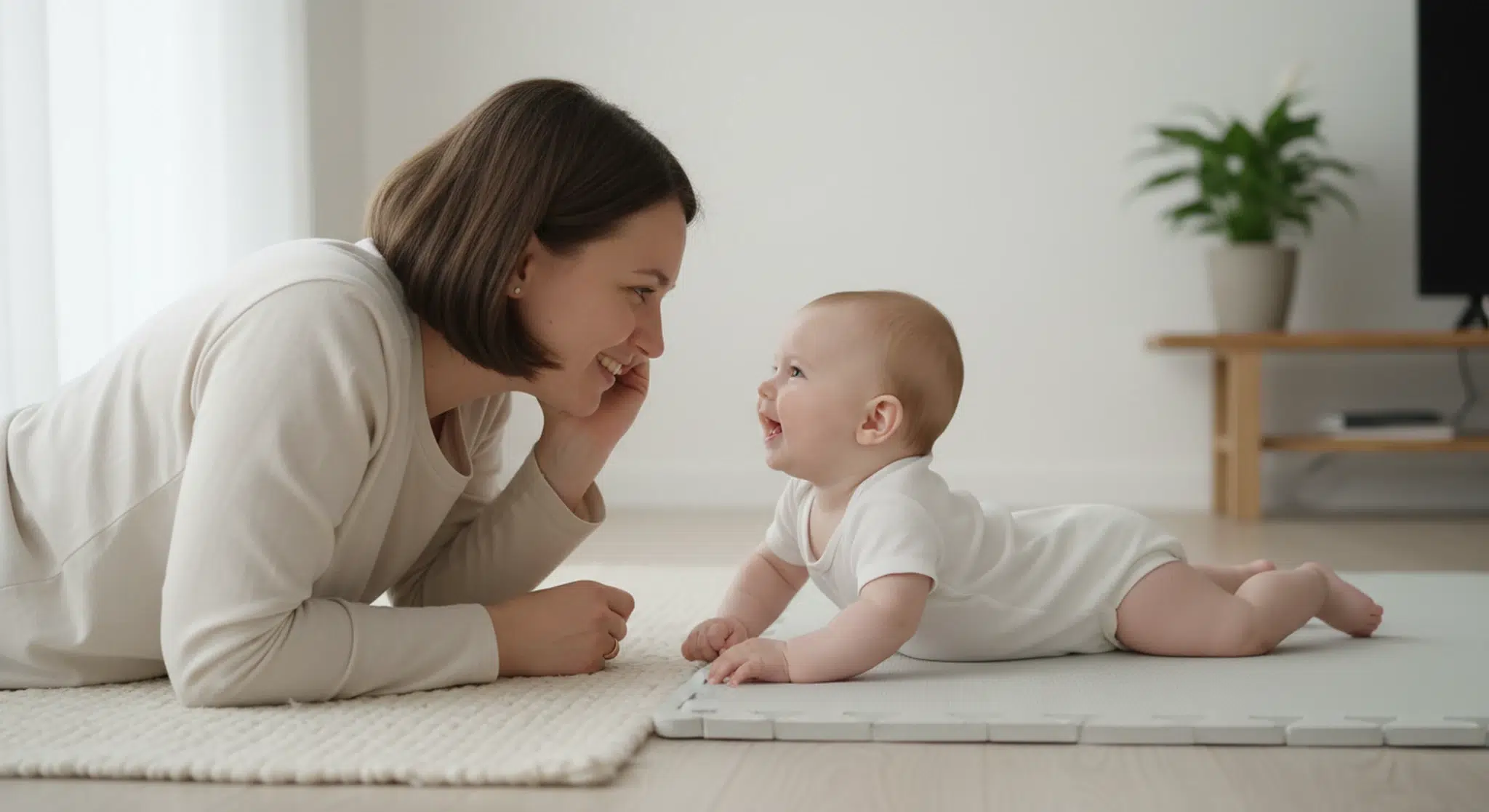
Make face time part of the day: diaper changes, feeds and tummy time (with you lying face to face on the floor) are natural chances to chat.
Pause adult conversations: the AAP suggests stopping to look at your baby when they wiggle or make sounds to get your attention.
Share the job: partners, grandparents and siblings can all play.
If you feel too drained or low to enjoy these moments, that matters too. Exhaustion and postpartum mood changes are common, and help is available. See sleep deprivation and postpartum depression and talk with your own doctor.
Premature Babies: Use Adjusted Age for Smiling
If your baby was born early, expect the social smile based on their adjusted age (also called corrected age), not the date of birth. The AAP explains how to work it out: subtract the number of weeks your baby was born early from their actual age in weeks.
Born at
Weeks early
Actual age
Adjusted age
40 weeks (full term)
0
8 weeks
8 weeks
36 weeks
4
12 weeks
8 weeks
36 weeks
4
16 weeks
12 weeks (about 3 months)
32 weeks
8
16 weeks
8 weeks (about 2 months)
Adjusted age examples based on the AAP method. Full term is counted as 40 weeks.
The AAP advises using adjusted age when tracking development until 2 years of age. The CDC says to use corrected age to choose a milestone checklist if your child was born more than 3 weeks early, and to use the younger checklist if their age falls between two.
Baby Not Smiling at 2 or 3 Months? What It Can Mean
If your baby is not smiling at you yet, first check the basics:
Adjusted age: a baby born a few weeks early may simply be younger, developmentally, than the calendar says.
Timing: are you trying when your baby is alert and content? Many babies save smiles for calm, wide-awake moments.
Temperament: some babies are naturally more watchful. A serious face that still tracks you, coos and calms when you pick them up is reassuring.
Other signs: look at the whole picture: eye contact, interest in your face and voice, sounds other than crying, and how your baby reacts to loud noises.
A missing smile can have many explanations and is not something to diagnose at home, but it is worth raising with your pediatrician. The CDC’s guidance for families is direct: if you are concerned about your child’s development, don’t wait, because acting early can make a real difference.
The AAP recommends keeping the 2 month checkup, which is a natural time to ask. Bring your observations, and ask whether a developmental screening makes sense.
What Comes After the First Smile
Once social smiling settles in, smiles turn into conversation starters around 4 months, then laughter joins in. By 9 months, the CDC checklist lists smiling or laughing at peek-a-boo, showing several facial expressions such as happy, sad, angry and surprised, and being shy, clingy or fearful around strangers. So a baby who beamed at everyone at 4 months may hide in your shoulder when a new face appears. That is an expected stage. See 9 month old milestones for what else happens at that age.
Bring up smiling at any well visit, and call sooner if something is worrying you. Talk with your pediatrician if your baby (using adjusted age):
Is not smiling when you talk to or smile at them by the end of month 2, or not smiling on their own to get your attention by 4 months.
Does not look at your face or seem interested in watching you move.
Does not react to loud sounds or turn toward voices.
Does not show several facial expressions, like happy, sad, angry and surprised, by 9 months.
Just seems different to you, even if you cannot say why. You know your baby best.
The CDC suggests sharing a milestone checklist with your child’s doctor and asking about developmental screening. If a delay is possible, ask for a referral to a specialist. You can also contact your state’s early intervention program for a free evaluation for children under 3. The CDC notes you do not need to wait for a doctor’s referral or a diagnosis to make that call.
Most babies who are slow to smile are perfectly fine and simply on their own timeline. Checking early costs nothing and gives you peace of mind or a head start on support.
Frequently Asked Questions
When do babies smile for the first time?
Many newborns grin in the first weeks, often in their sleep, but these are usually reflex smiles. The first social smile, aimed at you, usually appears by the end of the second month, according to the American Academy of Pediatrics. The CDC lists smiling when you talk to or smile at your baby as a 2 month milestone.
What is the youngest age a baby can smile?
Many newborns grin in the first weeks of life, often while asleep or drowsy. These early grins are usually reflex smiles that are not a response to people. The AAP says the first true social smile usually appears by the end of the second month, so a smile aimed at you before then is an early bonus.
How can I tell if my baby’s smile is a social smile?
A social smile happens when your baby is awake and alert, is aimed at your face or voice, lasts longer than a flicker, and often comes back when you smile again. Reflex smiles are brief, often happen during sleep or drowsiness, and do not follow your cues. Try smiling and talking, then pause and watch.
Is it normal if my baby is not smiling at 2 months?
Some babies smile a little later than others, and premature babies should be judged by adjusted age. Still, the CDC lists social smiling as a 2 month milestone, so mention it at the 2 month checkup. Your pediatrician can look at the whole picture, including eye contact, hearing and vision, and decide if screening is needed.
Why do babies smile in their sleep?
Smiling during sleep is very common in newborns and is usually a reflex rather than a response to something they see. These sleep smiles often happen during light sleep or while drifting off. They are harmless, and they can continue for months even after your baby starts giving social smiles while awake.
When do babies start laughing after smiling?
Laughter usually follows a couple of months after the first social smile. The CDC lists chuckling, not yet a full laugh, when you try to make your baby laugh at 4 months, and the American Academy of Pediatrics lists laughing aloud around 4 months. Every baby’s timing is a little different.
Gentle changes, peaceful nights.
Betteroo builds a personalized sleep plan for your baby or toddler. Take the free two-minute quiz to get started.