Great 5th grade science fair projects ask one testable question, change one variable, measure the result in numbers, and are done by your 10 or 11 year old over 4 to 6 weeks.
These 5th grade science fair projects are written for parents helping a 10 or 11 year old: 27 original ideas across plants, chemistry, physics, earth science and the human body, each with a testable question, its variables and a time estimate.
You will also get a plain-English walkthrough of the scientific method, a trifold board layout, what judges look for, a 6 week timeline, and how much help is too much.
Key Takeaways
Pick a question your child can measure with numbers, and change only one thing.
Use a control group and repeat each test at least 3 times.
Plan 4 to 6 weeks; longer plant projects need the full 6.
Your child does the work and the talking; you handle safety and supplies.
Goggles for chemistry, no open flames without an adult, no live vertebrate animal experiments, and check your school’s rules.
As an Amazon Associate, Betteroo earns from qualifying purchases.
Table of Contents
5th Grade Science Fair Projects at a Glance
Quick Answer
The best 5th grade science fair projects ask one testable question, change one thing, and measure the result with numbers. Easy picks: salt and ice, sugar cubes in warm and cold water, paper helicopters, the ruler drop reaction test and shadow tracking. Bigger projects that impress judges: where a plant’s mass comes from, soil erosion with and without roots, and an insulation challenge. Plan 4 to 6 weeks and let your child do the work.
Below are 27 original ideas sorted by field, each with its testable question, variables and time estimate, followed by a step-by-step guide, board layout, timeline and safety rules.
Plants and Biology Science Fair Project Ideas
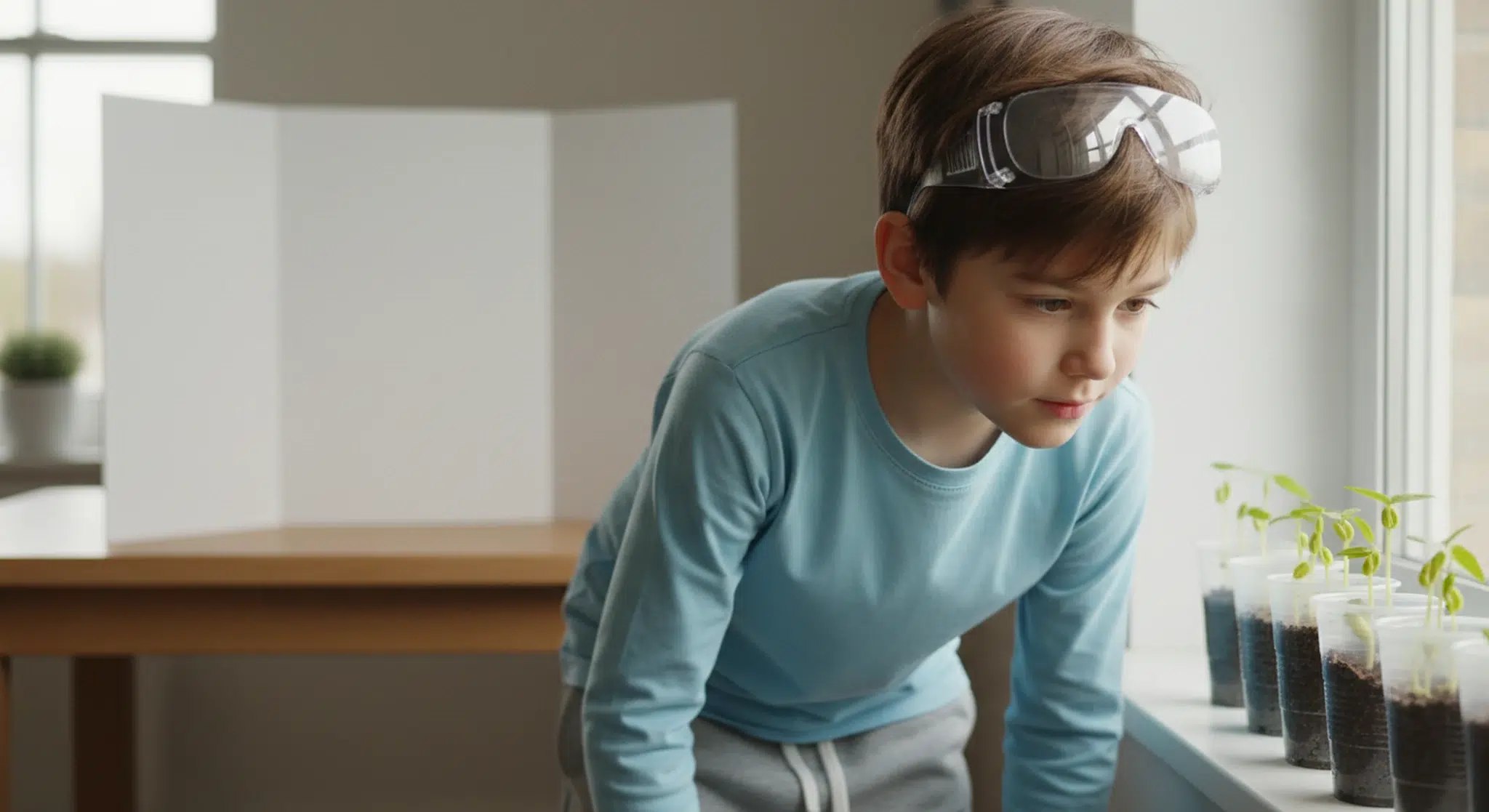
Seeds are cheap and easy to measure. The Next Generation Science Standards ask fifth graders to argue that plants get the materials they need for growth chiefly from air and water, not from the soil, so idea 5 fits many classrooms.
Project
Testable question
You change
You measure
Time
1. Colored light and bean seedlings
Does the color of light change how tall bean seedlings grow?
Colored clear plastic wrap over each cup (red, blue, green, none)
Seedling height in millimeters every 2 days
2 to 3 weeks
2. Salt water and sprouting
Does salty water change how many radish seeds sprout?
Teaspoons of salt per cup of water (0, 1, 2, 3)
Percent of seeds sprouted after 7 days
1 week
3. Soaking seeds first
Do bean seeds sprout faster if you soak them first?
Soaking time (0, 4, 12 hours)
Days until the root appears
1 to 2 weeks
4. Where bread molds fastest
Does storage place change how fast bread gets moldy?
Location (fridge, counter, dark cupboard)
Days until mold appears and percent of slice covered
1 to 2 weeks
5. Where a plant’s mass comes from
Does a growing plant use up the soil it grows in?
Time (start vs end of the project)
Mass of dry soil and mass of the plant, in grams
4 to 6 weeks
6. Upside down seeds
Does the direction you plant a seed change which way its roots grow?
Seed position (pointing up, down, sideways) against the side of a clear cup
Root direction and days until it turns
1 week
Plant and biology science fair project ideas for 5th grade.
Mold safety: seal bread in zip bags before mold starts, photograph through the plastic, never open the bags, and throw them away sealed. Skip it if anyone at home has a mold allergy or asthma.
Idea 5 tip: weigh the soil completely dry at the start and again at the end, then compare that change with the plant’s mass.
Chemistry and Kitchen Science Project Ideas
Many easy 5th grade science fair projects live in the kitchen. A fifth grade standard asks students to investigate whether mixing substances makes a new substance, which the projects below do. Goggles on for all of them.
Project
Testable question
You change
You measure
Time
7. Sugar cube race
Does water temperature change how fast a sugar cube dissolves?
Water temperature (cold, room, warm tap water)
Seconds until the cube disappears
1 afternoon
8. Balloon on a bottle
Does more baking soda make more gas with the same amount of vinegar?
Teaspoons of baking soda (1, 2, 3, 4)
Balloon circumference in centimeters
1 weekend
9. Hungry yeast
Does water temperature change how much gas yeast makes?
Water temperature (cold, lukewarm, warm)
Balloon circumference after 30 minutes
1 to 2 days
10. Rust race
Which liquid makes an iron nail rust fastest?
Liquid (tap water, salt water, vinegar, cooking oil, nothing)
Rust score from 0 to 4, using daily photos
1 to 2 weeks
11. What melts ice
Does salt melt ice faster than sugar or sand?
What you sprinkle on the ice (salt, sugar, sand, nothing)
Minutes until fully melted, or mL of meltwater at 20 minutes
1 afternoon
12. Cabbage color detective
Do fruit juices test more acidic than other kitchen liquids?
Liquid (lemon juice, apple juice, milk, baking soda water, vinegar)
Color of red cabbage juice indicator, matched to a color chart you make
1 to 2 days
Chemistry and kitchen science fair project ideas for 5th grade.
In kid terms: baking soda and vinegar react to make carbon dioxide gas, yeast are tiny living things that give off carbon dioxide as they feed on sugar, and rust forms when iron reacts with oxygen and water. Red cabbage contains a natural pigment that changes color in acids and bases.
Want quicker one-day experiments to warm up first? Our easy science experiments for kids hub has 16 safe at-home activities that become fair projects once you add a variable and repeated trials.
Physics and Engineering Project Ideas
Physics projects suit builders. Every idea below ends in a number you can measure.
Project
Testable question
You change
You measure
Time
13. Paper helicopters
Does wing length change how long a paper helicopter takes to fall?
Wing length (6, 8, 10 cm)
Fall time in seconds from the same height
1 day
14. Cold ball bounce
Does temperature change how high a rubber ball bounces?
Ball temperature (freezer, room, warm water bath)
Bounce height in centimeters
1 day
15. Pendulum puzzle
Does the length of a string change how long a pendulum takes to swing?
String length (20, 40, 60 cm)
Time for 10 full swings, divided by 10
1 day
16. Ice cube insulation
Which wrap keeps an ice cube from melting longest?
Does folding paper change how much weight a paper bridge holds?
Shape (flat, accordion folds, rolled tubes)
Number of coins before it collapses
1 day
18. Coil power
Does the number of wire coils change how strong an electromagnet is?
Coils around an iron nail (10, 20, 30)
Paper clips lifted
1 day, with an adult
Physics and engineering science fair project ideas for 5th grade.
Electromagnet safety: use one standard 1.5-volt battery, keep an adult nearby, and disconnect between trials because the wire can get hot.
Recycled builds: cardboard tubes make great ramps and marble runs. Save them from our toilet paper roll crafts and test whether tube slope changes how fast a marble travels.
Big days go better with a good night of sleep.
Got a little one at home too? Our free two-minute quiz builds a gentle, personalized sleep plan for babies and toddlers.
Fifth grade standards include graphing patterns such as how the length and direction of shadows change through the day, so idea 18 fits many classrooms.
Project
Testable question
You change
You measure
Time
19. Shadow tracker
How does a stick’s shadow change from morning to afternoon?
Time of day (every hour from 9 a.m. to 3 p.m.)
Shadow length in centimeters and its direction
1 sunny day, repeat a week later
20. Evaporation shapes
Does the width of a container change how fast water evaporates?
Container (narrow glass, bowl, pie pan) with the same water
mL of water lost per day
3 to 5 days
21. Roots vs erosion
Does grass cover reduce how much soil washes away?
Tray of bare soil vs tray with grass grown in it
Grams of soil washed into a catch cup
2 to 3 weeks (to grow grass)
22. Hot colors
Does the color of a surface change how warm it gets in the sun?
Paper color (black, white, red, blue) over a thermometer
Temperature after 30 minutes
1 sunny afternoon
23. Crater maker
Does drop height change the size of a crater?
Height you drop a marble into flour (25, 50, 100 cm)
Crater width in millimeters
1 day
Earth science and weather science fair project ideas for 5th grade.
Idea 22 suits space fans. Pair it with our planets for kids guide.
Human Body and Psychology Project Ideas
People projects use volunteers, so they come with extra rules: every volunteer agrees, a parent says yes for any child volunteer, nobody is pressured, and no names or faces go on the board. Many science fairs have special rules for projects with human participants, so check your school’s rules before your child asks anyone.
Project
Testable question
You change
You measure
Time
24. Ruler drop reaction
Do people catch a falling ruler faster with their writing hand?
Hand (writing hand vs other hand)
Centimeters the ruler falls before the catch
1 to 2 days
25. Heart rate bounce back
How long does it take a heart rate to return to resting after 1 minute of jumping jacks?
Time after exercise (0, 1, 2, 3 minutes)
Beats per minute
1 day
26. Color word trick
Do people name ink colors slower when the word and the color do not match?
Matching vs mismatched color words
Seconds to name all the ink colors
1 to 2 days
27. Nose and flavor
Can people identify a flavor with their nose pinched?
Nose open vs nose pinched
Number of correct guesses out of 5
1 day
Human body and psychology science fair project ideas for 5th grade.
Taste tests: use foods every volunteer already eats, ask about allergies first, and use clean spoons for each person.
Exercise tests: only healthy volunteers, only light exercise, and anyone can stop at any time.
NASA’s Jet Propulsion Laboratory frames a good question as “How does INPUT affect OUTPUT?” and stresses changing only one thing at a time. NOAA’s student guide adds research, careful records, a display, a short report and practice explaining. In kid-sized pieces:
1. Ask a question: something your child wonders about and can measure. “What makes plants grow?” is too big; “Does salty water change how many radish seeds sprout?” is just right.
2. Do background research: read 3 or 4 kid-friendly sources and note what each says and where it came from.
3. Write a hypothesis: a prediction with a reason: “If I add more salt to the water, then fewer seeds will sprout, because…” A wrong hypothesis with honest data is still good science.
4. Name the variables: the independent variable is the one thing you change, the dependent variable is what you measure, and controlled variables are everything you keep the same (seed type, cup, light, water). Add a control group, such as seeds given plain water.
5. Write the procedure: numbered steps someone else could follow, plus a materials list. Use metric units (centimeters, grams, milliliters).
6. Run repeated trials: test each condition at least 3 times, or use several plants per group, and log dates, numbers, notes and photos.
7. Build a data table: one row per trial, one column per condition, units in the headings, and an average row.
8. Make a graph: a bar graph compares groups; a line graph shows change over time. Label both axes with units. Kids who like computers can graph in a free spreadsheet, a nice step toward coding for kids.
9. Write the conclusion: answer the question, say whether the data supported the hypothesis, note what went wrong, and suggest what to test next.
Trifold Board Layout and What Judges Look For in 5th Grade Science Fair Projects That Win
Board sizes and rules vary, so check yours first. Lay it out left to right:
Six weeks suits a plant project; four works for a one-day test. Count backward from the fair date.
Week
Your child’s job
Your job
Week 1
Brainstorm 3 ideas, pick one, write the question
Check school rules and any approval forms
Week 2
Background research, hypothesis, variables, materials list
Help gather materials and plan a safe workspace
Weeks 3 to 4
Run the experiment and repeated trials, fill in the logbook
Supervise anything hot, sharp or electrical
Week 5
Data table, averages, graph, conclusion
Ask questions; do not write answers
Week 6
Build the board, write the report, practice the talk
Be the practice audience
A sample 6 week science fair timeline for a 10 or 11 year old.
Skip the late-night board crunch; see how much sleep kids need and plan around a normal bedtime.
How Much Should Parents Help, and Safety Rules
A useful rule: your child does the thinking and the work, and you handle safety, rides and supplies. A crooked title your child glued on beats a perfect one you made. Ask guiding questions (“How will you keep that fair?”), teach skills like reading a measuring cup, and let your child decide, measure and write every word.
Goggles for chemistry: the National Science Teaching Association says eye protection is essential in every lab activity, from elementary school up. Use goggles marked ANSI Z87.1; for liquids that could splash, look for chemical splash goggles marked D3.
No open flame without an adult: candles, matches and stovetops need an adult right there, every time.
No experiments on live vertebrate animals: that includes pets. Many fairs follow rules modeled on the Regeneron International Science and Engineering Fair, which set extra requirements for projects involving vertebrate animals, human participants or hazardous materials.
Kitchen chemicals only: stick to food-grade items like vinegar, baking soda and salt. Keep household cleaners out of science projects entirely.
Check your school’s rules: ask about forms that must be signed before the experiment starts, display rules (for example, whether liquids, food or glass are allowed at the table) and board size.
Common Science Fair Mistakes to Avoid
A demonstration, not an experiment: a baking soda volcano shows a reaction but tests nothing. Add a variable (“Does more baking soda make a taller eruption?”) and it becomes a project.
Changing more than one thing: if you change the water and the light, you cannot tell which made the difference.
Only one trial: one result could be luck. Repeat each condition at least 3 times.
No control group: without a plain-water cup or an unwrapped ice cube, you have nothing to compare to.
Fudging the conclusion: if the data surprised you, say so. Explaining an unexpected result shows real understanding.
The best 5th grade science fair projects are not the flashiest. They ask one clear question, test it fairly a few times, show the numbers in a table and graph, and end with a conclusion your child can explain in their own words. Pick an idea your child already loves, start 4 to 6 weeks out, handle safety, and let the work be theirs.
Frequently Asked Questions
What are some easy 5th grade science fair projects?
Easy 5th grade science fair projects use cheap materials and finish in a day: whether salt melts ice faster than sugar, how water temperature changes how fast a sugar cube dissolves, how wing length changes a paper helicopter’s fall time, or which hand catches a falling ruler faster. Each has one clear variable and a result you can measure with numbers.
How do you do a science fair project step by step?
Ask a testable question, do background research, write a hypothesis, name your independent, dependent and controlled variables, write a procedure, run at least 3 trials, record results in a data table, make a labeled graph, and write a conclusion that answers the question. Finish by building the board and practicing a short talk.
How long should a 5th grade science fair project take?
Plan 4 to 6 weeks from choosing a topic to presenting. Quick kitchen or physics tests can be run in a day but still need time for research, graphs and the board. Plant growth, erosion and rust projects need 1 to 3 weeks of experiment time on their own, so start those first.
What do judges look for in a science fair project?
Judges usually look for a clear testable question, a fair test with a control and repeated trials, real data shown in a table and graph, a conclusion that matches the data, and a student who can explain the work in their own words. Ask your teacher for the exact rubric your fair uses.
How much should parents help with a science fair project?
Your child should choose the idea, do the measuring, write every word and present it. Parents can ask guiding questions, buy supplies, teach skills like reading a thermometer, and supervise anything hot, sharp or electrical. Judges can usually tell when an adult did the work, and it takes the learning away.
What goes on a science fair trifold board?
Put the title across the top. The left panel holds the question, hypothesis, research and variables. The center shows materials, procedure, photos, the data table and graph. The right panel holds results, the conclusion and ideas for next time. Keep the logbook on the table in front.
Gentle changes, peaceful nights.
Betteroo builds a personalized sleep plan for your baby or toddler. Take the free two-minute quiz to get started.