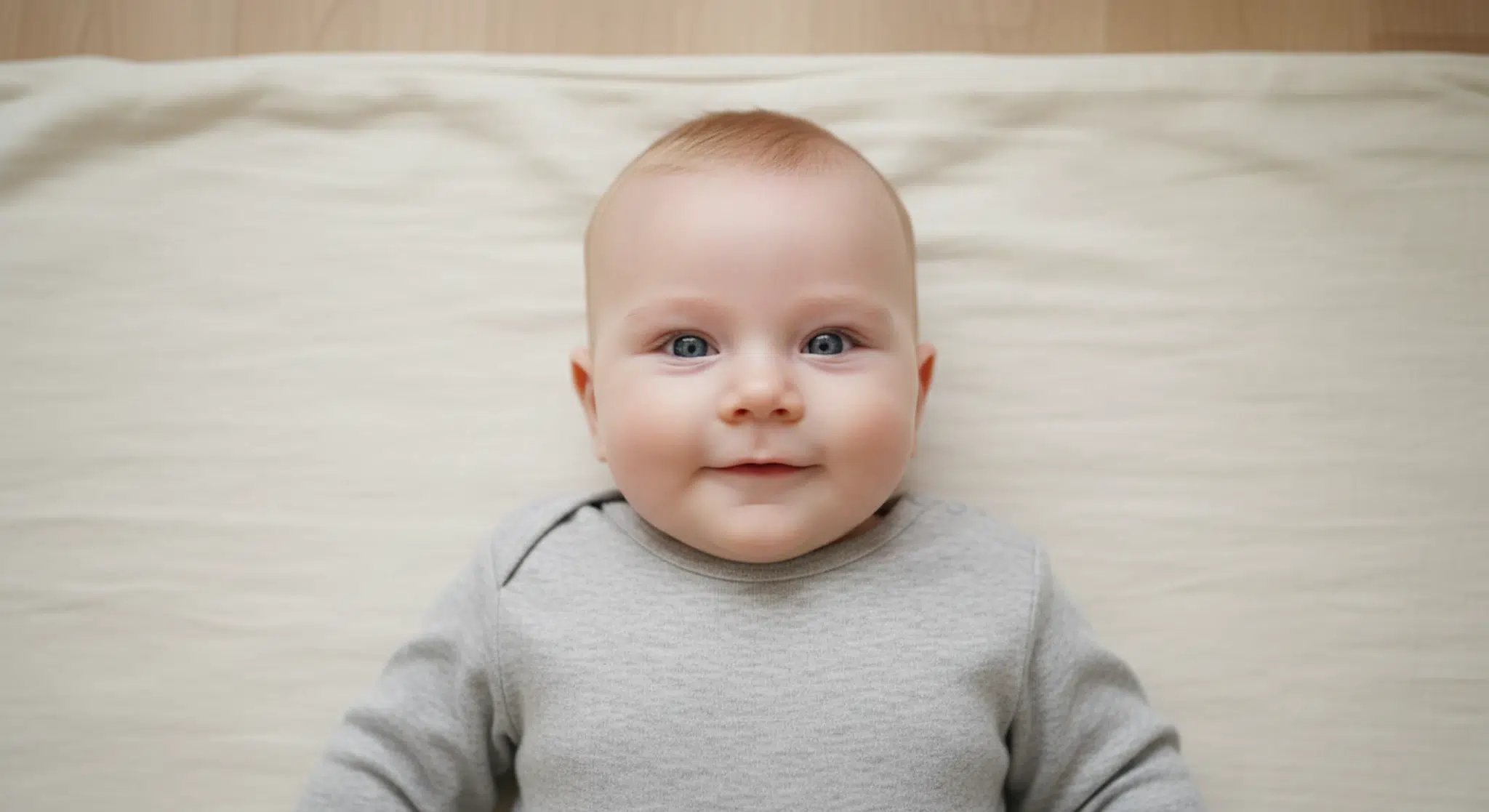
When do babies’ eyes change color? Usually between about 3 and 9 months, as pigment builds in the iris, and most babies have their lasting eye color by around 9 to 12 months, though some keep changing slightly for a few years.
Many parents spend the first months staring into their baby’s eyes and wondering whether that blue or gray will last. When do babies’ eyes change color, and how much can you read from what you see now? The answer depends on how much pigment your baby’s irises still have to add.
This guide pulls together what the American Academy of Pediatrics, the American Academy of Ophthalmology, Cleveland Clinic and NIH genetics researchers say: the timeline, a month-by-month eye color chart, how eye color is inherited, what heterochromia means, and which eye changes deserve a call to your pediatrician.
Key Takeaways
Most eye color change happens between about 3 and 9 months, often around 6 months (Cleveland Clinic).
The AAO says color is usually final by about 9 months; the AAP says pigment cells take about a year, and some children change for longer.
Not all babies are born with blue eyes: in one 2016 study, about 63% of newborns had brown eyes.
Eye color depends on many genes, so no predictor or chart can tell you your baby’s final color.
A white pupil in photos, eyes that do not track by 3 months, two different colors or a sudden change all deserve a call.
Table of Contents
When Do Babies’ Eyes Change Color? The Short Answer
Quick Answer
Most babies’ eyes change color, if they change at all, between about 3 and 9 months, often around 6 months (Cleveland Clinic). The American Academy of Ophthalmology (AAO) says eye color is usually final by about 9 months, while the American Academy of Pediatrics (AAP) says the pigment cells take about a year to finish their work. Some children keep changing for longer: Cleveland Clinic gives up to 3 years in one article and about age 6 in another.
So the honest answer is a range, not a date. HealthyChildren.org, the AAP’s parent site, says the change slows after about 6 months but can continue, so predicting eye color before the first birthday is unreliable.
Not every baby’s eyes change. Cleveland Clinic puts it plainly: not all babies’ eyes will change color, but many will. When they do, Cleveland Clinic says the color can deepen or change altogether once the eyes get more light, and many babies born with blue-gray eyes change color as they grow.
Why Babies Are Born With Blue or Gray Eyes
Eye color comes from melanin, the same pigment that colors skin and hair. Cleveland Clinic explains that the iris (the colored ring of muscle around the pupil) contains pigment-producing cells called melanocytes. A baby gets very little light in the womb. After birth, those cells respond to light and start making more pigment.
The amount of pigment sets the color. HealthyChildren.org explains: a little melanin gives blue eyes, more gives green or hazel, and a lot gives brown. MedlinePlus Genetics (NIH) ties color to the melanin in the front layers of the iris.
That is why a baby who is still building up melanin can look blue or gray at first and later show green, hazel or brown. HealthyChildren.org notes that if the melanocytes only release a little melanin over time, the eyes stay blue.
Are All Babies Born With Blue Eyes?
No. This is one of the most repeated baby myths. Cleveland Clinic points to a 2016 study of newborns that found about 63% had brown eyes at birth, about 20% had blue eyes, and just under 6% had green eyes. Brown, not blue, was the most common newborn eye color in that study.
Cleveland Clinic also reports that in a 2-year follow-up of that study, about 1 in 3 children had changed eye color.
Worldwide, Cleveland Clinic says more than half of all people have brown eyes, and green is the rarest of the main colors at about 2%.
Big days go better with a good night of sleep.
Got a little one at home too? Our free two-minute quiz builds a gentle, personalized sleep plan for babies and toddlers.
Use this baby eye color chart as a rough guide. Every row is tied to a source, and “varies” means no source gives a reliable rule for that age.
Age
What sources say
Source
Birth
Color varies. In one 2016 study, about 63% of newborns had brown eyes, about 20% blue and just under 6% green
Cleveland Clinic
0 to 3 months
Varies. Pigment cells begin responding to light after birth
Cleveland Clinic
3 to 6 months
Changes may appear as early as 3 months; change often happens around 6 months
Cleveland Clinic
6 to 9 months
Change slows after about 6 months but can continue; usually final by about 9 months
AAP, AAO
9 to 12 months
Slight changes are not uncommon; pigment cells take about a year to finish
AAO, AAP
1 to 3 years
Final color can take up to 3 years in some children
Cleveland Clinic
3 to 6 years
Changes should finish by about age 6; a small percentage keep changing into adulthood
Cleveland Clinic
Baby eye color chart by age. Ranges are general patterns, not predictions for any one child.
Want to watch it happen? Take a photo in the same spot and the same kind of light each month so the pictures are fair to compare. Until about the first birthday, what you see is a snapshot, not the final answer.
What the Final Eye Color Can Be
Cleveland Clinic lists six main eye colors and describes how the pigment differs for most of them:
Eye color
What the iris has
Notes from the source
Brown
A lot of melanin in both layers
Most common worldwide (more than half of people)
Hazel
Less melanin than brown, more than blue or green
A mix of brown, gold and/or green that varies by person
Green
Less front-layer melanin than brown
About 2% of people worldwide; the rarest main color
Amber
Not described in detail
Listed as one of the main colors
Gray
Little or no front-layer melanin
Often appears with blue
Blue
Little or no front-layer melanin
Grouped with gray by pigment level
Eye colors and pigment. Source: Cleveland Clinic, eye colors article.
Baby Eye Color Predictor: Why Genetics Is More Complex Than the Old Chart
You may remember a school chart where brown eyes were “dominant” and blue were “recessive,” and two blue-eyed parents could never have a brown-eyed child. MedlinePlus Genetics says that single-gene model was found to be too simple, and that two blue-eyed parents can, though uncommonly, have a brown-eyed child.
Here is what MedlinePlus Genetics describes instead:
A main region on chromosome 15: two genes there, OCA2 and HERC2, play a major role. OCA2 helps the cell structures that make and store melanin mature; common variations reduce its protein and can lead to blue eyes. A section of HERC2 controls how active OCA2 is.
At least eight more genes:ASIP, IRF4, SLC24A4, SLC24A5, SLC45A2, TPCN2, TYR and TYRP1 have smaller effects. Together they produce a continuum of colors, not a few fixed boxes.
Prediction is possible but imperfect: a child’s eye color can often be predicted from parents and other relatives, but genetic variation sometimes produces unexpected results.
Cleveland Clinic goes further and says researchers know of dozens of genes and DNA changes that affect eye color, and that eye color can skip generations. So an online baby eye color predictor can only give rough odds from a simplified model. No predictor can tell you your baby’s actual eye color: treat any result as a guess for fun.
Can Two Blue-Eyed Parents Have a Brown-Eyed Baby?
Yes, though it is uncommon, according to MedlinePlus Genetics. Here is how the sources describe the odds for common parent pairings:
Parents’ eye colors
What sources say
Blue + blue
Usually a blue-eyed child, but not always (AAP). Cleveland Clinic puts the chance of blue eyes at 99%. A brown-eyed child is possible but uncommon (MedlinePlus Genetics)
Brown + brown
Likely, but not guaranteed, a brown-eyed child (AAP). A blue-eyed baby is less likely but can happen, especially if grandparents had blue eyes (Cleveland Clinic)
Brown + blue
Roughly even odds (AAP)
Any pairing with a blue-eyed grandparent
Slightly raises the chance of a blue-eyed baby (AAP)
Eye color odds by parents’ eye colors, as each source states them. These are general patterns, not a calculation for your family.
Because genetic variation sometimes produces unexpected results (MedlinePlus Genetics), a color nobody in the family seems to have is not by itself a concern. A sudden change, or two eyes that do not match, is different and is covered below.
Heterochromia: When a Baby Has Two Different Eye Colors
Heterochromia means the irises are different colors. The AAO describes three types:
Complete: one iris is a different color from the other.
Partial (sectoral): part of one iris is a different color from the rest of it.
Central: an inner ring of the iris is a different color from the outer part.
The AAO says heterochromia present at birth or soon after is called congenital. It is often harmless: children born with it usually have no other eye or general health problems. Sometimes, though, it is linked to another condition. The AAO lists causes in infants that include benign heterochromia, Horner syndrome, Sturge-Weber syndrome, Waardenburg syndrome and piebaldism, among others.
Because of that, the AAO says an ophthalmologist should examine any infant with heterochromia. HealthyChildren.org gives the same advice in plain terms: if your baby has one brown eye and one blue eye, tell your doctor, since it can be a sign of Waardenburg syndrome, a rare genetic condition.
Newborn Vision Milestones That Go Along With Eye Color
Meanwhile your baby’s vision is developing fast. The AAO lists these milestones (for preemies, count from the due date):
Age
What the AAO describes
Newborn
Very sensitive to bright light, with small pupils; side vision works but central vision is still developing
First few weeks
Pupils widen; large shapes and bright colors start to draw attention
About 1 month
May briefly focus on a parent’s face; prefers bright objects up to about 3 feet away
About 2 months
Follows moving objects with the eyes
About 3 months
Eyes should work together to focus and track; may bat at nearby moving objects
About 5 months
Depth perception is more developed; color vision is good but not yet adult level
About 9 to 10 months
Judges distance well; at about 10 months can pick up small objects between thumb and forefinger
Baby vision milestones in the first year. Source: American Academy of Ophthalmology.
HealthyChildren.org adds that in the first 2 to 4 weeks a baby’s eyes may cross or wander because vision is not yet sharp enough to lock onto a target, that by 2 months babies should track from side to side, and that by 6 months the eyes should keep pointing the same way.
Pediatricians also look at the eyes at well-child visits; the AAO says the red reflex (the red glow in the pupil) should be checked at every one, so bring any eye color questions along.
Gradual color change over the first year is common. These signs are different, and the sources say to bring them to your pediatrician or an eye doctor promptly:
A white, grayish white, yellow or black reflection in the pupil: HealthyChildren.org lists a white or grayish white pupil as a warning sign. The AAO says an odd reflection in a flash photo can be a warning sign, and a large white reflex (leukocoria) is a serious red flag that can point to cataracts, retinal detachment, infection or retinoblastoma, a rare eye cancer. Show the photo to your pediatrician promptly.
Eyes that do not track: the AAO says to talk to your pediatrician if eyes do not focus and track together by 3 months. HealthyChildren.org adds a baby who cannot make steady eye contact or seems unable to see.
Eyes that cross or drift after the early months: occasional misalignment is common in newborns, but HealthyChildren.org says regular crossing or drifting after 4 months should be reported. The AAO says to call if one eye constantly turns in or out.
Two different eye colors: the AAO says an ophthalmologist should examine any infant with heterochromia.
A sudden or distinct change in eye color: Cleveland Clinic says any sudden change in eye color may signal a medical problem and should be raised with an ophthalmologist as soon as possible.
Other eye symptoms: HealthyChildren.org lists eyes that flutter quickly side to side or up and down, redness that does not go away in a few days, pus or crust, eyes that are always watery, drooping eyelids, and eyes that often seem very sensitive to light.
Yellow or pink whites: HealthyChildren.org says jaundice may turn the whites yellow and inflammation may make them look pink or red; both are worth a call. See our baby jaundice guide.
If your baby has an eye injury or seems to be in pain, call your pediatrician right away, and if you cannot reach them, seek urgent care. You see your baby’s eyes every day, so trust your instincts. This article is general education, not medical advice. More on what to watch for in the first year: 12 month old milestones.
Frequently Asked Questions
When do babies’ eyes change color for good?
Sources differ. The American Academy of Ophthalmology says eye color is usually final by about 9 months, with slight later changes not uncommon. The AAP says pigment cells take about a year, and Cleveland Clinic says it can take up to 3 years.
Are all babies born with blue eyes?
No. Cleveland Clinic cites a 2016 study in which about 63% of newborns had brown eyes, about 20% had blue eyes and just under 6% had green eyes. Many babies born with blue-gray eyes change color as melanin builds in the iris.
How can I tell what color my baby’s eyes will be?
You cannot know for sure early on. HealthyChildren.org, from the American Academy of Pediatrics, says predicting eye color before the first birthday is unreliable because pigment cells take about a year to finish. Parents’ and relatives’ eye colors give rough odds, but genetic variation can still surprise you.
Can two blue-eyed parents have a brown-eyed baby?
Yes, though it is uncommon. MedlinePlus Genetics says the old idea of brown as simply dominant and blue as recessive was too simple, because many genes affect eye color. The American Academy of Ophthalmology also says two blue-eyed parents can have a brown-eyed child.
Can brown eyes turn blue?
In babies, the change sources describe is pigment building in the iris, which deepens color. Cleveland Clinic says a sudden change in eye color at any age may signal a medical problem, so mention any lightening or uneven change to your pediatrician.
Is it normal for a baby to have two different colored eyes?
It can be harmless, but it should be checked. The American Academy of Ophthalmology says children born with heterochromia usually have no other health problems, yet an ophthalmologist should examine any infant with it, because it is sometimes linked to conditions such as Waardenburg syndrome.
Gentle changes, peaceful nights.
Betteroo builds a personalized sleep plan for your baby or toddler. Take the free two-minute quiz to get started.