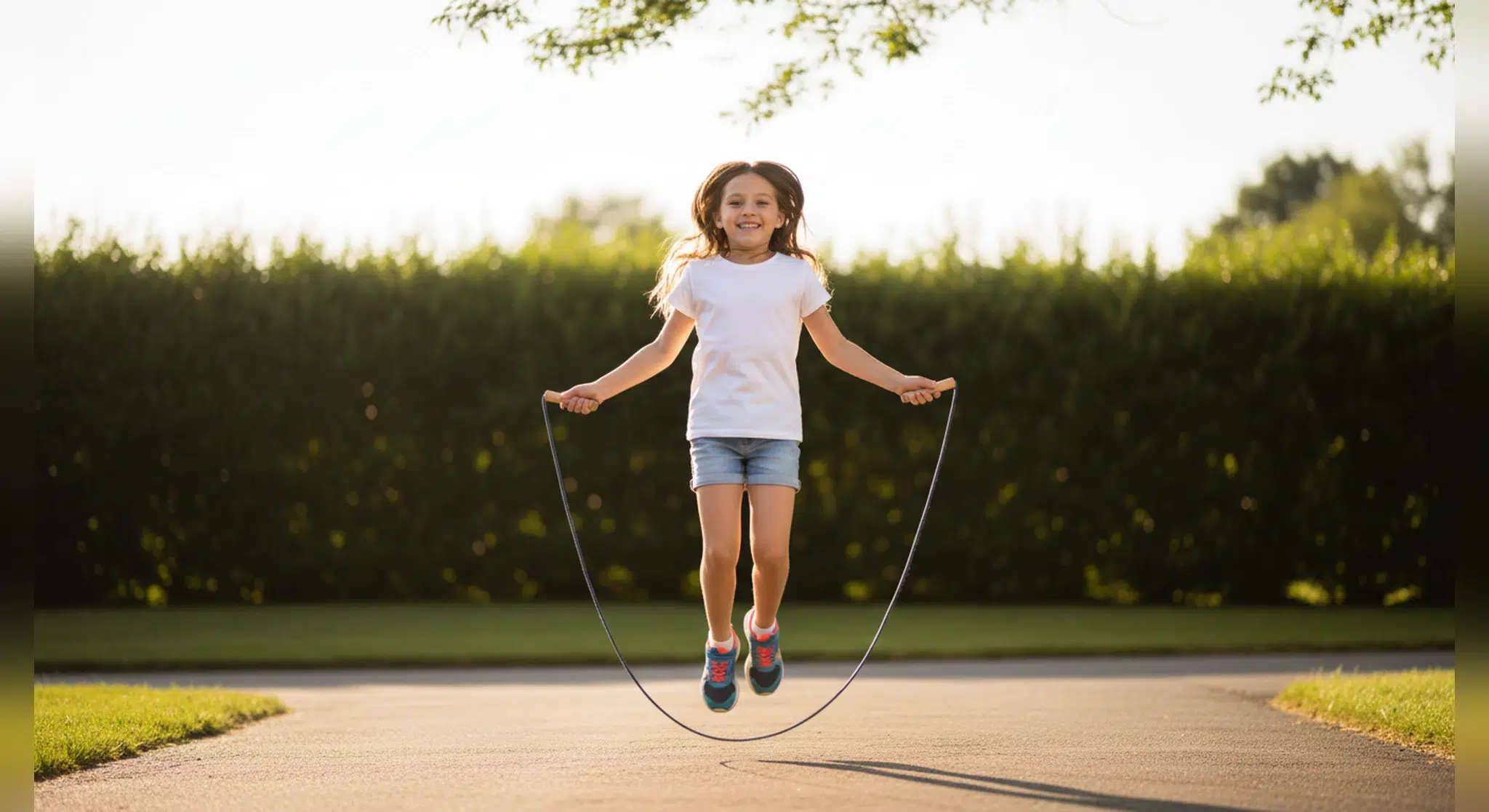
The best jump rope games for kids are Snake, High Water, Low Water, Jump the Creek, Helicopter, Traffic Jam, solo count challenges, partner jumps, Chinese jump rope and Double Dutch, matched to your child’s age and skills.
Jump rope games need almost nothing: a short rope for each child, or one long rope for a group, plus a flat open space. Below you will find solo, partner and long-rope group games, Double Dutch and Chinese jump rope basics, what preschoolers, early grade schoolers and older kids can realistically manage, and how to size a rope in thirty seconds.
We also cover the safety basics (surface, clearance and shoes) and how jump rope fits the CDC’s daily activity recommendations for kids, so you can turn ten spare minutes in the driveway into real exercise.
Key Takeaways
Preschoolers do best with ropes on the ground: Snake, Jump the Creek and High Water, Low Water.
Many kids learn to turn and jump their own rope around ages 5 to 7; Double Dutch usually comes later.
Size a rope by standing on the middle: handles at about armpit height suit most learners.
The CDC lists jumping rope as both vigorous aerobic and bone strengthening activity for kids.
Jump on a flat, forgiving surface in sneakers, check overhead clearance, and never tie ropes to playground equipment.
As an Amazon Associate, Betteroo earns from qualifying purchases.
Table of Contents
Jump Rope Games: Quick Picks by Age and Group Size
Quick Answer
The best jump rope games match the rope to the crowd: preschoolers do best with ropes on the ground (Snake, Jump the Creek, High Water Low Water), 5 to 7 year olds are ready for solo skipping and simple long-rope games, and 8 to 12 year olds can take on tricks, partner jumps and Double Dutch. All you need is one short rope per child or one long rope for a group, a flat open space and sneakers.
One long rope can keep a whole class busy at recess, and a short rope fits in a backpack. Use the table to pick a game in seconds.
Jump rope games at a glance. Ages are a rough guide: go by your child’s skills, not the number.
If you need more ideas for the same afternoon, our outdoor games for kids and backyard games guides pair well with a jump rope, and many of these games slot right into a field day station.
How to Size a Jump Rope for Kids
A rope that is too long drags and tangles; one that is too short catches on heels. Sizing takes thirty seconds.
The stand-on-it check: Have your child stand on the middle of the rope and pull both handles straight up along their sides. In Science Buddies’ rope-length method, a short rope reaches between the belly button and the armpits, a medium rope reaches about the armpits, and a long rope reaches the chin. Armpit height is a comfortable start for most kids learning to skip.
Beginners vs confident jumpers: New jumpers usually do better with a little extra length. A slightly shorter rope turns faster and suits tricks.
Adjusting: Many kids’ ropes adjust at the handle. If yours does not, tie a knot near each handle to shorten it.
Long ropes for groups: Long-rope games need room for two turners standing well apart with a jumper in the middle, and Double Dutch uses two ropes of the same length. Soft cloth ropes are kindest for games where the rope may touch legs, like Helicopter and Snake.
Toddlers and young preschoolers do not need a turning rope at all: a rope laid flat on the ground, or a line of tape indoors, is plenty.
Solo Jump Rope Games and Counting Challenges
Once your child can turn the rope overhead and hop it, these games need one short rope each.
Count challenge: How many jumps in a row without a miss? Post the record on the fridge and try to beat it.
Beat the clock: Count jumps in 30 seconds. Competing against yourself is kinder for siblings of different ages.
Alphabet and months: Say one letter (or one month) per jump. After a miss, restart where you stopped.
Spell and skip: Spell your name, one letter per jump, or this week’s spelling words.
Skip counting: Count by 2s, 5s or 10s on each jump: sneaky math practice.
Trick ladder: Two-foot bounce, one-foot hops, running step, jumping jacks, side-to-side ski hops, arm crossover, backward turns. Move up a rung after 10 in a row.
Run and jump: Jog forward while turning the rope, start line to finish line.
Copycat: One child makes up a short combination; the next copies it and adds one move.
Kids not yet turning smoothly can play the same counting games jumping side to side over a rope on the ground.
Big days go better with a good night of sleep.
Got a little one at home too? Our free two-minute quiz builds a gentle, personalized sleep plan for babies and toddlers.
Partner jumping is part skill, part comedy. Start slowly and expect tangles.
Face to face: One partner turns a rope while the other stands in front, facing in, and both jump. The turner sets a slow, steady pace.
Side by side: Partners each hold one handle in their outside hand and turn together.
Jump in, jump out: One partner jumps alone; the other steps in for a few jumps, then out, without stopping the rope.
Mirror moves: Partners face each other with their own ropes, and one copies the other’s tricks.
Two-person count-off: One jumps while the other counts aloud. Swap after each miss and keep a team score.
For siblings far apart in age, give the older child turning duty, a real job and a skill they need for Double Dutch. Our cooperative play guide has more teamwork ideas.
Long-Rope Jump Rope Games for Groups
Long-rope games need two turners and a line of jumpers, perfect for recess, parties and group games. Rotate turners often.
Snake: Two turners crouch and wiggle the rope along the ground; jumpers run up one at a time and hop it without touching. Playworks notes that this ground-level play builds coordination for jump rope and Double Dutch later.
High Water, Low Water: Turners hold the rope still at ankle height and raise it a little each round. When it is too high to jump, switch to going under. Hold it loosely so it drops if a foot catches.
Jump the Creek: Lay two ropes side by side as a creek; kids jump it and land on two feet, and the creek widens each round. Playworks’ version, Jump the River, is aimed at pre-K through second grade.
Helicopter: A player in the middle of a circle swings a long, soft rope low along the ground, and players jump it as it passes. Keep it at ankle height, with no hard handles or weights.
Action chant games: The jumper acts out motions called in a traditional chant, such as turning around, touching the ground and waving, then jumps out. No chant? Turners can just call actions.
Keep the Kettle Boiling: Jumpers run through the turning rope without jumping and loop back to the line, aiming for no empty turns.
Traffic Jam: Every five jumps, another child runs in to join until someone misses. Count how many fit.
Cat and Mouse: Jumpers run through the rope in a figure eight around each turner, great for timing practice.
Color call: Turners call a color, and only kids wearing it run in.
Entering a turning rope: stand beside a turner. When the rope hits the ground and swings up and away, run in toward the middle and start jumping. It takes many tries, so celebrate near misses.
Double Dutch Basics
Double Dutch uses two long ropes turned in opposite directions, egg-beater style. It is learnable in steps, usually by kids 8 and up who already jump a single long rope confidently.
Start with the turners: Each turner holds one rope in each hand and turns them inward, alternating. Practice without a jumper until the ropes hit the ground in an even rhythm.
Learn the entry: Watch the rope closest to you. When it hits the ground and swings up away from you, step in.
Jump light and quick: Small, quick hops on the balls of the feet, once for each rope.
Exit on the diagonal: Jump toward the opposite turner and run out at an angle.
Build up: Add turns, claps or one-foot jumps, then two jumpers at once.
If the ropes keep tangling, slow the turners down: almost every Double Dutch problem is a turning problem.
Chinese Jump Rope (Elastics)
Chinese jump rope, also called elastics or French skipping in some places, uses a long loop of stretchy elastic. Two players stand inside the loop a few steps apart so it stretches around their ankles, and a third jumps a pattern in and out.
Basic patterns: Both feet inside, both outside, one foot on each strand, and landing on the strands to pin them. Jumpers often call each move aloud.
Raising the level: After a clean pattern, the elastic moves up: ankles, knees, then thighs. A miss means swapping with a holder.
Playing alone: Loop the elastic around two sturdy chairs.
Elastics suits kids who find a turning rope frustrating, because they control the pace.
Jump Rope by Age: What Kids Can Manage
The American Academy of Pediatrics notes on HealthyChildren.org that skipping, hopping and jumping are among the basic skills young children work on, and that kids acquire most of these skills by early elementary school. It also notes that balance can temporarily dip around ages 4 to 5. That timeline explains why turning a rope over your head often clicks in kindergarten or first grade, and not before.
Age
Typical skills
Best games
Preschoolers (3 to 5)
Jumping forward with two feet, hopping, stepping over a still rope
Snake (slow), Jump the Creek, High Water, Low Water at ankle height, walking a rope laid on the ground like a tightrope
Ages 5 to 7
Learning to turn a short rope and hop over it, running through a long rope, jumping a few times in a turned rope
Solo counts, spell and skip, Keep the Kettle Boiling, action chant games, Helicopter
Ages 8 to 12
Steady rhythm, tricks, entering a moving rope, turning for others
A rough guide to jump rope skills by age. Children develop at different speeds.
If your child is far behind peers in jumping, running or balance, or seems to be losing skills, mention it at the next well visit.
Why Jump Rope Games Are Great Exercise for Kids
According to the CDC, following the federal Physical Activity Guidelines for Americans, kids and teens ages 6 to 17 need at least 60 minutes of moderate to vigorous activity every day, mostly aerobic, with vigorous activity, muscle strengthening and bone strengthening each at least 3 days a week. The CDC lists jumping rope as both a vigorous aerobic activity and a bone strengthening activity for school-age kids and teens.
Preschoolers ages 3 to 5 have no minutes target: the guidelines say they should be active throughout the day, and the HHS summary suggests about 3 hours of active play daily at any intensity. HHS adds that activity helps young people’s cognition, bone health, fitness and heart health and lowers depression risk. For more, see our kids fitness activities and after-school activities guides.
Jump Rope Safety: Surface, Space and Shoes
Pick a forgiving surface: A wood gym floor, rubber play surface, packed dirt or short dry grass beats concrete. Avoid gravel and wet or slick ground.
Check the clearance: Swing the rope once first. Indoors, look up for ceiling fans and lights; outdoors, stay away from cars and the street.
Wear sneakers: No flip-flops, slippery socks or bare feet on pavement.
Land softly: Small hops on the balls of the feet with soft knees.
Give the rope room: Waiting jumpers stand well back, especially in Helicopter and Double Dutch.
Ropes are not for necks: Never wrap a rope around anyone’s neck. The American Academy of Pediatrics warns never to attach ropes or jump ropes to playground equipment because children can strangle on them. Store ropes away from toddlers and babies.
Take breaks: Bring water, rest in the shade, and stop if anyone is dizzy or in pain.
Rainy day? Use a garage or basement with a high ceiling, or a rope on the floor. Our indoor activities for kids guide has more ideas.
Jump rope games are cheap, portable and easy to scale: one short rope per child for counting and trick challenges, or one long rope for a group game like Snake, High Water, Low Water or Traffic Jam. Start little kids with ropes on the ground, let 5 to 7 year olds learn to turn their own rope, and save partner jumps and Double Dutch for when your child has a steady rhythm.
Size the rope so the handles reach about armpit height, choose a flat, forgiving surface with plenty of clearance, and wear sneakers. A few jump rope breaks a day go a long way toward the 60 active minutes school-age kids need. Looking for something to do after the rope comes out? Try our fun challenges to do with friends or party games for kids.
Frequently Asked Questions
What are some fun jump rope games for kids?
Popular jump rope games for kids include Snake, where turners wiggle a rope along the ground; High Water, Low Water, where the rope rises after each round; Helicopter; Keep the Kettle Boiling; Traffic Jam; Jump the Creek; solo count and spelling challenges; partner jumps; Chinese jump rope with an elastic loop; and Double Dutch for older kids with a steady rhythm.
What age can a child learn to jump rope?
Many children learn to turn a short rope over their head and jump it around ages 5 to 7. The American Academy of Pediatrics notes that kids acquire most basic hopping, skipping and jumping skills by early elementary school. Preschoolers can start with ropes laid on the ground, Snake and Jump the Creek, which build the same timing and coordination.
What is the jump rope game with two ropes called?
The game with two ropes is Double Dutch. Two turners swing two long ropes in opposite directions, alternating like an egg beater, while one or two jumpers hop in the middle. Most kids are ready for it around age 8 or older, once they can jump a single long rope and enter it while it is turning.
How do you play Snake with a jump rope?
Two players crouch at each end of a long rope and wiggle it back and forth along the ground so it slithers. The other players run up one at a time and jump over the moving rope without touching it. Make the wiggles faster or bigger as kids improve, and swap turners often so everyone gets to jump.
How long should a jump rope be for a child?
Have your child stand on the middle of the rope and pull the handles up along their sides. For most kids learning to skip, the handles should reach about armpit height. Beginners may prefer a bit more length, while confident jumpers often like a shorter rope. Long-rope games need a rope long enough for two turners and a jumper.
Is jumping rope good exercise for kids?
Yes. The CDC lists jumping rope as both a vigorous aerobic activity and a bone strengthening activity for school-age children and teens. Kids ages 6 to 17 need at least 60 minutes of moderate to vigorous activity daily, with bone strengthening at least 3 days a week, and a few jump rope games can cover part of that.
Gentle changes, peaceful nights.
Betteroo builds a personalized sleep plan for your baby or toddler. Take the free two-minute quiz to get started.