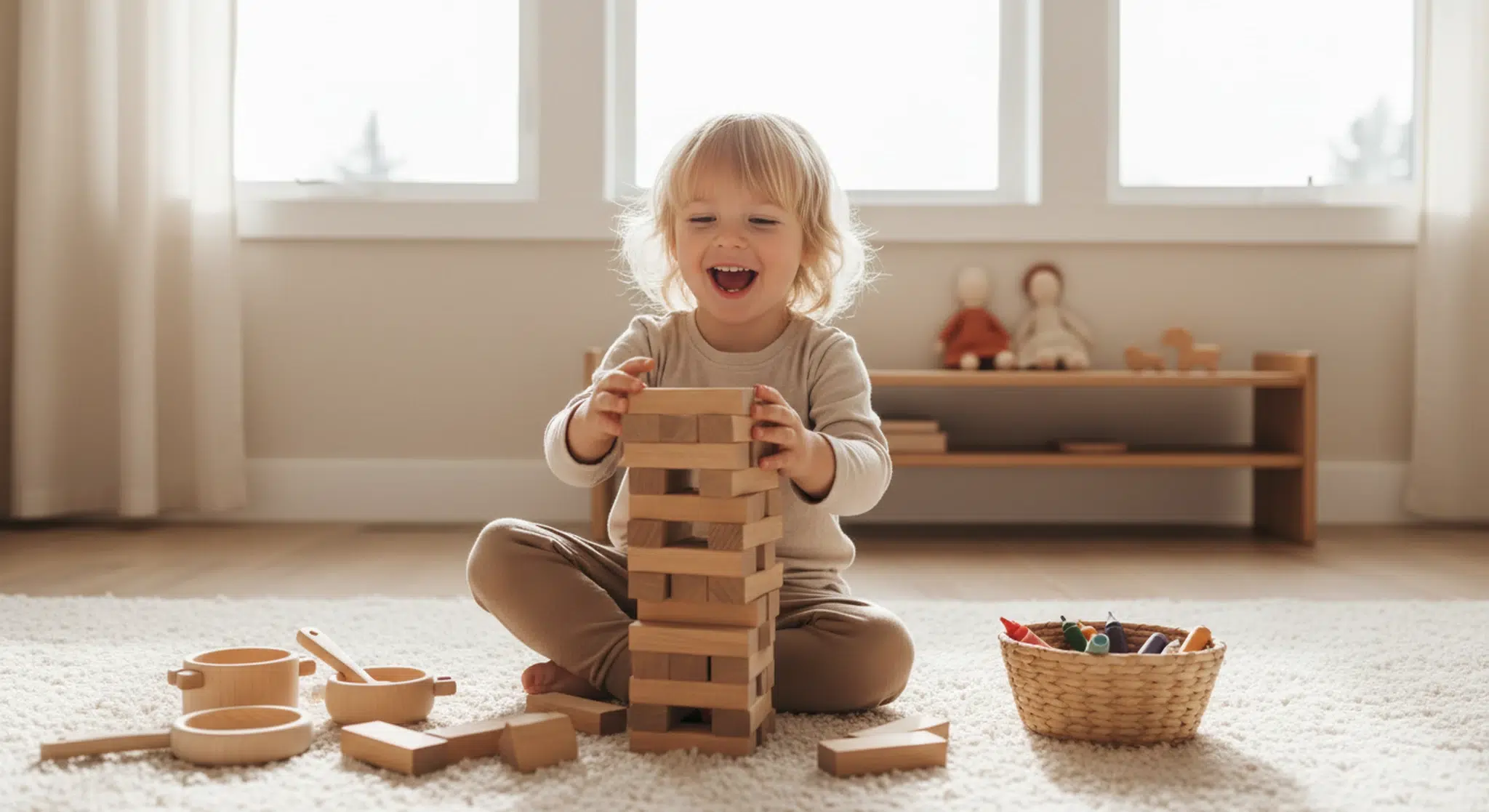
The best toys for 3 year olds are simple, open-ended toys that match new skills: a play kitchen or dress-up box, blocks or magnetic tiles, a balance bike or trike, art supplies, puzzles and picture books.
Shopping for toys for 3 year olds can feel overwhelming, but most great picks fall into a handful of categories. Three year olds are talking in real conversations, starting to play with other kids, drawing first circles, and running, climbing and pedaling with new confidence. The right toys give those skills room to grow.
Below: more than 50 toy ideas by skill, what the CDC and the American Academy of Pediatrics (AAP) say about play and screens, toy rotation, the safety rules behind 3+ labels, and budget gifts.
Key Takeaways
Open-ended toys (pretend play, blocks, art supplies, balls) give the most play value at age 3.
The AAP says the most educational toy is one that gets you and your child playing together.
Toys for 3 year old boys and girls are the same list: follow interests, not aisle labels.
Keep fewer toys out, rotate them, and limit screens to about 1 hour a day with an adult.
Mind 3+ labels around younger siblings, choose screw-secured battery doors, keep magnets away, and add a helmet to any ride-on.
As an Amazon Associate, Betteroo earns from qualifying purchases.
Table of Contents
Best Toys for 3 Year Olds at a Glance
Quick Answer
The best toys for 3 year olds are open-ended and simple: a play kitchen or dress-up box for pretend play, wooden blocks or magnetic tiles for building, a balance bike or tricycle (with a helmet), chunky crayons and playdough, large-piece puzzles and plenty of picture books. The American Academy of Pediatrics (AAP) says the most valuable toys are the ones you play with together.
Skill
Toy types that fit
Imagination and language
Play kitchen, dress-up clothes, dollhouse, toy doctor kit, puppets
Problem solving
Wooden blocks, magnetic tiles, large interlocking bricks, ramp sets
Gross motor
Balance bike, tricycle, playground balls, indoor climber
Fine motor
Chunky crayons, playdough and tools, lacing beads, safety scissors
Thinking and early math
Jigsaw puzzles, matching games, counting bears, first board games
Language and listening
Picture books, toy instruments, a kid-friendly music player
Curiosity and the senses
Magnifying glass, sensory bin, water table, bug catcher
Toys for 3 year olds organized by the skill they build. Every toy here suits boys and girls alike.
What 3 Year Olds Are Learning (and What That Means for Toys)
At 3, children move from playing next to other kids to playing with them, talk in real conversations, and use their hands with much more control. The CDC’s 3 year milestones include joining other children to play, conversations with at least two back-and-forth exchanges, asking who, what, where and why questions, drawing a circle when shown, and stringing large beads or macaroni. Those point straight at toy choices: lacing beads, crayons and paper, picture books to talk about, and toys two children can share. See our 3 year old milestones guide for the full list.
The AAP’s clinical report on choosing toys (Healey and Mendelsohn, 2018) says the ideal toy fits a child’s current abilities while encouraging new ones, and supports language, pretend play, problem solving, social interaction and physical activity. AAP guidance on play adds that pretend play helps children practice social roles, cooperation and negotiation. Our guide to cooperative play shows how shared play grows from here.
Screens versus play. The CDC suggests no more than 1 hour a day of children’s programming at this age, watched with an adult, and no screens in the bedroom. The AAP’s toy report gives the same limit for children 2 and older, says many products that claim to be educational have not proven it, and notes that electronic toys alone do not provide the interaction children need. If you do use screens, our list of best shows for toddlers can help.
Pretend Play and Building Toys for 3 Year Olds
If you only buy one or two toys, make them pretend play and building toys. They are open-ended, last for years, and invite siblings and parents to join in.
Most 3 year olds need to move, and the AAP notes that outdoor play supports balance, spatial awareness and attention. Read more in our guide to gross motor skills.
Balance bike: Your child should be able to sit with both feet flat on the ground.
Tricycle: Look for a low seat your child can climb onto alone.
Helmets are part of the gift. The U.S. Consumer Product Safety Commission (CPSC) says riding toys and scooters call for safety gear, including a helmet sized to fit and worn properly every time. Our ride-on toys guide compares balance bikes, trikes and scooters by age.
Arts and Crafts Toys for Little Hands
Art at 3 is about the process, not the product. The CDC suggests an activity box of paper and crayons, drawing shapes together, and playdough for squeezing, pinching and rolling, which builds hand strength for writing and buttoning.
Three year olds love to match, sort and figure things out, and simple games work if turns are quick. The CDC recommends counting, matching and opposites games at this age.
Reading together is one of the CDC’s top tips at this age: look at pictures, ask what might happen next, and let your child tell the story. The AAP also suggests using books to inspire pretend play.
Picture books: Mix stories, simple nonfiction about animals or trucks, and books about feelings and routines.
A calm, screen-free activity is also a good part of the wind-down before bed. See our 3 year old sleep schedule for timing.
Toys for 3 Year Old Boys and Girls: It’s the Same List
Parents often search for toys for 3 year old boys or toys for 3 year old girls, but the honest answer is that the list is the same. Trucks, dolls, kitchens, dinosaurs, art and balls build useful skills for every child. The AAP’s toy report asks parents to be aware that toys can promote gender-based and race-based stereotypes, so follow your child’s interests rather than aisle colors, offer a wide mix, and choose dolls and books that show many kinds of people and families.
How Many Toys a 3 Year Old Needs, Plus Budget and Non-Toy Gifts
There is no magic number, and more is not better. A few open-ended toys covering pretend play, building, movement, art, puzzles and books usually get more use than a crowded playroom.
Try toy rotation. Keep a small selection on low, open shelves and store the rest. Every week or two, swap a few. Familiar toys feel new again and cleanup is easier. Toys nobody misses can be passed on: see where to donate toys.
Some of the best gifts cost little or are not toys at all:
Cardboard box kit: A big box, tape and markers becomes a car, rocket or house.
Homemade playdough and cookie cutters: An activity and a gift in one.
Kitchen helper set: A child-size apron, whisk and bowl. The CDC suggests letting 3 year olds wash produce and stir.
Experience gift: A zoo, aquarium, farm or children’s museum day with a grandparent.
Membership: A family pass to a local museum, zoo or science center gives a year of outings.
Class sign-up: A swim, music or tumbling class, if it fits your schedule.
Toy Safety for 3 Year Olds: Age Labels, Batteries and Magnets
Age 3 is the line on many toy labels for a reason. Under federal rules enforced by the CPSC, toys intended for children under 3 cannot contain small parts that could cause choking, and certain toys with small parts, small balls, marbles or balloons must carry a choking hazard warning. A 3+ label often means small pieces, not that the toy is too advanced.
Think about every child in the home: The CPSC advises following age labels and remembering that toys for older kids can hurt younger siblings. Store small-part sets up high or in closed bins.
Button and coin batteries: The CPSC says a swallowed button battery can cause severe injury within about 2 hours. Choose toys whose battery doors need a screwdriver or tool. If you suspect one was swallowed, get emergency care and call the National Battery Ingestion Hotline (800-498-8666) or Poison Help (800-222-1222).
Magnets: Two or more swallowed magnets can attract each other inside the body, and many cases need surgery. Keep loose magnets away and discard any cracked magnetic toy.
Balloons: The CPSC says to keep balloons away from children under 8, as latex balloons are a choking risk.
Helmets: A fitted helmet, every ride, on balance bikes, trikes and scooters.
The best toys for 3 year olds are simple, open-ended and played with together: something to pretend with, something to build, something to ride (with a helmet), art supplies, puzzles and plenty of books. Choose by skill and interest rather than by boy or girl aisles, keep fewer toys out and rotate them, limit screens to about an hour a day, and follow age labels with any younger siblings in mind. If you notice your child is losing skills they once had or not meeting the milestones above, mention it to your pediatrician.
Frequently Asked Questions
What are the best toys for 3 year olds?
The best toys for 3 year olds are open-ended ones that match new skills: a play kitchen or dress-up clothes for pretend play, blocks or magnetic tiles for building, a balance bike or tricycle with a helmet, crayons and playdough, simple puzzles and matching games, and picture books. The AAP says the best toys are the ones you play with together.
What should a 3 year old be able to play with?
Most 3 year olds can string large beads, draw a circle when shown, use simple tools like a fork, join other children in play, and hold short conversations, according to the CDC. That makes lacing beads, crayons, playdough, puzzles with large pieces, pretend play sets and ride-on toys with helmets a good fit for this age.
How many toys should a 3 year old have?
There is no set number. A small collection of open-ended toys covering pretend play, building, movement, art, puzzles and books usually gets more use than a crowded playroom. Many families keep a few toys out on low shelves and rotate the rest every week or two so toys feel new again and cleanup stays manageable.
Should a 3 year old have a tablet?
A tablet is not necessary. The CDC suggests no more than 1 hour a day of children’s programming for 3 year olds, watched with an adult, and the AAP recommends under 1 hour of total screen time daily for children 2 and older. The AAP also says real play with caregivers is better for learning than digital media.
Why do toys say ages 3 and up?
Federal rules enforced by the CPSC ban small parts that could cause choking in toys intended for children under 3, and certain toys with small parts, small balls, marbles or balloons must carry a choking hazard warning. A 3 and up label usually means the toy has small pieces, so keep it away from babies and toddlers in the home.
Are there different toys for 3 year old boys and girls?
No. The skills 3 year olds are building are the same for every child, so the best toys are too. The AAP encourages parents to be aware that toys can promote gender stereotypes. Follow your child’s interests, offer a wide mix such as vehicles, dolls, kitchens and art, and ignore aisle colors and labels.
Gentle changes, peaceful nights.
Betteroo builds a personalized sleep plan for your baby or toddler. Take the free two-minute quiz to get started.