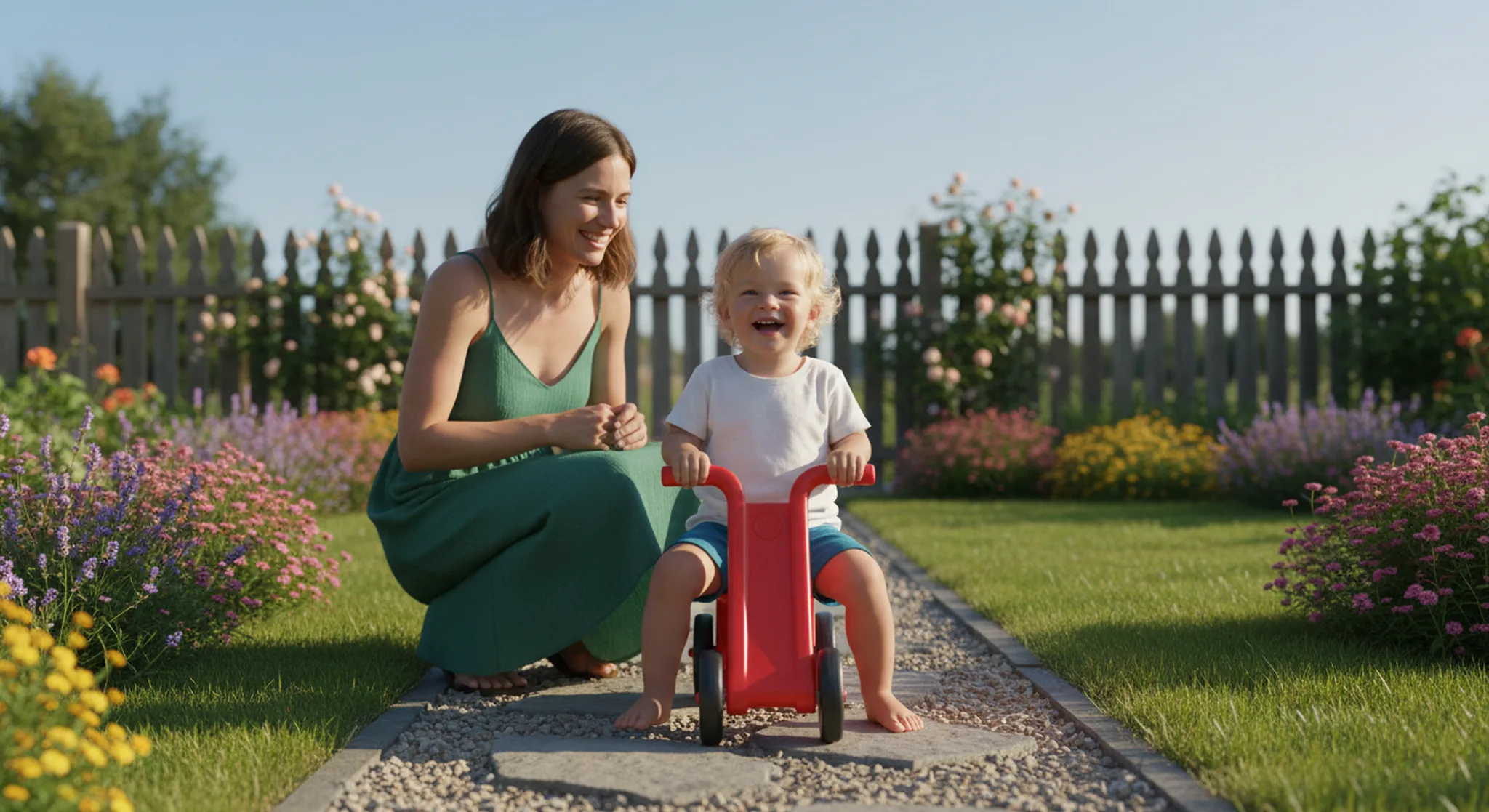
The best ride on toys for toddlers are low, stable push or foot-to-floor ride-ons, while kids 3 and up are usually ready for tricycles, scooters, balance bikes and pedal cars, always with a helmet and close supervision.
If you are shopping for ride on toys, start with your child’s age and size, not the flashiest car on the shelf. A toy your child can get on, steer and stop alone is the one that gets ridden every day.
Below you will find every main type of ride-on, a table of what fits at ages 1, 2, 3, 4 to 5 and 6 and up, what to look for in battery-powered cars, indoor vs outdoor picks, storage and battery care, and the safety rules from the AAP and CPSC that matter most.
Key Takeaways
Toddlers do best on low, wide, slow ride-ons they can push with feet flat on the floor.
The AAP says most children are ready for a tricycle around age 3.
Choose battery-powered cars by the model’s labeled age and weight range, with a parental remote for young children.
A CPSC-compliant bicycle helmet belongs with every bike, trike and scooter, worn every ride.
Ride only in protected places, away from streets, driveways and pools, with an adult watching.
As an Amazon Associate, Betteroo earns from qualifying purchases.
Table of Contents
Which Ride-On Fits Your Child: Quick Guide
Quick Answer
For 1 year olds, choose a low push or foot-to-floor ride-on or a rocking ride-on. For 2 year olds, a sturdier foot-to-floor car or a balance bike that fits. Around age 3, the AAP says most children are ready for a tricycle. From 3 to 5, add a three-wheel scooter, a balance bike or a pedal car, and consider a battery-powered car only within its labeled age range. Pair any bike, trike or scooter with a CPSC-compliant helmet, and ride only in protected places away from streets, driveways and pools.
Ride on toys are some of the most loved toys of early childhood, and the CPSC reports that scooters cause more toy-related emergency room injuries than any other toy. This guide covers every main type, which ages each suits, the features that matter, and the safety rules that make the difference.
Types of Ride-Ons for Toddlers and Kids
Push and foot-to-floor ride-ons: a low seat on wheels that a child scoots with their feet, often with a push handle for a grown-up. They are the classic first ride-on, and many double as a walking support while a toddler is still steadying.
Rocking ride-ons: a rocking horse or animal on curved runners or a stable base. They stay in one spot, which makes them an indoor favorite for young toddlers.
Balance bikes: two-wheel bikes with no pedals. Children sit, walk and then glide, practicing balance and steering before they ever pedal.
Tricycles: three wheels and pedals on the front wheel. Some come with a removable parent push handle.
Kick scooters: three-wheel versions (two wheels in front is common for beginners) are steadier than two-wheel scooters, which suit older, more coordinated kids.
Pedal cars and go-karts: child-powered cars that use pedals, usually for preschoolers and up.
Battery-powered ride-on cars: electric cars, trucks, tractors and motorcycles. They are labeled by battery voltage (commonly 6V, 12V or 24V), and each model lists its own age and weight range.
Wagons and plasma or swing cars: wagons are pulled by an adult, and swing cars move when a child wiggles the steering wheel. See our toddler wagon picks if a wagon is on your list.
Best Ride On Toys by Age
The age printed on the box is your starting point. Then look at the child: can they get on and off alone, sit with both feet flat on the floor, and steer where they mean to go?
Age
Ride-on types that usually fit
Why
What to check
1 year
Push or foot-to-floor ride-on; rocking ride-on
New walkers and climbers; the CDC lists walking without holding on and climbing on and off a couch by 18 months
Very low seat, wide base, no small detachable parts
2 years
Sturdier foot-to-floor car; balance bike if it fits; low-power battery ride-on only if labeled for this age
Toddlers run, kick and want to go faster
Feet flat on the floor, weight limit, parental remote on powered models
3 years
Tricycle; three-wheel scooter; balance bike
The AAP says most children are ready for a trike around 3
Low trike with large wheels, helmet that meets the CPSC standard
4 to 5 years
Balance bike or first pedal bike; pedal car; battery car within its labeled age
Better coordination and longer attention for play
Seat height, brakes, speed settings, seat belt
6 years and up
Pedal bike; two-wheel scooter; larger ride-ons as labeled
Kids can learn and follow simple riding rules
Correct bike size, helmet fit, rules about where to ride
Ride on toys by age: a general guide. Always follow the manufacturer’s age and weight labels.
Development varies a lot within each age. A tall, steady 2 year old may be ready for a balance bike while a cautious 3 year old prefers a foot-to-floor car for another year, and that is fine. Our guides to 2 year old milestones and 3 year old milestones show the movement skills to watch for.
Ride On Toys for Toddlers (1 to 3 Years)
For toddlers, the best ride on toys are low, slow and stable. Look for:
Feet flat on the floor: when seated, a toddler should be able to plant both feet to push, steer and stop.
A wide wheelbase: wheels set wide apart resist tipping during tight turns.
A low center of gravity: a low seat close to the ground makes falls shorter and getting on and off easier.
A stable push handle: if the toy doubles as a walker, the handle should not tip the toy backward when a toddler pulls up on it.
Simple, sturdy parts: no small pieces that can come loose, and no gaps where fingers can get pinched.
Battery-Powered Ride-On Cars: What Parents Should Know
Electric ride-on cars are a big purchase and a big thrill. Manufacturers usually group them by battery voltage, most often 6V, 12V and 24V, but voltage alone does not tell you whether a car suits your child. Each model sets its own age range, weight limit and top speeds, so read the label and the manual for the specific car. Start younger children on lower-power models designed for their age.
Features worth paying for:
Parental remote control: lets you steer and stop the car while a young child learns, and override them if they head somewhere unsafe.
Speed settings: a low-speed setting or lockout for beginners.
Seat belt: and a seat that fits your child, without them sliding around.
Soft start: gradual acceleration rather than a jolt.
Clear weight limit: including both children if it is a two-seater.
Listed safety certification: the AAP advises looking for a UL label on electric toys, and the CPSC suggests looking for a certification mark from an independent testing organization.
Charging safety. Battery ride-ons are toys, but the batteries deserve grown-up care. The CPSC’s charging advice for battery-powered micromobility products makes sense here too: use only the charger supplied with the product, stay present while it charges (never overnight while you sleep), unplug it when done, use only an approved replacement battery pack, and never put lithium batteries in household trash or regular recycling. Charge in a spot away from anything that can burn, and keep children away from the charger and battery compartment.
Safety Rules for Every Ride-On
The CPSC reports that non-motorized scooters account for the largest share of toy-related emergency room injuries, about one in five toy injuries for children 14 and younger in its holiday safety report. A few rules prevent most problems:
Helmet every time: the CPSC says to get helmets for scooters and other riding toys and to wear them every time. The AAP recommends a well-fitting bicycle helmet from a child’s first tricycle or bike, labeled as meeting the CPSC standard. The CPSC lists a bicycle helmet for kick scooters, too.
Fit the helmet: it should sit level, feel snug, not shift side to side or front to back, and have the chin strap fastened. Replace any bike helmet after a crash, even if it looks fine.
Protected places only: the AAP says tricycles should be used only in protected places, away from cars, driveways and swimming pools, and that low riders can be hard for a driver backing up to see. Never let a child ride near a street, a driveway, a pool or the top of stairs.
Constant supervision: young children should ride only with adult supervision and off the street.
Closed-toe shoes: the AAP recommends them for tricycle riding; they protect toes on any ride-on.
Daylight only: the AAP says never to ride at dusk or in the dark.
Check for recalls: look up any new or used ride-on at cpsc.gov/Recalls before buying, and register it with the manufacturer so you hear about future recalls.
Pools deserve extra caution with any wheeled toy, since a child can roll in fast. Our guide on babies and pools covers pool safety basics.
Indoor vs Outdoor Ride-Ons
Indoor
Outdoor
Best types
Rocking ride-ons, small foot-to-floor cars, swing cars
Balance bikes, trikes, scooters, pedal and battery cars
Wheels
Smooth plastic or rubber-covered wheels that are gentle on floors
Wider, treaded wheels for paths, grass and uneven ground
Space
A clear room with no stairs nearby; block stairways with a gate
A fenced yard, park path or empty playground surface
Watch out for
Rugs that catch wheels, furniture corners, open stairs
Balance bike: size it by inseam rather than age: your child should be able to sit with both feet flat on the ground. An adjustable seat buys more time. Our balance bikes page covers sizing in more detail.
Tricycle: pick a low tricycle with large wheels, which the AAP says is less likely to tip. A removable push handle helps on walks before your child can pedal far.
Scooter: a three-wheel kick scooter with a wide deck and a rear foot brake suits beginners.
First pedal bike: when your child is ready, choose a bike they can straddle with feet on the ground, and check tires, brakes and seat height at least once a year, as the AAP advises.
Storage, Care and Gift Tips
Store under cover: sun and rain fade plastic, rust bolts and wear out tires and batteries. A garage, shed or covered porch extends the toy’s life.
Check it often: tighten loose bolts and handlebars, check tires and wheels, and look for cracks in plastic seats and footrests.
Battery care: follow the manual for the first charge and for storage between seasons, and charge only with the supplied charger.
Clean wheels before indoor use: to keep floors clean and wheels rolling smoothly.
Giving a ride-on as a gift? Check with the parents first: they will know the space, the stairs, and whether a big battery car is welcome. Include a helmet that fits, and if the toy needs assembly, build it before the party so it is ready to ride. Kids outgrow ride-ons quickly, so adjustable seats and handlebars give more value. Shopping for a preschooler? Our gifts for 4 year olds guide has more ideas.
The best ride on toys match your child’s size and skills today: low foot-to-floor ride-ons for new walkers, balance bikes and tricycles around age 2 to 3, scooters and pedal cars for preschoolers, and battery cars only within their labeled age and weight range. Whatever you buy, add a helmet for bikes, trikes and scooters, ride only in protected places away from streets, driveways and pools, stay close, and check cpsc.gov/Recalls before you buy.
Frequently Asked Questions
What age are ride on toys for?
Ride on toys come in versions for nearly every age. Low push and foot-to-floor ride-ons and rocking ride-ons suit children from about the time they walk, tricycles fit most children around age 3 according to the AAP, and scooters, pedal cars and battery cars suit older children within the age range on each model’s label.
Can a 1 year old use a ride on toy?
Yes, many ride on toys are made for 1 year olds. Choose a very low push or foot-to-floor ride-on, or a rocking ride-on, with a wide base and no small parts. Your child should be able to sit with both feet flat on the floor. Stay close, and keep the toy away from stairs and other drops.
Are battery powered ride on cars safe for toddlers?
They can be when you choose a model labeled for your child’s age and weight, use the low speed setting and a parental remote, and supervise every ride on flat ground away from streets, driveways and pools. Charge only with the supplied charger, stay present while it charges, and check cpsc.gov/Recalls before buying.
Does my toddler need a helmet on a tricycle?
Yes. The AAP recommends a well-fitting bicycle helmet every time your child rides, starting with their first tricycle or bike. Look for a label saying it meets the Consumer Product Safety Commission standard. The helmet should sit level, feel snug, and have the chin strap fastened so it barely moves.
Is a balance bike or tricycle better for a 3 year old?
Both can work. A tricycle is stable and teaches pedaling, and the AAP says most children are ready for one around age 3. A balance bike teaches balance and steering, which children use later on a pedal bike. Many families pick based on the child’s interest, size and where they will ride.
Where should kids ride their ride on toys?
Only in protected places. The AAP says tricycles should be kept away from cars, driveways and swimming pools, and warns that low riders can be hard for drivers backing up to see. A fenced yard, an empty playground surface or a park path with an adult close by works well. Never ride at dusk or in the dark.
Gentle changes, peaceful nights.
Betteroo builds a personalized sleep plan for your baby or toddler. Take the free two-minute quiz to get started.