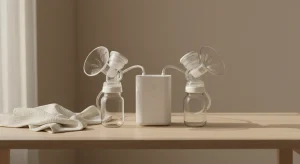
The best pumping schedule copies your baby’s feeds: about 8 to 12 sessions a day for exclusive pumping in the early months, fewer as feeds space out, and 2 to 3 sessions during a workday.
Whether you exclusively pump, pump at work, or just want a few bottles in the freezer, the right pumping schedule depends on why you pump and how old your baby is. The good news: one simple rule covers almost every situation.
Below you will find sample schedules by age, an at-work day, a freezer stash plan, guidance on night sessions, session length, realistic milk amounts and safe storage, plus the signs that mean it is time to call for help.
Key Takeaways
Pump when your baby would normally eat; that is the core of any pumping schedule.
Exclusive pumping in the early months usually means 8 to 12 sessions in 24 hours, including at night.
At work, most parents pump 2 to 3 times a shift, about 10 to 15 minutes each.
Drop sessions one at a time and gradually; abrupt stops can lead to clogs or mastitis.
Judge success by your baby’s growth and your 24 hour total, not by one session.
As an Amazon Associate, Betteroo earns from qualifying purchases.
Table of Contents
How Often Should You Pump? Pumping Schedule Basics
Quick Answer
A good pumping schedule copies your baby’s feeding pattern. The CDC says newborns breastfeed about 8 to 12 times in 24 hours, so exclusive pumping in the early months usually means 8 or more sessions a day and night. At work, the Office on Women’s Health says many parents pump 2 to 3 times a shift. Sessions usually take about 10 to 15 minutes once you are used to your pump.
The rule behind every schedule is simple: milk supply runs on demand. Cleveland Clinic puts it plainly: the more you pump, the more milk you will produce. The AAP notes that a dip in supply is most often the result of skipped pumping sessions or not pumping long enough.
The Office on Women’s Health (OWH) gives the most practical version of the rule: pump during the times your baby would normally eat. Whether you pump to replace every feed, to cover work hours, or to fill the freezer, everything below builds on that. If you’re still choosing a pump, ask your insurer which suppliers and models it covers. Yummy Mummy (paid link) is one supplier you can check.
Exclusive Pumping Schedule by Baby’s Age
With an exclusive pumping schedule, every bottle comes from the pump. The session counts follow the feeding ranges from the CDC and OWH; the clock times are examples to adapt, not prescriptions.
Baby’s age
Sessions per 24 hours
Overnight
Example times
Newborn (first weeks)
8 to 12, matching feeds
Yes, babies this age eat every 1 to 3 hours including at night (CDC)
Sample exclusive pumping schedules by age. Session counts follow your baby’s own feeds; times are examples only.
OWH gives no fixed age for each drop in feedings, so the later rows are typical patterns, not rules. Your baby’s actual feeds outrank any chart. If your 4 month old still eats 8 times a day, an 8 session day makes sense.
In the first weeks, aim for a session roughly as often as your baby eats. Once supply is steady, the goal shifts from building to maintaining. OWH notes that feedings may decrease as your baby gets older, and that babies get what they need from roughly the same number of ounces at 9 months, so you rarely need to add sessions.
Drop one session at a time: then wait several days and watch your daily total before you drop another.
Merge, do not skip: shift the neighboring sessions a little closer so no gap suddenly gets much longer.
Watch comfort: fullness, firm spots or tenderness after a drop is a sign to slow down.
Cleveland Clinic warns that stopping pumping abruptly can lead to clogged ducts or mastitis, and advises reducing how often or how much you pump gradually. If output is lower than you hoped, see how to increase milk supply; when you are ready to stop, our guide on how to wean off pumping walks through it.
Feeding and sleep go hand in hand.
Our free two-minute quiz builds a gentle, personalized sleep plan around your baby’s feeds.
Pumping While Breastfeeding to Build a Freezer Stash
If you nurse most feedings and only want a backup supply, you do not need an exclusive pumping schedule. OWH suggests pumping while your baby naps or is cared for by someone else,.
Time
Feeding
Pumping
6:30 a.m.
Nurse
7:15 a.m.
Pump about 10 to 15 minutes (morning)
1:30 p.m.
Optional second pump during a nap
Rest of the day and night
Nurse on cue
Example day: breastfeeding plus one or two pumping sessions to build a stash.
Start small: the first sessions often yield little. That is normal and does not mean low supply; the AAP notes a pump may not express as much as an effective nursing baby removes.
Do not overdo it: Cleveland Clinic says pumping more than your baby needs can cause oversupply. A stash of a few days is often plenty.
Introduce bottles thoughtfully: when someone else gives a bottle, paced bottle feeding helps protect breastfeeding.
Pumping at Work: A Sample Back-to-Work Day
At work you pump in place of the feeds you would give at home. OWH says you may need to pump two to three times each day at work,. OWH suggests practicing with your pump several days or weeks before your first day back, and the AAP suggests starting back in the middle of the work week if you can.
Time
At home or work
What happens
6:30 a.m.
Home
Nurse or pump before you leave
10:00 a.m.
Work
Pumping session 1
1:00 p.m.
Work
Pumping session 2 (lunch break)
4:00 p.m.
Work
Pumping session 3, if your day is long
6:00 p.m. onward
Home
Nurse on cue through the evening and night
Example 8 to 9 hour workday schedule. Match session count to the feeds you miss.
Plan the minutes: add time for setup, washing hands and storing milk to each session.
Expect reverse cycling: OWH notes some babies eat less during the day and nurse more at night when a parent returns to work, so you may need less pumped milk than you expect.
Pack a cooler: the CDC says milk can stay in an insulated cooler with frozen ice packs for up to 24 hours when traveling.
Your rights. The U.S. Department of Labor says the PUMP for Nursing Mothers Act was signed into law on December 29, 2022. Nearly all employees covered by the Fair Labor Standards Act can take reasonable break time to pump each time they need to, for up to one year after the child’s birth, in a place other than a bathroom that is shielded from view and free from intrusion. Employers with fewer than 50 employees may be exempt if compliance would cause undue hardship, and the Wage and Hour Division takes complaints. For daycare naps and evenings, see our guide to baby sleep when you go back to work.
Night Pumps: When to Keep Them and When Dropping Them May Be Reasonable
In the newborn period, night sessions are part of the schedule because night feeds are. The CDC says babies in the first weeks may eat every 1 to 3 hours, including during the night.
Later, many exclusive pumpers stretch or drop the middle of the night session. None of the sources we reviewed sets a single age for that, so use signals instead of the calendar:
Your baby sleeps a longer stretch: and your pediatrician has no concerns about growth.
Your daily total is steady: your 24 hour output has held for a week or more.
You are comfortable: you can sleep through the longer gap without painful fullness.
Move gradually: push the night session 30 minutes later every few nights, or shorten it, rather than cutting it all at once; Cleveland Clinic notes that abrupt stops can lead to clogs or mastitis. If your total drops and stays down for several days, put the night session back. See the signs your milk supply is decreasing to tell a true dip from a normal wobble.
How Long to Pump and How Much Milk to Expect
Session length. OWH says pumping takes about 10 to 15 minutes once you are used to using your pump, and sometimes longer. The AAP suggests at least 10 minutes per session even if milk stops flowing before then.
How much milk. Output varies widely between people, between breasts and across the day. As a reference point for what your baby needs, OWH says research shows breastfed babies between 1 and 6 months take in an average of 2 to 3 ounces per feeding, and roughly the same number of ounces at 9 months. The CDC suggests storing milk in 2 to 4 ounce portions.
A small single session is not a red flag. What matters is your total across 24 hours and whether your baby is growing. The AAP also cautions that a pump may not express as much as an effective nursing baby.
Signs Your Schedule Is Working
A schedule is working when your baby thrives and you can keep it up. Look for:
Healthy growth: the CDC says breastfed babies should be back to birth weight by day 10 to 14 of life, and your pediatrician tracks weight at checkups.
Enough diapers in the first week: by days 5 to 7, the CDC lists at least 6 wet and 3 dirty diapers a day.
Comfort: no lasting pain, no hard or red areas, and no dread of every session.
If output dips, check frequency and session length first. Power pumping is one focused technique some parents use for a short stretch to give supply a nudge; our dedicated guide explains how it works,.
Common Pumping Problems and What to Try
Problem
Common cause
What to try
Low or falling output
Skipped or short sessions (AAP)
Restore the missed session, pump at least 10 minutes, check your total over 24 hours
Pain while or after pumping
Fit, suction or nipple irritation
Lower suction, recheck fit, see a lactation consultant
Hard, tender spot
A clogged duct or early inflammation
Do not stop suddenly; call if fever or flu-like symptoms appear
Too much milk
Pumping more than baby needs (Cleveland Clinic)
Reduce volume or frequency gradually, with your provider
Common pumping schedule problems.
Pain is not something to push through. Our guide to breast pain after pumping covers the usual suspects in detail, from fit to suction settings, and when soreness points to something more.
Storing Pumped Milk Safely
The CDC limits for freshly pumped breast milk:
Where
How long (CDC)
Countertop, 77 F or colder
Up to 4 hours
Refrigerator
Up to 4 days
Freezer
About 6 months is best; up to 12 months is acceptable
Insulated cooler with frozen ice packs
Up to 24 hours when traveling
Thawed in the fridge
Use within 24 hours of being fully thawed; never refreeze
Leftover after a feeding
Use within 2 hours, then discard
Breast milk storage times. Source: CDC, Breast Milk Storage and Preparation.
The CDC also says to label milk with the date it was expressed, use the oldest first, leave about an inch at the top for expansion, skip the fridge door, and never thaw or heat breast milk in a microwave.
When to Talk to a Lactation Consultant or Your Doctor
An International Board Certified Lactation Consultant (IBCLC) can tailor a schedule to you. Reach out if pumping hurts, output is dropping, or your baby’s weight gain worries you.
Call your doctor or midwife promptly if you notice signs of mastitis. Mayo Clinic lists:
Breast tenderness, warmth or swelling.
Thickened tissue or a lump.
Pain or burning all the time or while breastfeeding.
Skin redness, often wedge shaped, which may be harder to see on Black or brown skin.
Feeling ill, or a fever of 101 F (38.3 C) or higher.
Read more in our mastitis guide. Call your baby’s doctor right away if you are worried about how much your baby is getting. The CDC says to seek care if your baby keeps losing weight after day 5, has fewer than 6 wet and 3 dirty diapers by day 5, or looks yellowish. For any emergency, such as a baby who is struggling to breathe, call 911.
This article is general education, not medical advice.
Frequently Asked Questions
What is a good pumping schedule for a newborn?
A good pumping schedule for a newborn follows feeding frequency. The CDC says newborns breastfeed about 8 to 12 times in 24 hours and may eat every 1 to 3 hours, including at night. If you exclusively pump, plan a session for each feed, including overnight in the early weeks.
How often should I pump breast milk?
Pump when your baby would normally eat, as the Office on Women’s Health advises. For exclusive pumping that usually means 8 or more sessions a day in the first months. At work, many parents pump 2 to 3 times a shift. If you nurse and only want a stash, one or two extra sessions a day usually covers it.
How long should each pumping session be?
The Office on Women’s Health says pumping takes about 10 to 15 minutes once you are used to your pump, and sometimes longer. The AAP suggests pumping at least 10 minutes per session, even if your milk stops flowing before then. If it hurts, ask a lactation consultant to check your setup.
Can I go 8 hours without pumping at night?
In the newborn weeks, usually not, because babies this age eat every 1 to 3 hours, including at night, according to the CDC. Later, some parents stretch the night gap once supply and baby’s growth are steady. Lengthen it gradually, and if your 24 hour total drops for several days, add the session back.
How much breast milk should I pump per session?
It varies widely between people and across the day. As a guide to need, the Office on Women’s Health says breastfed babies between 1 and 6 months take in an average of 2 to 3 ounces per feeding. Focus on your 24 hour total and your baby’s growth, not one session.
Should I pump if I am exclusively breastfeeding?
Only if you need milk for times apart, such as returning to work. The Office on Women’s Health suggests pumping while your baby naps or is with a caregiver to build a supply. Cleveland Clinic cautions that pumping more than your baby needs can cause oversupply, so a stash of a few days is often enough.
Calmer days, better nights.
Betteroo builds a personalized sleep plan for your baby. Take the free two-minute quiz and have it ready before the newborn weeks.