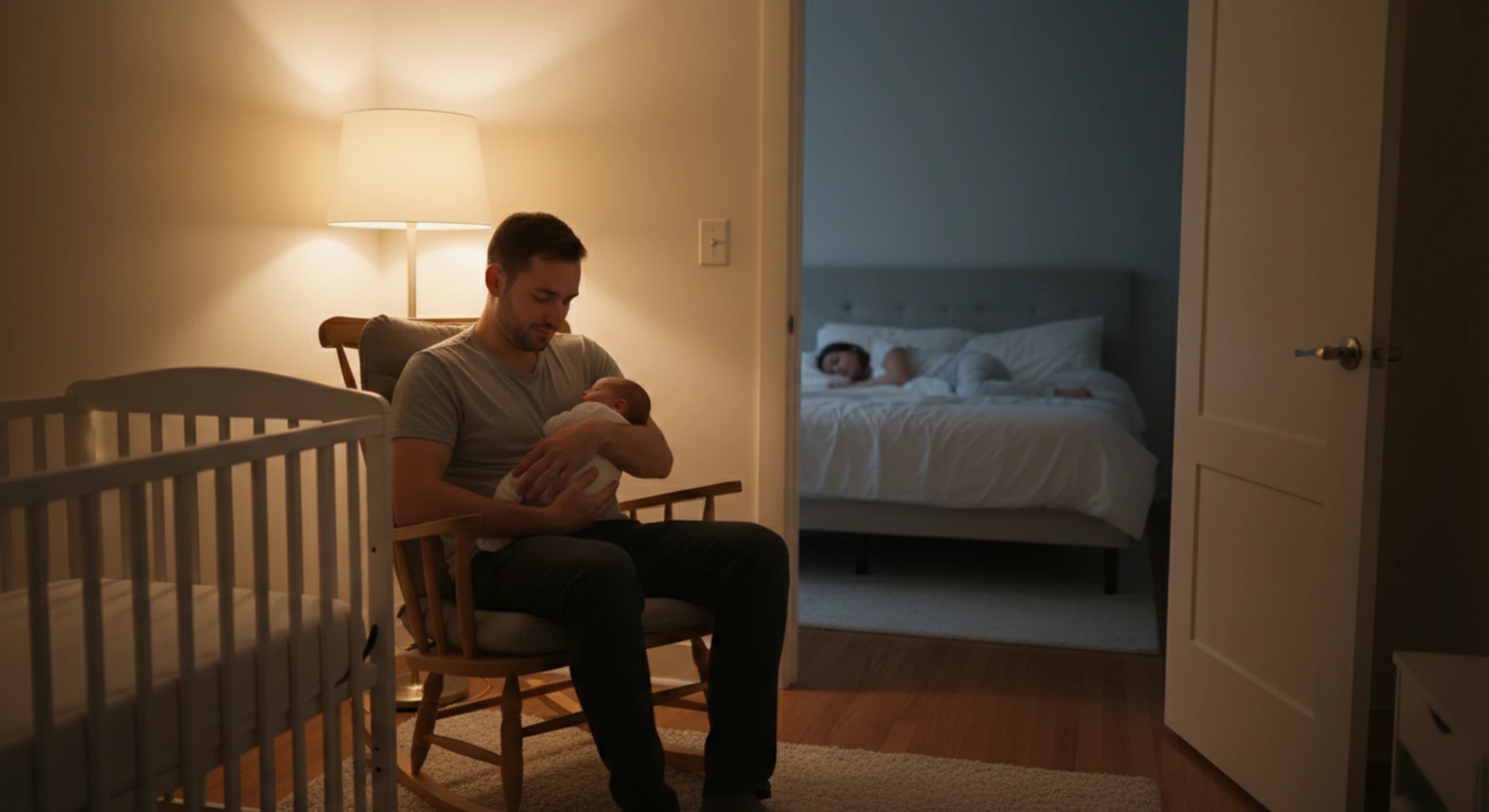


Splitting night shifts with a newborn works best when each parent gets one protected 4 to 5 hour block of sleep while the other is fully on duty, and if you are fighting more since the baby arrived, that is common, not a sign your relationship is broken.
Conflict after a new baby is very common: in one well-known study, 67% of new mothers reported a drop in marital satisfaction after their first baby, compared with 49% of wives without children. A planned night shift system, written down in daylight, is one of the most practical fixes.
Below you will find sample schedules for breastfed, pumped-milk and formula-fed babies, how a nursing parent can still get a protected stretch, safe sleep rules for exhausted parents at 3 a.m., how to share the mental load, scripts for talking about it, and when tiredness might be something more.
Key Takeaways
- Conflict after a baby is common: 67% of new mothers in one study reported lower marital satisfaction, versus 49% of childless wives.
- Aim for one protected sleep block of about 4 to 5 hours for each parent, with the other fully on duty.
- Breastfeeding parents can still take shifts: the partner handles everything except the feed, or gives pumped milk.
- Never doze with your baby on a couch or armchair; the AAP links this to a much higher risk of infant death.
- Sadness lasting more than two weeks, in either parent, is a reason to call a provider or the 1-833-TLC-MAMA hotline.
Table of Contents
Splitting Night Shifts With a Newborn: The Short Answer
Quick Answer
Newborns eat around the clock, which is why nobody sleeps. According to the American Academy of Pediatrics (AAP) on HealthyChildren.org, breastfed newborns usually nurse about every 2 hours, with 10 to 12 sessions in 24 hours being the norm, and most bottle-fed newborns eat every 2 to 3 hours, with 8 feeds generally recommended as the minimum per 24 hours. You cannot change that rhythm. You can change who is awake for it.
When you are both up at 1 a.m., 3 a.m. and 5 a.m., you are both running on scraps. When one of you is fully off duty, earplugs in and door closed, that person gets one real stretch of rest, and then you trade.
We Fight Constantly Because Neither of Us Is Sleeping. Is This Normal?
Yes, it is common, and it does not mean your relationship is failing. In a study by Shapiro, Gottman and Carrere published in the Journal of Family Psychology in 2000, 67% of new mothers reported a decline in marital satisfaction after the birth of their first baby, compared with 49% of wives without children over the same period. So the drop was more common after a baby, but plenty of couples without a baby also had a rough stretch.
Sleep is a big part of the picture. In the Betteroo State of Parent and Baby Sleep 2026 survey, which reached 83,901 parents in 118 countries through October 2026, 80% of parents said they were getting less than 6 hours of sleep and 82% said they felt exhausted or drained. Keep in mind that these respondents are parents who came to Betteroo for help with their child’s sleep, not a random sample, so the numbers describe tired families looking for help rather than all parents.
When you are both that depleted, small things become big fights: whose turn it was, why the bottles were not washed. Usually it is two people who each feel they are doing more and sleeping less. A shift plan replaces a nightly negotiation with an agreement you made in daylight. For more on how short sleep affects mood, read our guide to sleep deprivation in new parents.
How Should My Partner and I Split Night Wakings So We Both Get Some Sleep?
Start with one goal: each adult gets one protected block of sleep every night. Many families aim for 4 to 5 hours. That is a practical target, not a medical number, and some nights you will fall short. What matters is that the off-duty parent is truly off duty, and nobody wakes the sleeper to ask a question.
Then choose a schedule that matches how your baby is fed and when each of you naturally sleeps best. A night owl often does well with the early shift, and an early riser with the late one.
| Schedule | How it works | Breastfed baby | Pumped breast milk | Formula-fed baby |
|---|---|---|---|---|
| Split nights | One parent covers roughly 9 p.m. to 2 a.m., the other 2 a.m. to 7 a.m. Swap shifts every week or so if you like. | Partner brings the baby to the nursing parent for feeds during the partner’s shift, then does the diaper, burping and resettling. Nursing parent goes straight back to sleep. | Partner gives a bottle of pumped milk on their shift so the nursing parent can sleep through. Ask an IBCLC how to fit pumping into your plan. | Either parent can do every task on their own shift. The easiest version to split evenly. |
| Alternate nights | One parent is on for the whole night, the other is fully off. Trade the next night. | Hard to do fully, since the nursing parent is needed for feeds. Works better as an alternating role for everything except feeding. | Possible with pumped bottles, but discuss pumping timing with a lactation consultant first. | Works well. Each parent gets a full night of sleep every other night. |
| Sleep-in mornings | One parent takes the first morning wake-up (for example 5 a.m. to 9 a.m.) so the other can sleep late. | Partner takes the baby after the early feed so the nursing parent gets a solid morning block. | Partner gives a morning bottle. | Either parent can take the morning. |
| Weekend catch-up | Weekday shifts favor the parent with the earlier work start. On weekends, the other parent gets the long sleeps. | Partner covers everything except feeds on the weekend. | Partner covers weekend nights with pumped bottles. | Swap fully on weekends. |
Write the plan down, even on a sticky note on the fridge. Decide in advance what happens when the baby wakes 20 minutes before a shift change (usually the person on duty handles it) and what counts as a reason to wake the sleeping parent (an emergency, or a feed only the nursing parent can do).
Expect the schedule to change. Newborn patterns shift quickly, especially during growth spurts and cluster feeding in the evening. Our newborn sleep schedule week by week shows what the first months tend to look like, and how long a newborn can sleep without feeding explains when longer stretches may start.
Stuck on night two or three?
Our free two-minute quiz builds a gentle, personalized sleep plan that adapts when progress stalls.
Split Night Feeds When You Are Breastfeeding
Breastfeeding parents can take shifts too. The trick is to strip each night waking down to the one job only the nursing parent can do.
- Partner does everything else: the on-duty partner hears the baby, changes the diaper, brings the baby to the nursing parent, then takes the baby back for burping and resettling. The nursing parent feeds, then goes back to sleep.
- A bottle of pumped milk: some families have the partner give one bottle of pumped breast milk during the night so the nursing parent can sleep for a longer stretch. Our guide to introducing a bottle covers the practical side.
- Talk to a lactation consultant first: skipping or moving feeds can matter for milk supply, and every situation is different. An International Board Certified Lactation Consultant (IBCLC) or your pediatrician can help you decide whether and when a pumped bottle fits your plan.
- Feed in a safe spot: if you are worried about dozing off, read the safe sleep section below before choosing where you feed at 3 a.m.
The AAP notes on HealthyChildren.org that human milk reduces the risk of SIDS, and that the longer a baby gets breast milk, the more protection it gives. So build the shift plan around feeding rather than choosing between breastfeeding and sleep.
Some parents also try a late-evening feed before the first shift ends. Our dream feed guide explains how that works and who it tends to suit.
Safe Sleep Rules for Tired Parents at 3 a.m.
Shifts exist partly to keep you safe. The most dangerous moment is often a parent so exhausted that they fall asleep holding the baby. The AAP’s safe sleep guidance on HealthyChildren.org is clear on these points:
- Back to sleep, every time: place your baby on their back for all naps and at night, on a firm, flat sleep surface with a fitted sheet only and nothing else in the crib.
- Room-share without bed-sharing: the AAP recommends sharing a room with your baby, ideally for at least the first 6 months, with the baby on their own separate sleep surface.
- Avoid the couch and armchair: the AAP says the risk of sleep-related infant death is up to 67 times higher when infants sleep with someone on a couch, soft armchair or cushion. If you feel yourself nodding off on the sofa, put the baby down in their own sleep space or hand them to your partner.
- If you feed in your bed: the AAP says that if you bring your baby into your bed to feed or comfort them, place them back in their own sleep space before you go to sleep. If there is any possibility you might fall asleep while your baby is in your bed, remove pillows, blankets, sheets and other items from around the baby, and if you do fall asleep, move your baby back to their own sleep space as soon as you wake up.
- Exhaustion raises the risk: the AAP says the risk of sleep-related infant death is more than 10 times higher for babies who bed-share with someone who is fatigued, or who has been drinking alcohol, used marijuana or taken any medicines or illicit drugs.
This is where shifts help. The on-duty parent should be the most awake adult in the house. If you are on duty and you cannot keep your eyes open, wake your partner. That is not failing at your shift; it is exactly what the plan is for. Our safe sleep environment checklist walks through setting up the crib or bassinet.
Make the Off-Duty Sleep Actually Restful
- Sleep in a different room if you can, or use earplugs and an eye mask.
- Go to bed at the start of your off shift. Scrolling for an hour eats into the one block the plan protects.
- Agree on a handoff routine: the outgoing parent says when the last feed was, how much the baby took, and anything unusual. A shared notes app or a paper log works.
- Use daytime naps as a top-up. A short nap while a grandparent or friend holds the baby still counts.
If a grandparent, nanny or night helper joins the rotation, get everyone on the same page about wake-ups, soothing and safe sleep. Our guide to keeping the same sleep routine with every caregiver includes a handoff sheet.
Share the Mental Load, Not Just the Night Feeds
Many fights that look like they are about sleep are really about invisible work: appointments, diaper supplies, feed tracking, pump parts. The parent carrying that list can feel exhausted even after a decent sleep.
| Task | Who owns it | Notes |
|---|---|---|
| Tracking feeds and diapers | Whoever is on duty logs it | One shared log so nobody has to ask |
| Washing bottles and pump parts | Off-duty parent in the evening, or a set time | Before the night shift starts |
| Laundry (baby and adult) | Pick one owner per week | Swap weekly to keep it fair |
| Pediatrician appointments and questions | One parent books, both attend when possible | Keep a running question list |
| Meals and groceries | Plan simple meals, accept help | Freezer meals and drop-offs count |
| Visitors and family updates | One point person | Protect nap and shift times |
Fill in the middle column together. Owning a task means noticing it, planning it and doing it, not waiting to be asked. If you already have a toddler, the load roughly doubles; our two under two survival guide has ideas for that stage.
How to Talk About It Without Fighting
Have the shift conversation in daylight, ideally when you are both fed and the baby is asleep or with someone else. A few scripts that tend to land better than “you never get up”:
- “I am running on empty. Can we try a split-night schedule for one week and see how it goes?”
- “I want us both to get one long sleep. What shift would be easiest for you?”
- “When I am on shift, I will handle everything unless it is a feed only you can do. Can we agree not to wake each other otherwise?”
- “I feel like I am tracking everything in my head. Can we split the list so you own a few things completely?”
Set a check-in after one week. Ask what worked, what did not, and change one thing at a time. If the same argument keeps coming back even after better sleep, take that seriously.
The newborn months are intense, but they pass. Our guide to the 4th trimester explains why the early weeks feel so hard.
When It Is More Than Tiredness
Exhaustion and short tempers are expected with a newborn. Persistent sadness, hopelessness or a feeling that you cannot cope are different, and they deserve care.
- Baby blues: MedlinePlus says these feelings are common and usually go away within a few days to a week.
- Postpartum depression: MedlinePlus says that if symptoms are more severe and last longer than two weeks, you may have postpartum depression, which can begin anytime within the first year after childbirth. CDC research shows about 1 in 8 women with a recent live birth reported symptoms of postpartum depression. The CDC lists symptoms that may include crying more often than usual, feeling angry, feeling distant from your baby and doubting your ability to care for your baby.
- Partners can be affected too: the AAP’s HealthyChildren.org says that between 7% and 9% of new fathers develop postpartum depression, and that irritability, anger and aggression are common symptoms in dads. Supporting partners, including adoptive parents, can be affected as well.
If either of you has symptoms like these, the AAP and CDC both advise talking with a health care provider. Getting sleep is part of recovery, so a shift plan supports treatment; it does not replace it.
How Betteroo Can Help
If night wakings are still wearing you both down as your baby grows, Betteroo’s free sleep quiz can suggest a personalized sleep plan based on your baby’s age and routine. Whichever plan you use, following it the same way on every shift is what makes it work.
Related Betteroo Guides
- Sleep Deprivation in New Parents
- Newborn Sleep Schedule Week by Week
- Cluster Feeding in Newborns
- Dream Feed Guide
- Same Sleep Routine With Every Caregiver
- Safe Sleep Environment Checklist
When to Get Help
Reach out to your doctor, midwife or your baby’s pediatrician if you or your partner feel sad, empty or hopeless most days, lose interest in the baby, feel unable to care for the baby, or if symptoms last longer than two weeks. You do not have to wait for a scheduled visit.
- National Maternal Mental Health Hotline: call or text 1-833-TLC-MAMA (1-833-852-6262), 24/7, in English and Spanish (run by HRSA).
- Postpartum Support International HelpLine: 1-800-944-4773 for information, support and local resources. It is not a crisis line.
- In an emergency: if you or your partner are thinking about harming yourselves or your baby, call 911, or call or text 988 (the Suicide and Crisis Lifeline).
Asking for help is part of taking care of your baby. A well-rested, supported parent is safer at 3 a.m. than one pushing through alone.
Frequently Asked Questions
What is the best way of splitting night shifts with a newborn?
Many families use split nights, such as 9 p.m. to 2 a.m. for one parent and 2 a.m. to 7 a.m. for the other, so each gets one protected block of sleep. Alternate nights work well with formula. Pick shifts that match when each of you sleeps best, write the plan down and review it after a week.
How do you split night feeds when breastfeeding?
The partner on duty does everything except the feed: hears the baby, changes the diaper, brings the baby over, then burps and resettles. Some families add one bottle of pumped milk so the nursing parent sleeps longer. Talk with an IBCLC or your pediatrician before moving or skipping feeds, since milk supply needs vary.
Is it normal to fight with your partner after having a baby?
Yes, it is common. In a study by Shapiro, Gottman and Carrere published in 2000, 67% of new mothers reported a decline in marital satisfaction after their first baby, compared with 49% of wives without children. Lack of sleep makes small disagreements feel bigger, so planning shifts and sharing chores often helps.
How many hours of sleep should each parent get with a newborn?
There is no official number for parents of newborns. A practical goal many families use is one protected block of about 4 to 5 hours each night per parent, plus naps when possible. Newborns feed every 2 to 3 hours according to the AAP, so a shift plan is how you protect that longer block.
Can dads get postpartum depression?
Yes. The American Academy of Pediatrics says between 7% and 9% of new fathers develop postpartum depression, and that irritability, anger and aggression are common symptoms in dads. Supporting partners and adoptive parents can be affected too. Anyone with symptoms should talk with a doctor, and the National Maternal Mental Health Hotline is available 24/7.
Is it safe to fall asleep while feeding the baby in bed?
The AAP advises putting your baby back in their own sleep space before you go to sleep. If you might doze off while your baby is in your bed, remove pillows, blankets and sheets from around the baby, and move the baby back as soon as you wake. Avoid falling asleep with a baby on a couch or armchair.
Gentle changes, peaceful nights.
Betteroo builds a personalized sleep plan for your baby or toddler. Take the free two-minute quiz to get started.
8 Sources
- Shapiro AF, Gottman JM, Carrere S. The baby and the marriage: identifying factors that buffer against decline in marital satisfaction after the first baby arrives. J Fam Psychol. 2000.
https://pubmed.ncbi.nlm.nih.gov/10740682/ - American Academy of Pediatrics (HealthyChildren.org). How to Keep Your Sleeping Baby Safe: AAP Policy Explained.
https://www.healthychildren.org/English/ages-stages/baby/sleep/Pages/a-parents-guide-to-safe-sleep.aspx - Moon RY, et al. Sleep-Related Infant Deaths: Updated 2022 Recommendations for Reducing Infant Deaths in the Sleep Environment. Pediatrics. 2022.
https://pubmed.ncbi.nlm.nih.gov/35726558/ - American Academy of Pediatrics (HealthyChildren.org). How Often and How Much Should Your Baby Eat?
https://www.healthychildren.org/English/ages-stages/baby/feeding-nutrition/Pages/how-often-and-how-much-should-your-baby-eat.aspx - Centers for Disease Control and Prevention. Depression During and After Pregnancy.
https://www.cdc.gov/reproductive-health/depression/index.html - American Academy of Pediatrics (HealthyChildren.org). Perinatal Depression in Partners: Can Both Parents Get the Baby Blues?
https://www.healthychildren.org/English/ages-stages/prenatal/delivery-beyond/Pages/dads-can-get-postpartum-depression-too.aspx - MedlinePlus, U.S. National Library of Medicine. Postpartum Depression.
https://medlineplus.gov/postpartumdepression.html - Health Resources and Services Administration. National Maternal Mental Health Hotline.
https://mchb.hrsa.gov/national-maternal-mental-health-hotline