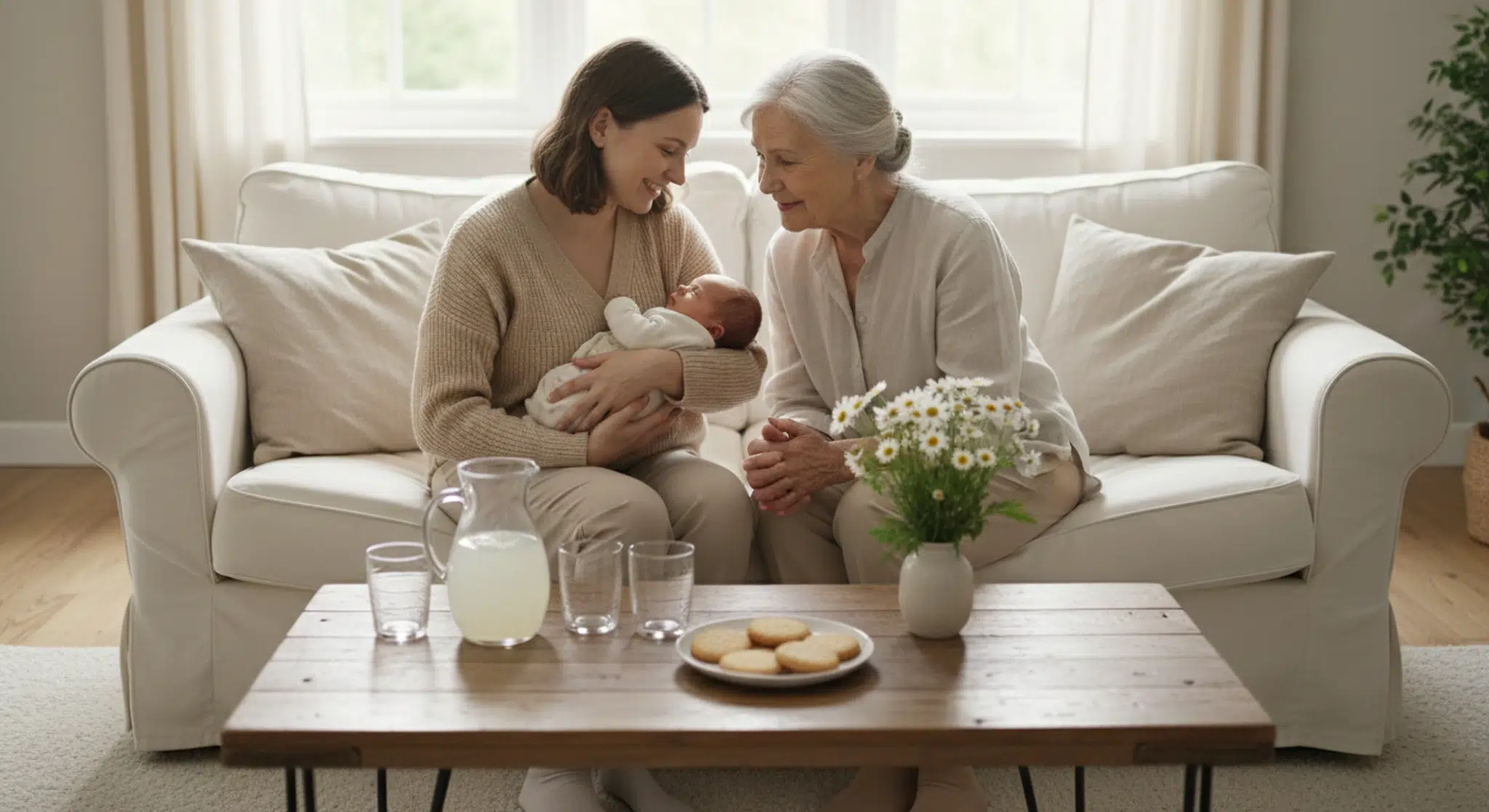
A sip and see party is a casual gathering held after a baby is born so friends and family can enjoy a drink and meet the baby, usually a few weeks to a few months after birth.
A sip and see party is a low-key way to introduce your baby to the people who have been waiting to meet them. Guests sip something, see the baby, and head home before anyone gets overtired.
Below: how it differs from a shower, timing, guests, invitation wording, food, gifts, a planning timeline, and the CDC and AAP health precautions most party guides leave out.
Key Takeaways
A sip and see is a short, casual post-birth gathering where guests meet the new baby.
Unlike a baby shower, the baby is present, gifts are optional, and there are few or no games.
Many families wait a few weeks to a few months, depending on recovery, the baby’s health and the season.
Ask sick guests to stay home, have everyone wash hands, and do not let guests kiss the baby.
The CDC advises close contacts to get Tdap and flu vaccines at least two weeks before meeting the baby.
Table of Contents
What Is a Sip and See Party?
Quick Answer
A sip and see party is a relaxed gathering held after your baby is born so friends and family can sip a drink and see (meet) the new baby. Many families host it when baby is a few weeks to a few months old. Ask guests to stay home if they feel sick, wash their hands before holding the baby, skip kissing the baby’s face, and get whooping cough (Tdap) and flu vaccines at least two weeks beforehand, as the CDC advises.
Think of a sip and see as a welcome party for the baby rather than a gift party for the pregnancy.
Its origins are often retold online, but we found no reputable source documenting them, so we keep it simple: it is a post-birth gathering to meet the baby. Some families host one instead of a shower, some host both, and one planned window replaces a stream of separate visits.
Sip and See vs Baby Shower: The Key Differences
A baby shower prepares the parents for what is coming, usually with gifts. A sip and see celebrates the baby who is already here. The Emily Post Institute notes that showers are usually given four to six weeks before the due date, though they can also wait until a few weeks after the birth, and that some couples prefer to hold off on gifts until the baby arrives. For shower planning, see how to host a baby shower and when to have a baby shower.
Baby shower
Sip and see
Timing
Usually during pregnancy, often 4 to 6 weeks before the due date
After the birth, often a few weeks to a few months later
Purpose
Help parents prepare, usually with gifts
Introduce the baby and celebrate the family
Baby present?
No
Yes, as the guest of honor
Typical host
Often a friend or relative
Often the parents, with a relative or friend doing the work
Gifts
Expected; a registry is common
Optional, especially after a shower
Format
Food, games, gift opening
Drop-in open house, light refreshments
Length
Often a few hours
Usually 1 to 2 hours, or staggered visiting windows
Health planning
Pregnant parent’s comfort
Newborn infection precautions come first
Sip and see vs baby shower at a glance.
When to Have a Sip and See
There is no fixed rule. The right date depends on your recovery, your baby’s health and the season.
Your recovery: Healing from a vaginal or cesarean birth takes time. Plan around any activity limits from your provider.
Your baby’s health: A baby born early, who spent time in the NICU, or who has a heart or lung condition may need a longer wait and a smaller crowd. Ask your pediatrician before setting a date.
The season: HealthyChildren.org, from the American Academy of Pediatrics (AAP), notes that RSV is the most common cause of hospitalization in children under 1 year and advises limiting a baby’s exposure to crowds and anyone with a cold. During cold and flu season, keep the party smaller, shorter, or partly virtual.
Your baby’s age: The CDC notes that babies do not start their own whooping cough vaccines until 2 months. Johns Hopkins Medicine suggests extended family and friends may want to wait two to three months, until the baby’s immune system is stronger.
A practical approach: pencil in a date around 6 to 12 weeks after the birth, call it tentative on the invitation, and confirm it once you know how you and the baby are doing.
Big days go better with a good night of sleep.
Got a little one at home too? Our free two-minute quiz builds a gentle, personalized sleep plan for babies and toddlers.
Most party guides skip this, and it matters more than the decor. These precautions come from the CDC, AAP HealthyChildren and Johns Hopkins Medicine.
Sick guests stay home: Johns Hopkins Medicine advises that anyone with symptoms of illness should not visit the baby until they have fully resolved.
Wash hands first: HealthyChildren.org recommends soap and water and scrubbing for at least 20 seconds.
No kissing the baby: Johns Hopkins Medicine advises visitors not to kiss the baby or get close to their face. HealthyChildren.org warns that the herpes simplex virus (the cause of cold sores) is dangerous to babies under 6 months, especially newborns, and that relatives with active cold sores should be especially careful not to kiss babies.
Vaccines for close contacts: The CDC recommends that teens and adults who will be around the baby get a Tdap (whooping cough) booster if they have never had one, and that everyone caring for the baby get a flu vaccine each season, at least two weeks before meeting the baby so antibodies have time to develop. Johns Hopkins Medicine also advises visitors to be up to date on COVID-19 vaccination.
RSV protection for your baby: HealthyChildren.org explains that babies can be protected by a maternal RSV vaccine during pregnancy or by an infant RSV immunization. If your party falls in RSV season, ask your pediatrician whether your baby is covered.
You decide who holds the baby: It is fine to let guests see the baby in your arms or a carrier and keep holding to a few close relatives.
Johns Hopkins Medicine also notes that a fever above 100.4 F in a baby younger than 3 months is an emergency. If your baby seems unwell, cancel and call the pediatrician. A sip and see can always be rescheduled.
Who Hosts a Sip and See Party, and Who to Invite
Parents often host their own sip and see, since it happens at home and on the baby’s schedule. The best setup is usually shared: you choose the date, guest list and health rules, and a grandparent, sibling or close friend handles shopping, setup, serving and cleanup. If someone offers to host, say yes.
Keep the list smaller than a shower. Common guests include grandparents and relatives, close friends, neighbors and coworkers you are close to. Young children often bring colds, so including them is your call. A long list can be split into time slots.
Sip and See Invitations and Wording Examples
Send invitations about two to four weeks ahead by text, email, digital invitation or card. Include the baby’s name, the date, a clear start and end time, the address, how to RSVP, and your health requests. Many parents send it with their birth announcement; our baby announcement captions can help with that part. Original wording you can adapt:
Open house: Come sip and see! We would love for you to meet [Baby’s name], born [birth date]. Drop by anytime between 2 and 4 p.m. on [date] at [address]. RSVP to [name].
Staggered time slots: To keep things calm for our little one, we are welcoming guests in small groups. Please choose a 30-minute window between 1 and 3 p.m. on [date] when you RSVP.
Health request: To keep [Baby’s name] healthy, please stay home if you feel under the weather and plan to wash your hands when you arrive. We ask that visitors be up to date on flu and whooping cough (Tdap) vaccines.
Gift line: Your presence is the only present we need. (Or, with no shower: For those who have asked, [Baby’s name]’s registry is at [link].)
Sip and See Ideas: Food, Drinks and Decor
Nobody expects a full meal. Choose food you can set out ahead, eat with one hand, and serve at room temperature: small sandwiches, a cheese and cracker board, vegetables with dip, a fruit platter, mini muffins or cupcakes. Many of our baby shower food ideas work here too. For drinks, think lemonade, iced tea, sparkling water with fruit, a mocktail punch, and coffee for a morning party.
If you serve alcohol, include at least one festive non-alcoholic option for nursing parents, pregnant guests and drivers. If you are breastfeeding, the CDC says not drinking is the safest option, notes that up to one standard drink a day is not known to be harmful to the baby, and says that to be safest you can wait at least 2 hours after a single drink before nursing. Pumping and dumping does not clear alcohol from milk faster.
Decor is optional. A few simple theme ideas:
Nursery colors: Repeat the nursery or announcement colors in napkins, flowers and a small banner.
Garden party: Flowers, lemonade and outdoor seating in mild weather.
Storybook: Guests bring a favorite children’s book with a note inside instead of a gift.
Low-Key Activities and Sip and See Gift Etiquette
A sip and see does not need games; the baby is the entertainment. If you want a little structure, keep it quiet and optional: a guest book where people write a wish for the baby (see our new baby wishes), a time capsule box of notes to open on a future birthday.
Gifts are optional. The Emily Post Institute advises against asking for or mentioning gifts in a birth announcement, noting that many people send gifts anyway but nobody should feel obligated. Apply the same thinking here: after a shower, say “no gifts, please” or say nothing; with no shower, it is fine to share a registry when people ask. Guests can browse gifts for new parents guide. You do not need to open gifts at the party. Set a basket by the door, open them later, and send notes when you can; our thank-you messages can save you time.
How to Keep It Short and Protect Baby’s Sleep
Newborns can only stay comfortably awake for a short stretch, as our newborn wake windows guide explains, so plan for your baby to sleep during the party.
Set an end time: A 90-minute to 2-hour open house lets guests come and go without crowding the room.
Start after a feed: Your baby is more likely to be content.
Have a quiet room: Set aside a calm, dim space to feed or settle the baby, and tell guests you may step away.
Let the baby sleep: Guests can peek rather than pass the baby around. Any sleep in a crib, bassinet or play yard follows safe sleep rules: on the back, on a firm, flat, bare surface, with no blankets, pillows or toys.
Sip and See Planning Timeline and Checklist
When
What to do
During pregnancy (optional)
Decide on a shower, a sip and see, or both. Remind close family that the CDC advises Tdap and flu shots at least 2 weeks before meeting the baby.
2 to 4 weeks after birth
Check in on how you and the baby are doing. Pick a tentative date and ask a helper to co-host.
3 to 4 weeks before
Finalize the guest list. Send invitations with the health request and RSVP date.
1 to 2 weeks before
Plan a simple menu and assign food and drinks. Choose a quiet room and a gift spot.
2 to 3 days before
Shop, confirm RSVPs, print photos, and put out a hand-washing sign.
Day before
Prep food, set the table and chill drinks.
Day of
Feed the baby before guests arrive and let your helper host.
After
Rest. Open gifts later and send thank-you notes over the next few weeks.
A flexible sip and see planning timeline. Stretch it to fit your recovery.
Virtual Sip and See Option
A virtual sip and see suits relatives who live far away, a baby born during cold and flu season, or a doctor’s advice to limit contact. Keep the video call to about 30 to 45 minutes, send the link a week ahead with the time zone, raise a drink of choice for a quick toast, and show the baby near a window along with a short slideshow of newborn photos. Ideas from our virtual baby shower guide, like online guest books, work here too.
A sip and see party is a simple way to share your new baby with the people you love. Pick a date that respects your recovery and your baby’s health, keep the guest list manageable, and put health requests on the invitation: sick guests stay home, everyone washes hands, nobody kisses the baby, and close contacts get Tdap and flu shots at least two weeks ahead. Keep it to about two hours and let someone else do the dishes. For more on the early weeks, see things to do with a newborn.
Frequently Asked Questions
What is a sip and see party?
A sip and see party is a casual gathering held after a baby is born so family and friends can stop by, enjoy a drink and a light snack, and meet the new baby. It is usually short, often run like an open house, and focused on welcoming the baby.
What is the difference between a baby shower and a sip and see?
A baby shower usually happens during pregnancy and helps parents prepare, often with gifts and games. A sip and see happens after the birth, the baby is there as the guest of honor, gifts are optional, and guests simply drop in for a relaxed visit.
How soon after birth should you have a sip and see?
There is no set rule. Many families wait a few weeks to a few months so the parent can recover and the baby gets a little older. Babies start whooping cough vaccines at 2 months. Ask your pediatrician if your baby was premature or has health concerns.
Do you bring a gift to a sip and see?
A gift is optional. If the parents did not have a baby shower, many guests bring a small present or choose from a shared registry. If there was already a shower, a card or note is plenty. Follow any wording on the invitation, such as a request for no gifts.
Who hosts a sip and see?
Parents often host their own sip and see because it happens at home and on the baby’s schedule. A grandparent, sibling or close friend can co-host by handling food, setup and cleanup, so the new parents can rest, feed the baby and enjoy their guests.
How long should a sip and see last?
Most sip and see parties last about one to two hours. An open house window lets guests come and go so the room never gets crowded. Keeping it short protects the baby’s sleep and the parents’ energy, and you can step away to feed or settle the baby.
Gentle changes, peaceful nights.
Betteroo builds a personalized sleep plan for your baby or toddler. Take the free two-minute quiz to get started.