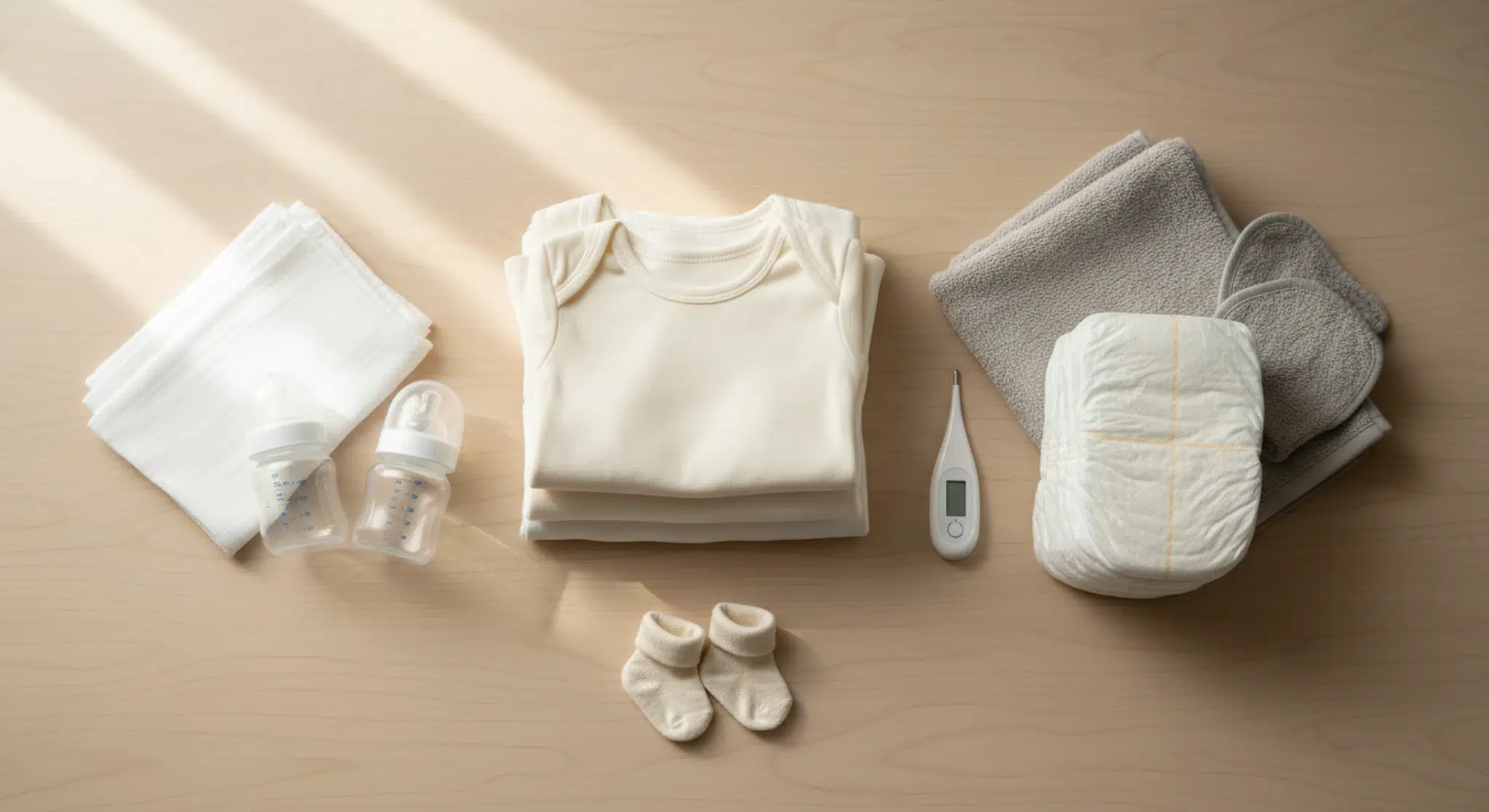
The newborn essentials you need for the first 6 weeks are a safe sleep space, feeding supplies for your method, 3 to 4 dozen newborn diapers, bath basics, a small wardrobe, a digital thermometer, a rear-facing car seat and recovery supplies for you.
Newborn essentials lists tend to run to a hundred items. In reality, the first 6 weeks at home revolve around a few repeating jobs: sleep, feed, change, bathe, dress, check on your baby, get out the door, and recover. This guide is built around those jobs, so you can see exactly what you need for each one and how many.
Safety points are checked against the AAP, NHTSA and CDC, with a buy now, later or skip table up top and a printable checklist at the end.
Key Takeaways
Your baby’s first sleep space is likely next to your bed: the AAP recommends room sharing, not bed sharing, for at least 6 months.
Buy feeding supplies for your chosen method only, and add more once you see what you use.
The AAP suggests starting with 3 to 4 dozen newborn-size diapers and buying clothes in bigger sizes.
Keep a digital thermometer at home; the AAP says rectal readings are most accurate for babies under 3 months.
If you drive home, you need a rear-facing infant car seat installed before birth.
As an Amazon Associate, Betteroo earns from qualifying purchases.
Table of Contents
Newborn Essentials at a Glance
Quick Answer
The newborn essentials for your first 6 weeks are a safe sleep space meeting CPSC standards, feeding supplies for your method, 3 to 4 dozen newborn diapers, sponge bath basics, a small wardrobe, a digital thermometer, a rear-facing infant car seat and recovery basics for you. Everything else can wait.
Daily task
Have before birth
Fine to buy after
Skip
Sleeping
Bassinet, crib or play yard; firm, flat mattress; fitted sheets; sleep sacks
Newborn essentials by daily task: what to have before birth, what can wait, and what to skip.
How This Checklist Is Organized
Most newborn essentials lists are organized by store aisle. This one follows what you will actually be doing all day in the first 6 weeks, with realistic quantities for each job.
A note on quantities: counts not credited to the American Academy of Pediatrics (AAP) are our practical suggestions.
Sleeping: The Non-Negotiables
The AAP’s safe sleep guidance is simple: your baby sleeps alone, on their back, on a firm, flat surface with nothing else in it. The AAP also recommends sharing a room with your baby, but not a bed, for at least the first 6 months, so your first sleep space will probably be next to your own bed.
A bassinet, crib or play yard: The AAP says to use a crib, bassinet, portable crib or play yard that meets the safety standards of the Consumer Product Safety Commission (CPSC).
A firm, flat mattress made for that product: Use the mattress that fits your specific sleeper snugly. The AAP notes that any surface inclined more than 10 degrees is not safe for sleep.
2 to 3 sleep sacks or swaddles:Wearable blankets replace loose blankets. The AAP says to stop swaddling when your baby looks like they are trying to roll over.
What stays out of the sleep space: bumpers, pillows, blankets, stuffed animals and sleep positioners. The AAP says soft objects and loose bedding raise the risk of suffocation, and warns against weighted blankets, sleepers and swaddles. Do not use nursing pillows, loungers, inclined sleepers or other products not made for infant sleep. If your baby falls asleep in a car seat, swing or other sitting device, the AAP says to move them to a firm, flat sleep surface on their back as soon as you can.
The AAP says overheating can increase the risk of SIDS, so dress your baby in no more than one layer more than you wear. Our safe sleep environment guide walks through the full bedside setup.
Feeding Supplies by Method: Breast, Bottle or Both
What you need depends on how you plan to feed, and plans often change in the first weeks, so buy the minimum and add as you go.
Feeding supply counts by method. Practical suggestions, not official guidance.
Breastfeeding: The essentials are about comfort: a supportive chair, water, burp cloths and breast care items. A lactation consultant can help with latch.
Bottle feeding: Start with a few small bottles and newborn-flow nipples before buying a full set, so you can switch types easily if one does not work for your baby. Choose an infant formula with your pediatrician and prepare it exactly as the label directs.
Combination feeding: Plan for both lists, but keep bottle numbers modest until you see how often you actually use them.
Never give honey to your newborn, including honey on a pacifier. The CDC says honey can contain the bacteria that cause botulism and should not be fed to a child younger than 1 year old.
Big days go better after a good night of sleep.
Got a baby or toddler at home too? Our free two-minute quiz builds a gentle, personalized sleep plan for little ones.
Diapering: Realistic Quantities for the First Weeks
Set up one main changing station and a small caddy you can carry from room to room.
Newborn-size diapers: The AAP’s layette list suggests starting with 3 to 4 dozen newborn-size diapers. Do not overstock that size: many babies move up quickly, so keep one unopened pack of the next size on hand instead.
Wipes: Several packs, or soft washcloths and warm water.
Diaper cream: A barrier cream for redness. Ask your pediatrician if a rash does not improve.
Changing pad: Place it on a sturdy surface. The AAP recommends a changing table with a 2-inch guardrail on all four sides and says never to leave your baby unattended on it, even if strapped. Keep one hand on your baby.
Skip baby powder: The AAP says not to use baby or talcum powder on your baby, because inhaling it can seriously damage a baby’s lungs.
Bathing and Skin Care Essentials
The AAP says to give only sponge baths until the umbilical cord stump falls off, which usually happens within one or two weeks, and notes that about three baths a week during the first year may be enough.
A mild cleanser: The AAP suggests using soap sparingly, choosing only mild, neutral-pH soaps without additives for the messiest areas.
Fragrance-free moisturizer: The AAP suggests a small amount of fragrance-free, hypoallergenic lotion right after a bath to help prevent dry skin.
An infant tub (can wait): Useful once the cord stump is gone. The AAP suggests filling a basin with about 2 inches of water.
Water temperature safety: the AAP recommends that the hottest water at your faucet be no more than 120 degrees Fahrenheit, which you can control by adjusting your water heater. Before your baby goes in, check that the water feels warm, not hot, on the inside of your wrist or elbow. And never leave your baby alone in the bath, even for an instant.
The AAP advises buying bigger sizes: unless your baby is premature or very small, newborn sizes may be outgrown within days and even three-month sizes within the first month.
The AAP’s suggested starting layette is 3 or 4 sleepwear sets, 6 to 8 T-shirts, 3 or 4 onesies with snaps between the legs, 3 newborn sleep sacks, 2 sweaters, 2 caps, 4 pairs of socks or booties, and 4 to 6 receiving or swaddle blankets.
Choose easy access: The AAP suggests outfits with snaps or other access for diaper changes, and clothes that are not tight around the neck, arms or legs and have no ties or cords.
No shoes: The AAP says not to put shoes on a newborn, and socks should not be tight around the feet or ankles.
Wash the right way: Flame-retardant sleepwear should be washed with laundry detergent rather than soap, according to the AAP, because soap can wash out the flame retardant.
Digital thermometer for rectal temperatures: The AAP says a digital thermometer is best and that a rectal temperature gives the most accurate reading, especially for babies under 3 months. Do not use a mercury thermometer.
Your pediatrician’s number, including after-hours: The AAP says to call right away if your baby is 2 months old or younger and has a rectal temperature of 100.4 degrees Fahrenheit or higher.
Nail file or baby nail clippers: Newborn nails grow quickly, and short nails help prevent scratches.
Nasal bulb syringe: For a stuffy nose. Ask your pediatrician how and when to use it.
Pacifiers (optional): The AAP suggests offering a pacifier at nap time and bedtime. If you are breastfeeding, wait until breastfeeding is established. Never hang a pacifier around your baby’s neck or attach it to their clothing during sleep, and if it falls out after your baby falls asleep, you do not need to put it back. See when to introduce a pacifier for timing.
Getting Out of the House
If you are traveling by car, the one item you must have from day one is a car seat.
A rear-facing infant car seat: The National Highway Traffic Safety Administration (NHTSA) says a child under age 1 should always ride in a rear-facing car seat, kept rear-facing as long as possible, in the back seat. Install it before your due date. Child passenger laws vary by state, and hospitals set their own discharge policies, so ask your hospital what it expects for the ride home.
Register the seat and get it checked: NHTSA recommends registering your seat with the manufacturer so you hear about recalls, and notes that certified technicians will inspect your car seat free of charge in most cases.
Be careful with secondhand seats: NHTSA has a used car seat checklist; only use a secondhand seat if it passes every item.
Stroller, carrier and diaper bag (can wait): Choose these after birth, once you know how you get around.
Your Own Recovery Basics
Your recovery needs are simple but easy to forget until you are home.
Postpartum pads and comfortable underwear: Stock up before you go into labor so you are not shopping in the first days home.
Easy food and water: Freezer meals and one-handed snacks.
Nursing bras or soft bras: Your size may change in the first weeks, so buy just a few at first.
Help and a plan for rest: Line up who can bring meals or take a shift so you can sleep.
The newborn essentials that matter in the first 6 weeks are the ones you will use every few hours: a safe, bare sleep space next to your bed, the right supplies for how you feed, plenty of newborn diapers, a few washcloths and towels, a small set of clothes in roomy sizes, a digital thermometer, and a properly installed rear-facing car seat. Add recovery basics for yourself and you are ready. Buy the rest once you know what you actually need, and let safe sleep rules, not marketing, decide what goes in the sleep space.
Frequently Asked Questions
What are the newborn essentials I need before birth?
Before birth, have a safe sleep space that meets CPSC standards with a firm, flat mattress and fitted sheets, sleep sacks, feeding supplies for your method, newborn diapers and wipes, washcloths, a small set of clothes, a digital thermometer, a rear-facing infant car seat, and postpartum supplies for yourself.
What do you need for a newborn in the first month?
In the first month you mostly need to sleep, feed, change and clean your baby safely: a bassinet or crib beside your bed, feeding supplies, plenty of diapers, sponge bath basics until the cord stump falls off, a few outfits, a thermometer and your pediatrician’s number. Most other gear can wait.
How many diapers does a newborn need?
The AAP’s layette list suggests starting with 3 to 4 dozen newborn-size diapers. Many babies outgrow the newborn size quickly, so keep one unopened pack of the next size up rather than stockpiling newborn diapers, and buy more as you learn your baby’s pace.
What newborn items can I skip?
You can skip crib bumpers, pillows, blankets, sleep positioners, inclined sleepers, loungers and weighted sleep products, which are not safe for sleep. Baby powder, mercury thermometers and baby shoes are also unnecessary. Wipe warmers, bottle gadgets and most decor can wait until you know you actually need them.
When should I start buying newborn essentials?
Many parents aim to have the core items ready a few weeks before the due date. That leaves time to install and check the car seat, set up the sleep space, and wash clothes and sheets. Strollers, extra bottles and larger sizes can be bought after your baby arrives.
Do you need a car seat to leave the hospital?
If you are going home by car, yes. NHTSA says children under age 1 should always ride in a rear-facing car seat in the back seat. Laws vary by state and hospitals set their own discharge policies, so install the seat early and ask your hospital what it expects.
Gentle changes, peaceful nights.
Betteroo builds a personalized sleep plan for your baby or toddler. Take the free two-minute quiz to get started.